
US, Iran Warn Ready for War as Talks in Limbo

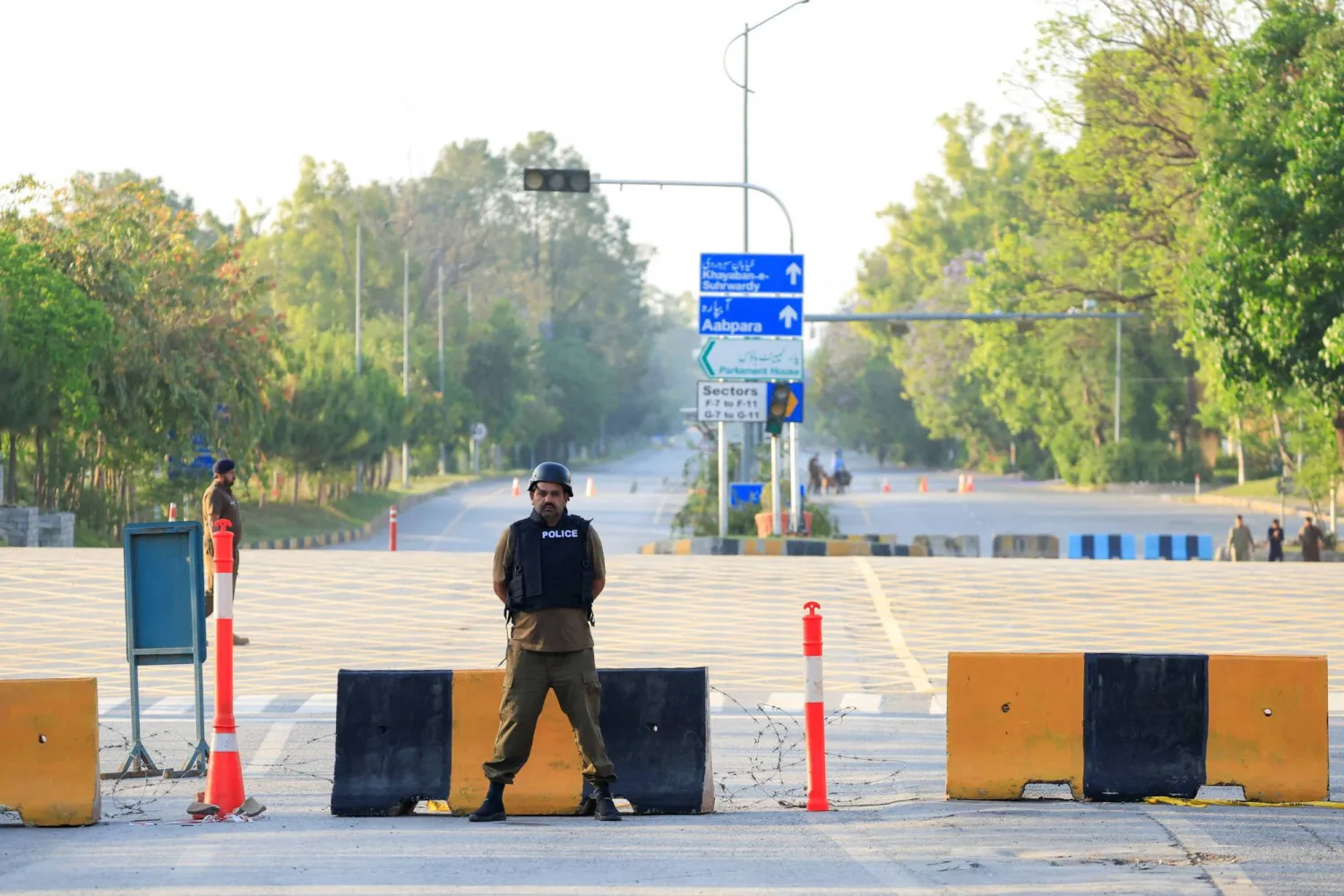
 Police officers stand guard on a road leading to the Serena Hotel, as Pakistan prepares to host the US and Iran for the second phase of peace talks in Islamabad, Pakistan, April 21, 2026. (Reuters)
Police officers stand guard on a road leading to the Serena Hotel, as Pakistan prepares to host the US and Iran for the second phase of peace talks in Islamabad, Pakistan, April 21, 2026. (Reuters)
TT

US, Iran Warn Ready for War as Talks in Limbo

 Police officers stand guard on a road leading to the Serena Hotel, as Pakistan prepares to host the US and Iran for the second phase of peace talks in Islamabad, Pakistan, April 21, 2026. (Reuters)
Police officers stand guard on a road leading to the Serena Hotel, as Pakistan prepares to host the US and Iran for the second phase of peace talks in Islamabad, Pakistan, April 21, 2026. (Reuters)

The United States and Iran each warned they were ready for war as the clock ticked down Tuesday on a ceasefire, with uncertainty on talks that President Donald Trump had announced would resume in Pakistan.

The White House said Vice President JD Vance was ready to fly back to the Pakistani capital Islamabad, which was preparing for a second round of talks on ending the war that has engulfed the Middle East and shaken global markets.

But Tehran's cleric-run government declined to confirm that it would participate and accused the United States of violating the truce through its blockade of Iranian ports and seizure of a ship.

"By imposing a blockade and violating the ceasefire, Trump wants to turn this negotiating table into a surrender table or justify renewed hostilities, as he sees fit," said Iran's powerful parliament speaker Mohammad Bagher Ghalibaf, who headed the delegations to talks two weeks ago in Pakistan.

"We do not accept negotiations under the shadow of threats, and in the last two weeks we have been preparing to show new cards on the battlefield," he wrote on X.

Iran's Revolutionary Guards warned of targeting any vessel attempting to pass through the Strait of Hormuz without permission.

Trump has similarly accused Tehran of violating the truce by harassing vessels in the key strait, the transit passage for about a fifth of the world's oil that Iran had all but shut in retaliation for the war launched February 28 by the United States and Israel.

The channel in peacetime sees around 120 daily transits, according to Lloyd's List, a shipping industry intelligence site.

On Tuesday, the site reported that more than 20 Iranian so-called "shadow vessels", had transited past the US blockade.

In one of a series of posts on his Truth Social platform, Trump insisted that the blockade was "absolutely destroying" Iran and said it will not end "until there is a 'DEAL'," in which the United States is pressing for Iranian concessions on its contested nuclear program.

- 'Agreed' to attend talks -

Trump told PBS News that Iran was "supposed to be there" at the talks in Pakistan.

"We agreed to be there," he said, warning that if the ceasefire expired "then lots of bombs start going off".

He separately told Bloomberg News it was "highly unlikely" he would extend the two-week truce.

Based on its start time, the truce theoretically expires overnight Tuesday, Tehran time, although in his comments to Bloomberg, Trump said the end was a day later, on Wednesday evening Washington time.

Oil prices fell on Tuesday while most stocks rose on lingering hopes for a deal to end the US-Iran war and reopen the Strait of Hormuz, even as Tehran said it had not decided whether to attend peace talks.

Despite some normalcy of life returning to Tehran during the ceasefire, city residents who spoke to Paris-based AFP journalists said the situation was far from rosy.

"Let's see what happens by Tuesday," one 30-year-old doctor said on condition of anonymity.

Saghar, 39, said there was little hope for Iranians squeezed by the government and the war's impact, adding that the "economy is horrible".

- New Israel-Lebanon talks -

A separate ceasefire agreed between Israel and Lebanon was announced on Friday and included Hezbollah, whose rocket fire in support of Iran drew Lebanon into the war.

Israel and Lebanon, which have no diplomatic relations, will hold a second round of talks on Thursday in Washington, a State Department official told AFP.

Sporadic violence continued and Israel's military warned civilians against returning to dozens of villages in southern Lebanon, claiming Hezbollah's activities were violating the truce.

The UN Security Council condemned on Monday the killing of a French peacekeeper in Lebanon, whose death France blamed on Hezbollah.

The Frenchman was killed and three others wounded when their unit was ambushed on Saturday as it headed to a UN Interim Force in Lebanon (UNIFIL) outpost cut off from the fighting between Hezbollah and Israel.

Hezbollah lawmaker Hassan Fadlallah told AFP that his group would work to break the "Yellow Line" that Israel has established in the south, even as he said it wanted "the ceasefire to continue".

Israeli attacks on Lebanon have killed at least 2,387 people since the start of the war, a Lebanese government body said in its latest toll.

Another major issue in the US-Iran negotiations has been Tehran's stockpile of enriched uranium, which Trump said on Friday it had agreed to hand over.

But Iran's foreign ministry has said the stockpile, thought to be buried from US bombing in last June's 12-day war with Israel, was "not going to be transferred anywhere".

Spokesman Esmaeil Baqaei said handing over uranium was "never raised as an option" in talks with US negotiators.


US Forces Board a Sanctioned Oil Tanker in the Indian Ocean, the Pentagon Says

 Tankers and bulk carriers anchored in the Strait of Hormuz, Saturday, April 18, 2026. (AP)
Tankers and bulk carriers anchored in the Strait of Hormuz, Saturday, April 18, 2026. (AP)
TT

US Forces Board a Sanctioned Oil Tanker in the Indian Ocean, the Pentagon Says

 Tankers and bulk carriers anchored in the Strait of Hormuz, Saturday, April 18, 2026. (AP)
Tankers and bulk carriers anchored in the Strait of Hormuz, Saturday, April 18, 2026. (AP)

US forces have boarded an oil tanker previously sanctioned for smuggling Iranian crude oil in Asia, the Pentagon said Tuesday, as it puts into place a global warning to track down vessels tied to Tehran.

US forces “conducted a right-of-visit maritime interdiction” and boarded the M/T Tifani “without incident,” the Pentagon said on social media.

The Tifani was captured in the Bay of Bengal — between India and Southeast Asia — and was carrying Iranian oil, according to a US defense official who spoke on condition of anonymity to discuss an ongoing military operation. The US military will decide in the next four days what to do with the vessel, such as tow it back to the US or turn it over to another country, the official said.

It's the latest move in the US war on Iran to stop any ship tied to Tehran or those suspected of carrying supplies that could help its government, from weapons and oil to metals and electronics. The announcement comes ahead of the expiration of an already tenuous ceasefire between the US and Iran, and as Pakistan attempts to broker talks between Washington and Tehran.

It is the second vessel linked to Iran that has been interdicted by the US military. The US Navy attacked and seized an Iranian-flagged cargo ship Sunday that it said had tried to evade its blockade of Iranian ports, with President Donald Trump saying an American destroyer blew a hole in the ship’s engine room.

Targeting Iran-linked ships in international waters The Pentagon on social media described the Tifani as “stateless” despite it being a Botswana-flagged vessel.

“As we have made clear, we will pursue global maritime enforcement efforts to disrupt illicit networks and interdict sanctioned vessels providing material support to Iran — anywhere they operate,” the Pentagon announcement said, echoing previous statements from Trump administration officials. “International waters are not a refuge for sanctioned vessels.”

Gen. Dan Caine, chairman of the Joint Chiefs of Staff, said last week that the enforcement actions would extend beyond Iranian waters and the area under control of US Central Command.

US forces in other areas of responsibility, he told reporters at the Pentagon, “will actively pursue any Iranian-flagged vessel or any vessel attempting to provide material support to Iran.” He specifically pointed to operations in the Pacific and said the US would target vessels that left before the blockade began outside the Strait of Hormuz, a crucial waterway for energy and other shipments.

The military also detailed an expansive list of goods that it considers contraband, declaring that it will board, search and seize them from merchant vessels “regardless of location.” A notice published Thursday says any “goods that are destined for an enemy and that may be susceptible to use in armed conflict” are “subject to capture at any place beyond neutral territory.”

Blockades can be lawful in wartime, expert says

The US military’s actions against Iranian-linked vessels, namely the attack over the weekend on the cargo ship named the Touska, have raised questions about the two-week ceasefire.

The US and Iran are operating in “an awkward space where the law doesn’t give you a clean yes-or-no answer” on whether the ceasefire was violated, said Jason Chuah, a law professor at the City University of London and the Maritime Institute of Malaysia.

“The United States seems to take the line that the conflict never fully switched off — that is there is still a state of armed conflict,” Chuah said. “By saying that, it can keep doing things like enforcing a blockade and even using limited force at sea.”

But Iran is treating the ceasefire as a pause on all hostile acts, Chuah said. Iran’s joint military command has called the armed boarding an act of piracy and a violation of the ceasefire.

The US earlier had instituted a blockade against sanctioned oil tankers linked to Venezuela but had never fired on those vessels.

Blockades and even limited attacks on vessels can be lawful in wartime, with merchant vessels becoming legitimate targets if they contribute to military actions, carry contraband or are incorporated into enemy logistics, Chuah said.

It's harder to prove that a ship such as the Touska is realistically contributing to military action against the US, Chuah said.

“The whole dispute really turns on a deceptively simple question: Did the ceasefire actually suspend the right to use force?” Chuah said. “If it did, then firing on vessels or seizing them is very hard to square with the United Nations Charter.”

Mark Cancian, a retired Marine colonel and a senior defense adviser with the Center for Strategic and International Studies, said a violation is up for interpretation because there were no defined terms.

“Trump announced it. The Iranians agreed. But there’s no formal agreement,” Cancian said. “So whether it broke the ceasefire or not depends on your perspective. ... Nothing was written down.”

Michael O’Hanlon, a defense and foreign policy analyst at the Brookings Institution, said the US did not violate the ceasefire because it was limited to bombing Iran, not the blockade.

“We agreed to stop dropping bombs on them, and that’s the basic thing they wanted,” O’Hanlon said, adding that the US still had to enforce the blockade “if you’re going to make it mean anything.”


Russia, North Korea Connect Road Bridge Ahead of Summer Opening

This handout image released by the Russian Transport Ministry on April 21, 2026, shows a ceremony marking the connection of the two sides of the new Russia-North Korea road bridge over the Tumen River, set to open this summer. (Handout / Russian Transport Ministry / AFP)
TT

Russia, North Korea Connect Road Bridge Ahead of Summer Opening

This handout image released by the Russian Transport Ministry on April 21, 2026, shows a ceremony marking the connection of the two sides of the new Russia-North Korea road bridge over the Tumen River, set to open this summer. (Handout / Russian Transport Ministry / AFP)

Russia and North Korea held a ceremony Tuesday to mark the joining of the first road bridge connecting the countries, set to open for traffic this summer, Moscow said.

Ties between the two heavily sanctioned countries have surged amid Russia's war on Ukraine, with Moscow and Pyongyang deepening economic, political, cultural and military links.

South Korea warned last week that Chinese and Russian support was helping revive the North Korean economy, which has struggled for years under sweeping international sanctions, almost complete international isolation and huge military investment.

Moscow's foreign ministry said the opening of the bridge would "become a truly landmark stage in Russian-Korean relations. Its significance goes far beyond a purely engineering task."

The bridge, which crosses the Tumen River that marks the border between the two countries, will be able to handle up to 300 vehicles and 2,850 people a day, Russia's transport ministry said.

Russia and North Korea inked a defense treaty in 2024 that calls for military support in the case of either country being attacked.

Pyongyang that year sent thousands of troops to Russia to support its war on Ukraine. They were deployed to the western Kursk region to held fend off a months-long counter-offensive by Kyiv's troops.

Several senior Russian officials have visited North Korea recently, including the interior minister, currently in the country.

Russia's foreign ministry said the bridge would help "develop trade, economic and humanitarian exchanges" between Russia's Far East and North Korea.

North Korea does not publish official data on the size of its economy.

Its nominal gross domestic product was equivalent to about $30 billion in 2024, according to Seoul's official estimate -- a tiny fraction of the South Korean economy, one of the most developed in the world.

North Korea has long faced shortages. A famine in the mid-1990s killed hundreds of thousands of people, and reports indicate that the Covid-19 pandemic also pushed many into extreme hunger.


Germany Rejects Push to Suspend EU-Israel Cooperation Deal

 Germany's Foreign Minister Johann Wadephul speaks with the media as he arrives for a meeting of EU foreign ministers at the European Council building in Luxembourg, Tuesday, April 21, 2026. (AP)
Germany's Foreign Minister Johann Wadephul speaks with the media as he arrives for a meeting of EU foreign ministers at the European Council building in Luxembourg, Tuesday, April 21, 2026. (AP)
TT

Germany Rejects Push to Suspend EU-Israel Cooperation Deal

 Germany's Foreign Minister Johann Wadephul speaks with the media as he arrives for a meeting of EU foreign ministers at the European Council building in Luxembourg, Tuesday, April 21, 2026. (AP)
Germany's Foreign Minister Johann Wadephul speaks with the media as he arrives for a meeting of EU foreign ministers at the European Council building in Luxembourg, Tuesday, April 21, 2026. (AP)

Germany on Tuesday poured cold water on calls to suspend the EU's cooperation deal with Israel, despite rising anger over the war in Lebanon and the situation in the occupied Palestinian territories.

Spain and Ireland had put the issue of halting the agreement back on the table at a meeting of EU foreign ministers in Luxembourg.

But German Foreign Minister Johann Wadephul called the proposal "inappropriate".

"We have to talk with Israel about the critical issues," he said at the start of the meeting.

"That has to be done in a critical, constructive dialogue with Israel. That is what we stand for."

Attitudes towards Israel among EU member states, already hardened over its conduct in the war in Gaza, stiffened further after the Israeli invasion of Lebanon and a new law on the death penalty for Palestinians in the occupied West Bank.

"We need to act. We need to make sure that our fundamental values are protected," Irish foreign minister Helen McEntee said.

Facing alarm at the civilian toll exacted in the Gaza war, the EU last year already put on the table a raft of potential measures to punish Israel, including cutting trade ties or sanctioning government ministers.

But so far none of the steps laid out by Brussels has garnered enough support from member states to be put into action.

Suspending the entirety of the EU's cooperation agreement, as Spain and Ireland are pushing for, requires unanimity among the bloc's 27 countries and would almost certainly be blocked by allies of Israel.

More feasible could be suspending the part of the deal facilitating closer trade ties, a move that only requires support from a weighted majority of EU countries.

That would require a shift in position from EU heavyweights such as Germany or Italy.

Rome has already signaled a tougher line on Israel by suspending a defense agreement.

But EU officials and diplomats said it seemed there would not be sufficient support to take those actions, especially after a ceasefire was agreed in Lebanon.

"If the opinions of the member states have changed, then we can move forward with these decisions," said EU foreign policy chief Kaja Kallas.

France and Sweden meanwhile re-upped an earlier call from some other EU countries for the bloc to consider halting the import of goods from Israeli settlements in the occupied West Bank, which are considered illegal under international law.