

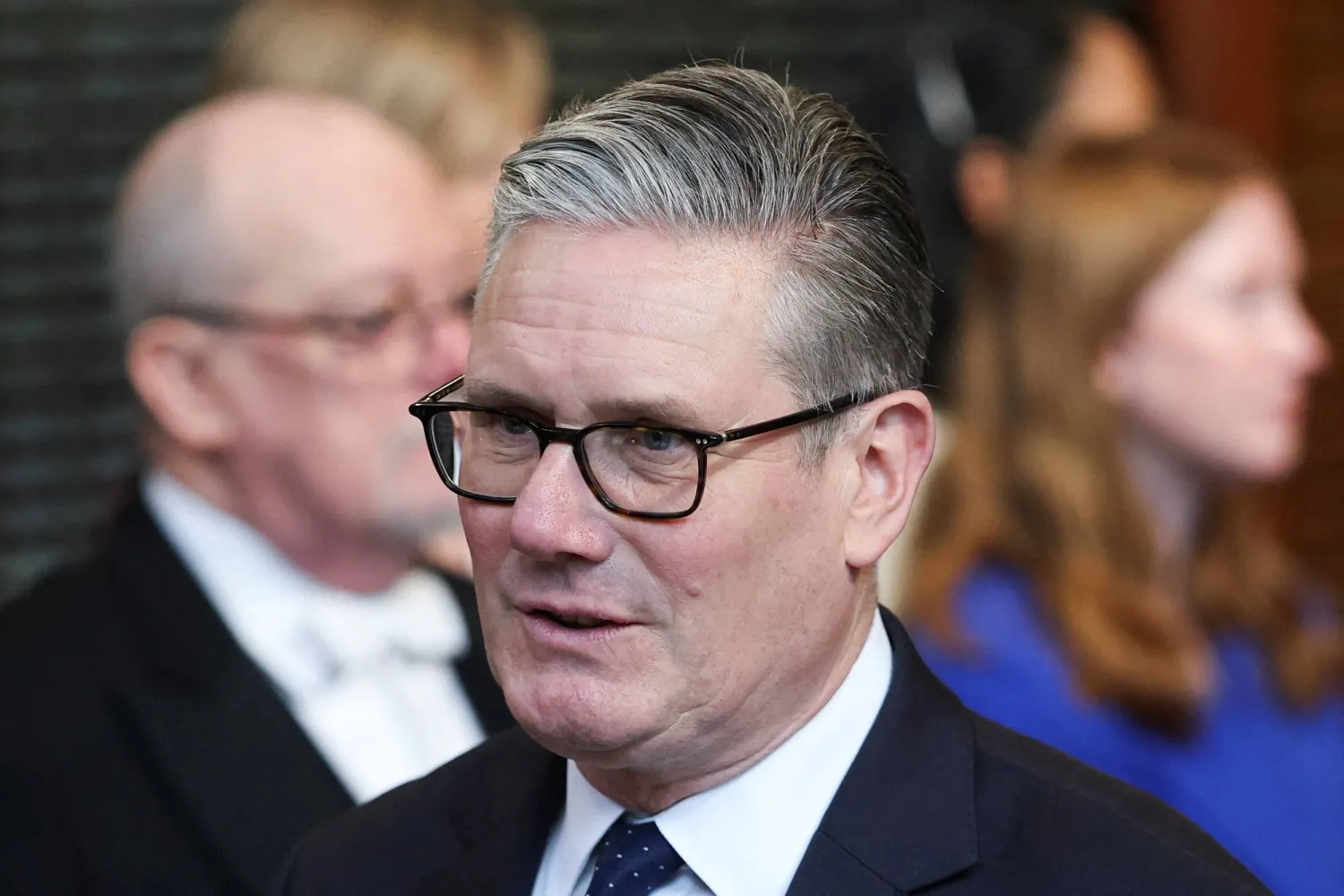

Starmer Faces Possible Leadership Challenge, Vows to Fight On

Britain's Prime Minister Keir Starmer walks through the House of Commons to attend the State Opening of Parliament at the Palace of Westminster in London on May 13, 2026. (Photo by Toby Melville / POOL / AFP)
TT

Starmer Faces Possible Leadership Challenge, Vows to Fight On

Britain's Prime Minister Keir Starmer walks through the House of Commons to attend the State Opening of Parliament at the Palace of Westminster in London on May 13, 2026. (Photo by Toby Melville / POOL / AFP)

British Prime Minister Keir Starmer faced the increasing prospect of a leadership challenge on Thursday, with his health minister reported to be ready to resign and his former deputy calling on him to "reflect" on his position.

Starmer, who has repeatedly said he would fight to keep his job, has so far been unable to stem the tide of calls for him to set a timetable for his departure after his Labor Party suffered some of its worst losses in local elections last week.

While the number of calls for him to resign ebbed on Wednesday, when his government turned to King Charles to set out its agenda for a new parliamentary term, Thursday was set to become yet another showdown for Britain's prime minister, Reuters said.

Wes Streeting, the country's centrist health minister, was expected to resign later on Thursday to try to launch a leadership campaign, the Times newspaper reported, although Starmer's allies questioned whether he had the necessary number of backers required.

Starmer's former deputy, ‌Angela Rayner, announced she ‌had been cleared of deliberate wrongdoing over her tax affairs, an impediment to any leadership bid from ‌her, ⁠but she would ⁠not say whether she wanted to launch a bid to oust the prime minister.

STARMER SHOULD REFLECT, RAYNER SAYS

"I've said to Keir this is a really significant moment for our party and the country ... The pace of change hasn't been enough for voters to see, and also mistakes have really blown us off course and made voters doubt us," she told the Guardian newspaper, adding he should "reflect on" stepping aside.

On her own leadership ambitions, Rayner, 46, said: "I’ll play my part in doing everything we possibly can to deliver the change, because it's not a personal ambition, I know the difference it makes."

She said in a separate statement that Britain's tax authorities had cleared her of tax avoidance, with no fine or penalty applied, a move ⁠she described as exonerating her "of the accusation that I deliberately sought to avoid tax".

Starmer, 63, had ‌hoped to end the calls for him to resign, which began at the weekend when ‌the scale of the losses in elections to councils in England and the parliaments in Scotland and Wales hit home.

REEVES WARNS OF CHAOS

He has adopted ‌a "business as usual" approach and has received support from the majority of his cabinet team of top ministers. Sources close to him ‌say he is determined to run if a leadership contest is triggered.

His finance minister, Rachel Reeves, warned lawmakers against "plunging the country into chaos" at a time when Britain's anemic economy was turning a corner. The economy grew unexpectedly in March.

She told the BBC that waiting lists for Britain's public health service were falling because of government investment.

"If we put that at risk, we put at risk the investment in our public services and also the growth that is ‌necessary to help people with the cost of living," she said.

BOSS SAYS BUSINESSES BEING HIT BY TURMOIL

For now, a leadership race has yet to be triggered, but the political instability has pushed ⁠borrowing costs higher, with some investors nervous ⁠over the possible election of a more left-wing, tax-and-spend Labor prime minister.

The boss of Aviva, one of Britain's biggest financial companies, complained on Thursday that businesses were being hammered by the political turmoil.

"There have been too many changes of government strategy, leadership, just in my six years of being CEO, and I think that is harmful to a major economy such as the UK and how we are perceived abroad," CEO Amanda Blanc told Reuters.

If Starmer were replaced, the new leader would be Britain's seventh prime minister in around 10 years.

A poll by Survation published this week of Labor members found that a left-wing candidate would most likely win any leadership contest if the prime minister resigned.

Among the possible candidates on the left are Rayner, Greater Manchester mayor Andy Burnham and Ed Miliband, the minister for energy security and net zero. Burnham does not have the necessary seat in parliament to mount a challenge and would need a lawmaker to stand down to give him the chance to run.

For now both wings are canvassing support.

One Labor lawmaker, who has not called for the prime minister to resign, said he was approached by an ally of Streeting this week to ask for support.

"He is a nice guy, but we don't agree on the big issues," said the lawmaker, who is on the left of the party.



Why Greater Tunb Matters Near the Strait of Hormuz

An aerial view of Iran’s Qeshm Island near the Strait of Hormuz (Reuters)
TT

Why Greater Tunb Matters Near the Strait of Hormuz

An aerial view of Iran’s Qeshm Island near the Strait of Hormuz (Reuters)

US strikes on Greater Tunb on Wednesday thrust one of the most sensitive points at the entrance to the Strait of Hormuz back into the center of the confrontation, after US Central Command said it hit coastal defense systems, storage sites and cruise missile launchers in a 90-minute assault.

CENTCOM said the strikes were aimed at reducing Iran’s ability to attack commercial vessels in the strait.

Greater Tunb, one of three Emirati islands occupied by Iran since 1971, hosts a military airfield, Iranian Revolutionary Guard Corps Navy bases, garrisons and missile assets used to monitor nearby shipping lanes.

Former IRGC Navy commander Alireza Tangsiri had called the island vital to Iran’s control of the strait because it sits between the main inbound and outbound shipping routes.

Tangsiri, who was killed in an airstrike in Bandar Abbas on March 26, said in an earlier state television interview that losing Greater Tunb would mean losing control of transit routes through the Strait of Hormuz.

Its location, he said, gave Iranian forces the ability to monitor maritime traffic and shape its movement.

Tangsiri also tied Abu Musa and Sirri islands to Iran’s gas fields and Gulf trade, warning that the loss of Abu Musa could lead to the loss of Sirri and its military positions, gas fields and trade routes.

He had overseen the expansion of IRGC bases across the islands, including the military airfield on Greater Tunb and facilities on Sirri.

Islands and shipping lanes

Greater Tunb is part of a chain that includes Abu Musa, Lesser Tunb, Qeshm, Larak, Hormuz and Sirri. Studies have described the islands as forming Iran’s “defensive arc” around the strait.

Iranian officials have likened them to “unsinkable aircraft carriers” because they host anti-ship missiles, surveillance posts and naval bases.

Greater Tunb’s importance also lies in its proximity to the two main shipping lanes.

Tehran says vessels must follow routes and schedules set by Iranian authorities and secure prior approval. Washington is pressing for a southern route along the Omani coast that would fall outside Iranian control.

The routes have become a central point of dispute since the Islamabad memorandum of understanding on June 17.

Iran interprets its fifth provision as granting Tehran a role in regulating passage. The United States says the Strait of Hormuz is an international waterway that cannot be subjected to unilateral permits or fees.

Greater Tunb is a forward military outpost in Iran’s network of control over the strait.

The strikes were aimed at disabling coastal defense and missile sites that could be used against vessels and weakening Iran’s ability to impose its rules on shipping.


US Strikes Expand into Northern Iran as it Disables Ship Trying to Run Blockade

TOPSHOT - This frame grab taken from AFPTV video footage on July 12, 2026 shows cargo ships anchoring near the Strait of Hormuz off the eastern coast of the United Arab Emirates at Khor Fakkan. (Photo by AFPTV / AFP)
TT

US Strikes Expand into Northern Iran as it Disables Ship Trying to Run Blockade

TOPSHOT - This frame grab taken from AFPTV video footage on July 12, 2026 shows cargo ships anchoring near the Strait of Hormuz off the eastern coast of the United Arab Emirates at Khor Fakkan. (Photo by AFPTV / AFP)

The United States intensified its strikes targeting Iran early Thursday, hitting targets further north as American forces also fired into a ship it accused of trying to break its naval blockade on Iran.

Iran retaliated with missile and drone fire targeting Bahrain, Jordan and Kuwait before dawn.

Days of back-and-forth strikes by the US and Iran across the Middle East — and renewed threats to the Strait of Hormuz — have shredded the interim deal to end the Iran war and could tip the region back into all-out war. Already, Iranian officials say US strikes have killed more than 35 people and wounded over 300 others. Strikes also reached into areas around Iran’s capital, Tehran, for the first time of this latest round of violence, The Associated Press said.

When the US and Israel launched the war on Iran on Feb. 28, Tehran effectively closed the strait to shipping traffic, a move that sent the price of oil, fertilizer and many other goods soaring far beyond the region and gave Iran major leverage in negotiations.

US and Iran trade threats as attacks intensify

Those rising prices pose a particular challenge to US President Donald Trump and his Republican Party, which hopes to retain control of Congress in elections in November. But Washington has struggled to successfully reopen the waterway, leading to Trump reimposing the naval blockade Wednesday.

Iran’s parliament speaker and lead negotiator, Mohammad Bagher Qalibaf, said Iran was prepared for a fuller military confrontation if the US does not live up to the terms of the interim deal, and Iran’s paramilitary Revolutionary Guard threatened to halt all energy exports from the Middle East over the blockade.

“The export of oil and gas from the region will be either for everyone or for no one,” the Guard said.

Trump again insisted Iran was ready to strike a peace deal, but he did not elaborate.

“They don’t like what we’re doing, and they do want to settle. We’ll find out whether or not we settle with them, or we just finish it off,” he said Wednesday at the US Army War College in Pennsylvania.

Trump separately said on social media that Tehran made a goodwill gesture by releasing an American citizen wrongly detained in Iran since 2024. He didn’t release further details. Human rights lawyer Jared Genser released a statement identifying the detainee as his client Dena Karari, a US-Iranian citizen who runs a nonprofit and was charged with espionage.

Iran did not immediately acknowledge the release and her case was not publicly known, as is sometimes the case with detentions in Iran.

Both the US and Iran launch attacks as blockade is reimposed

The US strikes early Thursday hit around Tehran, state media reported. It also reported that American attacks targeted Semnan province, home to Iran’s ballistic missile production and space program.

On Wednesday, the US resumed striking Iran during daylight, further showing the increasing tempo of the attacks. An attack on Greater Tunb Island, a strategic point in the Strait of Hormuz, targeted Iranian defense and missile sites, Central Command said.

Meanwhile, the US military said it opened fire on the Curacao-flagged oil tanker Belma sailing toward Kharg Island, Iran’s main oil export terminal in the Arabian Gulf. After the ship “ignored multiple warnings,” a US aircraft disabled the merchant vessel by firing a missile into the ship’s smokestack.

Another American strike Wednesday targeted a barracks for Iran’s 388th Mechanized Infantry Brigade, which operates tanks and armored vehicles, in Sistan and Baluchestan province, Iranian state television reported. The report said Americans fired at least 13 missiles in the attack and the seven dead included conscripts and career soldiers. A number of troops were wounded.

Iran retaliated Thursday with missile and drone attacks on Bahrain, Jordan and Kuwait, authorities in those countries home to US forces said. There was no immediate acknowledgment of damage or casualties from the attacks.

The Strait of Hormuz remains at the heart of the fighting

The latest round of fighting is focused on the Strait of Hormuz. How to reopen the strait has bedeviled the US since Iran choked it off in the early days of the war.

During the interim deal, some ships began moving through the passage using a route near Oman overseen by the US military that is outside Tehran’s control.

In recent days, Iran attacked ships using that route — and back-and-forth attacks ensued. The US has threatened to reopen the strait by force — but experts say that would require a much bigger armada if not tens of thousands of ground troops. Imposing the blockade is another way to put pressure on Iran.

But in the meantime, oil prices are rising. The price for Brent crude oil, the international standard, traded above $85 a barrel on Thursday — more than 15% higher than the price before the war, but still well below the nearly $120 reached at the height of the conflict.


US Says It Issued Sanctions to Disrupt Iran’s Weapon Procurement

The American flag flies over the US Treasury building in Washington, US, January 20, 2023. (Reuters)
TT

US Says It Issued Sanctions to Disrupt Iran’s Weapon Procurement

The American flag flies over the US Treasury building in Washington, US, January 20, 2023. (Reuters)

The US government issued sanctions on Wednesday targeting individuals and entities that it said were a part of an international network helping Iran procure weapons.

The sanction targets include Iranian and Russian nationals, as well as entities bases ‌in Iran, ‌Russia and Nigeria, the ‌US Treasury ⁠Department said in ⁠a statement.

The move comes amid heightened tensions between Washington and Tehran, including recent hostilities over control of the Strait of Hormuz, and as the Trump administration ⁠ramps up pressure on Iran ‌through a ‌series of sanctions measures.

Wednesday's sanctions targets "exemplify ‌Iran's use of foreign aviation and ‌transport firms, financial conduits, and travel coordinators to obscure the Iranian Revolutionary Guards Corps (IRGC) role in illicit procurement and to move material ‌and personnel globally," the Treasury said in a statement.

They ⁠add ⁠to US actions in May against individuals and companies, including several in China and Hong Kong, over accusations of aiding Iran's weapons sector.

In June, the US imposed sanctions against 11 people and entities for helping weapons procurement by the IRGC and the Iranian military.