


Japan Overhauls Decades-Old Weapons Export Rules

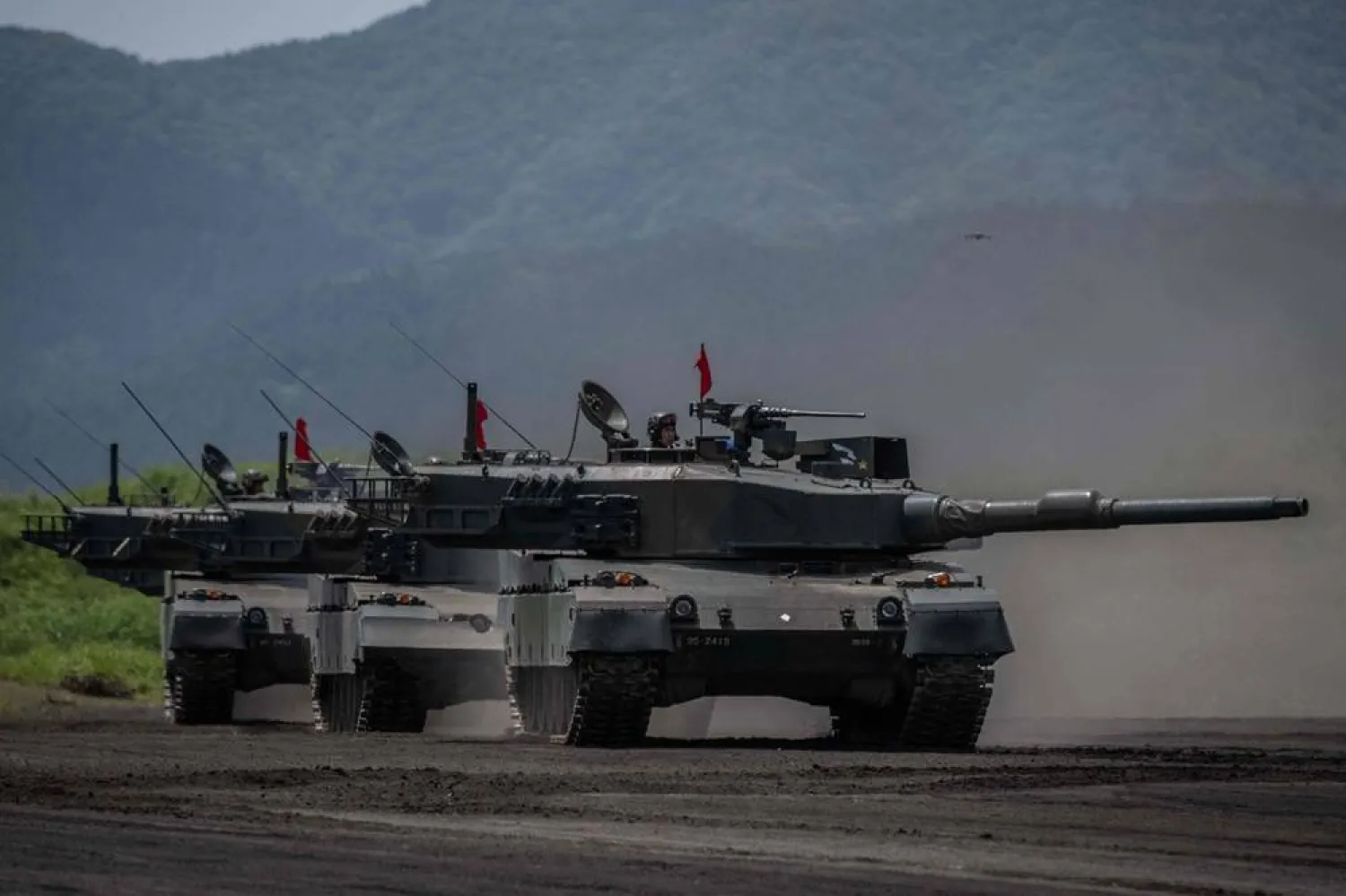
Japan Ground Self-Defense Force (JGSDF) battle tanks take part in a live fire exercise at East Fuji Maneuver Area in Gotemba on May 27, 2023. (AFP)
TT

Japan Overhauls Decades-Old Weapons Export Rules

Japan Ground Self-Defense Force (JGSDF) battle tanks take part in a live fire exercise at East Fuji Maneuver Area in Gotemba on May 27, 2023. (AFP)

Japan will ease decades-old arms export rules, the government's top spokesman Minoru Kihara said on Tuesday, a policy shift that paves the way for the sale of lethal weapons overseas.

The new rules end Japan's self-imposed curb on sales of lethal arms as Tokyo seeks to enter the international arms market, hoping to bolster national defense as well as boost economic growth.

It comes as anxiety increases over China's escalating military activity in the region, as well as persistent security threats from North Korea and Russia.

"These decisions have been made at a time when changes in the security environment surrounding our country are occurring at an accelerating pace, and they serve to ensure Japan's security while contributing even more to peace and stability in the region and the international community," Kihara told a news conference.

"Today, no nation can safeguard its own peace and security by itself alone."

Exports had previously been limited to equipment classified under five categories: search and rescue, transportation, warning, surveillance and minesweeping.

However, Prime Minister Sanae Takaichi posted on X that "with this amendment, transfers of all defense equipment will in principle become possible".

Proponents of the policy shift argue that the change should further integrate Tokyo in the international defense supply chain, deepening defense, diplomatic and economic ties with partner nations as regional instability grows.

But the decision has caused unease among some members of the Japanese public, with critics accusing Takaichi of eroding the proud history of the nation's staunch pacifism.

The policy change has been approved by the Cabinet and the National Security Council, Kihara said.

Heigo Sato, an expert on defense issues and arms control at Takushoku University, said Japan must use this time of peace to ensure combat readiness by establishing "a system that ensures the smooth exchange of weapons and ammunition" between allies.

He told AFP that exports require routine maintenance, providing defense contractors with steady business while also strengthening ties with buyer nations.

By making the arms trade a two-way exchange, Japan might improve the chances of receiving help from allies in the event of an unexpected, prolonged conflict, he said.

- 'Turning point' -

The new rules are part of an incremental easing of the blanket export ban on weapons that was first introduced in 1976.

Takaichi said export "recipients will be limited to countries that pledge to use the equipment in a manner consistent with the United Nations Charter".

"There is absolutely no change in our commitment to the path and fundamental principles we have followed for more than 80 years as a pacifist nation since the end of the war," she said, referring to World War II.

However, the Japanese public appears uneasy about the prospect of exporting lethal arms.

A March survey by national broadcaster NHK showed that 53 percent of participants opposed the step, while only 32 percent supported it.

Peace activists have staged rallies across the nation over concerns that Takaichi's hawkish world views and open support for US President Donald Trump could drag Japan into conflicts. Some appeared to be protesting against the easing of arms export rules.

Veteran activist Koji Sugihara warned that the change was "a historic turning point", arguing that Japan's pacifist reputation has historically aided its diplomatic and business relations.

"People do not want Japanese-made products to be used to kill people in foreign countries," Sugihara said.

Japan previously exported bullets and military supplies to boost its economy, particularly during the Korean War in the 1950s, but adopted a conditional weapons export ban in 1967 before a total bar came in a decade later.

Tokyo has made exceptions to the rules in recent decades, especially when joining international weapons development projects, before it opened the door to exports in 2014 in the five non-lethal military product categories.

Five Japanese firms -- Mitsubishi Heavy Industries, NEC, Kawasaki Heavy Industries, Mitsubishi Electric and Fujitsu are among the world's top 100 arms companies, according to data from the Stockholm International Peace Research Institute.



US Forces Board a Sanctioned Oil Tanker in the Indian Ocean, the Pentagon Says

 Tankers and bulk carriers anchored in the Strait of Hormuz, Saturday, April 18, 2026. (AP)
Tankers and bulk carriers anchored in the Strait of Hormuz, Saturday, April 18, 2026. (AP)
TT

US Forces Board a Sanctioned Oil Tanker in the Indian Ocean, the Pentagon Says

 Tankers and bulk carriers anchored in the Strait of Hormuz, Saturday, April 18, 2026. (AP)
Tankers and bulk carriers anchored in the Strait of Hormuz, Saturday, April 18, 2026. (AP)

US forces have boarded an oil tanker previously sanctioned for smuggling Iranian crude oil in Asia, the Pentagon said Tuesday, as it puts into place a global warning to track down vessels tied to Tehran.

US forces “conducted a right-of-visit maritime interdiction” and boarded the M/T Tifani “without incident,” the Pentagon said on social media.

The Tifani was captured in the Bay of Bengal — between India and Southeast Asia — and was carrying Iranian oil, according to a US defense official who spoke on condition of anonymity to discuss an ongoing military operation. The US military will decide in the next four days what to do with the vessel, such as tow it back to the US or turn it over to another country, the official said.

It's the latest move in the US war on Iran to stop any ship tied to Tehran or those suspected of carrying supplies that could help its government, from weapons and oil to metals and electronics. The announcement comes ahead of the expiration of an already tenuous ceasefire between the US and Iran, and as Pakistan attempts to broker talks between Washington and Tehran.

It is the second vessel linked to Iran that has been interdicted by the US military. The US Navy attacked and seized an Iranian-flagged cargo ship Sunday that it said had tried to evade its blockade of Iranian ports, with President Donald Trump saying an American destroyer blew a hole in the ship’s engine room.

Targeting Iran-linked ships in international waters The Pentagon on social media described the Tifani as “stateless” despite it being a Botswana-flagged vessel.

“As we have made clear, we will pursue global maritime enforcement efforts to disrupt illicit networks and interdict sanctioned vessels providing material support to Iran — anywhere they operate,” the Pentagon announcement said, echoing previous statements from Trump administration officials. “International waters are not a refuge for sanctioned vessels.”

Gen. Dan Caine, chairman of the Joint Chiefs of Staff, said last week that the enforcement actions would extend beyond Iranian waters and the area under control of US Central Command.

US forces in other areas of responsibility, he told reporters at the Pentagon, “will actively pursue any Iranian-flagged vessel or any vessel attempting to provide material support to Iran.” He specifically pointed to operations in the Pacific and said the US would target vessels that left before the blockade began outside the Strait of Hormuz, a crucial waterway for energy and other shipments.

The military also detailed an expansive list of goods that it considers contraband, declaring that it will board, search and seize them from merchant vessels “regardless of location.” A notice published Thursday says any “goods that are destined for an enemy and that may be susceptible to use in armed conflict” are “subject to capture at any place beyond neutral territory.”

Blockades can be lawful in wartime, expert says

The US military’s actions against Iranian-linked vessels, namely the attack over the weekend on the cargo ship named the Touska, have raised questions about the two-week ceasefire.

The US and Iran are operating in “an awkward space where the law doesn’t give you a clean yes-or-no answer” on whether the ceasefire was violated, said Jason Chuah, a law professor at the City University of London and the Maritime Institute of Malaysia.

“The United States seems to take the line that the conflict never fully switched off — that is there is still a state of armed conflict,” Chuah said. “By saying that, it can keep doing things like enforcing a blockade and even using limited force at sea.”

But Iran is treating the ceasefire as a pause on all hostile acts, Chuah said. Iran’s joint military command has called the armed boarding an act of piracy and a violation of the ceasefire.

The US earlier had instituted a blockade against sanctioned oil tankers linked to Venezuela but had never fired on those vessels.

Blockades and even limited attacks on vessels can be lawful in wartime, with merchant vessels becoming legitimate targets if they contribute to military actions, carry contraband or are incorporated into enemy logistics, Chuah said.

It's harder to prove that a ship such as the Touska is realistically contributing to military action against the US, Chuah said.

“The whole dispute really turns on a deceptively simple question: Did the ceasefire actually suspend the right to use force?” Chuah said. “If it did, then firing on vessels or seizing them is very hard to square with the United Nations Charter.”

Mark Cancian, a retired Marine colonel and a senior defense adviser with the Center for Strategic and International Studies, said a violation is up for interpretation because there were no defined terms.

“Trump announced it. The Iranians agreed. But there’s no formal agreement,” Cancian said. “So whether it broke the ceasefire or not depends on your perspective. ... Nothing was written down.”

Michael O’Hanlon, a defense and foreign policy analyst at the Brookings Institution, said the US did not violate the ceasefire because it was limited to bombing Iran, not the blockade.

“We agreed to stop dropping bombs on them, and that’s the basic thing they wanted,” O’Hanlon said, adding that the US still had to enforce the blockade “if you’re going to make it mean anything.”


Russia, North Korea Connect Road Bridge Ahead of Summer Opening

This handout image released by the Russian Transport Ministry on April 21, 2026, shows a ceremony marking the connection of the two sides of the new Russia-North Korea road bridge over the Tumen River, set to open this summer. (Handout / Russian Transport Ministry / AFP)
TT

Russia, North Korea Connect Road Bridge Ahead of Summer Opening

This handout image released by the Russian Transport Ministry on April 21, 2026, shows a ceremony marking the connection of the two sides of the new Russia-North Korea road bridge over the Tumen River, set to open this summer. (Handout / Russian Transport Ministry / AFP)

Russia and North Korea held a ceremony Tuesday to mark the joining of the first road bridge connecting the countries, set to open for traffic this summer, Moscow said.

Ties between the two heavily sanctioned countries have surged amid Russia's war on Ukraine, with Moscow and Pyongyang deepening economic, political, cultural and military links.

South Korea warned last week that Chinese and Russian support was helping revive the North Korean economy, which has struggled for years under sweeping international sanctions, almost complete international isolation and huge military investment.

Moscow's foreign ministry said the opening of the bridge would "become a truly landmark stage in Russian-Korean relations. Its significance goes far beyond a purely engineering task."

The bridge, which crosses the Tumen River that marks the border between the two countries, will be able to handle up to 300 vehicles and 2,850 people a day, Russia's transport ministry said.

Russia and North Korea inked a defense treaty in 2024 that calls for military support in the case of either country being attacked.

Pyongyang that year sent thousands of troops to Russia to support its war on Ukraine. They were deployed to the western Kursk region to held fend off a months-long counter-offensive by Kyiv's troops.

Several senior Russian officials have visited North Korea recently, including the interior minister, currently in the country.

Russia's foreign ministry said the bridge would help "develop trade, economic and humanitarian exchanges" between Russia's Far East and North Korea.

North Korea does not publish official data on the size of its economy.

Its nominal gross domestic product was equivalent to about $30 billion in 2024, according to Seoul's official estimate -- a tiny fraction of the South Korean economy, one of the most developed in the world.

North Korea has long faced shortages. A famine in the mid-1990s killed hundreds of thousands of people, and reports indicate that the Covid-19 pandemic also pushed many into extreme hunger.


Germany Rejects Push to Suspend EU-Israel Cooperation Deal

 Germany's Foreign Minister Johann Wadephul speaks with the media as he arrives for a meeting of EU foreign ministers at the European Council building in Luxembourg, Tuesday, April 21, 2026. (AP)
Germany's Foreign Minister Johann Wadephul speaks with the media as he arrives for a meeting of EU foreign ministers at the European Council building in Luxembourg, Tuesday, April 21, 2026. (AP)
TT

Germany Rejects Push to Suspend EU-Israel Cooperation Deal

 Germany's Foreign Minister Johann Wadephul speaks with the media as he arrives for a meeting of EU foreign ministers at the European Council building in Luxembourg, Tuesday, April 21, 2026. (AP)
Germany's Foreign Minister Johann Wadephul speaks with the media as he arrives for a meeting of EU foreign ministers at the European Council building in Luxembourg, Tuesday, April 21, 2026. (AP)

Germany on Tuesday poured cold water on calls to suspend the EU's cooperation deal with Israel, despite rising anger over the war in Lebanon and the situation in the occupied Palestinian territories.

Spain and Ireland had put the issue of halting the agreement back on the table at a meeting of EU foreign ministers in Luxembourg.

But German Foreign Minister Johann Wadephul called the proposal "inappropriate".

"We have to talk with Israel about the critical issues," he said at the start of the meeting.

"That has to be done in a critical, constructive dialogue with Israel. That is what we stand for."

Attitudes towards Israel among EU member states, already hardened over its conduct in the war in Gaza, stiffened further after the Israeli invasion of Lebanon and a new law on the death penalty for Palestinians in the occupied West Bank.

"We need to act. We need to make sure that our fundamental values are protected," Irish foreign minister Helen McEntee said.

Facing alarm at the civilian toll exacted in the Gaza war, the EU last year already put on the table a raft of potential measures to punish Israel, including cutting trade ties or sanctioning government ministers.

But so far none of the steps laid out by Brussels has garnered enough support from member states to be put into action.

Suspending the entirety of the EU's cooperation agreement, as Spain and Ireland are pushing for, requires unanimity among the bloc's 27 countries and would almost certainly be blocked by allies of Israel.

More feasible could be suspending the part of the deal facilitating closer trade ties, a move that only requires support from a weighted majority of EU countries.

That would require a shift in position from EU heavyweights such as Germany or Italy.

Rome has already signaled a tougher line on Israel by suspending a defense agreement.

But EU officials and diplomats said it seemed there would not be sufficient support to take those actions, especially after a ceasefire was agreed in Lebanon.

"If the opinions of the member states have changed, then we can move forward with these decisions," said EU foreign policy chief Kaja Kallas.

France and Sweden meanwhile re-upped an earlier call from some other EU countries for the bloc to consider halting the import of goods from Israeli settlements in the occupied West Bank, which are considered illegal under international law.