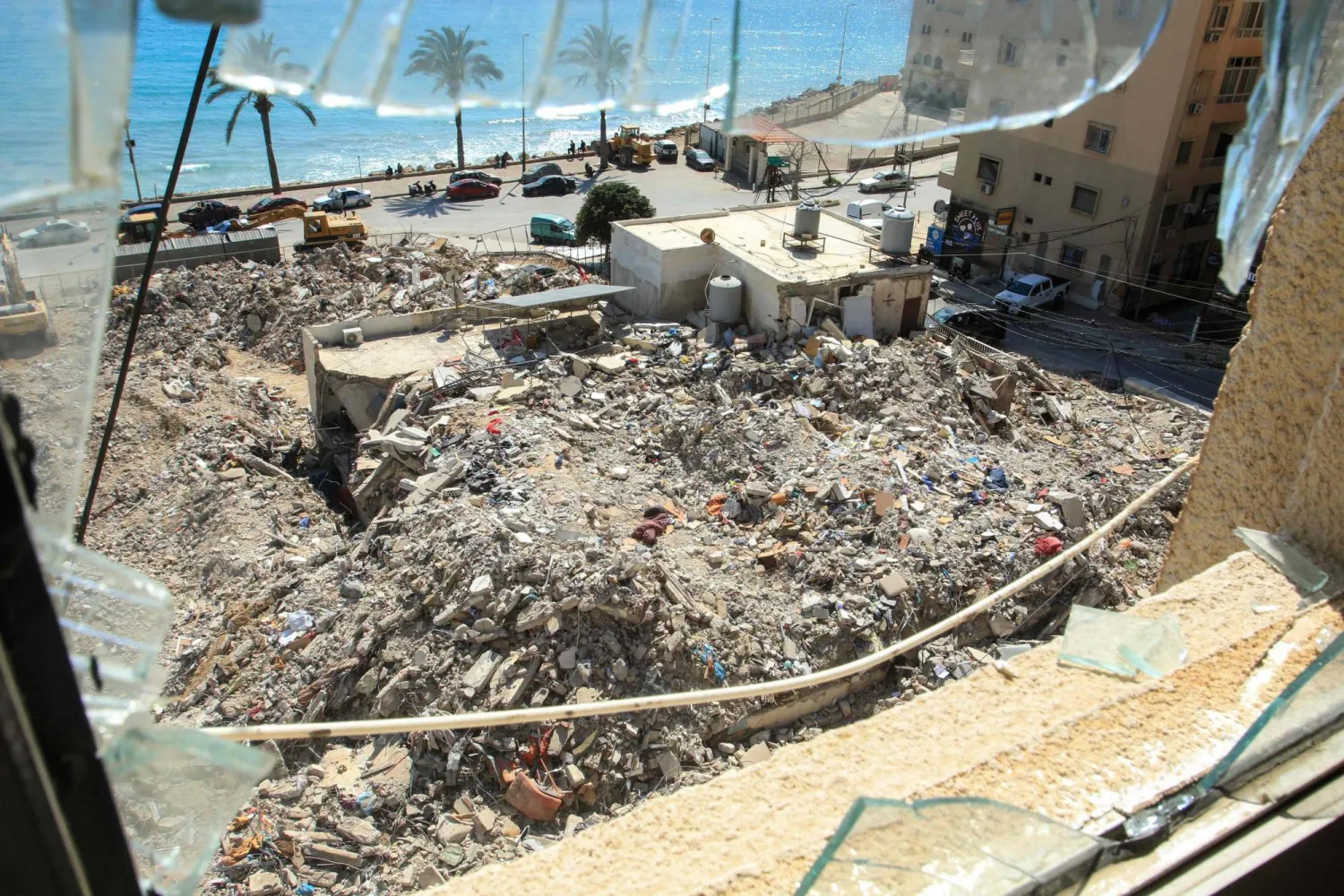
Lebanon Raises Israel-Hezbollah War Death Toll to 2,454

This picture shows the rubble of buildings destroyed in Israeli strikes in the southern Lebanese coastal city of Tyre on April 21, 2026. (AFP)
TT

Lebanon Raises Israel-Hezbollah War Death Toll to 2,454

This picture shows the rubble of buildings destroyed in Israeli strikes in the southern Lebanese coastal city of Tyre on April 21, 2026. (AFP)

Lebanon on Tuesday raised the toll from six weeks of war between Israel and Hezbollah to 2,454 dead as a fragile 10-day ceasefire holds.

The government's disaster risk management unit in a statement also said 7,658 people had been wounded in the conflict, which began on March 2, days after the broader Middle East war erupted.

Authorities and rescuers in Lebanon have been continuing to recover and identify bodies in areas that were subjected to heavy Israeli strikes.


Aoun: Army, Security Forces Sole Authorities Responsible for Lebanese Security

Lebanese President Joseph Aoun meets with a delegation from the southern town of Deir Mimas (National News Agency). 
TT

Aoun: Army, Security Forces Sole Authorities Responsible for Lebanese Security

Lebanese President Joseph Aoun meets with a delegation from the southern town of Deir Mimas (National News Agency). 

Lebanese President Joseph Aoun said the army and state security forces alone were responsible for citizens’ security, as Israeli attacks continued across southern Lebanon and Maronite bishops called for all weapons to be brought under state control.

Aoun made the remarks during a meeting with a delegation from Deir Mimas, a predominantly Christian town south of the Litani River, where he reaffirmed the state’s commitment to residents facing Israeli attacks and displacement.

He described the determination of southern residents to remain on their land as the strongest response to Israeli displacement and intimidation, pledging continued support for those who stayed in their villages and those forced to flee.

Municipal chief Tania Bernaba welcomed Aoun’s insistence that weapons remain exclusively in state hands and that decisions on war and peace rest with its legitimate institutions, particularly the army and security forces.

She outlined the town’s difficult security, economic and humanitarian conditions, stressing that residents wanted to remain connected to state institutions and services rather than feel abandoned or isolated.

In response, Aoun expressed solidarity with residents affected by Israeli attacks and pledged that the state would provide protection and support wherever security conditions permitted.

“The Lebanese army and legitimate security forces will be the sole authorities responsible for citizens’ security,” he said, describing the state’s responsibility toward southern residents as a non-negotiable national priority.

He added that political, diplomatic and negotiating efforts were continuing to halt Israeli attacks, secure a complete withdrawal from occupied territory and deploy the army to the internationally recognized southern border.

Maronite bishops back negotiations

Aoun’s position was echoed by the Council of Maronite Bishops, which condemned continued Israeli attacks on southern Lebanon following its monthly meeting in Bkerke.

The bishops urged the international community to help displaced residents return to their homes, support ongoing negotiations and back efforts to place all weapons under state control.

Meanwhile, several residents of Nabatieh al-Fawqa entered their town on foot despite Israeli threats, coinciding with Prime Minister Nawaf Salam’s visit to Nabatieh.

Their return underscored the determination of southern residents to reclaim their homes, while highlighting the gap between government efforts to restore normal life and conditions on the ground, where Israeli threats and military operations continue.

Israeli attacks continue across southern Lebanon

The political statements came amid continued Israeli military operations across several southern towns, including artillery shelling, airstrikes and demolitions.

Field reports indicated that Israeli artillery targeted Mays al-Jabal, while troops fired machine guns toward the outskirts of Baraachit and carried out major demolitions in Beit Lif and Aitaroun, in the Bint Jbeil district.

Israeli aircraft also launched two rounds of strikes on Mansouri, south of Tyre, where a powerful explosion sent tremors through Tyre and neighboring towns.

In Majdal Zoun, Israeli forces carried out two successive demolitions after artillery struck Beit Yahoun, Mansouri, Wadi Zibqin and Wadi al-Slouqi at dawn. Machine-gun fire was also reported toward Hadatha and the outskirts of Baraachit.


Sudanese Army Expands Control in North Kordofan

Sudanese army soldiers take part in a military parade in Gedaref on August 17 (AFP). 
TT

Sudanese Army Expands Control in North Kordofan

Sudanese army soldiers take part in a military parade in Gedaref on August 17 (AFP). 

The Sudanese army said Friday it had recaptured the strategic town of Al-Mazroub in North Kordofan, a week after retaking Sodari, as a deadly drone strike on student housing in the state capital, El-Obeid, highlighted the growing use of unmanned aircraft in the conflict.

The developments come as the UN Security Council prepares for fresh negotiations over a US proposal to extend the arms embargo on Darfur to all of Sudan.

In a statement, the army’s General Command said its troops and allied forces had retaken Al-Mazroub after “fierce battles,” inflicting heavy casualties and vehicle losses on the paramilitary Rapid Support Forces (RSF).

The army pledged to continue operations on all fronts, protect civilians and secure property, urging residents of recaptured areas to resume their normal lives.

Mohamed Deidan, spokesman for the Special Operations Forces in North Kordofan, announced on Facebook that army troops had entered Al-Mazroub at 9 a.m. Friday, a development corroborated by field sources.

Located about 130 kilometers northwest of El-Obeid, Al-Mazroub is an important livestock market that has also served as a military supply route during the war. It had long been under RSF control.

Witnesses reported that RSF fighters withdrew from the town in September but returned after the army captured Sodari, before retreating again as government forces advanced Friday morning.

Holding Al-Mazroub strengthens the army’s ability to monitor movements west of Bara and restrict the town’s use as a transit and supply hub. Consolidating the gain, however, depends on securing surrounding roads and rural areas.

The advance follows recent army gains in Sodari, Um Sharo, Bara, Jabra al-Sheikh and Um Sayala. Field reports indicated that RSF units had retreated toward Um Badr, Hamrat al-Sheikh and the state’s far west, although their current positions remain independently unverified.

Kordofan’s strategic importance stems from its location linking central Sudan to Darfur, making control of its towns and roads critical to troop movements and supply lines.

Meanwhile, the Sudan Doctors Network reported that five people were killed and 47 wounded in a drone strike on University of Kordofan student housing in El-Obeid.

The network blamed the RSF, describing the attack as an escalation in strikes against civilian and educational facilities.

The paramilitary group made no immediate comment, and responsibility for the strike could not be independently established.

El-Obeid has faced repeated drone attacks in recent weeks, reflecting the weapon’s growing use alongside ground operations.

Burhan addresses military recruits

In Khartoum, Sudan’s Sovereignty Council chairman and army chief Abdel Fattah al-Burhan told newly admitted military academy recruits that the armed forces must safeguard the country’s security and unity, with loyalty transcending political, tribal and regional affiliations.

He described the army as a national institution serving all Sudanese and urged recruits to develop their military and technical skills to keep pace with advances in weaponry and equipment.

The Security Council is expected to revisit Sudan sanctions before the current temporary extension expires on October 9.

In September, disagreements over a US proposal to expand the Darfur arms embargo nationwide forced the council to extend the existing measures by just one month.

Washington also seeks tighter restrictions on weapons, drones, related technology and foreign fighters, while Russia and China have expressed reservations about widening the embargo.

Sudan’s government opposes a nationwide ban, arguing it could undermine the army’s ability to defend the country. Instead, it wants tougher measures to prevent weapons and foreign support from reaching the RSF.

The latest escalation in Kordofan adds significance to the Security Council debate, as military operations and drone warfare have spread beyond Darfur, for which the embargo was established more than two decades ago.


Syria Security Incidents Raise Questions Over Who Benefits from Instability

A Syrian Interior Ministry security officer on the outskirts of the village of al-Soura al-Saghira in the Sweida countryside on Sept. 15 (Reuters). 
TT

Syria Security Incidents Raise Questions Over Who Benefits from Instability

A Syrian Interior Ministry security officer on the outskirts of the village of al-Soura al-Saghira in the Sweida countryside on Sept. 15 (Reuters). 

A series of security incidents across Syria in recent days raised concerns over attempts to undermine the authorities and spread instability as Damascus struggles to restore security and revive its economy.

The latest incident involved an attack on a bus carrying electricity company employees on the Masyaf Bridge in Homs, leaving several people dead and wounded.

It coincided with an explosion on a gas pipeline supplying the Tishreen thermal power plant in the Damascus countryside, knocking three power generation stations out of service and affecting drinking water networks.

Two days earlier, an explosion struck a gas pipeline in eastern Syria, while an assassination attempt targeted a Defense Ministry officer in al-Sanamayn, in Daraa province.

Unlike previous incidents, which occurred at relatively long intervals, the latest episodes unfolded within days of one another.

Their timing is particularly sensitive as Syrian authorities face mounting economic pressure while seeking to restore stability, attract reconstruction investment and transform the country into a strategic energy corridor linking Arab states to Türkiye and Europe, amid disruptions to shipping through the Strait of Hormuz caused by the US-Iran confrontation.

A Syrian security source declined to comment on the situation. Asharq Al-Awsat spoke to two security and military experts about who might benefit from weakening the authorities and spreading chaos.

Who Stands to Benefit?

Syrian strategic security and military expert Ismat al-Absi described the incidents as a deliberate pattern of sabotage rather than isolated events.

Their occurrence within a single week was neither coincidental nor random, he told Asharq Al-Awsat, describing them as a systematic campaign targeting vital infrastructure and portraying the state as incapable of protecting citizens’ most basic rights.

He suggested the primary objective was psychological: convincing Syrians that nowhere in the country was safe and that the new authorities had yet to establish effective control beyond major urban centers.

Al-Absi identified ISIS sleeper cells as potential beneficiaries, arguing that exposing government security failures could help the group rebuild its clandestine network and recruit new members.

Remnants of the former regime and their financial and military networks also had an interest in perpetuating instability, he argued, citing their knowledge of vital installations, familiarity with former security procedures and financial resources accumulated through years of corruption.

He said such networks could establish small armed cells, sabotage infrastructure and assassinate officers involved in the political transition or pursuing Assad-linked networks.

Al-Absi also identified Israel as having an interest in keeping Syria militarily weak and divided, while Iran, despite losing its former influence, retained influential networks, particularly along the Syrian coast.

Arms and drug traffickers were another potential beneficiary, he added, as weak security allowed cross-border smuggling routes through Türkiye, Iraq, Jordan and Lebanon to remain profitable.

Rather than a single perpetrator, he described an intersection of interests that stood to gain directly from instability.

Five Simultaneous Priorities

Al-Absi proposed five parallel measures, stressing that security solutions could not be separated from political, economic and institutional reforms.

The first was completing the process of bringing all weapons under state control. The second involved building an effective intelligence apparatus free of corruption, addressing what he described as fragmentation and poor coordination among existing agencies.

Third, he called for tackling the economic crisis fueling violence, citing unemployment exceeding 40 percent in some provinces and incomes below the poverty line.

He proposed reviving small and medium-sized businesses in marginalized areas, creating temporary jobs through public works programs and ensuring basic services reached rural communities where economic and cultural deprivation contributed to the spread of radical ideas.

His fourth priority was inclusive national dialogue. According to al-Absi, Syria’s communities viewed the transition through different fears: Druze concerns over central domination, Alawite memories of the March 2025 coastal violence, Sunni demands for safeguards against renewed authoritarian rule and Kurdish aspirations to preserve administrative gains in the northeast.

He advocated an elected constituent assembly representing all communities to draft a new constitution, alongside genuine administrative decentralization and clearly defined provincial financial powers.

Al-Absi believes that the fifth path lies in maintaining transparent communication with the public. Official silence surrounding explosions and assassinations fueled conspiracy theories and fear, he argued.

Citing the Sept. 21 explosion at an ammunition depot in al-Eis, south of Aleppo, he urged authorities to disclose whether poor storage was responsible or explain measures taken if internal security breaches were suspected. He also called for professional state media focused on providing information rather than propaganda.

Syria had a historic opportunity to rebuild, he argued, but needed swift, measurable decisions and tangible results within months rather than years, stressing that legitimacy was earned through actions, not slogans.

Swift, Precise Response Needed

Syrian political and security researcher Diaa Qaddour agreed that the country’s multiple security challenges required urgent action.

“When these challenges converge, the situation becomes more complicated, requiring a more precise and faster response,” he told Asharq Al-Awsat.

Qaddour cautioned that the recent incidents might or might not be connected.

He pointed to Syria’s sensitive circumstances following its removal from sanctions and terrorism lists, alongside threats from ISIS and strained relations with Lebanon’s Hezbollah and Iranian militias in Iraq.

The proliferation of weapons and opposition to the country’s political changes further complicated the domestic security landscape, he added.

Although these factors appeared separate, Qaddour argued that collectively they served one overarching objective: weakening the government and frustrating its efforts to establish security and stability.