
After Israel imposed a new reality on the ground following a ceasefire, a new deterrence equation has emerged, confining hostilities to the area south of the Litani River.
Israeli forces continue operations in zones under their control, while Hezbollah has limited its attacks to that area, with restrained responses to ceasefire violations inside northern Israel.
With direct talks between Lebanon and Israel expected to begin, with Israeli withdrawal a central issue, this equation came into focus on Tuesday.
Hezbollah said it responded to what it called “blatant and documented violations by the Israeli army, exceeding 200 breaches since the ceasefire took effect, including targeting civilians and destroying villages and homes in southern Lebanon.”
It said it targeted an artillery position in the settlement of Kfar Giladi, which it described as the source of recent shelling toward Yohmor al-Shaqif, using a barrage of rockets and drones.
On Wednesday, Hezbollah said it again targeted an Israeli artillery position in Bayyada with a drone, “in response to Israeli ceasefire violations and continued shelling of villages in southern Lebanon.”
The Israeli military said Hezbollah launched a drone toward its troops on the front line in southern Lebanon, adding the air force intercepted it before it crossed into Israel, calling it a breach of the ceasefire.
Limited operations to avoid escalation
Riad Kahwaji, a security and defense analyst, told Asharq Al-Awsat that Hezbollah is trying to impose new rules of engagement but lacks the military capability to do so. He said the group knows any escalation beyond the current framework would trigger a broad Israeli response.
He explained that Hezbollah is operating within a calculated margin, carrying out limited strikes inside what is known as the “engagement zone” or “yellow zone” set by Israel, in an attempt to shape a new equation without sliding into full-scale war.
Kahwaji said rules of engagement are dictated by the balance of power, not intent, adding that Israel retains the ability to define the scope and ceiling of operations. He pointed to the expansion of Israeli activity to areas south of the Zahrani River, not just south of the Litani, highlighting a wide gap in military capabilities, from precision to firepower and reach, giving Israel operational superiority.
Kahwaji said Hezbollah’s operations reflect that reality, remaining limited and largely symbolic. He said they often target open areas, claiming to hit military targets without clear evidence, in an effort to preserve deterrence rather than shift the balance.
Hezbollah understands Israel’s ability to inflict wide destruction on border villages and that it cannot currently protect or retake them if the conflict expands. As a result, its role is confined to acting as “a support front for Iran,” launching rockets within calculated limits while preserving its military capacity ahead of any renewed war involving Iran, he added.
Captive Hezbollah fighter
Israeli ceasefire violations continued on Wednesday. One person was killed, and two were wounded in a drone strike on the outskirts of the Jbour area in western Bekaa.
The town of Tayri was later shelled in an area where journalists and civilians were present, the National News Agency said, adding that two people were killed and journalists were wounded.
The agency said Israeli forces surrounded journalists Amal Khalil and Zeinab Faraj and prevented the Red Cross and the Lebanese army from reaching them for some time, triggering an alert in Lebanon. Information Minister Paul Morcos said he was following up with UNIFIL and the Lebanese army and held Israel responsible for their safety.
Separately, Lebanese Civil Defense personnel in Rmeish treated a wounded Hezbollah fighter who had crawled to Ain Ebel from Bint Jbeil, before contacting the Lebanese Red Cross to evacuate him. Israeli forces in Debel called the rescuers, demanding he be handed over and threatening to target the ambulance, the agency said.
The rescuers refused. The wounded man then chose to walk toward Debel to surrender, to protect the medics and residents, despite heavy blood loss.
Systematic demolitions
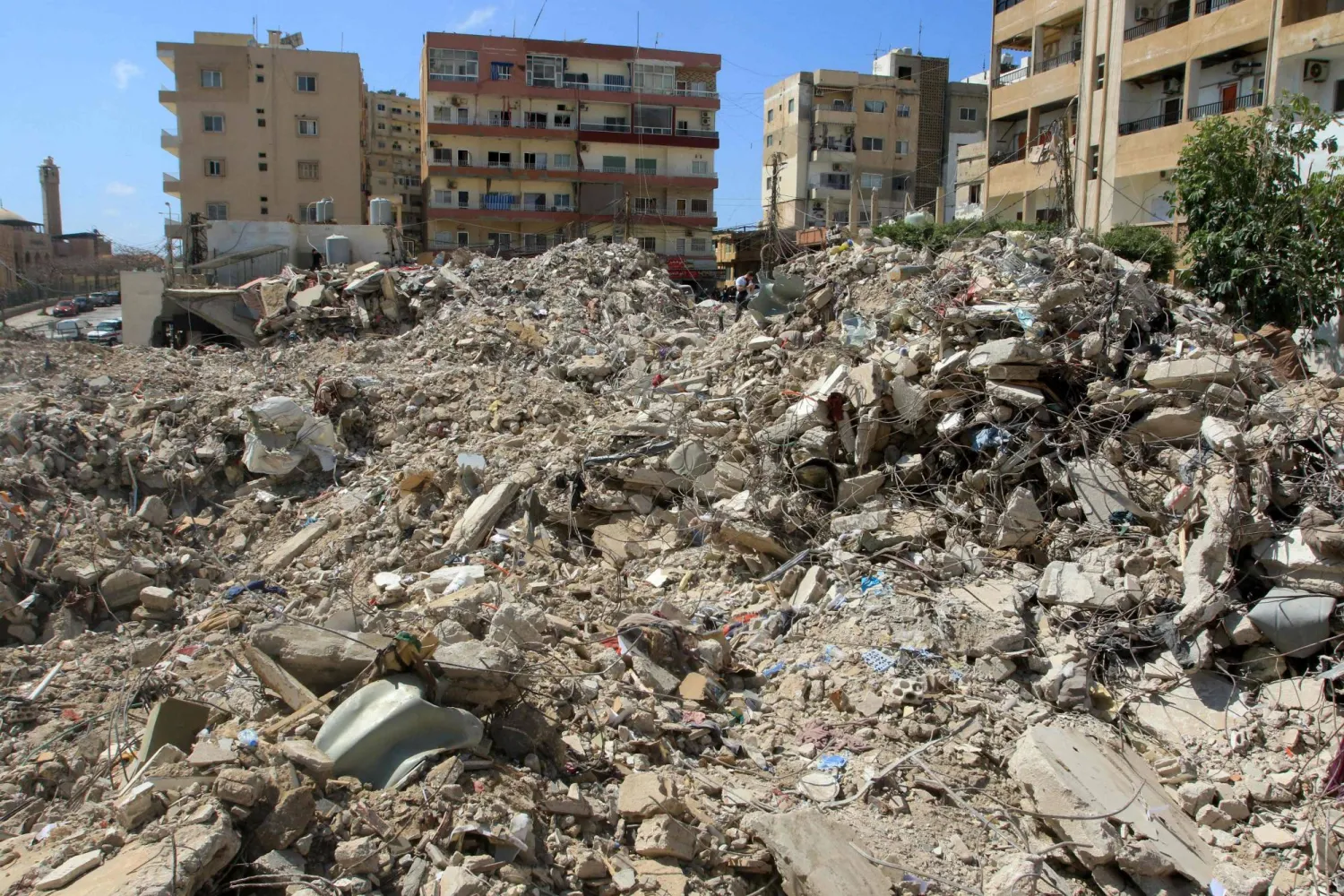
Israeli operations south of the Litani have intensified, with systematic demolitions in residential neighborhoods in Bint Jbeil and the towns of Beit Lif, Shema, Tayr Harfa and Hanine.
Roads in Wadi al-Slouqi have been bulldozed using heavy machinery backed by military vehicles. Homes and property in Aita al-Shaab were also destroyed, including remaining shops along the main road.
In Khiam, near-continuous explosions have targeted homes, buildings and mosques, alongside demolition and bulldozing of infrastructure, in what appears to be an attempt to erase the town. Israeli forces also blew up several homes at dawn in Bayyada, with explosions heard across Tyre.
Israeli army spokesperson Ella Waweya said the military carried out an airstrike to “eliminate an immediate threat” after detecting two individuals who she said breached the front defensive line in Wadi al-Slouqi.
She added that forces are continuing operations south of that line to prevent threats to northern communities.