Israeli Fire Kills Five in Gaza and the West Bank, Medics Say

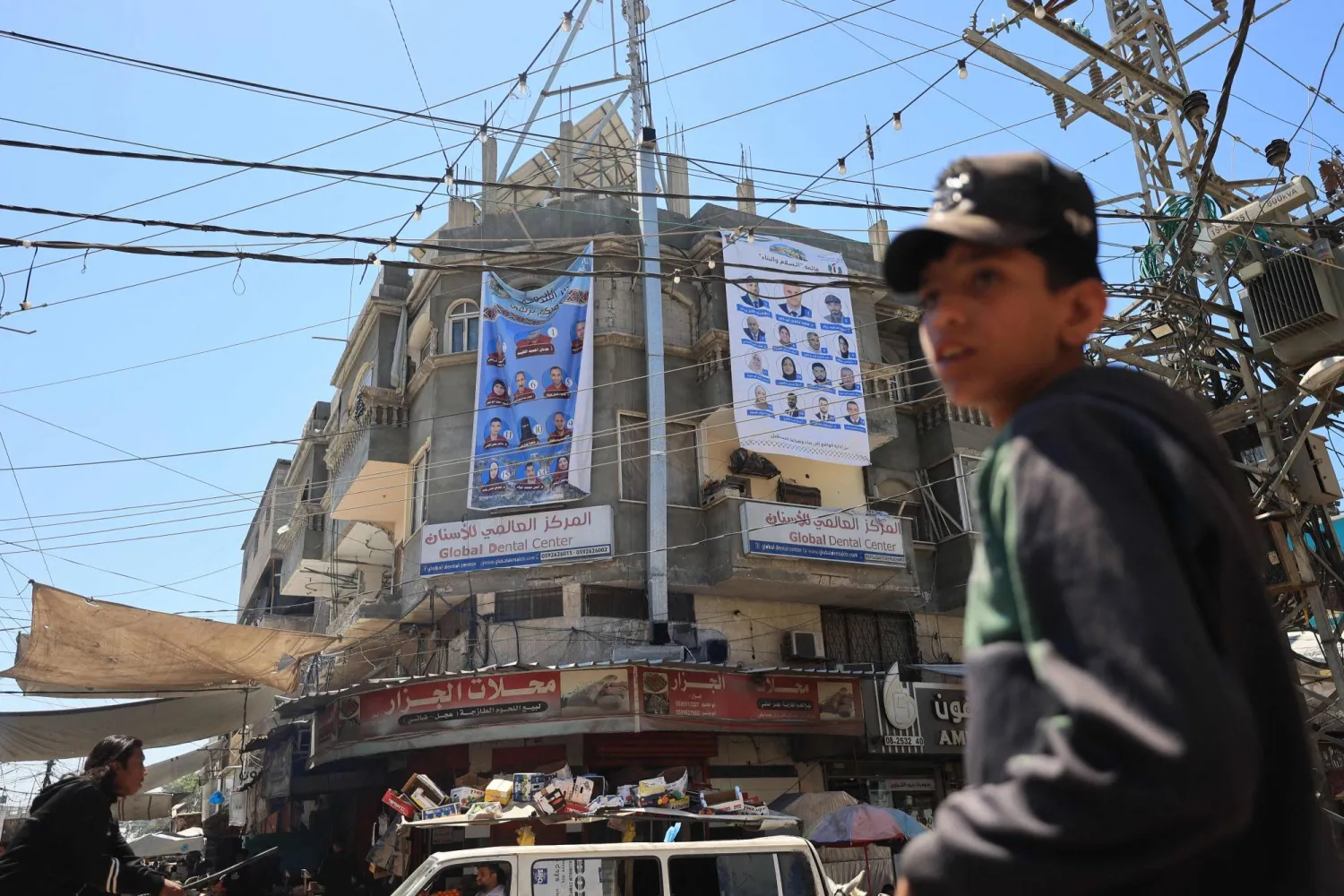
 Election campaign banners showing candidates for the upcoming municipal elections hang on a building in Deir el-Balah in the central Gaza Strip on April 21, 2026.  (Photo by Eyad Baba / AFP)
Election campaign banners showing candidates for the upcoming municipal elections hang on a building in Deir el-Balah in the central Gaza Strip on April 21, 2026. (Photo by Eyad Baba / AFP)
TT

Israeli Fire Kills Five in Gaza and the West Bank, Medics Say

 Election campaign banners showing candidates for the upcoming municipal elections hang on a building in Deir el-Balah in the central Gaza Strip on April 21, 2026.  (Photo by Eyad Baba / AFP)
Election campaign banners showing candidates for the upcoming municipal elections hang on a building in Deir el-Balah in the central Gaza Strip on April 21, 2026. (Photo by Eyad Baba / AFP)

Israeli airstrikes killed at least four Palestinians in Gaza on Thursday, while soldiers shot and killed a 15-year-old child during an army raid in the Israeli-occupied West Bank, Palestinian health officials said.

One person was killed in a strike in southern Gaza's Khan Younis in which several others were wounded, local medics said. Israel's military said it had targeted militants transporting munitions, who it said had posed a threat to Israeli soldiers, Reuters reported.

Three others, including a rescue worker, were killed in a separate strike in Maghazi, a Palestinian refugee camp in the Deir al Balah area in central Gaza, health officials said. Israel's military had no immediate comment on that strike.

Israel has carried out repeated strikes on Gaza since a US-brokered ceasefire came into effect in October. Both Israel and Hamas have accused each other of ceasefire violations.

There is no mechanism for enforcing the ceasefire. Four Israeli soldiers and more than 780 Palestinians have been killed in Gaza since the ceasefire started.

At Gaza City's Al Shifa Hospital, the territory's largest medical facility, relatives stood among mourners gathered to bury five people, including three children, who were killed on Wednesday in an Israeli airstrike on a northern Gaza town.

"There is no ceasefire, no truce, nothing at all," said Mohammed Baalousha, a relative of one of the victims. "There is no safety in any area."

Israel's military has not commented on the strike.

WEST BANK VIOLENCE

In the West Bank city of Nablus, health officials said Israeli forces shot and killed a teenager during an ongoing raid in the city.

The health ministry said Israeli settlers shot and killed a 25-year-old Palestinian man in Deir Dibwan town near Ramallah a day ago, in the latest in what human rights groups have described as a surge in violence against Palestinians waged by Israeli settlers and soldiers.

The Israeli military did not immediately comment on either incident. The Palestinian health ministry said at least 15 people had been killed by Israeli settlers' attacks so far this year.


Israel’s Army Strikes South Lebanon, Israeli Civilians Injured in Hezbollah Drone Attack

Smoke rises from the site of an Israeli airstrike that targeted the southern Lebanese village of Deir El Zahrani on May 13, 2026. (Photo by Kawnat HAJU / AFP)
TT

Israel’s Army Strikes South Lebanon, Israeli Civilians Injured in Hezbollah Drone Attack

Smoke rises from the site of an Israeli airstrike that targeted the southern Lebanese village of Deir El Zahrani on May 13, 2026. (Photo by Kawnat HAJU / AFP)

Israel's military said it launched strikes against Hezbollah targets across southern Lebanon on Thursday, hours before US-brokered talks between the two countries were set to begin in Washington.

"The IDF has begun striking Hezbollah terror infrastructure sites in several areas in southern Lebanon," the military said after issuing evacuation warnings for a number of villages in the area.

Also Thursday, a Hezbollah drone strike injured several Israeli civilians, the Israeli military said.

"A short while ago, an explosive drone that was launched by the Hezbollah terrorist organization fell within Israeli territory, near the Israel-Lebanon border," the military said.

"As a result, several Israeli civilians were injured and evacuated to receive medical treatment at the hospital."


Somalia is in a Deadly Drought again. Most Humanitarian Aid Isn't there this Time

The World Food Program’s Assistant Executive Director for Program Operations, Matthew Hollingworth, talks to civilians during his visit to a camp for the internally displaced people to assess the knock on effects from the escalation in the Middle East, alongside drought and sharp cuts in humanitarian funding that are worsening hunger, in Kahda district of Mogadishu, Somalia May 7, 2026. REUTERS/Feisal Omar
TT

Somalia is in a Deadly Drought again. Most Humanitarian Aid Isn't there this Time

The World Food Program’s Assistant Executive Director for Program Operations, Matthew Hollingworth, talks to civilians during his visit to a camp for the internally displaced people to assess the knock on effects from the escalation in the Middle East, alongside drought and sharp cuts in humanitarian funding that are worsening hunger, in Kahda district of Mogadishu, Somalia May 7, 2026. REUTERS/Feisal Omar

Most of Abdi Ahmed Farah’s hundreds of goats have died. It has not rained steadily in this part of Somalia for three years, something the 70-year-old never thought possible.

He is in debt from buying water. The reservoir outside his tent is nearly empty. His family is down to one meal a day: rice with sugar and oil. The youngest of his 22 children was born three weeks ago and his wife produces only occasional drops of breast milk.

“I have considered abandoning my family because I cannot provide for them,” said Farah, sitting in front of dwindling food supplies, as if on guard.

Yet another drought is affecting millions of people across Somalia, one of the world's most vulnerable countries to climate shocks. Some rivers are dry. Crops have withered. Experts say the drought could be among the worst in Somali history, The Associated Press said.

The crisis is compounded by aid cuts, most dramatically by the Trump administration, and rising prices from the Iran war. Somalia buys most of its fuel from the Middle East, and 70% of its food is imported.

Production of staple crops of maize and sorghum in the October-December rainy season was the lowest on record in Somalia, according to the UN Food and Agriculture Organization.

Food security experts warn that nearly a half-million children might face severe acute malnutrition, the harshest kind. That would be higher than the number of children requiring treatment for it during droughts in 2011 and 2022, according to UNICEF.

‘It’s a repeated climate shock' "2026 is the worst year on record for Somalia in terms of drought,” said Hameed Nuru, the UN World Food Program director for Somalia. “Children have started dying.”

The Somali government and United Nations estimate that 6.5 million people face crisis levels of hunger, representing a third of the country’s population and a 25% increase since January.

Aid agencies are trying to maximize resources, and the Somali diaspora is sending money to help, but humanitarian workers warn it is not enough.

“This drought is not just another cycle of dry season. It’s a repeated climate shock with shrinking humanitarian support,” said Mohamed Assair, a manager with Save the Children in Puntland, a semi-autonomous region.

People drank dirty rainwater and got sick

Farah once had 680 goats, but a lack of food and water as well as diseases exacerbated by drought have claimed all but 110 of them, barely clinging to life.

“There is no market for my goats because they are so thin. Previously we would trade them for rice, but now we can’t,” he said. Farah’s family has been at a site outside Usgure village for 10 days. Almost a dozen goat carcasses lie nearby.

In Usgure, home to 700 families, community leader Abshir Hirsi Ali said the local economy has collapsed because they rely on pastoralists like Farah. Shops have closed and food rations have run low.

A recent, brief shower brought puddles of dirty rainwater. “Some families were so desperate they drank it ... now there is a high number of people with fever,” Ali said.

Save the Children occasionally brings free water to Usgure, but private water trucks have quadrupled their prices and the cost of a 50-kilogram (110-pound) bag of flour has increased by a third, to $40.

“I’m not only afraid for my family but the future of the whole village,” said Muhubo Tahir Omar, a 47-year-old mother of 11 children.

Omar, like other parents, had sold her goats to pay for school fees, “but when we didn’t pay, the teachers left.” Her last goat is now sick.

‘Conflict made our situation even worse’ Decades of conflict in Somalia have displaced millions of people. The drought has displaced another 200,000 this year, the UN estimates.

Some families flee across harsh landscapes with limited supplies.

“People are on the move ... and when people move, people die,” said Kevin Mackey, the Somalia director for humanitarian group World Vision. He recently met people who had walked for nine days to get aid in Dollow in the south.

Around 80 families live in a displacement camp outside Shahda village in Puntland.

Shukri, a 20-year-old mother of four, usually can eke out one meal a day from handouts. Now there is nothing to eat and limited access to clean water.

“The children got diarrhea (from dirty water) and malnourishment worsened,” said Shukri, who gave only her first name. “I know a few people who have died.”

Many people head to Mogadishu, the capital, where food also remains scarce.

Fadumo, a 45-year-old mother of seven, moved there from Lower Shabelle, where livelihoods were already threatened by al-Qaeda-linked al-Shabab militants.

“The water sources we depended on for farming, including the river, dried up,” Fadumo said. “Conflict made our situation even worse, forcing us to flee."

‘The outlook is deeply concerning’ Drought ravaged Somalia in 2022 and an estimated 36,000 people died, according to the UN. Now the kind of aid that was rushed to respond to such crises is shrinking.

“Unless there is a sudden and substantial response from donors, the outlook is deeply concerning. A drought of similar severity in 2022 received a response five times greater than what we are seeing,” said Antoine Grand, head of the International Committee of the Red Cross in Somalia.

Aid funding to Somalia dropped to $531 million in 2025 in large part because of aid cuts by the United States, which had been Somalia's top donor. In 2022, aid funding was nearly five times as much at $2.38 billion.

WFP said it intended to help 2 million people with food aid this year but has reached only 300,000 because of funding gaps.

A center at the hospital in Qardho, Puntland, treats children with severe acute malnutrition. But therapeutic milk is now rarely in stock, and nurses resort to homemade alternatives such as cow's milk, said director Shamis Abdirahman.

The center receives around 15 children a month, but they expect more as displaced people arrive.

One 4-year-old, Farhia, weighs a scant 7.5 kilograms (16.5 pounds). Her eyes are sunken and her bones are prominent under her skin.

Her family fled to Qardho when all of their goats died, said her mother, Najma.

“I don’t know what to hope for, or see how we can get back to what we had,” she said.


100 Days After His Assassination, Public Pressure Mounts to Reveal Killers of Saif al-Islam Gaddafi

Saif al-Islam Gaddafi seated inside an aircraft in Zintan on Nov. 19, 2011. (Reuters) 
TT

100 Days After His Assassination, Public Pressure Mounts to Reveal Killers of Saif al-Islam Gaddafi

Saif al-Islam Gaddafi seated inside an aircraft in Zintan on Nov. 19, 2011. (Reuters) 

Legal moves and public pressure inside Libya, particularly from supporters of the former regime, have intensified in recent weeks, demanding that authorities disclose the circumstances surrounding the killing of Saif al-Islam Gaddafi.

Saif al-Islam, son of Libya’s late leader Moammar Gaddafi, was killed in the western city of Zintan on Feb. 3, 100 days ago.

Since Libyan Attorney General al-Siddiq al-Sour announced on March 5 that three suspects had been identified in connection with the crime - without revealing their names - public calls have grown for the full investigation findings to be released, for those behind the incident to be identified, and for all those involved to be brought to trial in order to ensure transparency and justice.

A Libyan source familiar with the matter in the capital, Tripoli, confirmed that new legal efforts are underway in the case.

Asharq Al-Awsat learned that Khaled al-Zaidi, head of the defense team in the Saif al-Islam assassination case, visited the office of the head of the Supreme Judicial Council, counselor Abdullah Abu Rzeiza, in Tripoli on Sunday morning. No details were disclosed about the visit or the issues discussed.

The same source, who requested anonymity, said that “these legal moves could lead to positive results and developments that may help uncover the truth and push the case toward greater clarity in the coming period,” without elaborating further.

Additionally, an initiative known as the “National Truth Committee on the Saif al-Islam Gaddafi Case” launched an online public petition calling on the attorney general to disclose details of the crime and announce the investigation results publicly, stressing the need to uphold the law and ensure the principles of justice.

The petition also called for legal measures against the three individuals referred to in the attorney general’s office statement, as well as an expansion of the investigation to include anyone who planned, participated in, financed or assisted in carrying out the crime.

At the same time, public pressure has increased across Libya. The Conference of Social and Political Activities and Civil Society Institutions in Fezzan called on the attorney general to clarify the reasons behind the delay in arresting the suspects, saying the continued ambiguity has raised widespread questions among the public.

Political activist Dr. Khaled al-Hijazi, who is close to the former regime, said the public pressure was “logical,” given that “the assassination of Saif al-Islam is a public opinion issue that cannot be ignored or covered up.”

He told Asharq Al-Awsat that “the importance of the case is compounded by its connection to a public political figure who previously ran in a presidential race and enjoys significant popular support inside the country.”

A source in the public prosecution office had previously told Asharq Al-Awsat that investigations into the case were still ongoing, in response to unofficial accounts circulating in Libya regarding the identities and regional affiliations of the perpetrators.