


Gradual Escalation in South Lebanon Complicates Diplomatic Efforts

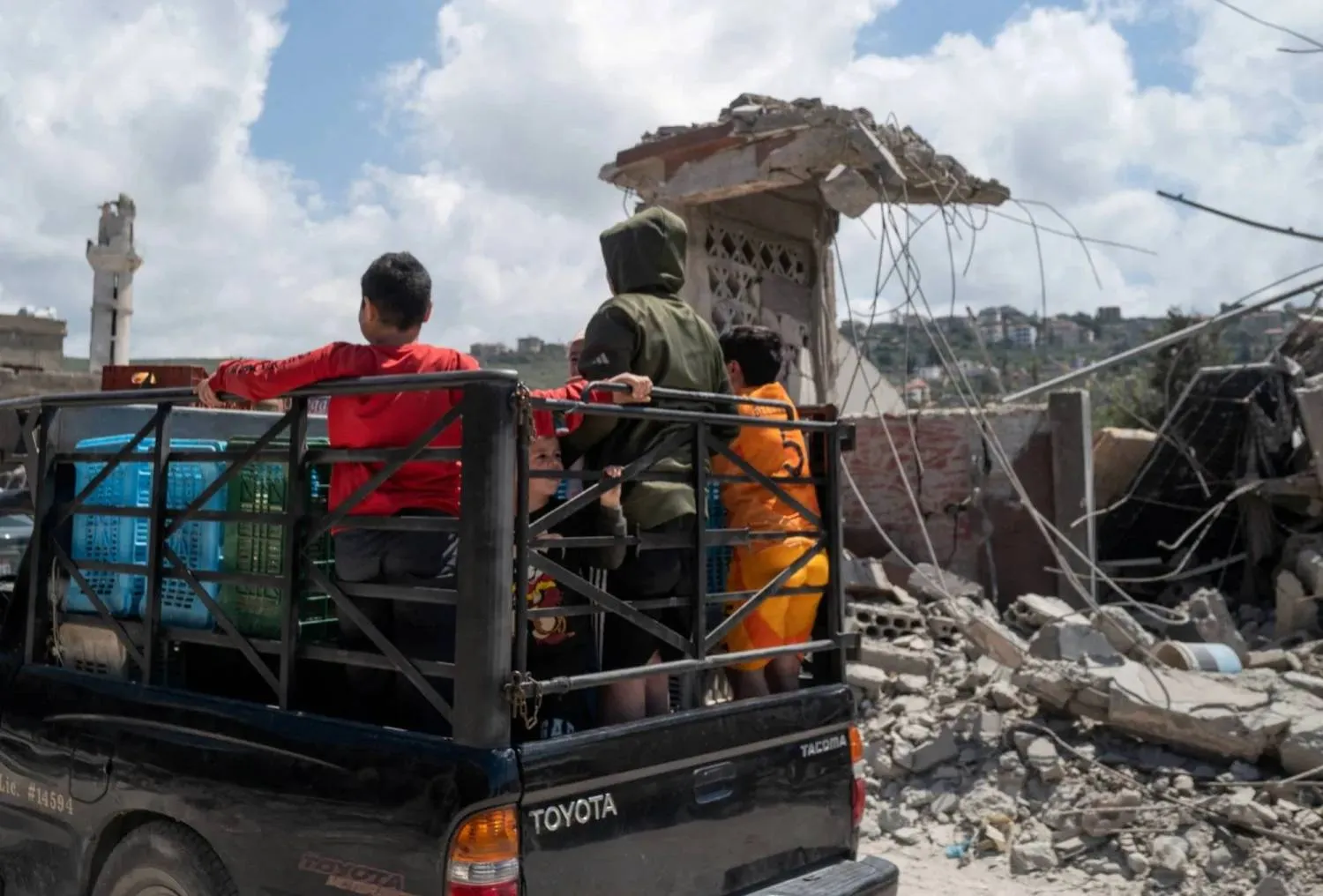
Children stand on a pickup truck as they pass damaged buildings after an Israeli airstrike in the southern Lebanese town of Mansouri (Reuters)
TT

Gradual Escalation in South Lebanon Complicates Diplomatic Efforts

Children stand on a pickup truck as they pass damaged buildings after an Israeli airstrike in the southern Lebanese town of Mansouri (Reuters)

Diplomatic efforts to resolve the crisis in southern Lebanon are running up against a gradual escalation on the ground, as fighting expands beyond the border area following four days of Israeli violations, with Hezbollah beginning limited attacks on Israeli forces deeper inside Lebanon and along the border.

Israeli operations have intensified, with homes being blown up, demolished and burned, while no-return zones are expanding. The measures appear to go beyond military objectives, pointing to an attempt to impose a new demographic and security reality.

Escalation widens, no-return zones expand

On Thursday, the Israeli army carried out operations in several towns, including Beit Lif, Hanine, Mais al-Jabal, and Khiam. Powerful explosions were reported, homes were destroyed or set ablaze, and artillery hit Wadi al-Hujeir, Wadi al-Slouqi, and Qantara.

The campaign signals a shift from remote strikes to systematic destruction of the built environment.

Hezbollah fired a rocket toward the Metula settlement, which Israel’s Iron Dome intercepted. The Israeli army also said it intercepted an aerial target launched from Lebanon.

More significant, however, was the widening of Israeli warnings, with renewed calls for residents of dozens of villages not to return or move south of set lines, resembling a “fire belt” with political and demographic implications aimed at reshaping the border area.

Displacement persists, uncertainty deepens

Local sources told Asharq Al-Awsat that many residents have yet to return to villages in the Nabatieh district, while others are holding back from returning to Beirut’s southern suburbs despite the truce, citing doubts over its durability.

They said continued exchanges of fire in the south underline the fragility of the ceasefire, warning that relative calm north of the Litani River and deeper inside Lebanon could collapse at any moment. The situation reflects a tense waiting phase rather than real stability.

The crisis is also evident administratively. Civil registry records from Mais al-Jabal have been moved from their temporary location in Nabatieh to the Interior Ministry, a step that entrenches a reality preventing the return of state institutions, mirroring administrative displacement alongside population displacement.

Testimonies cited by Haaretz, quoting Israeli soldiers, described looting of civilian property as a “routine phenomenon,” underscoring the erosion of the social and economic fabric of border villages and reinforcing what sources describe as “silent emptying.”

Diplomacy under strain

Political positions reflect the pressure. Hezbollah lawmaker Hassan Fadlallah said the group wants to respect the ceasefire, but Israel must do the same. MP Hussein Hajj Hassan said the group is no longer bound by the truce and will respond based on its assessment.

Retired brigadier general Naji Malaeb told Asharq Al-Awsat that Hezbollah’s response, described as part of deterrence, falls short given the imbalance of power and risks undermining Lebanon’s diplomatic efforts at a critical time.

He said Lebanon would have been better served by sustaining diplomatic pressure over Israeli violations without military responses, noting that even limited rocket fire weakens Lebanon’s leverage.

Double standards, shrinking leverage

Malaeb said any Hezbollah military action would be framed internationally, particularly by the United States, as a breach of the truce, while Israeli violations are largely overlooked.

That dynamic, he said, erodes Lebanon’s negotiating position as it bets on talks in Washington, turning the conflict into a “war of narratives” shaped by power rather than legal standards.

Focus on securing the truce

Malaeb said Lebanon should prioritize securing a firm ceasefire to allow the army to assert control and ensure its deployment is not obstructed. He said this aligns with the US approach but depends on Israeli compliance, which is uncertain.

He warned that any deal could leave Israel room to act under security pretexts, effectively allowing continued strikes and setting the stage for renewed escalation, with Hezbollah likely to respond.



100 Days After His Assassination, Public Pressure Mounts to Reveal Killers of Saif al-Islam Gaddafi

Saif al-Islam Gaddafi seated inside an aircraft in Zintan on Nov. 19, 2011. (Reuters) 
TT

100 Days After His Assassination, Public Pressure Mounts to Reveal Killers of Saif al-Islam Gaddafi

Saif al-Islam Gaddafi seated inside an aircraft in Zintan on Nov. 19, 2011. (Reuters) 

Legal moves and public pressure inside Libya, particularly from supporters of the former regime, have intensified in recent weeks, demanding that authorities disclose the circumstances surrounding the killing of Saif al-Islam Gaddafi.

Saif al-Islam, son of Libya’s late leader Moammar Gaddafi, was killed in the western city of Zintan on Feb. 3, 100 days ago.

Since Libyan Attorney General al-Siddiq al-Sour announced on March 5 that three suspects had been identified in connection with the crime - without revealing their names - public calls have grown for the full investigation findings to be released, for those behind the incident to be identified, and for all those involved to be brought to trial in order to ensure transparency and justice.

A Libyan source familiar with the matter in the capital, Tripoli, confirmed that new legal efforts are underway in the case.

Asharq Al-Awsat learned that Khaled al-Zaidi, head of the defense team in the Saif al-Islam assassination case, visited the office of the head of the Supreme Judicial Council, counselor Abdullah Abu Rzeiza, in Tripoli on Sunday morning. No details were disclosed about the visit or the issues discussed.

The same source, who requested anonymity, said that “these legal moves could lead to positive results and developments that may help uncover the truth and push the case toward greater clarity in the coming period,” without elaborating further.

Additionally, an initiative known as the “National Truth Committee on the Saif al-Islam Gaddafi Case” launched an online public petition calling on the attorney general to disclose details of the crime and announce the investigation results publicly, stressing the need to uphold the law and ensure the principles of justice.

The petition also called for legal measures against the three individuals referred to in the attorney general’s office statement, as well as an expansion of the investigation to include anyone who planned, participated in, financed or assisted in carrying out the crime.

At the same time, public pressure has increased across Libya. The Conference of Social and Political Activities and Civil Society Institutions in Fezzan called on the attorney general to clarify the reasons behind the delay in arresting the suspects, saying the continued ambiguity has raised widespread questions among the public.

Political activist Dr. Khaled al-Hijazi, who is close to the former regime, said the public pressure was “logical,” given that “the assassination of Saif al-Islam is a public opinion issue that cannot be ignored or covered up.”

He told Asharq Al-Awsat that “the importance of the case is compounded by its connection to a public political figure who previously ran in a presidential race and enjoys significant popular support inside the country.”

A source in the public prosecution office had previously told Asharq Al-Awsat that investigations into the case were still ongoing, in response to unofficial accounts circulating in Libya regarding the identities and regional affiliations of the perpetrators.


Sisi Visits Uganda as Egypt Increases Coordination on Water Security

Ugandan President Yoweri Museveni welcomes Egyptian President Abdel Fattah al-Sisi in Entebbe on Wednesday. (Egyptian Presidency)
TT

Sisi Visits Uganda as Egypt Increases Coordination on Water Security

Ugandan President Yoweri Museveni welcomes Egyptian President Abdel Fattah al-Sisi in Entebbe on Wednesday. (Egyptian Presidency)

Egyptian President Abdel Fattah al-Sisi and Ugandan President Yoweri Museveni discussed Nile water issues and regional security during talks in Entebbe on Wednesday, as Cairo steps up coordination with Nile Basin countries amid ongoing tensions with Ethiopia over the Grand Ethiopian Renaissance Dam (GERD).

The visit, which followed a trip by Museveni to Cairo several months ago, comes as Egypt seeks to strengthen political and economic ties with Nile Basin states in support of its water security strategy.

According to a statement from the Egyptian presidency, Sisi praised the growing momentum in relations with Uganda and called for broader cooperation in agriculture, irrigation, healthcare and training programs for Ugandan personnel.

He also stressed the importance of increasing trade and establishing sustainable investment partnerships.

Museveni described cooperation between the two countries as “a model for the desired integration among African states,” according to the statement. He also outlined Uganda’s Vision 2040 development plan and highlighted sectors where Kampala hopes to deepen cooperation with Cairo.

The two leaders exchanged views on regional crises, including conflicts in Sudan, Libya and the Palestinian territories, and emphasized the need for closer coordination on Nile and water-related issues.

Sisi called for neighboring countries to play a constructive role in restoring stability and achieving lasting peace across Africa, while Museveni stressed the importance of African-led solutions that take into account the continent’s particular circumstances and delicate balances.

Former Egyptian assistant foreign minister for African affairs Mona Omar said Egypt now viewed relations with Nile Basin countries as “an absolute priority,” including through investment, joint development projects and capacity-building initiatives.

Speaking to Asharq Al-Awsat, Omar said Uganda held particular importance for Egypt because of historical ties and Cairo’s support for Uganda’s independence movement.

She said water cooperation was a central element of the visit, citing the long-standing presence of an Egyptian technical mission affiliated with Egypt’s irrigation ministry in Uganda.

The mission participates in Nile measurements and water-related projects, including efforts to clear invasive weeds from Lake Victoria to facilitate trade and navigation, she said.

Omar added that discussions also addressed the GERD dispute. She said Uganda does not oppose the construction of the dam but rejects causing harm to downstream countries, a stance Egypt appreciates.

Cairo is seeking broader consensus among Nile Basin countries on reaching a legally binding agreement governing the operation of the dam, which Ethiopia considers essential for development but Egypt and Sudan fear could reduce their water supplies.

The talks also touched on the Entebbe Agreement, a framework accord launched by Ethiopia in 2010 that would revise historical Nile water-sharing arrangements involving Egypt and Sudan.

Ethiopia announced in October 2024 that the agreement had entered into force after ratification by six countries — Ethiopia, Uganda, Kenya, Tanzania, Rwanda and South Sudan — despite continued rejection by Egypt and Sudan.

Relations between Cairo and Kampala have gained momentum since Museveni’s visit to Egypt in August last year, during which several cooperation agreements were signed, Omar said.

She added that 65 Egyptian companies currently operate in Uganda in sectors including energy, infrastructure and food security, alongside cooperation in police and military training programs.

During his visit, Sisi renewed an invitation for Museveni to attend the African Union coordination summit to be hosted by Egypt in June 2026, as Uganda currently chairs the East African Community.


Iraqi Parliament Set to Vote on Al-Zaidi's Government

An Iraqi parliament session in Baghdad, March 2026. (INA)
TT

Iraqi Parliament Set to Vote on Al-Zaidi's Government

An Iraqi parliament session in Baghdad, March 2026. (INA)

Iraq’s parliament is scheduled to vote on Thursday on the cabinet lineup proposed by Prime Minister-designate Ali Falih Al-Zaidi, amid ongoing political disputes over key ministries and newly proposed posts.

Parliament’s media office said the agenda for session No. 24 includes a single item: a vote on “the government program and cabinet of Prime Minister-designate Ali Falih Al-Zaidi,” signaling efforts by political blocs to move forward with approving the new government despite lingering divisions, particularly within the Shiite Coordination Framework alliance.

Political and parliamentary sources said negotiations were continuing over several sovereign ministries, four deputy prime minister posts and two proposed new ministries, as pressure mounted to finalize the government before the Eid holiday to avoid a political vacuum or possible security escalation.

A source familiar with the talks told Asharq Al-Awsat that most lawmakers had not yet reviewed the résumés of ministerial nominees, despite constitutional requirements that they be distributed to parliament members before the confidence vote.

“Most lawmakers are not part of the negotiations taking place among bloc leaders, which are focused mainly on dividing ministerial quotas under the points system, while disagreements continue over some sensitive positions,” the source said.

Despite a relatively calm political atmosphere ahead of the session, political sources spoke of possible “last-minute surprises,” citing disputes within some parties over government priorities, particularly the issue of restricting weapons to state control.

A politician familiar with the negotiations noted that some leaders within the Coordination Framework had become less enthusiastic about backing Al-Zaidi than they were at the start of his nomination process, partly because of his pledge to place all weapons under state authority and concerns over his future relationship with armed factions allied to the coalition.

Some factions believe Al-Zaidi enjoys “clear international and American support,” the source said, referring to statements by Western officials in recent weeks that have fueled fears among some political groups that the next government could adopt a tougher stance on weapons outside state control.

Local media reports said resistance by some armed factions to disarm was one of the main reasons for delays in finalizing the cabinet, while political analysts also pointed to disputes among parties over the allocation of ministries.

A committee formed by the Coordination Framework has discussed the issue of weapons control with Al-Zaidi, while some armed groups continue to reject disarmament because of uncertainty over the future of their arsenals, the source added.

On the Sunni side, political factions appeared close to finalizing their ministerial share. Media linked to the Taqaddum party led by Mohammed Al-Halbousi circulated names of nominees and details of the distribution of ministries among Sunni blocs.

According to the reports, Taqaddum would receive the education and industry ministries, in addition to a deputy prime minister post, while the commerce ministry would go to the Al-Siyada party led by Khamis Al-Khanjar. The defense ministry would be assigned to the Hasm alliance headed by Thabit Al-Abbasi, and the planning ministry to the party of Muthanna Al-Samarrai.

Among Kurdish parties, there are signs that the Kurdistan Democratic Party would receive the foreign ministry and a deputy prime minister position, while the Patriotic Union of Kurdistan would take the construction and justice ministries.

In his first public comments on the government formation process, Al-Zaidi said he would “not respond to any personal demands” while selecting ministers, adding that he had secured Kurdish backing following meetings in Erbil.

Al-Zaidi said he aimed to form “a strong and solid economic government,” signaling that economic and development issues would be prioritized by his cabinet.