


A 60-Day Deadline Could Pressure Trump on Ending the Iran War

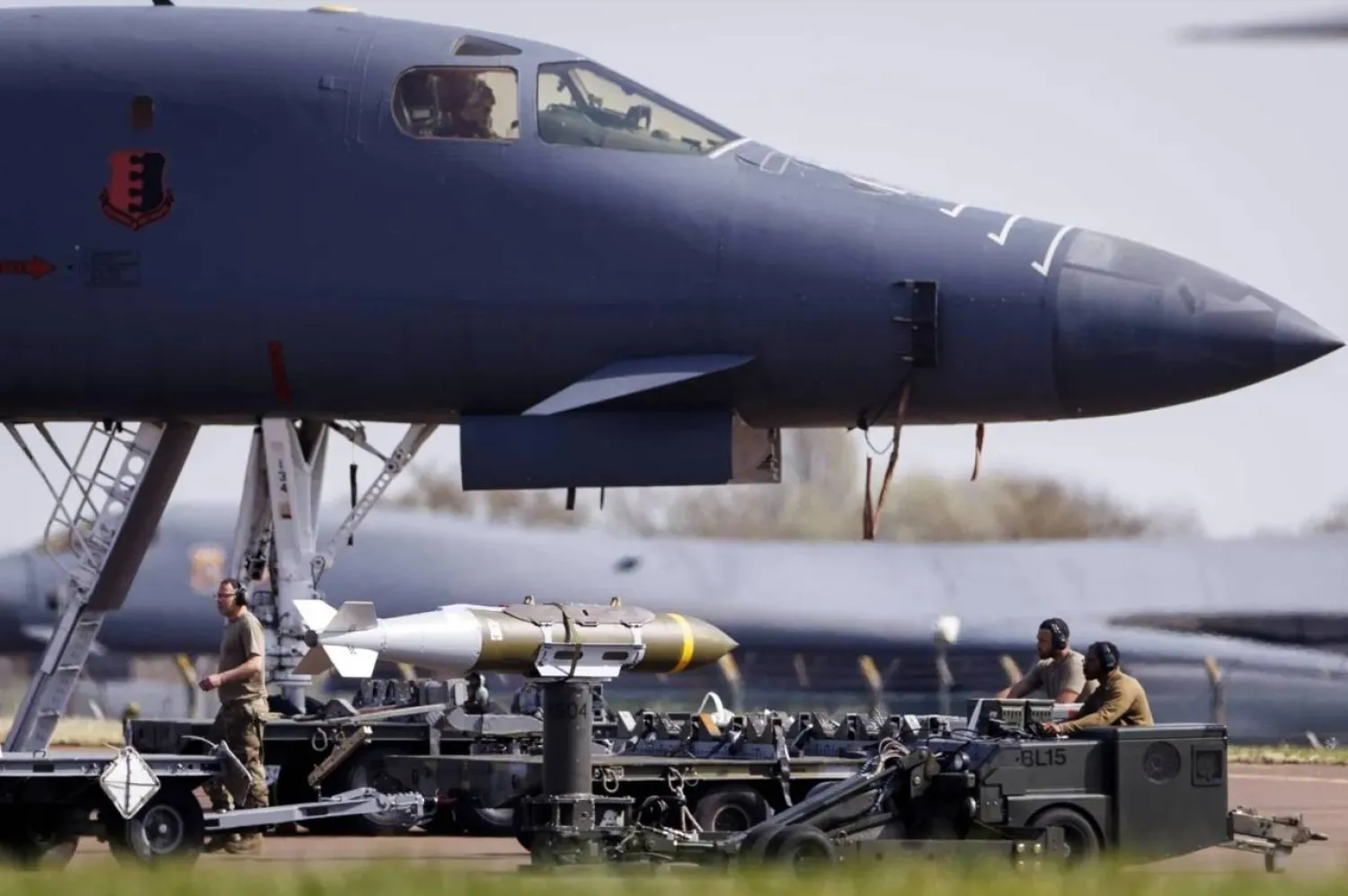
US Air Force personnel perform maintenance on bomber at UK's RAF Fairford (EPA)
TT

A 60-Day Deadline Could Pressure Trump on Ending the Iran War

US Air Force personnel perform maintenance on bomber at UK's RAF Fairford (EPA)

Washington - Robert Jimison

Over nearly eight weeks of war in Iran, Republicans in Congress have turned back repeated efforts by Democrats to halt the operation and force US President Donald Trump, who began the conflict without congressional authorization, to consult with lawmakers on the military campaign.

But some Republicans have signaled that a key statutory deadline in the coming weeks could be an inflection point when they will expect the president to either wind down the conflict or seek congressional approval to continue it.

Democrats have tried and failed several times to invoke a provision of the 1973 War Powers Resolution, a law aimed at curbing a president’s ability to wage war without congressional approval, to challenge the conflict in Iran.

The latest defeat came on Wednesday, when Senate Republicans blocked such a measure for the fifth time since the war began.

Yet the law also establishes a set of deadlines, the first of which is coming on May 1, that could increase the pressure on the Trump administration in the coming days. Here is what the law says about how long a president can continue to direct US forces in a conflict without congressional approval.

The 60-Day Mark

When the United States began joint strikes with the Israeli air force on Feb. 28, the president said he was acting under his authority as commander in chief to protect US bases in the Middle East, and to “advance vital United States national interests.”

He said the action was taken in “collective self-defense of our regional allies, including Israel.”

Many Democrats disputed that justification and have continued to argue that Trump acted illegally.

White House officials and most Republicans on Capitol Hill say he is operating within the bounds of the war powers statute, which sets a 60-day clock for a president to remove American forces from hostilities without congressional authorization to use military force.

Although the war began at the end of February, Trump formally notified Congress of the operation on March 2, starting the 60-day period that ends on May 1.

Some Republicans have already signaled they will not support any extension beyond 60 days.

Senator John Curtis, Republican of Utah, wrote in an opinion essay earlier this month that he “will not support ongoing military action beyond a 60-day window without congressional approval.”

Other Republicans, including Representative Brian Mast of Florida, who chairs the Foreign Affairs Committee, warned that the president could lose significant support if the conflict continued into May.

Moments after Republicans just barely blocked a war powers resolution in the House last week, Mast said there could be “a different vote count after 60 days,” alluding to the May 1 deadline.

A 30-Day Extension

Under the statute, once the initial 60-day deadline passes, the president’s options for continuing a military campaign without congressional approval become limited.

At that point, Trump would effectively have three choices: seek congressional authorization to continue the campaign, begin winding down US involvement or give himself an extension.

The law allows a one-time, 30-day extension of the deployment if the president certifies in writing that additional time is necessary to facilitate the safe withdrawal of US forces, but it does not grant authority to continue waging an offensive campaign.

Congress Can Authorize the War

Lawmakers also have the option at any time of granting explicit permission for Trump to continue the operation by passing an authorization for the use of military force.

Such measures have become the primary way Congress approves military campaigns short of a formal declaration of war, something that has not been done since World War II.

While Republicans have largely united in blocking Democrats’ attempts to halt the war, it is unclear whether the same unity exists when it comes to affirmatively authorizing the conflict.

Senator Lisa Murkowski, Republican of Alaska, has said she is working with a group of senators on a formal authorization for the use of military force against Iran, but has yet to introduce the resolution.

Congress has not voted in favor of using military force since 2002, when lawmakers authorized it against Iraq.

Murkowski was an early critic of the administration’s lack of transparency around the objectives, costs and timeline for the war, and said that her goal with an authorization vote would be to reassert congressional authority and require the administration to be held to firm parameters for the operation.

Why Trump Might Ignore the Deadlines

Administrations led by presidents of both parties have long argued that the Constitution gives broad authority to the commander in chief, meaning that the limits the war powers law places on the president are unconstitutional.

In 2011, President Barack Obama continued a military engagement in Libya beyond the 60-day mark, arguing that the law did not apply because “US operations do not involve sustained fighting or active exchanges of fire with hostile forces, nor do they involve US ground troops.”

Though that prompted bipartisan backlash at the time, some lawmakers anticipate that the Trump administration could make a similar argument about Iran.

During his first term, Trump similarly balked at the law in 2019 when he vetoed a bipartisan resolution both chambers had passed that sought to end American military involvement in Yemen’s civil war. He argued then that the measure was an “unnecessary, dangerous attempt to weaken my constitutional authorities.”

Still, ignoring the deadline could pose a political problem for Republicans, which so far has given the administration broad latitude to carry out the war without congressional involvement, including any formal oversight.

“Many Republicans are on record having set the 60-day mark as somehow legally important,” said Senator Chris Murphy of Connecticut, who has been among the Democrats offering resolutions aimed at limiting the president’s ability to continue the war without congressional authorization. “So I do think it will be harder for Republicans to continue to look the other way once we are out of the 60 days.”

The New York Times


Merz Floats Sanctions Relief for Iran Peace Deal, Other EU Leaders Cautious

 Germany's Chancellor Friedrich Merz speaks during a press conference after taking part in an informal meeting of the European Council in Nicosia on April 24, 2026. (AFP)
Germany's Chancellor Friedrich Merz speaks during a press conference after taking part in an informal meeting of the European Council in Nicosia on April 24, 2026. (AFP)
TT

Merz Floats Sanctions Relief for Iran Peace Deal, Other EU Leaders Cautious

 Germany's Chancellor Friedrich Merz speaks during a press conference after taking part in an informal meeting of the European Council in Nicosia on April 24, 2026. (AFP)
Germany's Chancellor Friedrich Merz speaks during a press conference after taking part in an informal meeting of the European Council in Nicosia on April 24, 2026. (AFP)

German Chancellor Friedrich Merz suggested on Friday that the European Union could ease sanctions on Tehran as part of a comprehensive deal that would end the Iran war, but other EU leaders struck a more cautious note.

The 27-nation EU has imposed sanctions on Iran for years, including travel bans and asset freezes for senior officials and entities, in response to human rights violations, nuclear activities and military support for Russia.

US officials have suggested a ‌comprehensive deal covering Iran's ‌nuclear and missile programs and the ‌re-opening ⁠of the Strait of ⁠Hormuz could bring a lasting end to the US-Israeli war with Tehran, beyond the current ceasefire.

After an EU summit in Cyprus, Merz said the bloc could gradually ease sanctions on Iran in the event that a comprehensive agreement was reached.

European leaders have been largely sidelined in the current Middle ⁠East conflict but some European officials see ‌the bloc's sanctions as a possible ‌way for the EU to be involved in a diplomatic solution.

"The ‌easing of sanctions can be part of a process," ‌Merz told reporters after the Nicosia summit.

"No one has objected to that," he said of the summit deliberations. "It is, so to speak, part of the contribution we can make to advance this ‌process and, hopefully, lead to a permanent ceasefire."

But European Council President Antonio Costa, the chair ⁠of the summit, ⁠told a press conference after the end of the meeting: "It is too early to talk about relieving any kind of sanctions."

European Commission President Ursula von der Leyen said sanctions relief could only come after clear evidence of fundamental changes of course from Iran.

"We believe that sanctions relief should be conditional on verification of de-escalation, particularly on progress on the international effort to contain its nuclear threat, and on a change to the repression of its own people," she told the same press conference.


German Court Jails Hezbollah Supporter Over Videos Showing Weapons

Coffins sit on a trailer beneath portraits of Hezbollah fighters killed before a 10-day ceasefire was agreed between the Iran-backed militant group and Israel during a mass funeral procession in the southern village of Kfar Sir on April 21, 2026. (AFP)
TT

German Court Jails Hezbollah Supporter Over Videos Showing Weapons

Coffins sit on a trailer beneath portraits of Hezbollah fighters killed before a 10-day ceasefire was agreed between the Iran-backed militant group and Israel during a mass funeral procession in the southern village of Kfar Sir on April 21, 2026. (AFP)

A German court on Friday sentenced a supporter of Lebanon's Hezbollah party to more than three years in jail Friday over for "illegal access to weapons" and social media posts supporting the group.

Earlier in the same trial the 30-year-old was acquitted on charges of actually fighting for Hezbollah and being a member of the group.

The court in Berlin gave him a sentence of three years and nine months over social media posts he made with videos taken during a trip to Lebanon in 2023.

In the videos he was seen handling rifles and anti-tank missiles and taking part in shooting practice.

The court found he also spread propaganda videos and displayed Hezbollah symbols, such as flags and scarves.

However, the court said that the videos in question showed that the accused had had no training in dealing with the weapons and that he had acted in a "partly amateurish" fashion.

His earlier claims to have fought with the group were made up in order to impress his friends, the court found.

Hezbollah's military wing is classed as a terrorist organization by the United States, the European Union and Britain.

Germany considers Hezbollah a "Shiite terrorist organization" and in 2020 banned Hezbollah from carrying out activities on its soil.


Key Go-Between Switzerland to Reopen Embassy in Iran

 Milad telecommunication tower is seen at left in a general view of a part of Tehran, Iran, Thursday, April 23, 2026. (AP)
Milad telecommunication tower is seen at left in a general view of a part of Tehran, Iran, Thursday, April 23, 2026. (AP)
TT

Key Go-Between Switzerland to Reopen Embassy in Iran

 Milad telecommunication tower is seen at left in a general view of a part of Tehran, Iran, Thursday, April 23, 2026. (AP)
Milad telecommunication tower is seen at left in a general view of a part of Tehran, Iran, Thursday, April 23, 2026. (AP)

Switzerland said Friday it had begun sending staff back to Tehran and would gradually reopen its embassy, enabling it to continue as a facilitator for diplomatic contacts between Washington and Tehran.

For decades, neutral Switzerland has played a central role in maintaining basic diplomatic contacts between Iran and the United States.

But the country temporarily closed its embassy on March 11 days after the Middle East war erupted with the first US-Israeli attacks on Iran.

The Swiss foreign ministry said four staff had returned and insisted the channel of communication between the US and Iran had been kept open even while the mission was shut.

"The decision to gradually reopen the embassy was taken after a risk analysis and in consultation with Iran and the United States, whose interests Switzerland represents under its protecting power mandate," the foreign ministry said in a statement.

Switzerland "is prepared to provide its good offices if the parties so wish and supports all diplomatic initiatives that contribute to de-escalation and a lasting peace".

Switzerland has represented US interests in Iran since Washington broke off relations with Middle Eastern country after the 1980 hostage crisis, which came a year after the Iranian revolution.

The Swiss embassy in Tehran handles all consular affairs between the United States and Iran, including passport requests, altering civil status and consular protection for US citizens in Iran.

Under the protecting power mandate, "Switzerland can either offer to act as a go-between on its own initiative or can fulfil this function at the request of the parties concerned, provided that all those involved agree", the foreign ministry says on its website.

A ceasefire has been in place since April 8 but prospective peace talks between senior US and Iranian envoys Pakistan are hanging in the balance.

Iran has all but closed the Strait of Hormuz in retaliation for the war, while the US has imposed a blockade of its own on Iranian ports.
