

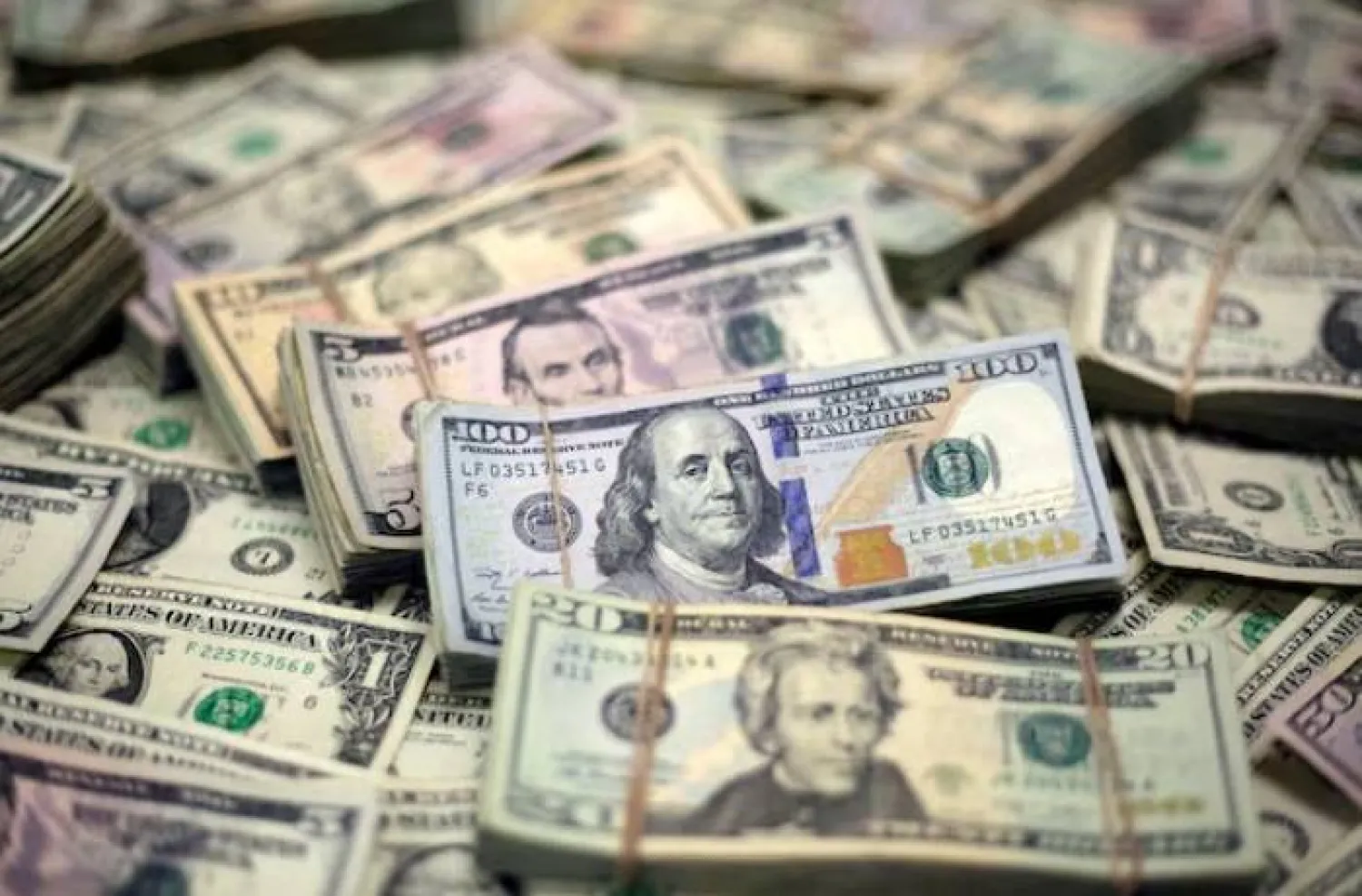

Dollar Set for Weekly Gain on Stalled US-Iran Talks and Middle East Uncertainty

US dollar banknotes (Reuters)
TT

Dollar Set for Weekly Gain on Stalled US-Iran Talks and Middle East Uncertainty

US dollar banknotes (Reuters)

The dollar was on track for its first weekly gain in three weeks on Friday in broadly muted trading, as stalled peace negotiations between the US and Iran dampened hopes for an immediate easing of Middle East tensions.

While Lebanon and Israel extended their ceasefire for three weeks ahead of its expiration on Sunday, Iran showed off its control over the Strait of Hormuz by releasing footage of its commandos storming a huge cargo ship, leaving the timing of the reopening of the world's most important shipping corridor uncertain and keeping oil prices elevated.

The dollar index, which measures the greenback against a basket of currencies including the yen and the euro, slipped 0.1% to 98.75 but remained on track for a weekly gain of 0.5%. The euro was 0.1% higher at $1.169, Reuters reported.

Sterling edged 0.1% higher, with stronger-than-expected UK retail sales for March barely moving the needle.

"If you look at the last week the major theme is just that there's no real progression with peace talks. For markets, it's difficult when there's no deadline," said Tommy Von Brömsen, FX strategist at Handelsbanken in Stockholm.

Brent crude futures rose 1.5% to $106.60 a barrel.

The dollar has drawn safe-haven demand amid the uncertainty. It gained ground in March as concerns over the conflict deepened, but gave back some of those gains this month as optimism over a potential resolution grew.

"Oil and the dollar are still moving pretty closely together, and with crude creeping back up ... I'd say the dollar is still staying fairly firm," said Sho Suzuki, a market analyst at Matsui Securities.

Meanwhile, the yen was steady after four days of losses, rising 0.1% to 159.7 per dollar.

CENBANK BONANZA LOOMS

Traders are looking ahead to a central-bank-heavy week next week, with the Bank of Japan, European Central Bank, Bank of England and Federal Reserve among those due to deliver policy decisions.

"The main message from the central banks is that they are - so far at least - in a kind of 'wait-and-see' approach," said Handelsbanken's Von Bromsen.

He said the focus will be on communication and guidance, as market watchers assess how policymakers are digesting not just higher energy prices but the second-round effects of potentially higher inflation.

The European Central Bank will hold its deposit rate on April 30 but hike it in June, according to just over half of economists polled by Reuters, in a bid to protect a war-induced energy shock from knocking the euro zone economy off balance.

Meanwhile in Japan core consumer inflation slowed below the central bank's 2% target for a second straight month in March. Analysts, though, expect inflation to accelerate back above the Bank of Japan's target in coming months, as companies begin to pass on higher fuel costs from the Middle East conflict.

The BOJ is set to hold its two-day policy meeting ending on Tuesday. Reuters reported the bank is likely to hold off raising interest rates next week as fading prospects of a near-term end to the Middle East war keep the country's economic and price outlook highly uncertain. The BOJ is still expected to signal its readiness to hike to counter mounting price pressures.

Japanese Finance Minister Satsuki Katayama reiterated her verbal warning on intervention on Friday that authorities can take "decisive" action against speculative moves in the foreign exchange market, a day after saying Japan has a "free hand" to intervene and that past interventions had been effective.

The Australian dollar rose 0.1% versus the greenback to $0.7135. New Zealand's kiwi rose 0.1% to $0.5859.

In cryptocurrencies, bitcoin was little changed at $77,895.85.


Oil Falls, Asian Stocks Climb on Hopes of US-Iran Hormuz Deal

The crude oil tanker Idemitsu Maru, owned by a subsidiary of Idemitsu Kosan, sails through Ise Bay near Chita City in Aichi Prefecture on May 25, 2026, after becoming the first crude tanker bound for Japan to transit the Strait of Hormuz since the Iran conflict began. (Photo by JIJI Press / AFP) / Japan OUT
TT

Oil Falls, Asian Stocks Climb on Hopes of US-Iran Hormuz Deal

The crude oil tanker Idemitsu Maru, owned by a subsidiary of Idemitsu Kosan, sails through Ise Bay near Chita City in Aichi Prefecture on May 25, 2026, after becoming the first crude tanker bound for Japan to transit the Strait of Hormuz since the Iran conflict began. (Photo by JIJI Press / AFP) / Japan OUT

Oil prices fell and Asian stocks climbed on Monday over hopes a deal between the United States and Iran to open the Strait of Hormuz could be brokered.

The price of North Sea Brent crude and West Texas Intermediate slipped close to five percent to $99.41 and $92.49 a barrel respectively, said AFP.

The United States and Iran appear closer than ever to a deal that would end the war that has ravaged the Middle East since late February, sending energy prices soaring and stoking global inflation.

But sticking points in their negotiations have tempered hopes of a swift resolution to restore the transit of oil and gas through the Strait of Hormuz.

US President Donald Trump said on Sunday he had informed US negotiators "not to rush into a deal".

"The negotiations are proceeding in an orderly and constructive manner, and I have informed my representatives not to rush into a deal in that time is on our side," a post to Trump's official Truth Social account said.

Iran's Tasnim news agency said based on their information key clauses of a possible agreement remained unresolved.

One of the main sticking points has been whether Tehran is willing to hand over its stockpile of highly enriched uranium.

The release of Iran's frozen assets held under longstanding US sanctions and whether Lebanon, repeatedly targeted by Israeli strikes, will be included in any peace deal are also key issues.

Markets across Asia climbed in early trade on hopes Washington and Tehran will be able to overcome these hurdles.

Tokyo soared more than three percent in early trade on Monday, while Hong Kong and Seoul were closed for public holidays.

Shanghai inched upwards, with Taipei, Manila, Bangkok, Jakarta, Singapore, Sydney and Wellington also climbing.

Kuala Lumpur was down 0.1 percent.

"The weekend news flow has once again focused on the prospects for a negotiated deal between the US and Iran," said Chris Weston, head of research at Pepperstone.

"According to reports from Donald Trump, a memorandum of understanding has been 'largely negotiated', with details to be announced at some stage soon, although there appears to be limited urgency," Weston said.

Investors will also be keeping an eye on how the US Federal Reserve and its new chief Chair Kevin Warsh react to Personal Consumption Expenditures (PCE) data this week, as well as European inflation metrics.

"The inflation story remains central to the entire setup," said SPI Asset Management analyst Stephen Innes.

"Investors will receive another critical read on Thursday with the release of the Personal Consumption Expenditures index, the Federal Reserve's preferred inflation gauge.

"After several hotter-than-expected consumer and producer inflation reports earlier this month, markets are increasingly concerned that elevated oil prices and supply disruptions tied to the Middle East conflict are beginning to seep into the broader inflation pipeline."

The conflict erupted after the United States and Israel attacked Iran on February 28, and Iran responded with missile and drone attacks across the region.

The United States and Iran have observed a ceasefire since April 8 while mediators push for a negotiated settlement, although Tehran has imposed controls on Gulf shipping and Washington has blockaded Iran's ports.


Morocco’s Royal Air Maroc Scales Back Flights Due to Fuel Costs

 People board a Royal Air Maroc flight on July 15, 2020 at Bordeaux airport. (AFP)
People board a Royal Air Maroc flight on July 15, 2020 at Bordeaux airport. (AFP)
TT

Morocco’s Royal Air Maroc Scales Back Flights Due to Fuel Costs

 People board a Royal Air Maroc flight on July 15, 2020 at Bordeaux airport. (AFP)
People board a Royal Air Maroc flight on July 15, 2020 at Bordeaux airport. (AFP)

Morocco's state-owned carrier Royal Air Maroc (RAM) said on Saturday it would temporarily suspend several routes to African and European destinations due to ‌rising jet ‌fuel prices, ‌elevated ⁠operating costs and ⁠weak demand.

Tensions in the Middle East have driven a surge in global jet fuel ⁠prices, putting ‌pressure ‌on carriers and ‌prompting temporary route suspensions.

RAM ‌will pause flights linking Moroccan airports with several African cities ‌of Bangui, Brazzaville, Kinshasa, Douala, Yaounde and ⁠Libreville, ⁠the airline said in a statement.

It will also halt flights to the European destinations of Malaga, Barcelona, Lyon, Bordeaux, Marseille and Brussels.


Official: Iraq Has Not Yet Applied for an IMF Loan

A floating oil export platform in Basra port, Iraq (Reuters)
TT

Official: Iraq Has Not Yet Applied for an IMF Loan

A floating oil export platform in Basra port, Iraq (Reuters)

Financial Advisor to the Iraqi Prime Minister Mazhar Mohammed Saleh revealed on Saturday that Iraq has not yet submitted a formal request for a loan from the International Monetary Fund (IMF).

The Iraqi News Agency quoted Saleh as saying that “Iraq enjoys close relations with the IMF, and since 2003, it has concluded more than five agreements, three of which were Stand-by Arrangements, while the other agreements related to emergency support.”

Iran's war has caused significant disruptions in supply chains, especially in the energy sector, which was severely affected by a near-complete closure of the Strait of Hormuz, through which about 20 percent of global oil supplies pass.

Saleh stated that “the Fund has played a significant role in supporting the Iraqi economy over the past 23 years, especially since Iraq is now considered one of the biggest victims of the ongoing war in the region, considering that 85 percent of its oil exports pass through the Strait of Hormuz. This has caused significant harm and international concern, given that Iraq is an important and active member in the stability of the region and world markets.”

He pointed out that there is an Iraqi government team in contact with the IMF, meeting with Fund officials for consultations twice a year.

He clarified that “Iraq signed an agreement with the IMF on July 7, 2016, for a Stand-by Arrangement by providing a significant loan, which played a major role in supporting the general budget,” noting that “signing an agreement with the Fund is a matter decided by the Iraqi government, and this does not prevent consultations between the two parties, as Iraq is a member of this institution responsible for global stability.”

Saleh mentioned that “Iraq will borrow from the International Monetary Fund if the need arises, but there is no formal request from the government yet, and the current need is for the war in the region to stop, and for its geopolitical impacts on oil exports to cease.”

He added that “technical assistance from the IMF is available now, unlike the issue of financing, which requires the approval of a program by the Iraqi government.”

He explained that “the loan itself represents a reform program to support the budget or to achieve social goals, such as supporting the health and education sectors, because it is a human investment that must be subject to conditions defining expenditure directions and commitment to a reform program agreed upon by the Iraqi state and the IMF.”
