


Low Turnout as Palestinians Vote in First Elections Since Gaza War

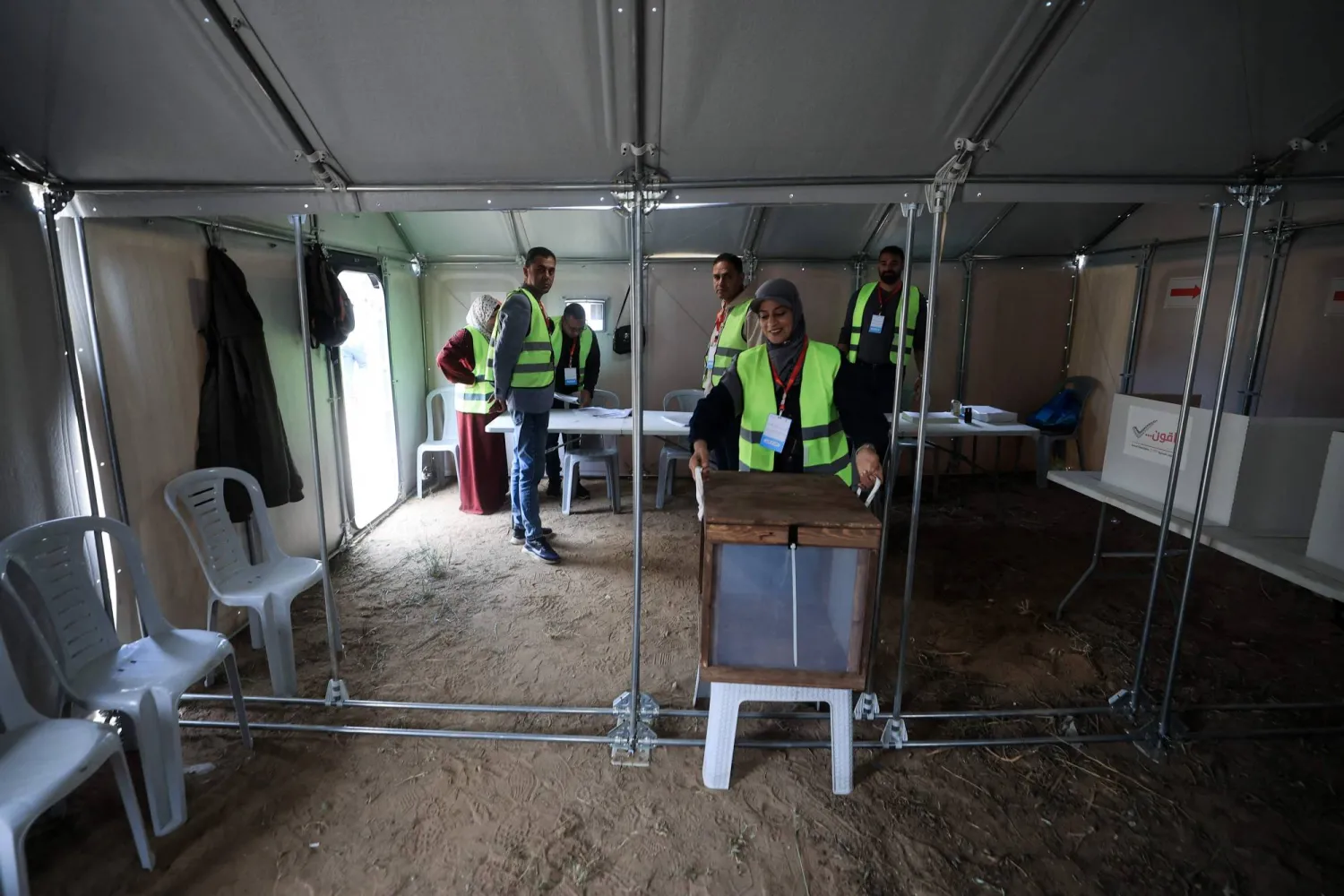
Palestinian electoral officials set up a polling station in a tent for municipal elections in Deir al-Balah, Gaza Strip, on April 25, 2026. (AFP)
TT

Low Turnout as Palestinians Vote in First Elections Since Gaza War

Palestinian electoral officials set up a polling station in a tent for municipal elections in Deir al-Balah, Gaza Strip, on April 25, 2026. (AFP)

Palestinians in the West Bank and central Gaza voted on Saturday in municipal elections, the first since the Gaza war erupted, marked by low turnout and a narrow slate of contenders. 

Nearly 1.5 million people were registered to vote in the Israeli-occupied West Bank, as well as 70,000 people in Gaza's Deir al-Balah area, according to the Ramallah-based Central Elections Commission (CEC). 

"We are very pleased to exercise democracy in spite of the many challenges we face, both locally and internationally," Palestinian president Mahmud Abbas told journalists after voting in Al-Bireh, Wafa news agency said. 

Early Saturday, a steady trickle of voters headed to polling stations in the West Bank, as foreign diplomats observed the process. 

By 5 pm (1400 GMT), turnout in the West Bank reached 40.62 percent, the CEC said. 

But participation in Deir al-Balah was significantly lower, at just 21.2 percent, by the time polls closed there at 6 pm. 

In the previous municipal elections in March 2022, turnout was 53.7 percent in West Bank cities. 

Voting in the West Bank ended at 7 pm, with a notable late surge of women voters in Jericho, an AFP journalist said. 

"We will elect someone who can improve the local community ... things like water and repairing the streets," said Manar Salman, an English teacher in the city. 

"We don't receive much support from outside, and the occupation affects us in many ways... it limits what the municipality can do." 

Some questioned the election's timing. 

"We didn't want elections at this time -- not with war in Gaza and settler attacks ongoing in the West Bank," said Ziad Hassan, a businessman from Dura Al-Qaraa village. 

"The decision was imposed on us, and so we are compelled to elect an administrative body for the village council." 

Israeli settler attacks have surged in recent months, and become a major concern. 

"The main thing is security from settlers. That's why we need new faces, young people willing to fight for our rights," said Abed Jabaieh, 68, former mayor of Ramun village. 

Most electoral lists were aligned with Abbas's secular-nationalist Fatah movement or composed of independents. 
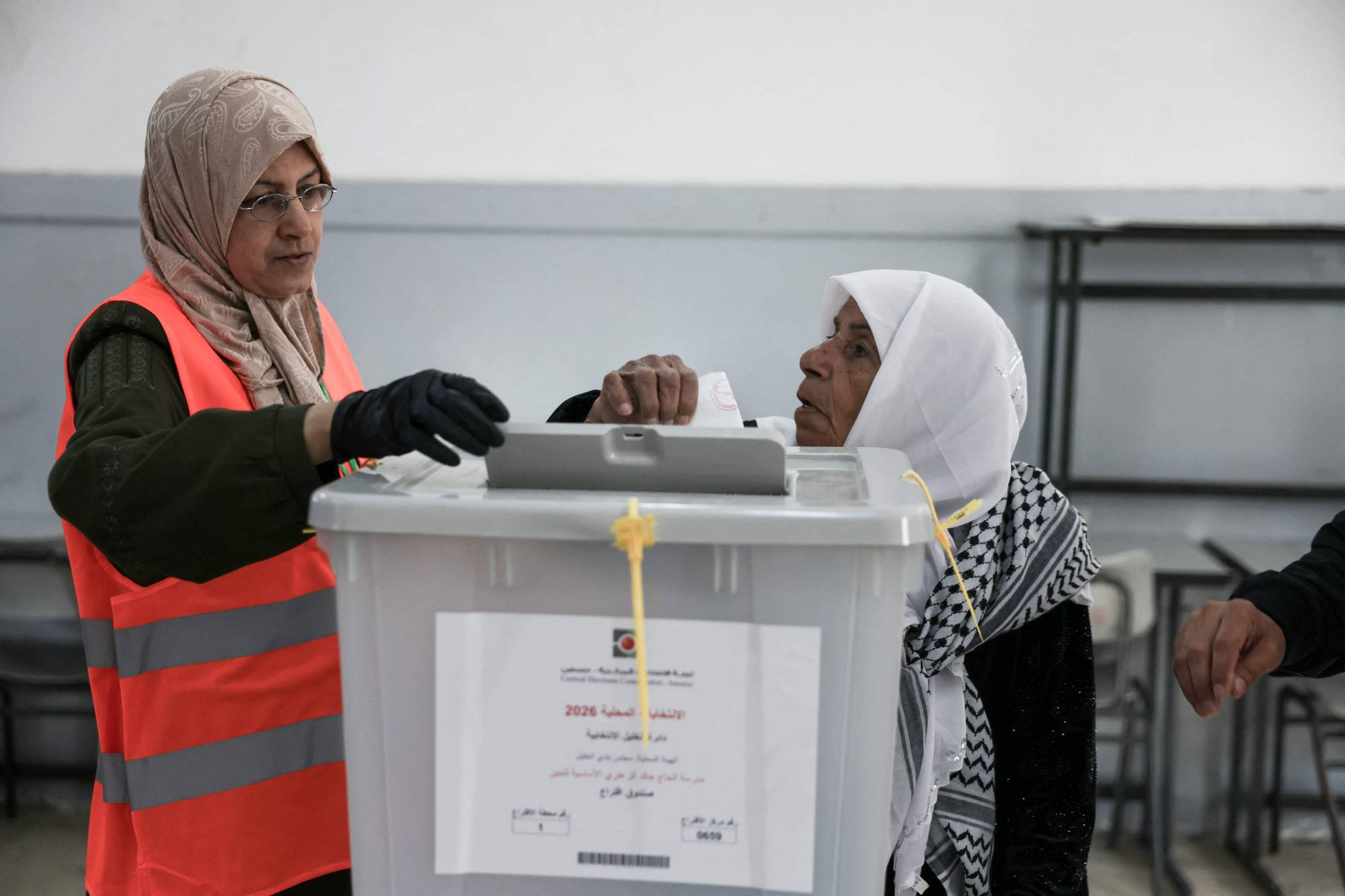
A Palestinian woman casts her ballot in a polling station during municipal elections in the Israeli-occupied West Bank city of Hebron on April 25, 2026. (AFP)

- EU hails vote - 

Hamas, Fatah's bitter rival and the ruling power in Gaza, was absent from the race. 

In many municipalities, Fatah-backed lists faced off against independents supported by smaller factions such as the Marxist-Leninist Popular Front for the Liberation of Palestine. 

Municipal councils oversee water, sanitation, and local infrastructure but do not enact legislation. 

Still, with presidential or legislative elections frozen since 2006, councils have become one of the last remaining democratic mechanisms under the Palestinian Authority. 

The PA faces widespread criticism over corruption, stagnation and declining legitimacy. 

Western and regional donors have increasingly tied financial and diplomatic support for the PA to reform, particularly in local governance. 

The European Union called the vote an "important step towards broader democratization and strengthened local governance ... in line with the ongoing reforms process". 
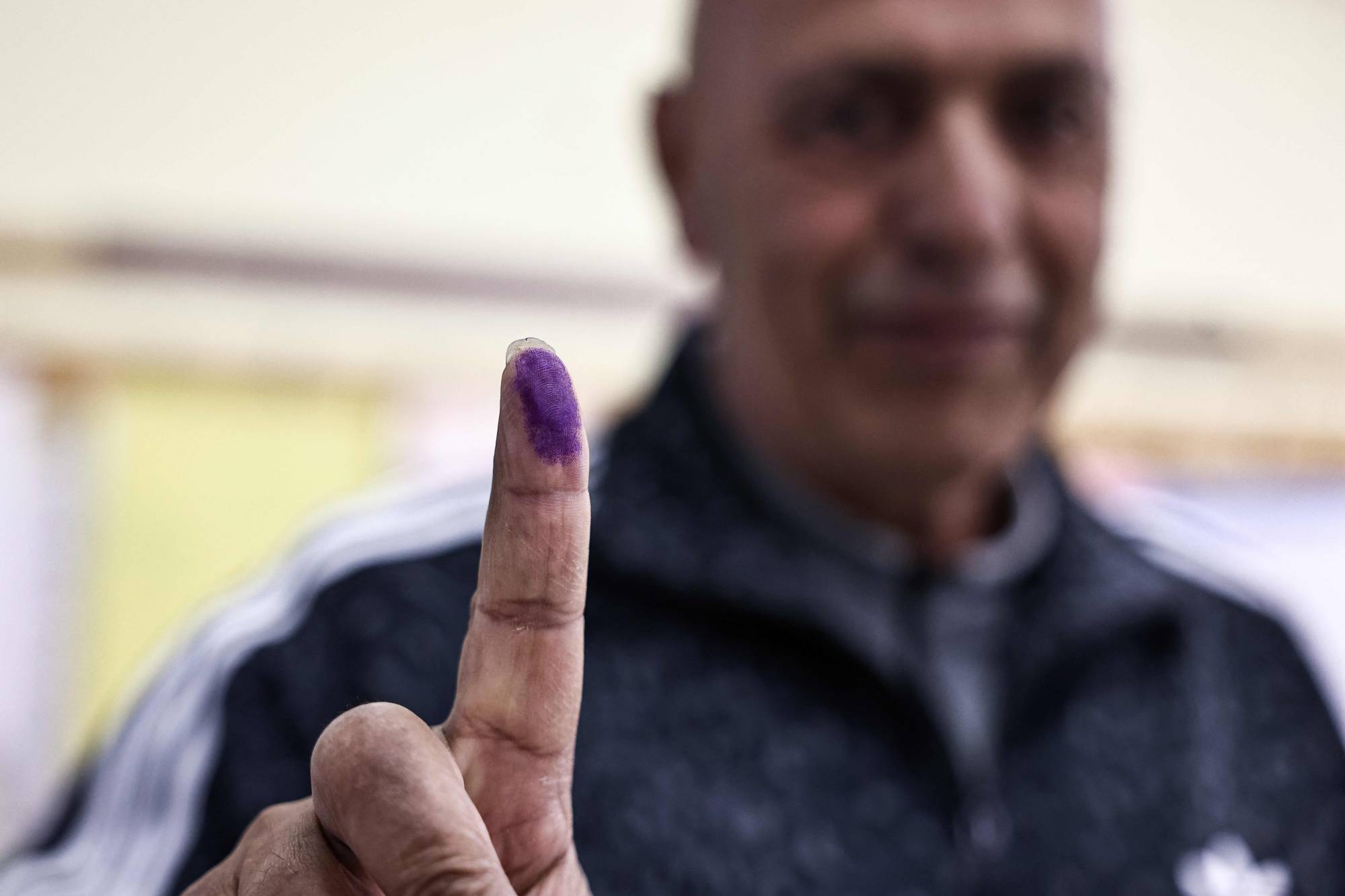
A Palestinian man shows his marked finger after casting his ballot at a polling station during municipal elections in the Israeli-occupied West Bank city of Al-Bireh on April 25, 2026. (AFP)

- 'Strong determination' - 

The polls closed earlier in Deir al-Balah to allow for counting in daylight because of the lack of electricity in the war-devastated strip, the CEC told AFP. 

Two years of war have left swathes of Gaza destroyed and more than 72,000 people dead, according to the territory's health ministry, whose figures are considered reliable by the UN. 

Public infrastructure, sanitation and health services in Gaza are all struggling to function. 

Under Hamas control since 2007, Gaza experienced its first vote since the 2006 legislative elections that the movement won. 

The PA is holding elections only in Deir al-Balah to test its "success or failure, since there are no post-war opinion polls", said Jamal al-Fadi, a political scientist at Cairo's Al-Azhar University. 

It was chosen as one of the few areas where the population has not been massively displaced. 

After voting there, Mohammed al-Hasayna, 24, said although the elections were largely symbolic, they served as a sign of people's "will to live". 

"We are an educated people with strong determination, and we deserve to have our own state," he told AFP. 

"We want the world to help us overcome the catastrophe of war. Enough wars -- it is time to work towards rebuilding Gaza." 



War Fears Cloud Iraq’s Drive to Bring Arms Under State Control

Members of Asaib Ahl al-Haq take part in a Quds Day march in Baghdad on July 1, 2016. (AP)
TT

War Fears Cloud Iraq’s Drive to Bring Arms Under State Control

Members of Asaib Ahl al-Haq take part in a Quds Day march in Baghdad on July 1, 2016. (AP)

The issue of weapons outside state control has returned to the center of Iraq’s political and security scene after Akram al-Kaabi, secretary-general of Harakat Hezbollah al-Nujaba, rejected any understandings with what he called “international forces backing Israel” and reaffirmed his movement’s commitment to “force and weapons.”

His comments came as the Iraqi government presses on with efforts to confine arms to the state, despite complex political and military challenges.

Kaabi’s remarks were made in a statement issued on Tuesday after recent regional developments and the military escalation between Iran and Israel.

He praised Iran’s missile strike against Israel earlier this week, calling it “discipline for the Zionist entity,” and commended Yemen’s Houthis for also firing at Israel, saying they delivered “a surprise slap to the enemy.”

Nujaba is an Iran-aligned Iraqi armed faction and one of the main pillars of an alliance of factions calling itself the Islamic Resistance in Iraq, which became directly involved in regional escalation after Hamas’ Oct. 7, 2023, attack on Israel.

Iraqi sources had said the government contacted leaders of armed factions to prevent them from joining the latest escalation, drawing on support from several factions for its plan to confine weapons to the state.

Kaabi said his movement was warning “anyone who imagines that Iraq can reach understandings with the supporters of” Israel and the United States.

“The logic of force and weapons” was the only option in dealing with them and that the movement “will never deviate from it,” he vowed.

The remarks come as debate grows in Iraq over the future of armed factions and whether all armed formations can be brought under state authority, now one of the most main issues tackled by Prime Minister Ali al-Zaidi's government.

The government has repeatedly said it is committed to the rule of law and to confining weapons to official institutions.

Influential cleric Moqtada al-Sadr announced on May 27 the integration of his military wing, Saraya al-Salam, into the state and called on the Popular Mobilization Forces factions to hand over their weapons. Asaib Ahl al-Haq and Kataib al-Imam Ali later also announced their separation from the PMF.

Split over mechanism

Figures close to armed factions rejected proposals to hand over weapons, saying they were driven by external pressure.

Abdul al-Rahman al-Jazairi, a leader in the PMF, said in remarks carried by local media that “the decision to confine weapons is not an individual decision,” calling for legislative authority to have a say over the “fateful” matter.

The remarks reflect the split over how to handle the armed factions file, which has grown more complicated after years in which armed groups expanded their influence, built military arsenals and secured independent funding sources.

Shakhawan Abdullah, head of the Kurdistan Democratic Party bloc, cited further obstacles to any disarmament plan, saying some weapons held by factions are not directly under their control.

He said one problem was that some factions “may decide to hand over their weapons, but the weapons originally belong to a regional state that considers them its property.” He added that those states may refuse to surrender such weapons, including drones.

Abdullah said some groups could transfer weapons to other formations rather than hand them over to the state. He said about 30% of armed groups fall under the PMF, while the rest are outside its framework.

Observers say the weapons file is not only a security issue. It also intersects with the economic and political interests of armed factions that have built networks of influence and their own financial institutions in recent years, making disarmament more complicated than legislation or government decisions.

Analysts say weapons for many factions are not only a military tool, but also a guarantee of political influence and a source of economic protection. That makes any response to calls for surrendering them limited unless they are paired with broader political and security arrangements.


Jordan Military Says Shot Down 5 Missiles from Iran

 A drone view shows military engineering teams working at the site where an Iranian missile, according to local authorities, fell in the countryside near Damascus, Syria, June 9, 2026. (Reuters)
A drone view shows military engineering teams working at the site where an Iranian missile, according to local authorities, fell in the countryside near Damascus, Syria, June 9, 2026. (Reuters)
TT

Jordan Military Says Shot Down 5 Missiles from Iran

 A drone view shows military engineering teams working at the site where an Iranian missile, according to local authorities, fell in the countryside near Damascus, Syria, June 9, 2026. (Reuters)
A drone view shows military engineering teams working at the site where an Iranian missile, according to local authorities, fell in the countryside near Damascus, Syria, June 9, 2026. (Reuters)

The Jordanian military said on Wednesday it shot down five missiles launched from Iran, as Tehran and Washington engaged in tit-for-tat strikes after the downing of a US helicopter.

"We intercepted and shot down five missiles launched from Iran towards Azraq. The interception resulted in debris falling, but there were no casualties or material damage," the Jordanian Armed Forces said in a statement.

The United States launched airstrikes early Wednesday against Iran after blaming Tehran for the crash of an American attack helicopter. Iran responded with attacks targeting Bahrain, Kuwait and Jordan, part of a widening round of retaliatory strikes that threaten to derail talks to reach an end to the Iran war.

Since the US and Israel began striking Iran on Feb. 28, the war has shaken the global economy, driven up energy prices around the world and made many basics, including food, more expensive.

Officials have been unable to turn the April ceasefire into a deal to permanently end the conflict, particularly as Israel intensifies and expands its military campaign in Lebanon against the Iranian-backed Hezbollah group.

The downing of the Apache attack helicopter and the strikes by the US military further strained the ceasefire a day after Iran and Israel exchanged fire for the first time since the fragile truce took effect.

Iranian state television said Tuesday that the Israeli attacks killed at least two members of the country’s air-defense units.


Eight Killed in Israeli Strike on Lebanon’s Tyre

Smoke rises following an Israeli airstrike in the southern city of Tyre on June 9, 2026. (AFP)
TT

Eight Killed in Israeli Strike on Lebanon’s Tyre

Smoke rises following an Israeli airstrike in the southern city of Tyre on June 9, 2026. (AFP)

Israel struck the historic port city of Tyre in southern Lebanon on Tuesday, killing at least eight people, in an escalation that adds strain to efforts to broker a peace deal to end the wider Middle East war.

On Monday, Israel and Iran halted direct attacks on each other after an appeal by US President Donald Trump, but Tehran warned it would resume hostilities if Israel continued to attack its ally Hezbollah in Lebanon.

The raids were the deadliest on Tyre since fighting erupted in Lebanon in early March, when Hezbollah launched rockets at Israel in support of Tehran after Israel and the United States began their war against Iran.

Israel had issued an evacuation order for the city earlier on Tuesday.

Residents fled and civil defense teams transported elderly residents into temporary shelters, state media reported.

The eight victims were killed in a ‌single strike on ‌the city's eastern edge, Lebanon's health ministry said.

A video verified by Reuters showed debris strewn ‌across ⁠a road at the ⁠site of the attack.

Israel's refusal to end its campaign in Lebanon, as Iran demands, has hindered Trump's efforts to extend a tenuous ceasefire in the wider US-Israeli war with Iran into a durable settlement.

US and Israeli officials said Trump and Israeli Prime Minister Benjamin Netanyahu had spoken on Monday.

In an interview with Axios, Trump said he had warned the Israeli leader not to return to war with Iran: "I said, 'Bibi, you better be careful, or you will be on your own very soon.'"

Tehran has long said any peace deal with the US depends in part on an end to fighting in Lebanon, which Israel invaded in March in pursuit of Hezbollah fighters who had fired across the border.

In northern Israel on Tuesday, Israeli troops operating in the Ramim Ridge area close to Lebanon's border killed one person in an incident in which they returned fire, the military said.

Israel has never halted its Lebanon campaign, which has killed thousands of people, saying the conflict should be treated separately from any US-Iranian ceasefire. Hezbollah has also continued its attacks.