UN: Drone Attack Hits Sudan Aid Truck

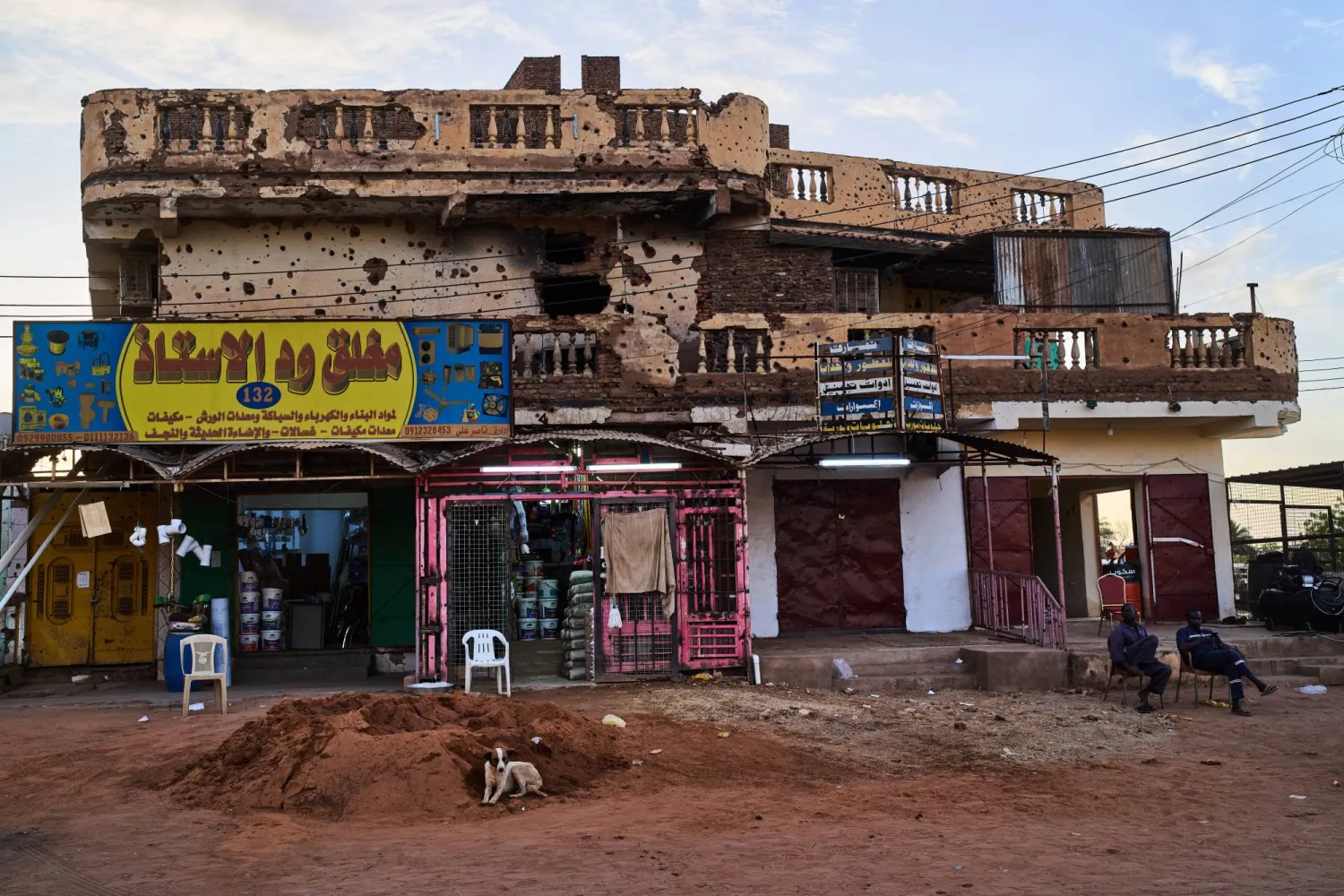
Shops operate beneath a war-damaged building in Omdurman, on the outskirts of Khartoum, Sudan, Thursday, April 23, 2026. (AP Photo/Bernat Armangue)
TT

UN: Drone Attack Hits Sudan Aid Truck

Shops operate beneath a war-damaged building in Omdurman, on the outskirts of Khartoum, Sudan, Thursday, April 23, 2026. (AP Photo/Bernat Armangue)

A drone attack hit an aid truck in Sudan's North Darfur state, destroying all the supplies on board, the UN refugee agency said on Sunday, without identifying who was responsible.

Drone strikes by both the Sudanese army and the Rapid Support Forces (RSF), who have been locked in a brutal war since April 2023, have escalated in recent months, often killing dozens at a time.

The UNHCR-operated vehicle "came under drone attack" on Friday while transporting emergency shelter kits to Tawila, home to more than 700,000 displaced people who fled fighting elsewhere in the western Darfur region, AFP quoted the agency as saying.

The driver escaped unhurt, but all supplies were destroyed in the resulting fire, it added.

UNHCR condemned the attack, warning that it would "leave 1,314 families living in desperate conditions in Tawila without shelter" at a time when humanitarian needs are already overwhelming.

More than 127,000 people fled El-Fasher, North Darfur's capital and the army's last stronghold in the region, after it fell to paramilitary forces in October, with reports of mass killings, sexual violence, looting and rape following the takeover.

Fighting has since spread to neighboring Kordofan, now the main theatre of the war, and the southeastern Blue Nile state, raising fears of a longer and increasingly fragmented conflict.

According to the UN, nearly 700 civilians have been killed in drone strikes by both sides since January alone.

UNHCR voiced "deep concern" over the rising use of drones, calling repeated attacks on humanitarian operations "particularly abhorrent".

According to an assessment by the UN's Food and Agriculture Organization, 28.9 million people, around 62 percent of Sudan's population, are facing acute food insecurity.

That includes 10.2 million who face severe food insecurity, in particular in the wider Darfur region and South Kordofan state.

Famine was declared last year in El-Fasher and Kadugli, the capital of South Kordofan, with 20 other areas at risk in Darfur and Kordofan, a UN-backed assessment found.

The conflict has already killed tens of thousands, uprooted over 11 million and created the world's largest displacement and hunger crises.


Iraq Arrests Politicians and Government Officials in Greed Zone Raids

A circulating image shows Iraqi Humvees at an entrance to the Green Zone at dawn Sunday
TT

Iraq Arrests Politicians and Government Officials in Greed Zone Raids

A circulating image shows Iraqi Humvees at an entrance to the Green Zone at dawn Sunday

Iraqi security forces arrested politicians, lawmakers and senior government officials early on Sunday after Elite Counter Terrorism Service (CTS) units raided their homes inside Baghdad's heavily fortified Green Zone, security sources told Asharq Al-Awsat.

A senior source quoted by ⁠state news ⁠agency INA said that some of the latest arrests were based on testimony provided by Adnan al-Jumaili, deputy oil minister for refining affairs, after his detention on corruption charges.

The source told INA that al-Jumaili's statements implicated a wider network of officials in alleged corruption schemes.

Iraqi security personnel are seen near a house in the Green Zone at dawn Sunday (X)

Sunday's operation was launched on direct orders from Prime Minister Ali al-Zaidi, a government official told Asharq Al-Awsat.

An Iraqi official said earlier that an official statement will be made about the ⁠arrests.


Iraq’s PM Sends Positive Signals Ahead of Trump Meeting

Iraqi Prime Minister Ali Al-Zaidi during his meeting with Iranian Ambassador Mohammad Kazem Al-Sadeq in Baghdad (Government media)
TT

Iraq’s PM Sends Positive Signals Ahead of Trump Meeting

Iraqi Prime Minister Ali Al-Zaidi during his meeting with Iranian Ambassador Mohammad Kazem Al-Sadeq in Baghdad (Government media)

Iraqi Prime Minister Ali al-Zaidi has been sending positive signals to Washington ahead of a planned mid-July visit, as analysts say his government is trying to reorganize ties with the United States based on an economic and security partnership while preserving relations with Iran.

US Secretary of State Marco Rubio said Washington had recently received good and constructive signals from the Iraqi government on armed factions, in a reference to efforts to place weapons under state control and disarm armed groups.

In his latest remarks carried by state media, al-Zaidi urged armed factions to “preserve their history after contributing to the fight against terrorism, and to work through the state,” renewing his government’s rejection of “weapons outside official institutions.”

Al-Zaidi said his government sought a “strong economic partnership” with the US, while stressing that Baghdad’s ties with Tehran were “based on good neighborliness, respect and common interests, as is our relationship with all countries of the region.”

“Iraq does not accept dictates from any party, and the decision will always be made according to the interests of Iraqis first,” he said, adding that his government’s strategic direction was built on “a strong partnership with the US, starting from Iraq’s interest, and not at the expense of any other party.”

He said Iraq “does not follow a policy of blocs or hostility, and wants to be a space for communication and stability, not an arena for conflict,” in a reference to US-Iranian competition in Iraq.

On Iraq’s regional ties, al-Zaidi said the “Gulf Arab states represent a historical, cultural and social depth and a source of strength for Iraq.”

Balancing Iran

Al-Zaidi’s expected visit to Washington comes as Baghdad seeks to reshape its relationship with the US while maintaining balanced ties with Iran, amid regional shifts that followed this year’s Israel-Iran war.

Iraqi researcher Muhanad Seloom said al-Zaidi “is clearly seeking a strong partnership with the US at all levels,” calling the approach “good.”

Seloom said there was popular support for fighting corruption and restricting weapons to the state, giving the government the basic tools to move ahead despite the complexity of the issue of militias.

Speaking to Asharq Al-Awsat, Seloom described Iranian as “negative.” He added that it was not in Iraq’s interest to enter into hostility with Iran, and that the US understood the special nature of Baghdad’s relationship with Tehran.

The ‘project to eliminate militias’

Political science professor Talib Muhammed Karim said al-Zaidi “is not going to Washington carrying a project to eliminate militias in the military sense, but rather a project to strengthen the state and restore its legitimate monopoly over the use of force.”

Karim told Asharq Al-Awsat that the wager was to build an internal consensus, backed by regional and international support, that would allow weapons to be gradually restricted to the state under the law.

He said Iranian influence was not confined to the security sphere, but extended to political, economic and social ties built up over more than two decades.

Reducing that influence, he said, would not come through a political decision or external pressure alone, but through stronger Iraqi state institutions, a more diversified economy and broader Arab and international partnerships. That, he said, would automatically reduce the impact of any outside influence.

Karim said the success of the Washington visit “will not be measured by whether there is a confrontation with armed factions,” but by Iraq’s ability to secure US and international backing for the state project, attract investment, strengthen the economy and expand security cooperation in ways that reinforce state sovereignty.

A shifting US view

Political science professor Abbas Abboud Salem offered a different reading, saying Iraq’s political system “cannot be reduced to the will of one person.” The post-2003 political scene, he said, is built on multiple competing political forces.

Salem told Asharq Al-Awsat that the silence of these forces does not mean they have given al-Zaidi a mandate to radically change Iraq’s policy.

What has changed most, he said, is the US view of Iraq. According to Salem, Washington moved from direct occupation to managing Iraq after the withdrawal as a zone of influence balanced with Iran, and then to seeking a return through direct influence amid regional geopolitical shifts.

Salem said these shifts were pushing Iraq to rebuild its alliance with the US in response to regional challenges and to reduce losses as the regional order is being reshaped.


Hezbollah Links Ceasefire Stance to Iran Track

Hezbollah supporters wave flags during a march marking Ashura in Beirut’s southern suburbs (EPA)
TT

Hezbollah Links Ceasefire Stance to Iran Track

Hezbollah supporters wave flags during a march marking Ashura in Beirut’s southern suburbs (EPA)

Israeli escalation in southern Lebanon has slowed, but not stopped, as Hezbollah seeks to cement a two-track position: declaring commitment to the ceasefire while documenting Israeli violations.

The latest came Saturday, when Israel struck the outskirts of Nabatieh. The Israeli military said it targeted Hezbollah members who had approached its positions.

Despite continued Israeli strikes in the South and drone flights over Beirut’s southern suburbs, Hezbollah said after a strike near Zawtar al-Sharqiya that it remained committed to the ceasefire. It called the Israeli army’s actions a “flagrant violation” of the agreement and said it was documenting all Israeli breaches.

Hezbollah part of the Iranian track

Political writer Harith Suleiman said Hezbollah’s insistence that it remains committed to the ceasefire, while documenting Israeli violations, “does not reflect a position within the Lebanese track, but falls within the framework of understandings underway between Iran and the United States.”

He said the group was acting as part of that track.

“Hezbollah wants Iran, not Lebanon, to negotiate on its behalf,” Suleiman told Asharq Al-Awsat.

“It is trying to make Lebanon part of the negotiations between Iran and the United States, and to present the ceasefire as part of an understanding between America, Israel and Iran, not as part of the Lebanese track.”

“When Hezbollah says it is committed to the ceasefire while Israel is violating it, it is effectively sending a message to Iran. It is saying: The agreement we are part of is being violated, and you, together with the United States and Israel, must act. That is why Hezbollah is part of the Iranian track, not the Lebanese track.”

Commitment tied to Iran talks

Suleiman said Hezbollah’s documentation of violations, coupled with its repeated commitment to calm, pointed to the continued existence of negotiation channels between Tehran and Washington.

“As long as negotiations between the Americans and Iranians are going well, Iran does not need Hezbollah to create a problem to improve its negotiating position. That is why Hezbollah is committed to calm and to the agreement. But if Iran decides to open a front or create a crisis, Hezbollah will be ready to move in that direction.”

Asked about the Hezbollah secretary-general’s Ashura speech, Suleiman said: “There is a difference between ideological rhetoric and operational conduct. Deals and understandings are built on practical steps, not slogans or ideological positions. What determines the actual course is what happens on the ground, and that remains tied to what Iran wants and decides.”

Hezbollah abides by what Iran agrees to

Retired Brig. Gen. Yarub Sakher said Hezbollah’s stated commitment to the ceasefire, alongside its documentation of Israeli violations, showed that its decision was tied more to Iranian understandings than to the Lebanese-Israeli negotiation track.

“When Hezbollah says it is committed to the ceasefire, it is sending a clear message that it abides by what Iran agrees to,” Sakher told Asharq Al-Awsat.

“During negotiations with the United States in Switzerland, Tehran reached an understanding to halt military operations and attacks on different fronts, including the Lebanese front. That is why Hezbollah is declaring its commitment to this track.”

“This position is not tied to the ongoing Lebanese-US-Israeli negotiations, which may lead to consolidating the ceasefire or to later security arrangements. It is meant to entrench the Iranian view.”

Documenting violations: building a case for escalation

Sakher said Hezbollah’s announcement that it was documenting Israeli violations “does not change the reality, because these violations are documented daily by the Lebanese state and the Lebanese army, and are also monitored by surveillance systems and satellites.”

“The documentation itself is not new, but it carries political significance.”

“Hezbollah is using this documentation to build a narrative it can use later if Iran decides to reopen the front. It would then say it showed strategic patience for a long time, documented the violations and remained committed to the ceasefire before justifying any new escalation.”

“This is exactly what it did before the latest confrontation, when it spoke of months of restraint before moving to military action.”

“There are Lebanese forces influenced by Hezbollah’s position that are betting on a US-Iranian understanding and, in practice, trying to give that track precedence over the Lebanese negotiation track.”

“At the same time, the US administration is treating the separation between the two files with a degree of political oversimplification, despite attempts by US Secretary of State Marco Rubio to address this gap.”