Lebanon's Aoun: We Won't Accept Humiliating Deal with Israel...Taking Country to War is 'Treason'

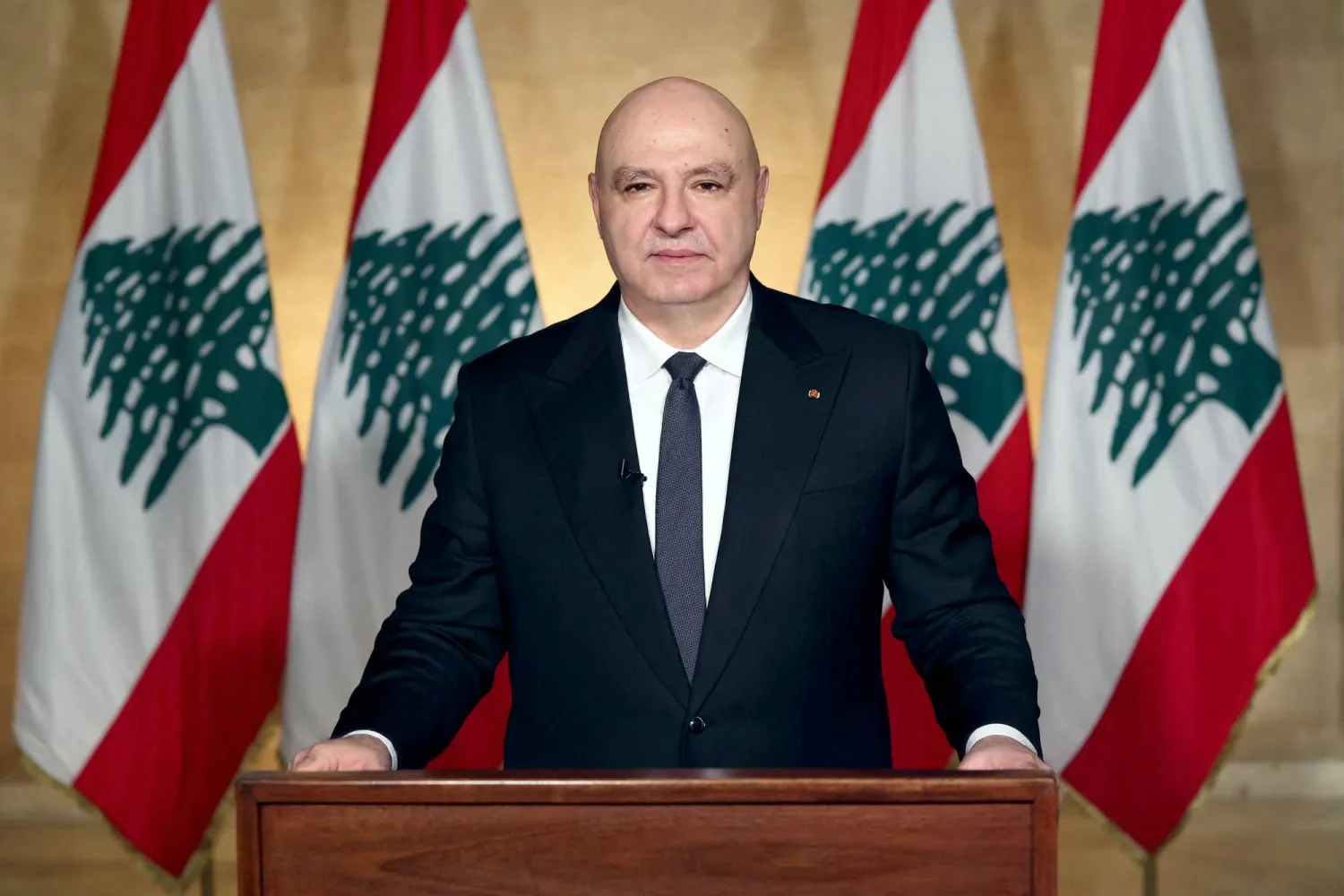
A photograph released by the Lebanese Presidency on April 17, 2026, shows Lebanon's President Joseph Aoun delivering a televised address to the Lebanese people from the Baabda Presidential Palace, east of the capital Beirut.  (Photo by Lebanese Presidency / AFP)
A photograph released by the Lebanese Presidency on April 17, 2026, shows Lebanon's President Joseph Aoun delivering a televised address to the Lebanese people from the Baabda Presidential Palace, east of the capital Beirut. (Photo by Lebanese Presidency / AFP)
TT

Lebanon's Aoun: We Won't Accept Humiliating Deal with Israel...Taking Country to War is 'Treason'

A photograph released by the Lebanese Presidency on April 17, 2026, shows Lebanon's President Joseph Aoun delivering a televised address to the Lebanese people from the Baabda Presidential Palace, east of the capital Beirut.  (Photo by Lebanese Presidency / AFP)
A photograph released by the Lebanese Presidency on April 17, 2026, shows Lebanon's President Joseph Aoun delivering a televised address to the Lebanese people from the Baabda Presidential Palace, east of the capital Beirut. (Photo by Lebanese Presidency / AFP)

Lebanese President Joseph Aoun said Monday that direct negotiations with Israel were aimed at ending the conflict with Hezbollah, while accusing those who drew Lebanon into war of "treason" in an implicit rebuke to the Iran-backed armed group.

"My goal is to reach an end to the state of war with Israel, similar to the armistice agreement" of 1949, Aoun said in a statement, adding that "I assure you that I will not accept reaching a humiliating agreement".

"Those who dragged us into war in Lebanon are now holding us accountable because we made the decision to go to negotiations... What we are doing is not treason. Rather, treason is committed by those who take their country to war to achieve foreign interests," he said.

Earlier on Monday, Hezbollah Secretary-General Naim Qassem reaffirmed his party’s rejection of direct negotiations by the Lebanese authorities with Israel, describing them as a “grave sin,” and warning that such a step would plunge the country into a “cycle of instability.”

In a statement carried by the group’s media outlets, Qassem said: “We categorically reject direct negotiations. Those in power should know that their conduct will not benefit Lebanon, nor will it benefit them.”

He added that it is the authorities’ responsibility “to roll back their grave missteps that place Lebanon in a cycle of instability. They are responsible for halting direct negotiations with the Israeli enemy and adopting indirect ones.”

Qassem added: “These direct negotiations and their outcomes are, to us, as if they do not exist, and they do not concern us in any way.” He stressed: “We will continue our defensive resistance to protect Lebanon and its people... We will respond to Israeli aggression and confront it,” underscoring that “no matter how much the enemy threatens, we will not retreat, bow, or be defeated.”

Following the outbreak of the latest war between Israel and Hezbollah, which began on March 2, the Lebanese and Israeli ambassadors in Washington held two rounds of direct talks, the first between the two countries in decades. After the first round, US President Donald Trump announced a ceasefire that took effect on April 17 for a period of 10 days, before later announcing a three-week extension after the second round of talks.

Lebanese authorities have repeatedly stated that the US-sponsored negotiations aim to end the war, secure Israel’s withdrawal from southern Lebanon, and enable displaced residents to return to their areas, after the fighting displaced more than one million people.

Despite the ceasefire, Israel continues to carry out air and artillery strikes, particularly in southern Lebanon, while its forces conduct widespread demolition and blasting operations in many border towns, where it has announced the establishment of a “yellow line” separating dozens of villages from the rest of Lebanese territory.

At least 2,509 people have been killed and 7,755 injured in Lebanon as a result of Israeli attacks since the start of the war on March 2, according to the Health Ministry.


1,400 Killed in Two Months as Yemen’s Dhamar Pays the Price of Houthi Attrition

A previous exhibition of photographs of fallen fighters staged by the Houthis in Dhamar (X).
TT

1,400 Killed in Two Months as Yemen’s Dhamar Pays the Price of Houthi Attrition

A previous exhibition of photographs of fallen fighters staged by the Houthis in Dhamar (X).

Yemen's Houthis have lost more than 1,400 fighters from Dhamar province in just two months, local sources said, exposing a mounting human toll as the group steps up recruitment and turns photographs of its dead into tools for mobilizing fresh fighters.

The Iran-aligned group has staged exhibitions of fallen fighters across Dhamar, about 100 km south of Sanaa, and its 12 districts, seeking to turn mounting battlefield losses into recruitment opportunities and replenish its depleted ranks.

Informed local sources told Asharq Al-Awsat that the fighters were killed on several fronts, particularly in Taiz, Dhalea, Jawf, the western coast and Marib.

The sources said the exhibitions and funeral processions sweeping the province offered a stark picture of the group's losses, even as it continued sending more local men to the front lines to replace those killed.

In recent days, the Houthis have intensified exhibitions displaying photographs of their dead across Dhamar as part of an annual week commemorating fallen fighters.

The group has used the events to reinforce its recruitment rhetoric and normalize death on the battlefield, rather than confront the heavy human cost of its military campaigns and the suffering they have inflicted on Yemeni families, the sources said.

Streets turned into memorials

In Dhamar city, the Houthis have transformed neighborhoods, main streets, schools, mosques and government buildings into open-air galleries displaying photographs of hundreds of dead fighters, including children and minors, according to local sources.

The exhibitions have spread to Wisab al-Ali, Anis, Duran Anis, Wisab al-Safil, Maghrib Anis, Jabal al-Sharq, Jahran, Mayfa'at Anis, Al-Hada, Al-Manar and Utmah, where tents and displays bearing photographs of the dead have become part of the group's broader mobilization campaign.

The scale of the displays underscores the extent of the losses and the group's efforts to channel them into its military and recruitment agenda, the sources said.

The photographs extend beyond frontline fighters to people involved in general mobilization, recruitment and security operations, as well as government employees, education workers and students whom the Houthis had sent into battle.

But the campaign has struggled to attract public support.

Local sources said the Houthis had pressured residents in several parts of Dhamar to organize group visits to the exhibitions, only to face what they described as "lackluster" attendance despite attempts to compel participation.

Funeral processions and fresh recruits

Alongside the exhibitions, the Houthis have continued staging funeral processions, filling streets, neighborhoods and alleyways across Dhamar with photographs of their dead and sectarian slogans.

The campaign seeks to project an image of widespread public mobilization, even as residents face pressure to participate while grappling with severe economic hardship.

Activists from Dhamar said the surge in memorial exhibitions laid bare the scale of the group's human losses.

Rather than acknowledge the toll on families and communities, they said, the Houthis were exploiting their annual commemorations to renew recruitment efforts, particularly among minors and public employees under their authority.

The activists warned that turning the dead into recruitment symbols risked fueling further losses, as more young men were sent to the front lines to fill the gaps left by fallen fighters.

Such efforts, they said, threatened to deepen families' suffering and keep the province trapped in a relentless cycle of battlefield deaths.

Meanwhile, as millions in Houthi-controlled areas struggle with worsening living and humanitarian conditions, informed Yemeni sources estimated that the group had spent billions of Yemeni rials on printing photographs, mounting exhibitions and organizing related events across its territory.

The dollar trades at 535 Yemeni rials, according to the exchange rate cited in the original report.

The spending comes as families struggle to afford basic necessities amid deepening poverty and declining purchasing power.

The expenditures highlight the group's priorities: pouring substantial resources into propaganda and recruitment campaigns while living standards deteriorate and residents struggle to meet their most basic needs.


From Gaza to Ramallah, Palestinians See Little Hope in Israeli Vote

Palestinians walk past buildings destroyed during the Israel-Hamas war in Gaza City Wednesday, Oct. 28, 2026. (AP)
TT

From Gaza to Ramallah, Palestinians See Little Hope in Israeli Vote

Palestinians walk past buildings destroyed during the Israel-Hamas war in Gaza City Wednesday, Oct. 28, 2026. (AP)

In war-ravaged Gaza and the occupied West Bank, many Palestinians were less focused on who would win Israel's election than on whether anything would really change.

Whether Benjamin Netanyahu clings to power with his far-right allies or centrist rival Gadi Eisenkot comes out on top, few see much reason for hope in the Tuesday vote.

"We fear these elections could bring an even worse leader," said Huda al-Houli, a displaced resident of Khan Younis in southern Gaza.

Such an outcome, she said, would only bring "more destruction and devastation" to the Palestinian territory.

Still, Houli said she hoped a more "human voice" would emerge in Israeli society and demand an end to the conflict, regardless of who forms the next government.

In Ramallah, in the West Bank, Ahmed Awad, 67, was equally skeptical.

"Whatever the result, and even if the politicians change, I don't think there will be any radical or dramatic shift in policies towards the Palestinian-Israeli conflict," he told AFP.

With 85 percent of ballots counted from Tuesday's vote, Netanyahu's camp remained ahead but without a clear majority, leaving uncertainty over Israel's next government.

The first election since Hamas's October 7, 2023 attack comes after years of right-wing and far-right rule marked by the war in Gaza and rising settler violence in the West Bank.

For Netanyahu, fighting for his political survival, several paths remain open: renewing his alliance with the far right, building a broader coalition or facing yet another political deadlock.

Far-right minister Itamar Ben-Gvir has already signaled that, if the current coalition survives, he would seek the defense portfolio and push for the expulsion of Gaza's population.

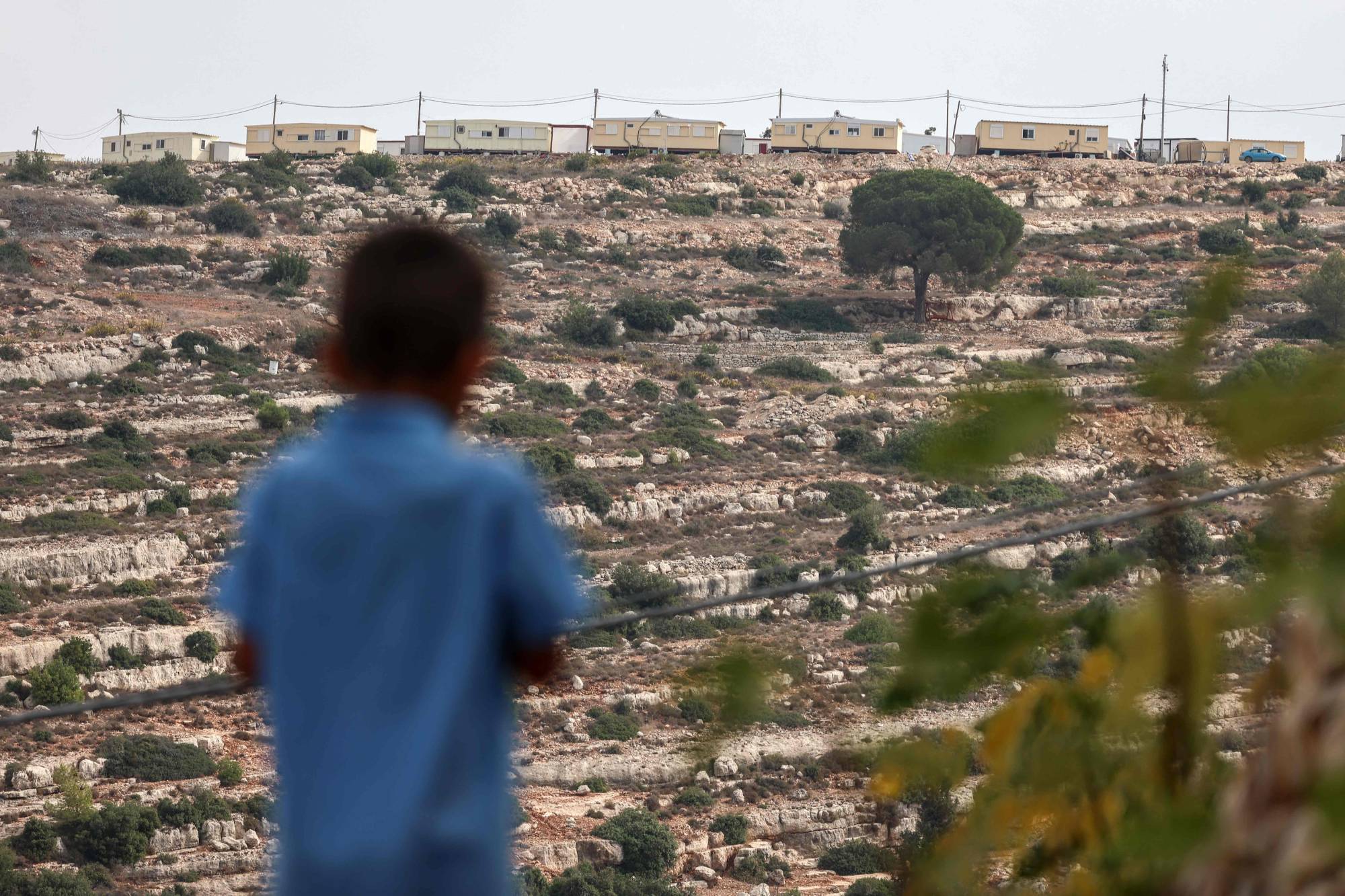
A Palestinian boy looks at an Israeli outpost on a hill overlooking the village of Umm Safa, northwest of Ramallah in the Israeli-occupied West Bank, on October 27, 2026, following a reported attack by Israeli settlers. (AFP)

- More of the same -

Not everyone has given up hope.

"Whatever happens, it will surely be better than what we've lived through in recent years," said Abdallah Abu Rahma, 54, from Ramallah.

But if Netanyahu remains in office, he added, "any coalition he forms, he will continue down the same path".

A government led by Eisenkot, a former army chief, could rein in the influence of the pro-settlement far right, said researcher Beth Oppenheim of the European Council on Foreign Relations.

It could also ease pressure on the Palestinian Authority and take a more flexible approach on aid and a ceasefire in Gaza.

But she warned against expecting too much.

There would be "nothing transformative", she said, and certainly no major shift on Palestinian statehood or the peace process, issues that have largely disappeared from Israeli political debate since October 7.

A renewed Netanyahu coalition with far-right partners would likely mean more of the same, including settlement expansion and impunity for settler violence, Oppenheim added.

"I think we need to have quite low expectations when it comes to seeing any major changes in policy from a different government," she said.

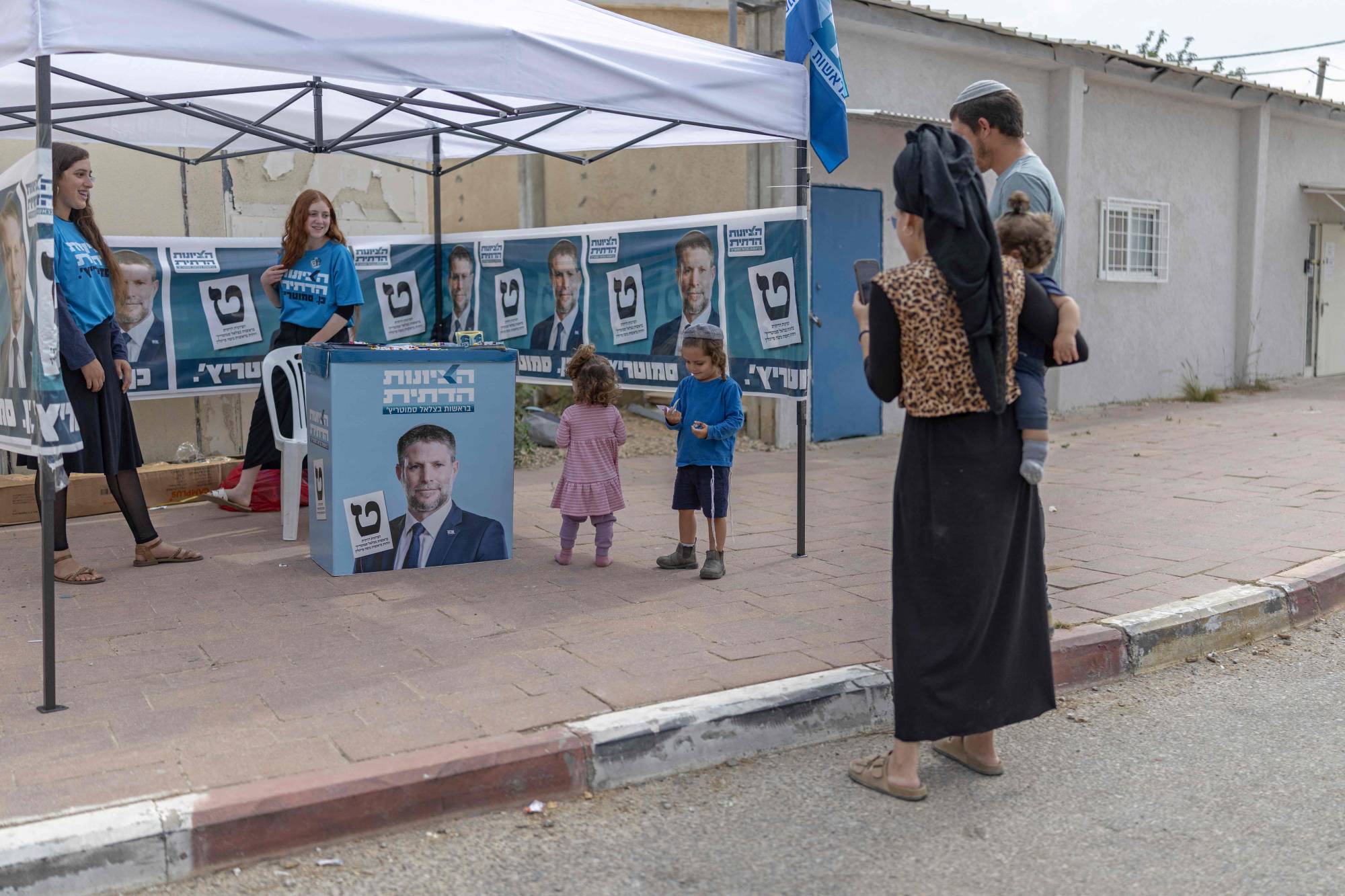
Israeli right-wing settlers stand at a polling station in the settlement of Adora in the occupied West Bank on October 27, 2026, amid Israel's legislative election. (AFP)

- Fears of escalation -

Even a Netanyahu defeat could leave Palestinians worse off in the short term, argued Yousef Munayyer, head of the Palestine-Israel program at the Arab Center Washington.

"There is every reason for Palestinians to be concerned," he said.

Eisenkot himself served in Israel's wartime cabinet during the Gaza offensive, Munayyer noted.

A fragile alternative coalition under constant attack from Netanyahu and the right could try to prove it was tough enough by taking a harder line on Palestinian issues.

In the West Bank, violence could rise if the far right loses power, with settlers potentially acting out against a new government, he explained.

"It's important to understand that most settler violence in the West Bank is structural. It's not about the government in charge," Munayyer said.

"Settlers live in places that surround the Palestinian population. The Palestinian population is vulnerable to the settlers, who are armed, whereas the Palestinians overwhelmingly are not."

In Gaza, Adnan Al-Assar said he harbored few illusions.

"Netanyahu may win," he said. "But whatever happens, they all follow the same overarching policy, directed against the Palestinian people."


What Has Lebanon So Far Implemented in its Ban on Hezbollah’s Military Activities?

A supporter of Hezbollah holds a placard reading in Arabic "We will not leave the weapon" during a gathering held to mark the 2nd anniversary of Hezbollah leader Hassan Nasrallah's death at the site where he died in Beirut, Lebanon, 26 September 2026. (EPA)
TT

What Has Lebanon So Far Implemented in its Ban on Hezbollah’s Military Activities?

A supporter of Hezbollah holds a placard reading in Arabic "We will not leave the weapon" during a gathering held to mark the 2nd anniversary of Hezbollah leader Hassan Nasrallah's death at the site where he died in Beirut, Lebanon, 26 September 2026. (EPA)

The seizure of a Hezbollah explosives shipment in eastern Lebanon has reignited questions over the government's enforcement of a ban on the group's military and security activities, imposed after its rocket attacks on Israel triggered a new war on March 2.

The explosives were intercepted in Dahr al-Baidar, and Hezbollah acknowledged they belonged to the Iran-backed party and were intended for use against Israel.

The March 2 ban orders Hezbollah to surrender its weapons to the state and to confine its activities to politics within constitutional and legal frameworks. It also instructs military and security agencies to act immediately to enforce the ban, prevent rocket and drone launches from Lebanese territory and arrest violators.

The most significant enforcement measures came in mid-to-late March, as Hezbollah fought Israel. Several armed members were arrested while heading to the battlefronts in southern Lebanon. A handful faced trial, but most were released on bail.

'Ink on paper'

Hezbollah rejects the ban outright, arguing that it serves Israel's interests while it continues to occupy Lebanese territory. The group maintains that liberating the occupied land remains part of its duty.

Its opponents say the government has not gone nearly far enough. They want tougher enforcement of the ban to ensure that decisions of war and peace rest exclusively with the Lebanese state.

Ghada Ayoub, a lawmaker from the Lebanese Forces' Strong Republic parliamentary bloc, said the ban "remains ink on paper, with none of it implemented."

That failure does not diminish the decision's political and legal weight, she told Asharq Al-Awsat.

"It marked a fundamental shift in the Lebanese state's position, clearly declaring Hezbollah's military and security activities illegitimate and stripping them of any official cover," she explained.

"It is no coincidence that Hezbollah keeps demanding its reversal. The group fully understands the decision's significance and its implications for its military and security project."

Waiting on developments abroad

Ayoub said that the Dahr al-Baidar explosives case underscored the importance of the ban, providing grounds to demand its referral to the Judicial Council because it involved prohibited military and security activities and posed a threat to the state and its citizens.

But she blamed the lack of enforcement on a failure of political will.

"The political leadership is still betting on regional and international developments, waiting to see how the confrontation between Israel and Hezbollah unfolds instead of assuming its responsibilities," she remarked.

"It is as though the authorities have chosen to let Hezbollah bear the consequences of refusing to surrender its weapons and abandon its military project, without confronting the group itself."

The result is a state that makes sovereign decisions but leaves their enforcement hostage to developments abroad, she went on to say.

She pointed to a cabinet decision on August 5, 2025, to impose state monopoly over weapons, saying its implementation remained incomplete. The government then banned Hezbollah's military and security activities on March 2 but failed to follow through with concrete action.

"Now, with the Dahr al-Baidar case, this approach is no longer acceptable," Ayoub stressed.

"Failing to refer the case to the Judicial Council raises serious questions about the government's commitment to its own decision."

Ayoub urged the state to demonstrate that it was serious about enforcing its decisions rather than waiting for Israel or the United States to carry out responsibilities that belonged to Lebanon itself.

"We cannot keep moving from one regional development to another while sovereign decisions remain on hold, using the need to preserve civil peace as a pretext for allowing violations of the law to continue," she demanded.

"Fear of confrontation cannot become a permanent surrender of state sovereignty."

'Arrest every armed Hezbollah member'

Retired Brigadier General George Nader echoed Ayoub's criticism, saying the government's decisions to establish state control over weapons and curb Hezbollah's military activities had yielded nothing.

"The slogans have proved hollow and the decisions remain on paper. It is a major blow to a state that issues decisions it cannot enforce," Nader told Asharq Al-Awsat.

"After the decision to bring weapons under state control, we went into Palestinian refugee camps and came back with truckloads of scrap metal," he said.

"Even after identifying those responsible for the Dahr al-Baidar explosives, we arrested only the people transporting them, not those behind them."

Nader said enforcing the cabinet's decisions would require arresting every armed Hezbollah member, not just those stopped at checkpoints.

"If we genuinely want to implement the cabinet's decisions, every armed Hezbollah member is breaking the law and must be arrested," he added.

"Arrests should not be limited to checkpoints. The authorities should go to where these members are and arrest them."

Nader placed responsibility squarely on the government, saying the army operates under the political leadership's instructions.

"What is needed today is a clear, explicit order to the Defense Ministry, directing it to instruct the army to arrest every armed Hezbollah member, wherever they may be," he urged.