


UK PM Starmer Faces Vote on Possible Parliamentary Probe Over Mandelson

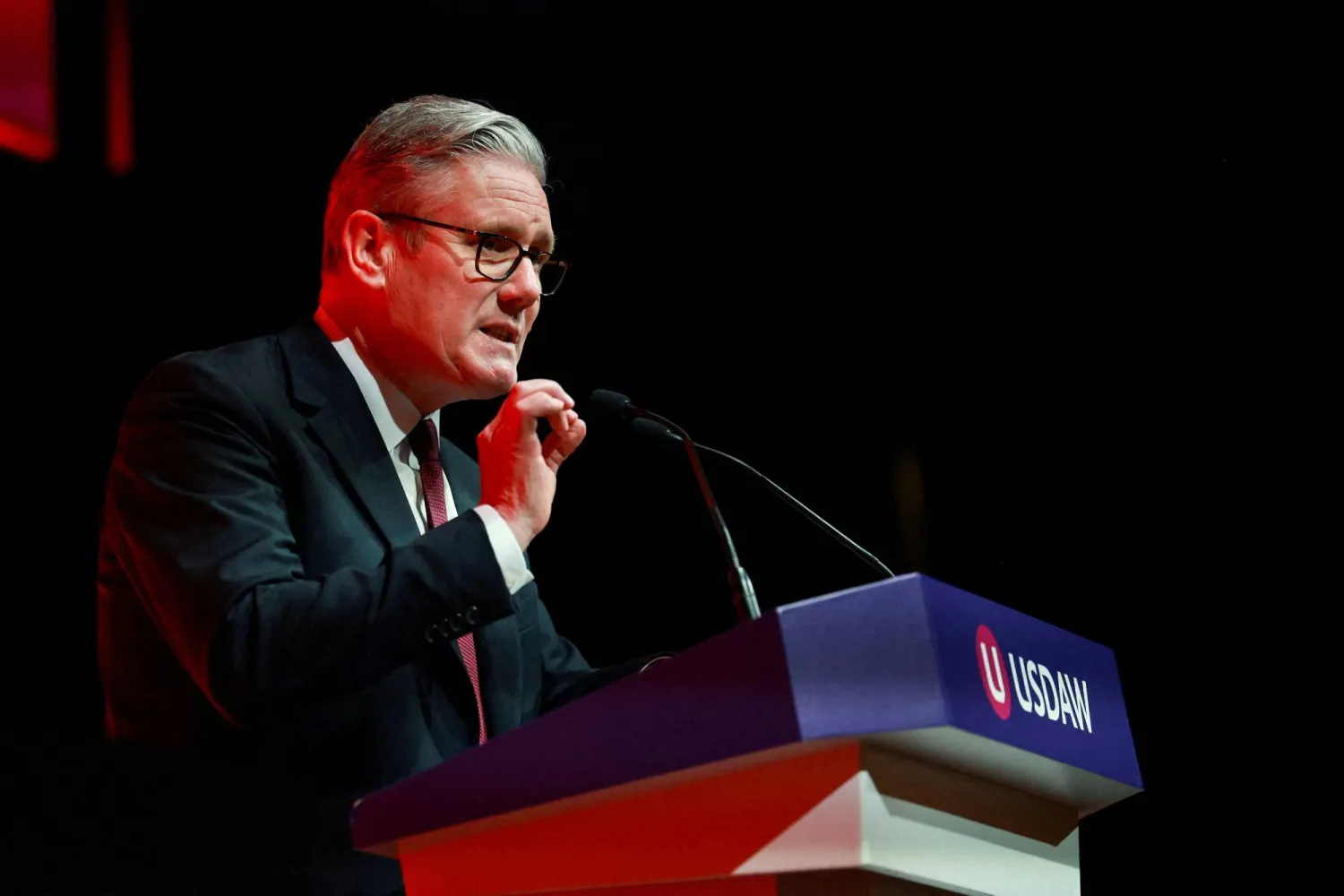
British Prime Minister Keir Starmer delivers a speech at the Union of Shop, Distributive and Allied Workers (USDAW) Annual Delegate Meeting at the Winter Gardens Blackpool, in Blackpool, Britain, April 27, 2026. (Reuters)
TT

UK PM Starmer Faces Vote on Possible Parliamentary Probe Over Mandelson

British Prime Minister Keir Starmer delivers a speech at the Union of Shop, Distributive and Allied Workers (USDAW) Annual Delegate Meeting at the Winter Gardens Blackpool, in Blackpool, Britain, April 27, 2026. (Reuters)

Britain's parliament will vote on Tuesday on a possible inquiry into Prime Minister Keir Starmer, looking at whether he misled the House of Commons over the appointment of former US ambassador Peter Mandelson.

Any such inquiry could have serious implications for Starmer's future. He has so far resisted pressure to quit over his decision to hire Mandelson, but if found to have knowingly misled parliament his position would likely become untenable.

House of Commons ‌Speaker Lindsay Hoyle ‌said he had approved a request from opposition Conservative ‌Party ⁠leader Kemi Badenoch for ⁠parliament to debate and vote on whether the Committee of Privileges should look into the matter.

Mandelson was fired by Starmer last September after his relationship with the late US sex offender Jeffrey Epstein was found to be deeper than previously known.

DOUBTS OVER PM'S JUDGMENT

That has raised doubts about Starmer's judgment in hiring him, exacerbated by the revelation that a security vetting body had described the appointment ⁠as a borderline case and that it was leaning against ‌granting clearance - a decision foreign ministry officials overruled ‌without telling the prime minister.

Starmer's center-left Labour Party has a large majority in parliament, ‌which could allow the government to instruct its lawmakers to vote down ‌the launch of an inquiry.

On Monday the government published a letter sent in September from former cabinet secretary Chris Wormald, saying he had concluded "that appropriate processes were followed in both the appointment and withdrawal" of Mandelson as ambassador.

A spokesperson from Starmer's office described ‌Badenoch's push for a vote as a "desperate political stunt" ahead of local elections due on May 7.

Hoyle said his decision ⁠to allow ⁠the vote should not be taken as an indicator of whether Starmer had done anything wrong or not.

If parliament did vote in favor of an inquiry, the committee, made up of lawmakers from the three biggest parties, would examine whether Starmer's statements on Mandelson amount to knowingly or inadvertently misleading the House of Commons.

The focus of any such inquiry would be expected to fall on Starmer's statement that due process was followed when hiring Mandelson.

The committee previously found that former Conservative Prime Minister Boris Johnson had knowingly misled parliament over rule-breaking parties held during the COVID-19 pandemic.

Johnson had already stood down as prime minister by the time the report was published, but he resigned from parliament altogether after seeing a draft copy of the findings.



Iran's President Delivers Defiant UN Speech

Iran's President Masoud Pezeshkian speaks during the 81st United Nations General Assembly at the United Nations Headquarters in New York, on September 23, 2026. (Photo by TIMOTHY A. CLARY / AFP)
TT

Iran's President Delivers Defiant UN Speech

Iran's President Masoud Pezeshkian speaks during the 81st United Nations General Assembly at the United Nations Headquarters in New York, on September 23, 2026. (Photo by TIMOTHY A. CLARY / AFP)

Iranian President Masoud Pezeshkian delivered a defiant speech at the United Nations on Wednesday as Tehran downplayed talks with the United States.

He said his country's people had been the “victims of terrorism” by the United States.

Delivering the rare wartime speech at the UN General Assembly, Pezeshkian displayed images of the late Supreme Leader Ali Khamenei and more than 150 schoolchildren killed in the opening days of the conflict.

“We have only defended ourselves. We are not terrorists,” he said. “Our innocent people have been the targets of cowardly attacks and aggressions imposed upon our country.”

Turning to the United States, Pezeshkian added: “Yes, they did hit us, but we did not bend the knee.”

On Wednesday, US Secretary of State Marco Rubio told reporters that President Donald Trump remained open to an agreement “that allows Iran to be what it should be, which is a great and prosperous country.”

Rubio said the prospects for such a deal were hindered by Iran’s nuclear ambitions and “their support of terrorism.” If those policies continued, he said, Trump could exercise “a number of options,” including further military action.

“It must be understood by Mr. Trump and those who seek to bully us that we are ready for dialogue and diplomacy and negotiations without accepting the language of force,” Pezeshkian said in his speech.


WHO: Congo is Running Short of Health Workers as Ebola Remains Out of Control

Ebola response teams organize a public demonstration to raise awareness about the Ebola virus disease in Beni, North Kivu province, eastern Congo, Tuesday, Sept. 22, 2026. (AP Photo/Sebastien Kitsa Musayi)
TT

WHO: Congo is Running Short of Health Workers as Ebola Remains Out of Control

Ebola response teams organize a public demonstration to raise awareness about the Ebola virus disease in Beni, North Kivu province, eastern Congo, Tuesday, Sept. 22, 2026. (AP Photo/Sebastien Kitsa Musayi)

Congo is running short of health workers to staff treatment centers for history's fastest-growing Ebola outbreak, particularly in the eastern province of North Kivu where cases have surged 73% over three weeks, the World Health Organization said Wednesday.

The warning came despite signs of improvement in other provinces, including Ituri, the outbreak’s epicenter. The outbreak has spread to seven provinces, with 7,773 confirmed cases and 3,759 deaths, according to the latest government figures.

Between Aug. 31 and Sept. 20, cases fell 26% in Ituri province and 15% in Haut-Uele, said Marie Roseline Belizaire, the WHO’s regional emergency director for Africa. But transmission patterns vary widely and the outbreak remains uncontrolled, she said.

“While cases and deaths are declining in some provinces, they continue to rise in others,” The Associated Press quoted Belizaire as saying. “The outbreak is still not under control and remains spread across a wide geographic area.”

The outbreak is spreading under extremely difficult conditions, fueled by insecurity, displacement, a health workers’ strike and intense population movements. The World Health Organization has said it is on track to surpass the 2014-2016 West Africa Ebola outbreak, the deadliest on record, which killed more than 11,000 people, primarily in Guinea, Liberia and Sierra Leone.

Catherine Smallwood, the WHO’s Ebola incident manager, said cases and deaths had begun declining in North Kivu after several weeks of increases. But although treatment beds are being added daily, facilities still lack enough staff and partners to operate them.

“The human resources gap is one of the biggest gaps,” Smallwood said.

WHO representative in Congo Anne Ancia said one Ebola treatment center requires about 300 health professionals, including anesthetists, hygienists, nurses and general practitioners.

“We are building Ebola treatment centers but do not always have the human resources needed to operate them,” Ancia said. “Those health workers must be paid.”

Frontline workers in Ituri previously went on strike over unpaid wages, worsening access to care.

Health Minister Roger Kamba said in July that the government was verifying payroll lists after the names of people not involved in the response were added. Frontline workers said officials promised to pay the arrears, but some workers received nothing and others only part of what they were owed.

Another major challenge in the response is the fatality rate among children, according to the WHO. Children under five have the highest case fatality rate, more than 60% compared with approximately 40% among adults, Belizaire said.

WHO Ebola Incident Manager Smallwood said detecting cases among children under five is also very difficult because the children can’t necessarily explain their symptoms, and the presentation of symptoms can be confusing.


Pakistani Officials Say Afghan Taliban Shelled Pakistani Border. Kabul Denies the Attack

Pakistani soldiers near a security fence at the border post in Torkham, Pakistan, in December. Credit Salahuddin/Reuters
TT

Pakistani Officials Say Afghan Taliban Shelled Pakistani Border. Kabul Denies the Attack

Pakistani soldiers near a security fence at the border post in Torkham, Pakistan, in December. Credit Salahuddin/Reuters

Afghanistan's Taliban forces shelled Pakistani border posts overnight after Pakistani troops foiled what they described as a cross-border infiltration attempt by militants, local Pakistani officials said Wednesday.

The spokesman for Afghanistan’s Taliban government, Zabiullah Mujahid, denied any attacks by the Afghan Taliban forces, The Associated Press said.

The conflicting statements came just days after Pakistani fighter jets struck sites in eastern Afghanistan that Islamabad said were militant hideouts, an escalation between Kabul and Islamabad that threatens mediation efforts by regional powers.

Pakistani security forces neutralized two rudimentary drones, which the officials said were launched by the Afghan Taliban, before they could enter the northwestern city of Kohat, the officials said. They said the action underscored Pakistan's round-the-clock vigilance and air-defense systems' readiness to counter emerging aerial threats from Afghanistan.

The airstrikes ended several weeks of relative calm following months of cross-border hostilities. Also, earlier this month, Pakistani security forces killed 15 militants attempting to cross into the country from Afghanistan.

Four local Pakistani officials said Wednesday that militants attempted to infiltrate Pakistan from areas near Afghan border posts in Paktia and Nangarhar provinces, allegedly with support from the Afghan Taliban forces.

The officials referred to the militants as Fitna-ul-Khawarij, a term Islamabad uses for the Pakistani Taliban, a group that is separate but allied with the Afghan Taliban. Pakistan has repeatedly accused Afghanistan’s Taliban government of allowing militants to operate from its territory and carry out attacks across the border, an accusation that Kabul denies.

After Pakistani troops thwarted the infiltration attempt, Afghan Taliban forces allegedly fired mortars and other heavy weapons at Pakistani border posts, the four officials said. Pakistani forces responded with artillery fire, targeting Taliban border posts, mortar sites, and defensive positions.

The officials said Afghan Taliban forces subsequently abandoned several positions and suffered casualties. The four officials spoke on condition of anonymity as they were not authorized to talk to the media about the latest flare-up.

The accounts could not be independently verified. The latest escalations threaten mediation efforts by China, Türkiye, Qatar and Saudi Arabia to broker a lasting peace between Kabul and Islamabad.

In Monday's airstrikes, Pakistan’s Information Ministry said 28 militants were killed, while Afghan authorities said at least three civilians died and four others were wounded. The U.N. mission in Afghanistan confirmed the civilian casualties and Kabul formally protested the attack.

On the sidelines of the UN General Assembly in New York, Pakistani Foreign Minister Ishaq Dar expressed concern about what he said was the presence of more than two dozen anti-Pakistani militant groups in Afghanistan.

Monday’s Pakistani airstrikes followed a shootout with militants in Hangu, a district in northwestern Khyber Pakhtunkhwa province near the Afghan border, that killed six Pakistani security personnel. Days earlier, a suicide bomber struck a mosque inside a police compound in the nearby city of Kohat.

Eight gunmen then stormed the compound, triggering a 20-hour gunbattle that killed at least 21 people, most of them police officers. No group had claimed responsibility for the attacks.

Pakistani authorities blamed the violence on the Pakistani Taliban and allied militant groups. The Pakistani Taliban, formally known as Tehrik-e-Taliban Pakistan, have stepped up their attacks on Pakistani security forces, boosted by the Afghan Taliban's return to power in Afghanistan in 2021.