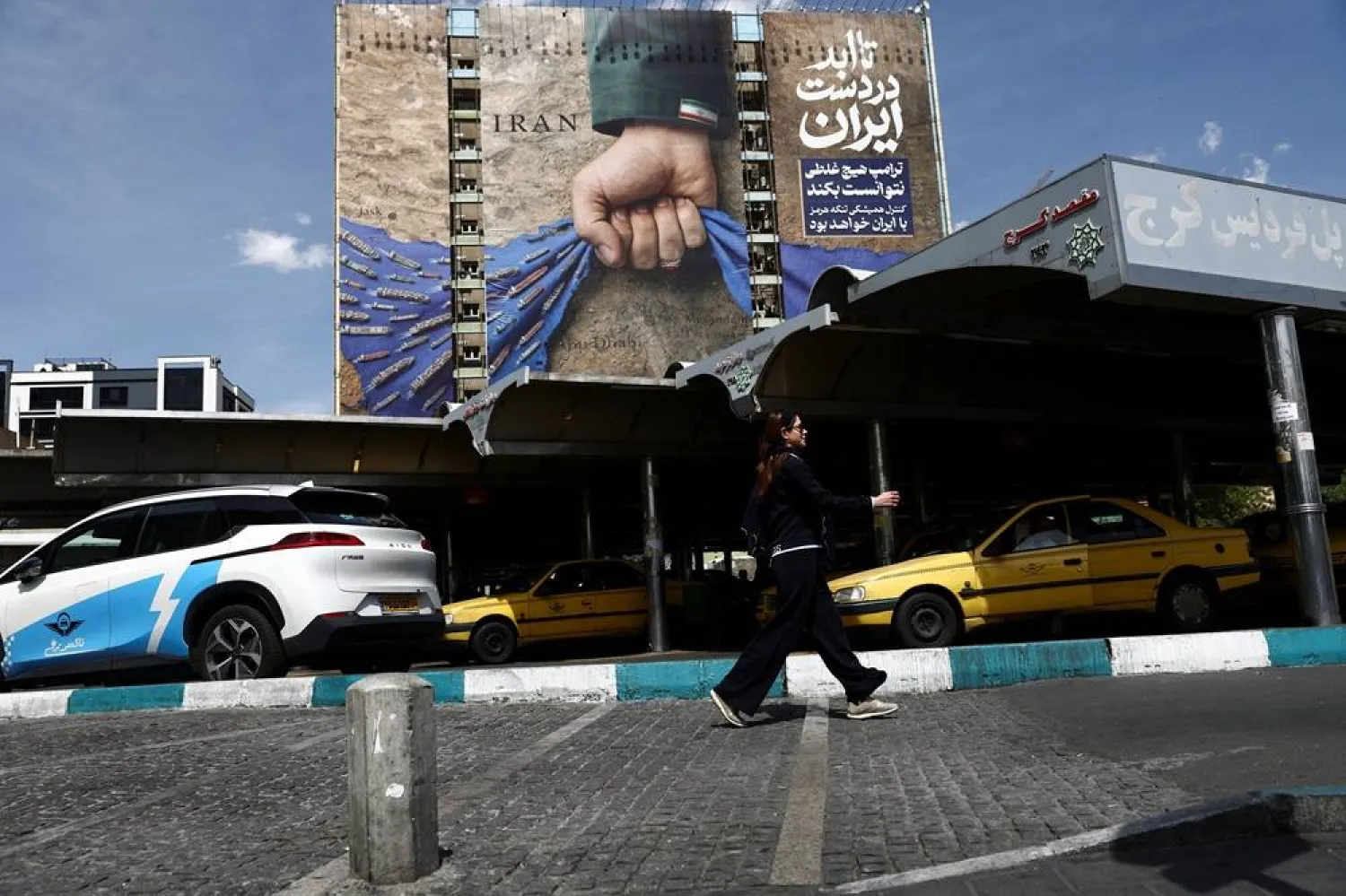
UN Maritime Agency Rejects Iran’s Demand for Hormuz Tolls

A woman walks past a billboard with a graphic design about the Strait of Hormuz on a building, amid a ceasefire between US and Iran, in Tehran, Iran, April 27, 2026. Majid Asgaripour/WANA (West Asia News Agency) via Reuters
TT

UN Maritime Agency Rejects Iran’s Demand for Hormuz Tolls

A woman walks past a billboard with a graphic design about the Strait of Hormuz on a building, amid a ceasefire between US and Iran, in Tehran, Iran, April 27, 2026. Majid Asgaripour/WANA (West Asia News Agency) via Reuters

The head of the UN's maritime agency said Monday there was "no legal basis" for imposing any fees for ships to pass through the Strait of Hormuz.

Shipping through the narrow strait has been strangled since the US and Israel attacked Iran in late February.

Iran has sealed off the passage, sharply cutting oil and gas flows and sending prices soaring, while the US has blockaded Iranian ports. Tehran has also said it wants to impose transit fees as part of any lasting peace deal.

"There's no legal basis for the introduction of any tax, any customs, or any fees for on straits for international navigation," IMO Secretary-General Arsenio Dominguez said at a press conference.

Iran's armed forces would have authority over the key shipping lane under the country's proposed law for managing the waterway, a top official said Monday.

Ebrahim Azizi, head of the national security commission in Iran's parliament, told state TV the armed forces were already in control of the strait and were seeking to prohibit the passage of "hostile vessels".

The bill also provides that financial gains from the strait would be paid in Iran's rial currency.

Speaking on the sidelines of an IMO maritime protection committee meeting, Dominguez said he was in contact with "all the countries of the region", including Iran.

He firmly rejected the idea that reopening the waterway could involve payment of any fees.

Dominguez also said a planned evacuation operation for around 20,000 seafarers currently stranded on vessels in the Gulf could only go ahead once the strait was fully secure.

The shipping lane remains a key sticking point in negotiations between Washington and Tehran, even as a fragile April 8 ceasefire continues to hold.


2 Trapped Workers Rescued from Hydropower Tunnel 9 Days after Nepal Floods

A handout photo made available by the Nepali Army shows a worker rescued from a hydropower tunnel following flash floods in Rasuwa district, Nepal, 04 September 2026. EPA/Nepali Army HANDOUT Handout
TT

2 Trapped Workers Rescued from Hydropower Tunnel 9 Days after Nepal Floods

A handout photo made available by the Nepali Army shows a worker rescued from a hydropower tunnel following flash floods in Rasuwa district, Nepal, 04 September 2026. EPA/Nepali Army HANDOUT Handout

Rescuers in Nepal pulled two workers alive from a hydropower tunnel Friday as emergency teams continued an operation to reach others believed to be trapped inside, officials said.

The two men were rescued from the Trishuli 3A tunnel nine days after floods, likely caused by a glacier collapse, devastated towns and swept away villages in Nepal on Aug. 26.

Nepalese lawmaker Shri Ram Neupane posted about the second rescue on his Facebook page shortly after army spokesperson Brig. Gen. Raja Ram Basnet confirmed the first trapped worker’s rescue. Officials identified the two men as a mechanical foreman and a mechanical supervisor, The Associated Press reported.

Local television news channels showed images of the first rescued worker covered in mud and being carried from the site on a rescuer’s shoulder.

Officials said both men were in stable condition and were flown to a hospital in Kathmandu.

At least 557 workers are missing from the Trishuli 3A hydropower project along the Trishuli River, with about 115 believed to be trapped in the main tunnel, according to the Independent Power Producers Association of Nepal.

Officials present at the rescue site said rescuers believe some people may still be alive inside the tunnel.

Nepal’s Communication Minister Bikram Timilsina said officials remain hopeful that more workers will be rescued.

“We are waiting for the rescue of more and more people,” Timilsina wrote on his Facebook page.

At least 1,259 people were killed in the floods and more than 5,000 remain missing, according to the country’s disaster management agency. China, as of late Wednesday, said 21 people were killed and 541 were missing on the Tibet side of the border.

About 900 workers are missing from 12 hydropower projects in Nepal, with roughly 500 believed to be trapped in tunnels, according to local authorities.


US Sanctions Grandson of Former Cuban Leader Raúl Castro

FILE PHOTO: Cuba's former President Raul Castro watches a May Day rally in Havana, Cuba May 1, 2025. REUTERS/Norlys Perez/File Photo/File Photo
TT

US Sanctions Grandson of Former Cuban Leader Raúl Castro

FILE PHOTO: Cuba's former President Raul Castro watches a May Day rally in Havana, Cuba May 1, 2025. REUTERS/Norlys Perez/File Photo/File Photo

The US government on Thursday slapped new sanctions on Cuba in a fresh push to strangle the island’s economy and deepen its multiple crises.

Among those hit with sanctions are Fidel Ernesto Castro, grandson of former President Raúl Castro, and Cuba’s Oil Industry Supply Import Company, known as Abapet. The company is responsible for importing special equipment and spare parts needed to sustain Cuba’s crumbling power grid.

The sanctions aim to push Cuba’s critical machinery offline and exacerbate its energy crisis, said Brett Erickson, a sanctions expert and managing principal at Obsidian Risk Advisors, a consulting firm.

“The US is trying to really tighten the screws as much as possible,” The Associated Press quoted him as saying.

“The Trump administration seems to have no seriousness to accept any change from Cuba other than a toppling of regime. Marco is not going to let that go,” he added, referring to US Secretary of State Marco Rubio.

Erickson anticipated that Cuba’s government would try to circumvent the sanctions “because they have to.”

“They’ll get creative in how they try to procure these maintenance parts,” he said, warning it would be a costlier alternative, which in turn would raise inflation and further hurt Cuba’s economy.

Islandwide blackouts have become increasingly common, while daily outages in Cuba now surpass 24 hours as the aging grid fails and fuel reserves dwindle ever since US President Donald Trump in late January threatened tariffs on any country that sells or provides oil to the island.

“The goal in theory is to create so much civilian hardship and suffering that they have no option but to essentially rise up and topple their government,” Erickson said. “It is an attempt to cause a humanitarian crisis.”

Talks earlier this year between the US and Cuba have since halted, while sanctions have increased in recent months.

Erickson said he expects the US to keep targeting smaller and smaller state companies to try and push them “into a death spiral.” The US has previously sanctioned entities including Cuba's state-owned oil and gas company.

The US State Department made the announcement just hours after Cuban officials held a press conference to share more details on the historic economic reforms approved in June.

When asked about the current situation in Cuba, Oscar Pérez-Oliva Fraga, Cuba’s deputy prime minister and minister of foreign investment, blamed the US government.

“This past year has been very complex, and we know why,” he said. “The blockade is a genocide.”

He spoke before the sanctions were announced.

Among the Cubans exhausted by the ongoing outages is 49-year-old Yaqueline Bernal. She said Thursday that she hasn’t had electricity since Sunday and worries most about the consequences for her eight young grandchildren.

“If we don’t have power, we don’t have water,” she said. “You really don’t know what’s going to happen to you.”

Bruno Rodríguez, Cuba's foreign affairs minister, decried the latest sanctions on X.

“Collective punishment is a crime. So, too, is inflicting suffering on an entire population through measures coldly calculated to trigger a humanitarian crisis,” he said. “Enough with the abuse. Put an end to the blockade once and for all and allow Cuba to live in peace.”

Eugenio Martínez Enríquez, Cuba’s ambassador in Mexico, called Rubio “a liar without scruples.”

“We will not forget his crimes,” he wrote on X.

Meanwhile, Rubio asserted on X that those sanctioned “are part of the corrupt Castro financial and intelligence network.”

“Cuba’s Communist regime elites preside over a failed state where ordinary Cubans go hungry while the Castro family and other insiders enrich themselves through sanctions evasion and other illicit schemes — and seek to export subversive Marxist ideology to the United States and other states in the Western Hemisphere,” he wrote.

“Trump and I are unwavering in our commitment that Cuba will be free.”


US House Passes Bill to Crack Down on University Boycotts of Israel

Police stand between counter-protesters and a protest encampment in support of Palestinians, during the conflict between Israel and the Palestinian group Hamas, at McGill University’s campus in Montreal, Quebec, Canada May 2, 2024. (Reuters)
TT

US House Passes Bill to Crack Down on University Boycotts of Israel

Police stand between counter-protesters and a protest encampment in support of Palestinians, during the conflict between Israel and the Palestinian group Hamas, at McGill University’s campus in Montreal, Quebec, Canada May 2, 2024. (Reuters)

The ‌US House of Representatives passed legislation on Thursday to block federal aid for universities that boycott Israel, the latest Republican-backed pro-Israel measure amid growing Democratic criticism of the Israeli government over the war in Gaza.

The Republican-majority chamber voted 237-169 in favor of the "Protect Economic and Academic Freedom Act," which would have to pass the Senate in order to become law.

The war in Gaza has devastated much of the Palestinian enclave since Hamas-led fighters killed 1,200 people ‌during an attack on ‌October 7, 2023, according to Israeli ‌tallies. ⁠Israeli attacks since then ⁠have killed more than 73,000 Palestinians, according to the Gaza health ministry.

The conflict sparked protests and calls for boycotts at many US campuses. In response, Republican President Donald Trump targeted colleges and universities with probes and federal funding suspension threats. The administration and many Republicans in Congress ⁠allege that the protesters were antisemitic and ‌supported extremism.

Protesters deny this, saying ‌advocacy for Palestinian rights and objections to the devastation in ‌Gaza should not be equated with antisemitism or support ‌for extremism.

Thursday's House vote was mostly along party lines, with just two Republicans voting nay and 33 Democrats voting in favor.

US Representative Jerrold Nadler, a New York Democrat, said in a statement ‌before the vote that he opposed the global Boycott, Divestment and Sanctions (BDS) movement but ⁠would vote no ⁠because he supported Americans' right to free expression.

"It is the only way to ensure speech I do agree with is equally protected," Nadler said.

The BDS movement seeks to isolate Israel over its treatment of Palestinians.

The bill's sponsors said it was not intended to hinder academic speech or debate, but to prevent the targeting of Israel and Judaism.

"It simply says that if your university takes federal taxpayer dollars, it can't discriminate against academic partnerships or investments with one country," US Representative Josh Gottheimer, a New Jersey Democrat, said in a speech urging support.