
Iraqi President Nominates Ali Al-Zaidi as PM-Designate

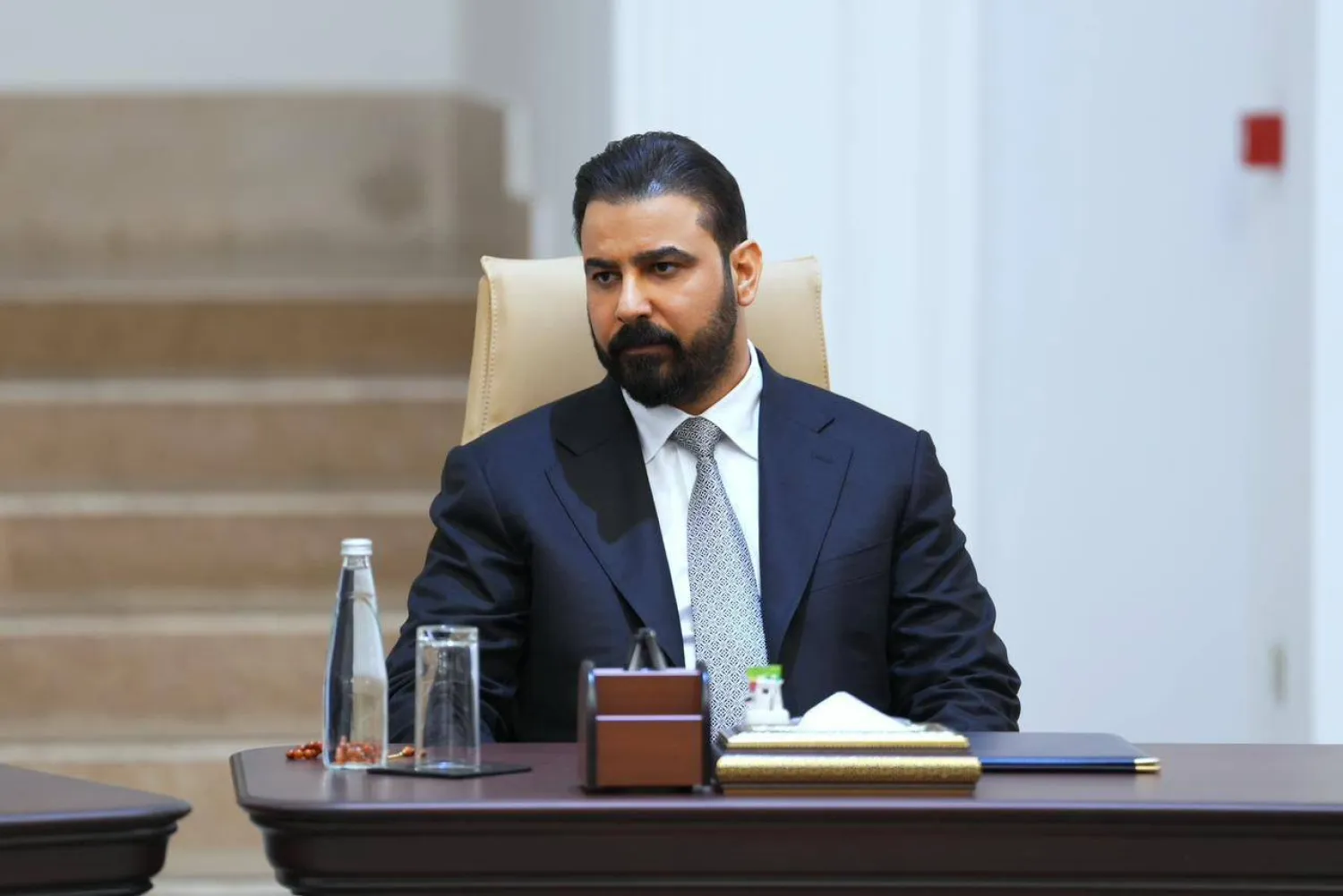
 Iraqi Prime Minister-designate Ali al-Zaidi attends the meeting of the Coordination Framework political bloc in Baghdad, Iraq, Monday, April 27, 2026. (Iraqi Presidency Office via AP)
Iraqi Prime Minister-designate Ali al-Zaidi attends the meeting of the Coordination Framework political bloc in Baghdad, Iraq, Monday, April 27, 2026. (Iraqi Presidency Office via AP)
TT

Iraqi President Nominates Ali Al-Zaidi as PM-Designate

 Iraqi Prime Minister-designate Ali al-Zaidi attends the meeting of the Coordination Framework political bloc in Baghdad, Iraq, Monday, April 27, 2026. (Iraqi Presidency Office via AP)
Iraqi Prime Minister-designate Ali al-Zaidi attends the meeting of the Coordination Framework political bloc in Baghdad, Iraq, Monday, April 27, 2026. (Iraqi Presidency Office via AP)

Iraq's newly elected president nominated businessman Ali al-Zaidi as the country's prime minister-designate on Monday, after the country's leaders yielded to US pressure not to support the bid of a former premier close to Iran.

The Coordination Framework, an alliance of Shiite factions with varying links to Iran, had initially backed powerbroker Nouri al-Maliki to become the country's next premier, but an ultimatum by US President Donald Trump left Iraqi leaders looking elsewhere.

For weeks, they were locked in intense discussions to settle the question and avoid punitive measures after Trump threatened in January to cut all support for Iraq if two-time ex-premier Maliki, who has close ties to Iran, returned to power.

"President Nizar Amedi has tasked Ali al-Zaidi, the candidate of the largest parliamentary bloc, with forming the new government," the presidency said in a statement.

Zaidi will now have 30 days to form a government -- a daunting task in a country where constitutional deadlines are rarely respected.

The announcement came shortly after the Coordination Framework endorsed Zaidi as its candidate.

The alliance also praised "the historic and responsible stance" of Maliki and caretaker Prime Minister Mohammed Shia al-Sudani "for withdrawing" their candidacies.

Yasser al-Maliki, the head of Maliki's parliamentary bloc, congratulated the PM-designate and said "we will support him" in his mission to form a government.

Following the 2003 invasion that overthrew former ruler Saddam Hussein, the US has held major sway in Iraq.

But the invasion has also paved the way for the US' archenemy Iran in the country's halls of power.

Since then, the country's leaders have struggled to balance relations between Washington and Tehran.

- 'Has the tools' -

By convention, a Shiite holds the powerful post of prime minister, the parliament speaker is a Sunni, and the largely ceremonial presidency goes to a Kurd.

Seen as a compromise figure, Zaidi is little known in political circles.

He is a businessman, banker and owner of a television channel, and has never held a government post.

If he succeeds in forming a government, Zaidi will become Iraq's youngest prime minister at the age of 40.

Political analyst Hamzeh Hadad said it appeared that Zaidi "has the tools" as a banker and TV channel owner "to help him sway people and politicians".

His nomination also "allows the Coordination Framework to claim they are abiding by the constitutional timeline," whether he ends up forming a government or not.

In recent years, and after decades of conflicts, oil-rich Iraq has begun to enjoy some stability, yet its politics remain volatile, shaped not only by internal disputes but also by regional dynamics.

- Regional war -

The new nomination came against the backdrop of a regional war ignited by a joint US-Israeli attack on Iran.

Iraq was dragged into the Middle East conflict, with strikes targeting both US interests and Tehran-backed groups in the country.

During the war, Iraqi leaders scaled back their talks to settle the premiership question, and only resumed them intensively a few days after a fragile US-Iran ceasefire took effect on April 8.

Iraq's new premier will be expected to address Washington's longstanding demand that Baghdad disarm Iran-backed groups, which the US has designated as terrorist organizations.

From the onset of the war, these groups targeted US interests in Iraq and the broader region.

The new PM will also need to repair Iraq's relations with Gulf countries, which have protested attacks by Tehran-backed groups on their territory during the war.

Zaidi will have to address Iraq's many economic woes, particularly after the sharp drop of income caused by disruption in the Strait of Hormuz, given that oil exports make up some 90 percent of the country's budget revenues.


Iraq’s Kurdistan Region Officially Unifies Peshmerga Forces

Kurdistan Region President Nechirvan Barzani speaks during a ceremony marking the unification of the Peshmerga forces. (Kurdistan Region Presidency)
TT

Iraq’s Kurdistan Region Officially Unifies Peshmerga Forces

Kurdistan Region President Nechirvan Barzani speaks during a ceremony marking the unification of the Peshmerga forces. (Kurdistan Region Presidency)

Iraq’s Kurdistan Region formally announced Monday the unification of its Peshmerga forces, ending a division into two forces that had lasted more than three decades, in a step aimed at unifying Kurdish ranks that have long been divided politically and on security matters.

The ceremony at the Kurdistan Region Presidency in Erbil was overseen by President Nechirvan Barzani, commander-in-chief of the Peshmerga, and attended by Prime Minister Masrour Barzani, the deputy prime minister and minister of Peshmerga affairs, Kurdish officials, representatives of the international coalition and diplomatic missions.

Abdul-Amir al-Shammari, director of the Office of the Commander-in-Chief of the Iraqi Armed Forces, also attended.

The Peshmerga split in the mid-1990s during the Kurdish civil war between the Kurdistan Democratic Party, led by Masoud Barzani, and the Patriotic Union of Kurdistan, then led by the late Jalal Talabani.

The forces were divided between the KDP-affiliated Unit 80, based in the party’s areas of influence in Erbil and Duhok provinces, and the PUK-affiliated Unit 70, concentrated in Sulaymaniyah province and the Halabja area.

Kurdish sources said the ceremony culminated a lengthy reform process aimed at unifying and reorganizing the Peshmerga under an institutional military structure overseen by the Ministry of Peshmerga Affairs.

Under a new decree, no Peshmerga force will remain outside the ministry as of Sept. 21, according to the regional presidency.

The integration process began years ago with support and pressure from the international coalition, particularly the United States, Britain and Germany, as well as other European countries. Integration was among the conditions for continued military and logistical assistance.

Although the Peshmerga are not explicitly named in Iraq’s constitution, Article 121 allows regional authorities to establish and organize internal security forces, including police, security forces and regional guards. Kurdish authorities consider the Peshmerga part of the regional guard.

Nechirvan Barzani said no force remained outside the Peshmerga umbrella and that the force must rise above partisan interests.

“The Peshmerga are the force of the people of Kurdistan,” he stated, adding that their mission was to protect all the region’s communities, including Kurds, Turkmen, Christians, Yazidis and Arabs.

He described the Peshmerga as part of Iraq’s defense system, saying stronger capabilities and greater coordination with federal forces would strengthen Iraq as a whole.

Barzani noted that unification must extend to training, duties, rights, promotions and military doctrine, stressing that the military should not become an arena for settling political or partisan scores.

He thanked the United States, the international coalition and countries that supported Iraq and the Kurdistan Region in the war against ISIS, including Britain, Germany, the Netherlands, Italy and France, and praised their role in Peshmerga reform, training and restructuring.

Washington, with Baghdad’s approval, delivered 24 M119 105mm howitzers to the Peshmerga in early August to bolster their capabilities against ISIS remnants, a move that drew objections from some Sunni and Shiite factions and figures in Baghdad.

Despite the unification, serious doubts remain over Kurdish political unity after nearly two years of failure to complete the regional government lineup following parliamentary elections.

PUK official Soran Dawoodi told Asharq Al-Awsat that Peshmerga unification could pave the way for political rapprochement between the KDP and PUK, adding that it would strengthen Kurdish public confidence in the force and advance the institutional framework sought by Kurdish citizens.


Lebanon's Prisoners Continue Hunger Strike Over Suspension of Amnesty Law

A sign held by a protester at Roumieh Prison calls for the implementation of the General Amnesty Law (Al-Markazia)
TT

Lebanon's Prisoners Continue Hunger Strike Over Suspension of Amnesty Law

A sign held by a protester at Roumieh Prison calls for the implementation of the General Amnesty Law (Al-Markazia)

Inmates at Lebanon’s Roumieh Central Prison are on a hunger strike for a 10th day over an appeal to a general amnesty law, as warnings mounted that deteriorating conditions could trigger a broader humanitarian and social crisis.

Prisoners in Block B of Roumieh, Lebanon’s largest prison, have refused food, water and medication while awaiting a Constitutional Council ruling on the challenge to the law, which hundreds of inmates hope will secure their release.

The strike has coincided with protests outside prisons, including a demonstration Sunday that drew hundreds to Al-Nour Square in the northern city of Tripoli at the call of a committee representing prisoners’ families.

“The prisoners remain committed to the strike, but the situation is still under control and has not yet reached a highly dangerous stage,” a security source told Asharq Al-Awsat.

The main concern was for inmates with chronic illnesses, particularly those refusing medication, the source added. The prison doctor was examining strikers daily, prioritizing those with health conditions, while arrangements were in place to transfer any inmate whose condition deteriorated to hospital.

The source nevertheless warned that tensions could worsen if the Constitutional Council upheld the appeal and struck down the amnesty law, potentially prompting prisoners to escalate their protest.

Omar al-Atrash, spokesman for Lebanon’s prisoners, said the health of inmates had started to deteriorate “one after another,” adding that two prisoners were hospitalized Sunday.

Al-Atrash warned that the action could expand in the coming days into a general strike across Lebanon’s prisons.

He held Free Patriotic Movement leader Gebran Bassil and his political camp “morally and humanely responsible” because of its challenge to the amnesty law that was passed by parliament on Aug. 12.

Al-Atrash urged state institutions to implement the law, warning that further delays could lead to “a humanitarian catastrophe and an explosion inside the prisons” that could rapidly develop into a national and social crisis.

One Roumieh inmate told Asharq Al-Awsat that the strikers’ health was rapidly deteriorating and that prisoners with chronic illnesses were at particular risk.

The inmates “will not back down until the amnesty law is upheld and published in the Official Gazette,” he said.

A judicial source said prosecutors were monitoring the strikers’ health in coordination with Roumieh prison authorities.

Courts had already begun preparing cases to implement the amnesty should the Constitutional Council allow the law to stand, the source said, in an effort to avoid delays in releasing eligible prisoners.


Trump Praises Aoun’s Leadership During Critical Period

Lebanon’s President Joseph Aoun holds a meeting with former head of the Progressive Socialist Party, Walid Jumblatt and his son, MP Taymour Jumblatt, at the Presidential Palace in Baabda on Monday (Lebanese Presidency)
TT

Trump Praises Aoun’s Leadership During Critical Period

Lebanon’s President Joseph Aoun holds a meeting with former head of the Progressive Socialist Party, Walid Jumblatt and his son, MP Taymour Jumblatt, at the Presidential Palace in Baabda on Monday (Lebanese Presidency)

US President Donald Trump on Monday praised President Joseph Aoun’s leadership of Lebanon during this critical period, and acclaimed the shared commitment of both sides to peace, security, and prosperity around the world.

Lebanon is engaged in US-mediated direct negotiations with Israel, aimed at ending the war, securing an Israeli withdrawal from occupied Lebanese territory, facilitating the return of detainees, and enabling displaced residents to return to their homes.

The talks also seek to ensure that weapons across Lebanon are placed exclusively under the authority of the country’s official security and military forces.

Trump’s praise came in a letter sent to Aoun, in which he expressed his “honor” to welcome the President to the White House on July 21 for a “truly historic visit,” according to the Lebanese presidency said.

“It was an honor to welcome you to the White House for a visit that was historic in every sense of the word—the first visit by a Lebanese head of state in nearly two decades—at a time when the Middle East is experiencing conflict. I have admired your decisive leadership on behalf of Lebanon and its people,” the letter said.

Trump also thanked Aoun for awarding him the National Order of the Cedar, Grand Cordon, saying: “This initiative is an exceptional honor and embodies the proud Lebanese spirit. I will cherish this gesture as a symbol of our shared commitment to peace, security, and prosperity around the world.”

Unlike Hezbollah, the Lebanese state’s approach of negotiating with Israel enjoys the support of most major political forces.

Following a meeting with Aoun on Monday at the Presidential Palace, former head of the Progressive Socialist Party, Walid Jumblatt said he supports the negotiations and the ceasefire agreement if they lead to a gradual or complete Israeli withdrawal.

“If the framework agreement leads to a withdrawal and the demarcation of the border, then where is the problem? This is my personal point of view, no more and no less,” he noted.

Hezbollah has stepped up its criticism of Aoun over his decision to pursue direct negotiations with Israel under US mediation, putting the Lebanese president at odd with the Shiite movement.

Following a meeting with the President on Monday, MP Alain Aoun said the success of the president’s efforts to end the war and restore Lebanese sovereignty requires cooperation from all Lebanese parties and engagement with the process of placing weapons exclusively under state authority.

The deputy called on Hezbollah to engage in dialogue with the president at Baabda Palace to agree on a roadmap aimed at advancing negotiations, securing an Israeli withdrawal and enabling the Lebanese Army to deploy across the country.