Tunisia President Sacks Energy Minister Ahead of Renewable Energy Projects Votehttps://english.aawsat.com/arab-world/5267502-tunisia-president-sacks-energy-minister-ahead-renewable-energy-projects-vote
Tunisia President Sacks Energy Minister Ahead of Renewable Energy Projects Vote
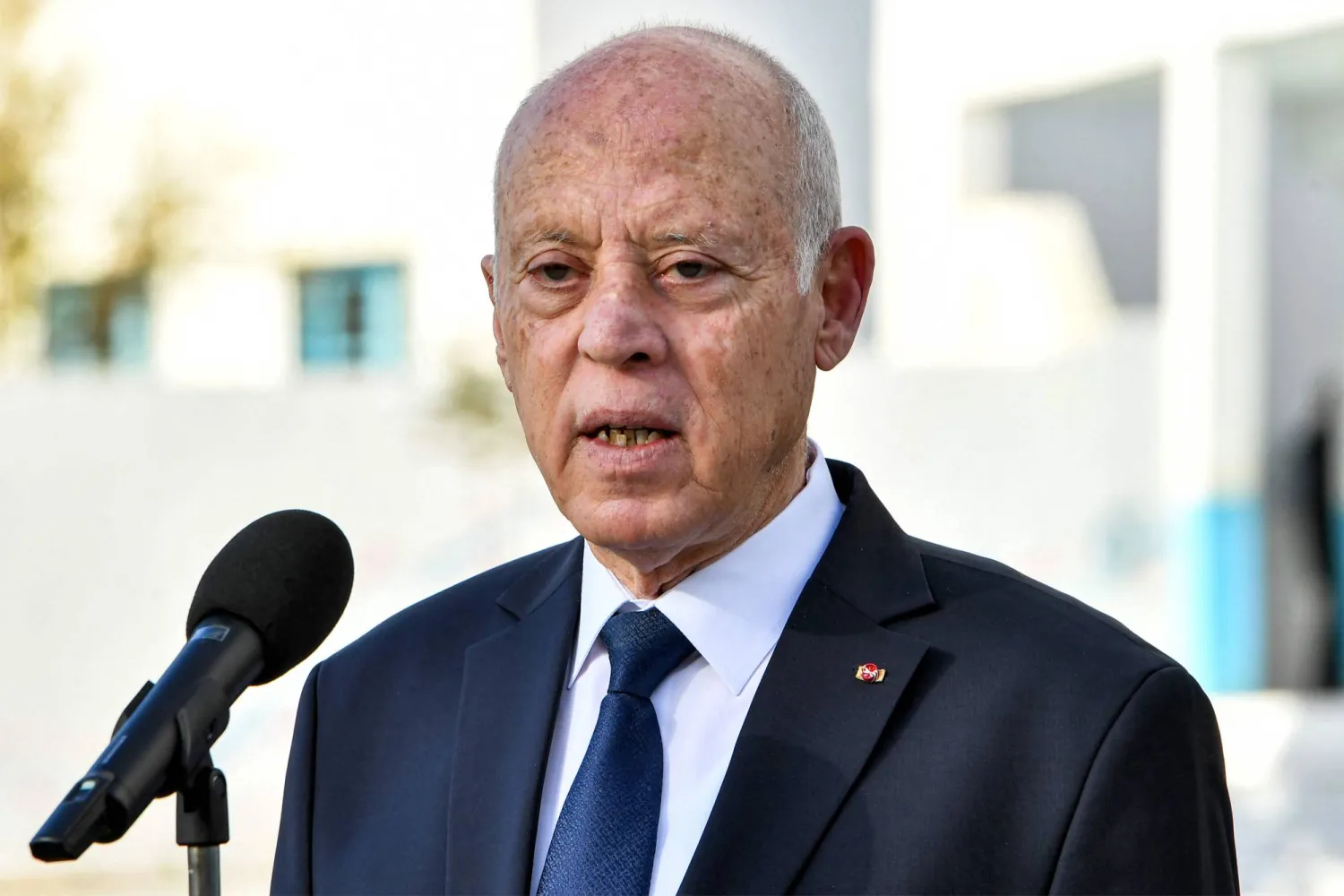
Tunisian President Kais Saied. (AFP)
TT
TT
Tunisia President Sacks Energy Minister Ahead of Renewable Energy Projects Vote
Tunisian President Kais Saied. (AFP)
Tunisia’s President Kais Saied dismissed Energy Minister Fatma Thabet on Tuesday, amid growing controversy over renewable energy projects set to be voted on in parliament.
Saied said he had appointed Housing and Infrastructure Minister Salah Eddine Zouari to temporarily oversee the ministry. No detailed explanation was provided for the decision.
The move comes as Saied's government seeks to pass draft laws on renewable energy, which will be put to a vote in parliament later on Tuesday.
The projects have a planned capacity of 600 megawatts, with 500 million euros ($585 million) as total investment.
The projects are part of Tunisia’s efforts to expand clean energy production. Some lawmakers and political parties oppose the projects, describing them as a form of "energy colonization."
They have criticized the exclusion of the state electricity company (STEG) from the contracts, which they say were awarded exclusively to foreign firms.
Asharq Al-Awsat Reveals Details of New Gaza Proposal
People fetch drinking water at the Bureij camp for Palestinian refugees in the central Gaza Strip on April 28, 2026. (Photo by Eyad Baba / AFP)
Asharq Al-Awsat has obtained details of a new proposal drafted by representatives of the Board of Peace, including the board’s high representative, Nickolay Mladenov, mediators from Egypt, Qatar and Türkiye, as well as the United States, concerning the Gaza Strip, particularly on the issue of disarmament.
The document - described as a “roadmap” for completing implementation of US President Donald Trump’s comprehensive peace plan for Gaza - has 15 provisions to carry out the second phase of the ceasefire agreement that entered into force on Oct. 10, 2025.
A senior Hamas source told Asharq Al-Awsat the proposal had also been conveyed to Israel, and meetings in Cairo could begin Wednesday to discuss responses from all parties, including Hamas and other factions.
The source declined to clarify Hamas’ position following internal consultations. Other sources said Monday that Mladenov would visit Israel before arriving in Egypt on Tuesday for discussions on Israel’s position on the proposal.
Nickolay Mladenov, the Board of Peace's lead envoy for Gaza, speaks during an interview with Reuters during a visit to Brussels, Belgium April 20, 2026. REUTERS/Christian Levaux
The document calls for establishing a committee known as the Implementation Verification Committee, to be created by the High Representative for Gaza and composed of guarantor states, the International Stabilization Force and the Board of Peace, to ensure all parties fulfill their obligations. The committee would be reinforced through an enhanced monitoring mechanism.
In its first provision, the document stresses the importance of all parties fully implementing UN Security Council Resolution 2803 and Trump’s comprehensive plan, describing them as an agreed international framework to guide the process toward restoring civilian life, enabling Palestinian governance, reconstruction, security and economic recovery, and creating conditions for a credible path to Palestinian self-determination and statehood.
The proposal adopts Palestinian demands recently presented by a Hamas and factional delegation, requiring Israel to complete all outstanding commitments from the first phase in full and without delay before moving to the second phase, under the supervision of the verification committee.
According to the document, movement from one stage of the second phase to the next would be conditional on completing all obligations in the preceding stage, under monitoring by the verification committee.
It grants the Board of Peace a mandate to oversee governance, reconstruction and development in Gaza until a reformed Palestinian authority can resume its responsibilities and conditions are created for a credible path to Palestinian statehood.
28 April 2026, Palestinian Territories, Gaza: Palestinian Civil Defense personnel and civilians inspect a vehicle after it was targeted by an Israeli missile on Gaza. Photo: Hadi Daoud/APA Images via ZUMA Press Wire/dpa
The Board of Peace would also be authorized to establish the International Stabilization Force and make arrangements necessary to implement the plan’s objectives.
The document explicitly states Hamas and all Palestinian factions would have no direct or indirect role in governing Gaza. Current civil servants affiliated with Hamas serving in civilian ministries would be dealt with legally and fairly, with full respect for their rights.
It says Gaza must be governed according to the principle of one authority, one law and one weapon, with arms permitted only for individuals authorized by the national committee, while all armed groups would cease military activities.
Newly trained police personnel would be integrated into existing police structures and subjected to security vetting. Those who fail to meet standards would be offered alternative unarmed roles or compensation packages. All police weapons would be transferred to committee control upon its entry into Gaza.
On weapons control, the document outlines a phased disarmament process linked to an agreed implementation timetable, monitored and supported by the office of the High Representative and the verification committee.
The process would be under Palestinian leadership, with weapons transferred to the national committee. All armed groups would participate in inventorying infrastructure and collecting all weapons, though they would not be required to transfer weapons to Israel. The process would be monitored by the verification committee.
The national committee for administering Gaza would have sole authority to register weapons, issue and revoke licenses, and collect unlicensed arms, primarily personal weapons.
Through a gradual process using buyback programs, reintegration assistance and social support, the national committee would oversee weapons collection, with factions committed to cooperating.
The document says surrender of personal weapons by armed members would occur only in parallel with the handover of militia weapons, under conditions ensuring security and police capacity to guarantee personal safety.
It also calls for signing a social peace agreement to prevent internal fighting and violence, ban shows of force, military parades and armed demonstrations, and halt retaliatory acts.
Regarding the International Stabilization Force, the document says it would deploy between areas controlled by Israeli forces and areas under the national committee’s control, but would not conduct policing activities. It would be permitted to support disarmament and humanitarian operations and provide protection for them.
The proposal calls for Israel to complete a phased withdrawal toward Gaza’s borders according to an agreed and implementable timetable, linked to verified progress in the disarmament process.
The national committee would address any security breaches in areas where weapons have been collected.
It also says reconstruction of the enclave would proceed through the entry of building materials into areas where disarmament has been carried out and which are effectively under the administration of the national committee.
Rubio Says Both Lebanon, Israel Agree on Dismantling Hezbollahhttps://english.aawsat.com/arab-world/5267660-rubio-says-both-lebanon-israel-agree-dismantling-hezbollah
Rubio Says Both Lebanon, Israel Agree on Dismantling Hezbollah
Secretary of State Marco Rubio speaks at the State Department, Friday, April 24, 2026, in Washington. (AP Photo/Rod Lamkey, Jr.)
US Secretary of State Marco Rubio said on Tuesday that both the Lebanese and the Israeli governments want the same thing: peace and Hezbollah gone.
In an interview with Fox News, Rubio said the Lebanese people are the victim of the pro-Iran organization, claiming that Israel has no territorial claims on Lebanon.
Asked about the Trump administration’s efforts to try and reach an agreement between Israel and Lebanon, the Secretary of State said the current ceasefire between the two nations “is very unique” because Lebanon and Israel are not at war.
“Israel’s problem is with Hezbollah. Unfortunately, Hezbollah happens to be inside of Lebanon conducting attacks against Israel,” he explained.
The top diplomat said both the Lebanese and the Israelis seek peace.
“They have no problem with one another. Israel has no territorial claims on Lebanon. There isn’t some part of Lebanon that Israel claims belongs to them.”
According to Rubio, the problem Israel has is not with Lebanon but with Hezbollah inside of Lebanon.
Also, he noted, the Lebanese have acknowledged that Hezbollah is a problem for them. “Not only is Israel the victim of Hezbollah, but so are the Lebanese.”
The US official noted that the efforts now focus on the ceasefire and to make sure that Israel has a right to defend itself from an imminent attack or an ongoing attack from Hezbollah elements, who will do everything they can to disrupt the ceasefire.
He said both sides agree that the answer is a Lebanese Armed Forces with the capability to go after and disarm and dismantle Hezbollah inside of their country.
“And that’s what we’re working towards establishing, is a system that actually works where vetted units within the Lebanese Armed Forces have the training, the equipment, and the capability to go after elements of Hezbollah and dismantle them so Israel doesn’t have to do it,” he added.
Rubio said US officials urged Israelis to measure themselves in their response, to make sure their responses are proportional and targeted, and so far that appears to be the case.
“I don’t know what’s happened since I’ve been in this room with you, but that’s so far the case because that’s important,” he said, adding that it’s acknowledged in the agreement that Israel has a right to deal with threats that Lebanon can’t deal with.
Asked whether he sees a scenario where Lebanon joins the Abraham Accords, Rubio said: “We’re not there yet.”
He added: “I mean, obviously that would be very promising, but we’re not at that point. I think what we perceive – and it’s pretty clear – is by and large there is no Lebanese-Israeli conflict per se.”
The Secretary of State said he thinks what needs to happen inside Lebanon is not just that the overwhelming majority of the country, the Sunnis and the Christians, say Hezbollah has been a nightmare for us, but even within the Shiite population that there be a rejection of Hezbollah.
“There should be one government, one armed forces inside of Lebanon, and it should belong to the Lebanese government. And that’s who we should be empowering,” he affirmed.
Who Is Iraq’s PM-Designate Al-Zaidi?https://english.aawsat.com/arab-world/5267628-who-iraq%E2%80%99s-pm-designate-al-zaidi
Despite his close ties to Shiite party leaders in Baghdad and his extensive financial investments, premiership nominee Ali Faleh Kazem al-Zaidi remains largely unknown to most Iraqis outside political circles.
Informed sources say al-Zaidi has multiple financial partnerships with political and business figures both inside and outside the government.
Those familiar with his affairs describe him as “a young man who joined the ranks of the wealthy over the past decade,” noting that he spends generously on social aid and assistance.
Born in Baghdad in 1986, Al-Zaidi holds a law degree and is not known for seeking public attention.
This is despite the fact that he owns Dijlah TV, which he acquired from Jamal and Mohammed al-Karboli, two brothers who are leaders of a Sunni party that competed in elections between 2010 and 2014.
If al-Zaidi succeeds in forming a government, he would become the youngest prime minister to hold the post since 2004.
The Coordination Framework surprised most Iraqis by naming him its candidate for prime minister, even though his name had not appeared among those circulated during the roughly five-month political crisis and government-formation talks.
Financial activities
Asharq Al-Awsat has learned that al-Zaidi is the owner and chairman of Al-Janoob Islamic Bank for investment and finance, a publicly listed company on the Iraq Stock Exchange established in 2016 and operating in the banking sector.
He later stepped down as chairman, handing the role to one of his brothers, after the US State Department placed the bank on its sanctions list in February 2024 for money laundering, prompting the Central Bank of Iraq to block its access to US dollars, according to informed sources.
Al-Zaidi also owns Al-Oweis Group, which, according to its website, includes 15 companies operating across food trade, agricultural and livestock production, contracting, printing, security services, electronics and oil, though it does not disclose its owner or founding date.
Property registration data indicates the company was established in 2007, later dissolved and converted into a private joint stock company with capital of 99 billion Iraqi dinars, about $75 million. An oil services company was also established in 2018 with a capital of 2 billion dinars.
The Iraq Stock Exchange website lists 2016 as the founding year of Al-Janoob Islamic Bank alongside a financial transfer company with capital of 250 billion dinars, about $191 million, meaning the bank’s total capital is less than the cost of a single “food basket.”
The company’s website says its total investments amount to $500 million and that it is responsible for contracts to supply the Trade Ministry’s food basket, as well as contracts with the Defense Ministry to provide food for 300,000 soldiers daily.
It also opened a private university last year named Al-Shaab.
Sources close to al-Zaidi say he holds further investments in education and media, including Al-Shaab University, Ishtar Medical Institute and Dijlah TV.
Sources say the Trade Ministry contracted Al-Oweis, owned by al-Zaidi, to supply food basket items to around 40 million Iraqis, a program inherited from Saddam Hussein’s government under the oil-for-food agreement during the 1990s sanctions period.
Citizens often complain about poor food quality and delivery delays.
However, the sources say the program has been scaled down in recent years to cover 18 million people, citing the exclusion of higher-income groups.
Group of companies
According to additional data, company registration records show that al-Zaidi owns 15 companies registered in his name, with an initial capital exceeding 282 billion Iraqi dinars.
These companies operate across key sectors including general contracting and construction, real estate and tourism investment, oil, gas and electricity, food and glass industries, agricultural and livestock production, as well as higher education, medical and financial services.
Among the most prominent is Al-Oweis, which holds contracts to feed the Iraqi army and import food basket items, alongside Al-Shaab University.
Through Al-Oweis Trading, General Contracting, Food Supply and Food Industries Ltd., al-Zaidi implements multiple projects, including feeding the Iraqi army.
The company signed a partnership contract with the State Company for Foodstuff Trading to supply both dry and fresh rations, covering 41 items for a total of 300,000 personnel.
Another project is the food basket program, under which Al-Oweis signed a partnership contract with the State Company for Foodstuff Trading to supply seven food items to support around 40 million people.
لم تشترك بعد
انشئ حساباً خاصاً بك لتحصل على أخبار مخصصة لك ولتتمتع بخاصية حفظ المقالات وتتلقى نشراتنا البريدية المتنوعة