


Jeddah Summit Stresses Importance of Restoring Navigation Security in Hormuz

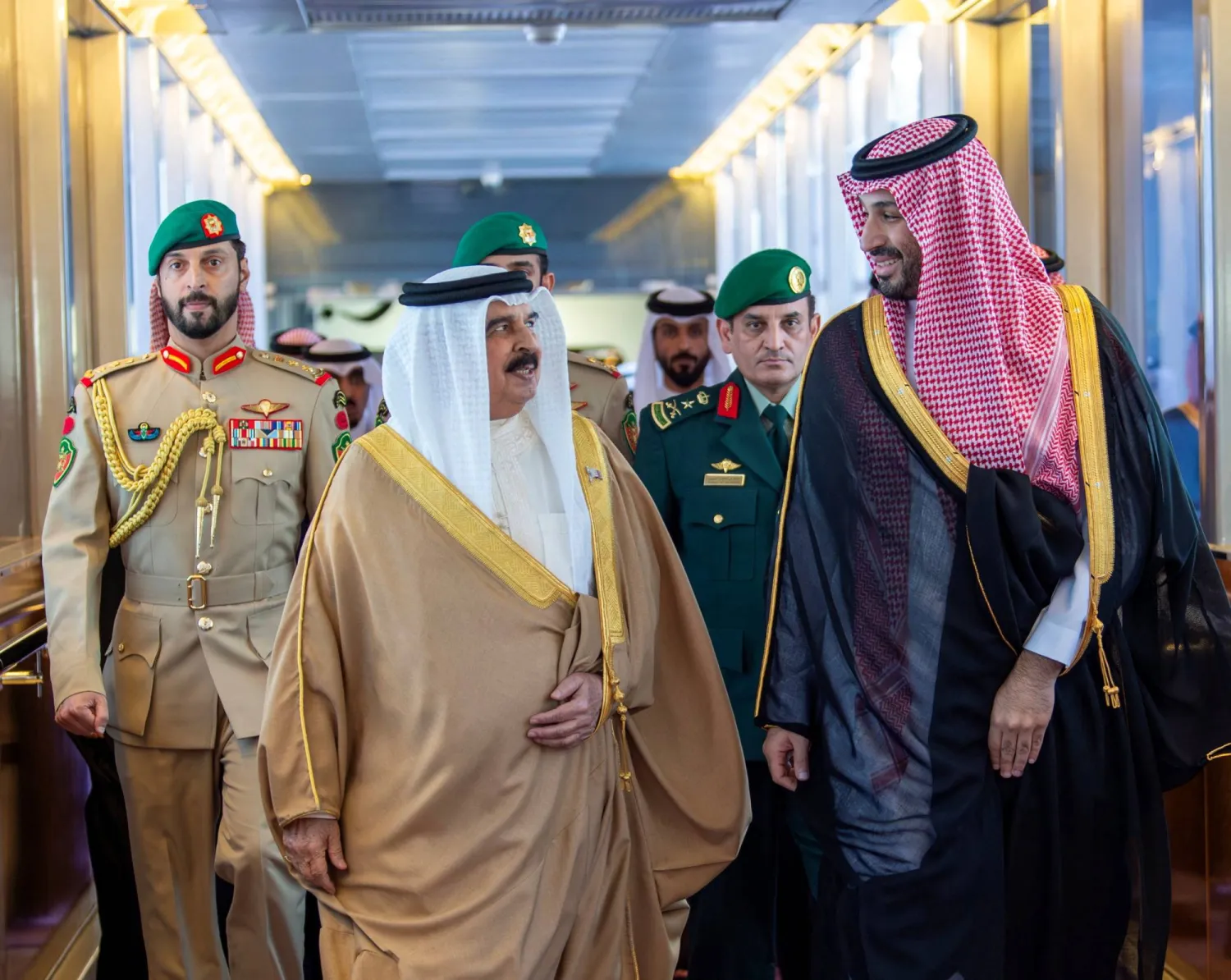
Saudi Crown Prince Mohammed bin Salman receives Bahrain's King Sheikh Hamad bin Isa al-Khalifa ahead of the Gulf Cooperation Council (GCC) meeting in Jeddah, Saudi Arabia, April 28, 2026. Bandar Algaloud/Courtesy of Saudi Royal Court/Handout via REUTERS
TT

Jeddah Summit Stresses Importance of Restoring Navigation Security in Hormuz

Saudi Crown Prince Mohammed bin Salman receives Bahrain's King Sheikh Hamad bin Isa al-Khalifa ahead of the Gulf Cooperation Council (GCC) meeting in Jeddah, Saudi Arabia, April 28, 2026. Bandar Algaloud/Courtesy of Saudi Royal Court/Handout via REUTERS

The Gulf summit, which was chaired on Tuesday by Saudi Crown Prince Mohammed bin Salman, discussed the regional situation.

It affirmed the necessity of restoring navigation security in the Strait of Hormuz and strongly condemned the flagrant Iranian aggressions against the Gulf Cooperation Council (GCC) states and Jordan.

GCC Secretary-General Jasem Albudaiwi affirmed in a statement that the summit was held at the invitation of the Saudi leadership and discussed ways to find a diplomatic path to end the crisis and pave the way for agreements and understandings that address the concerns of the Gulf states and enhance long-term security and stability.

He clarified that the leaders expressed strong condemnation and denunciation of the flagrant Iranian aggressions against the Gulf states and Jordan, emphasizing that these treacherous attacks have led to a sharp loss of confidence by the Gulf states in Iran.

Albudaiwi noted that the leaders praised the ability demonstrated by the Gulf states to deal with the challenges they faced due to this crisis, pointing out that the leaders expressed their categorical rejection of illegal Iranian measures to close the Strait of Hormuz and obstruct navigation in it, affirming the necessity of restoring navigation security and freedom and returning the situation in the Strait to what it was before February 28.

Albudaiwi also highlighted that the leaders of the Gulf states directed the urgency of completing the requirements for achieving access to all joint Gulf projects, including transport and logistics services, along with accelerating the implementation of the GCC railway project.

The Secretary-General of the Council further noted the leaders' affirmation of the importance of promptly taking steps towards establishing an oil and gas pipeline project, a water linkage project between the Gulf states, and moving forward with studying the creation of strategic Gulf reserve areas, in addition to the importance of intensifying military integration among the Council's states and accelerating the completion of the ballistic missile early warning system project.


Albudaiwi: Stability of the Gulf Is Now a Common Int’l Interest

Secretary General of the Gulf Cooperation Council (GCC) Jasem Mohamed Albudaiwi speaks at the panel in Prague on Saturday. (GCC)
TT

Albudaiwi: Stability of the Gulf Is Now a Common Int’l Interest

Secretary General of the Gulf Cooperation Council (GCC) Jasem Mohamed Albudaiwi speaks at the panel in Prague on Saturday. (GCC)

Secretary General of the Gulf Cooperation Council (GCC) Jasem Mohamed Albudaiwi stressed on Saturday that the latest developments demonstrate that security of the Middle East and Europe are "unprecedentedly" connected.

He said the GCC member states consistently seek to bolster security, stability, development, and prosperity to serve the mutual interests of the people in the region and entire world, noting the rapid geopolitical shifts and growing security and economic challenges facing the globe.

Albudaiwi was speaking at a panel session on GCC-European strategic links on the sidelines of the GLOBSEC Global Security Forum 2026 in Prague.

"The GCC General Secretariat’s participation in the GLOBSEC Global Security Forum 2026 embodies its keenness to maintain an active presence in regional and international forums," he continued.

"This engagement aims to bolster communication and exchange perspectives with international partners, decision-makers, and experts, thereby supporting efforts to maintain regional and international security while keeping pace with rapid global changes."

On the conflict in the Middle East, he said: "GCC states have sustained their continuous diplomatic efforts to de-escalate and defuse tensions in the region, promoting paths of dialogue and diplomacy to protect regional security, stability, and the safety of its peoples."

He underscored the paramount importance of protecting the security of air and maritime corridors, ensuring freedom of navigation, the safety of supply chains, and the stability of global energy markets.

"The stability of the Gulf region remains a fundamental pillar for the stability of the global economy and international maritime security," added Albudaiwi.

Furthermore, he explained that recent developments have proven that the security of Europe and the Middle East has become unprecedentedly interconnected.

"Any disruption in the Gulf region and its surrounding maritime passages directly affects the European economy, global energy security, supply chains, and international stability as a whole," he remarked.

"Gulf stability is no longer merely a regional matter, but has become a shared international interest," he continued.

Discussing the future of Gulf-European relations, he said that both sides aspire to elevate their ties to broader horizons.

The upcoming GCC-EU Summit will help in cementing cooperation across numerous fields and achieving the mutual interests of both parties, he added, while underlining the significance of reaching tangible results that serve both sides and elevate their ongoing cooperation.


Saudi FM, Arab and Islamic States Condemn Israeli Actions against Gaza Flotilla Activists

Logo of the Saudi Ministry of Foreign Affairs
TT

Saudi FM, Arab and Islamic States Condemn Israeli Actions against Gaza Flotilla Activists

Logo of the Saudi Ministry of Foreign Affairs

The foreign ministers of Saudi Arabia, Jordan, the United Arab Emirates, Qatar, Indonesia, Pakistan, Egypt, and Türkiye strongly condemned the appalling conduct of extremist Israeli minister Itamar Ben-Gvir against activists in the Gaza-bound flotilla while they were held in Israeli detention.

The ministers stressed that Ben-Gvir’s deliberate public humiliation of detainees constitutes a disgraceful affront to human dignity and a blatant violation of Israel’s obligations under international law, including international humanitarian law and international human rights law.

The ministers further condemned in the strongest terms the illegal and extremist acts of incitement and violence by Ben-Gvir and other Israeli officials directed against Palestinians in the Occupied Palestinian Territory.

The ministers warned that Ben-Gvir’s provocative actions fuel hatred and extremism, and obstruct efforts to advance a just and lasting peace on the basis of the two-state solution.

The ministers demanded accountability for the actions of Ben-Gvir and called for concrete measures to end his repeated provocations, incitement, and violations. They also urged steps to prevent him from posing further threats, and to ensure that such actions are neither tolerated nor repeated.

They further stressed the imperative of protecting human rights, safeguarding the dignity and humane treatment of all detainees, and ensuring full respect for international law in the Occupied Palestinian Territory.


Hajj Pilgrims Flock to Mina on Day of Tarwiyah

Pilgrims flock to Mina for the Day of Tarwiyah. (SPA)
TT

Hajj Pilgrims Flock to Mina on Day of Tarwiyah

Pilgrims flock to Mina for the Day of Tarwiyah. (SPA)

Hajj pilgrims will complete their arrival to Mina on Monday to complete the Day of Tarwiyah amid an integrated system of services prepared by Saudi authorities to ensure that they have a smooth journey throughout their pilgrimage and stay in the Kingdom.

Saudi Health Fahad Abdulrahman Al-Jalajel stressed that no diseases or viruses were detected at the Hajj, easing concerns over the Hantavirus that has captured headlines in recent weeks.

There is no need to be alarmed and pilgrims are in good health, he assured.

Thousands of security forces are on the ground to ensure that the pilgrims flock to Mina safely through dedicated routes. The holy sites in the Makkah are connected through several roads, tunnels and dedicated walking paths.

The pilgrims were making their way from Makkah to Mina without incident thanks to the integrated transportation system made available by the authorities overseeing the Hajj.

The Health Ministry has issued guides for the pilgrims on the optimal use of their umbrellas amid the high temperatures and to avoid heatstroke and UV rays, especially as they make their way to the holy sites.

Meanwhile, the Al-Mashaaer Al-Mugaddassah Metro line operated its first ride on Sunday. It will transport pilgrims across the holy sites, including Mina, Arafat and Muzdalifah. Each of the nine trains can transport 3,000 passengers. This year’s operational plan for the Hajj is aiming to transport over 2 million passengers over 2,000 trips.

The train plays a pivotal role in ensuring the transport is smooth across the holy sites. It has also helped ease traffic after over 50,000 bus rides were cancelled in favor of the use of the trains.