


Iran’s Supreme Leader Vows to Protect Nuclear and Missile Capabilities

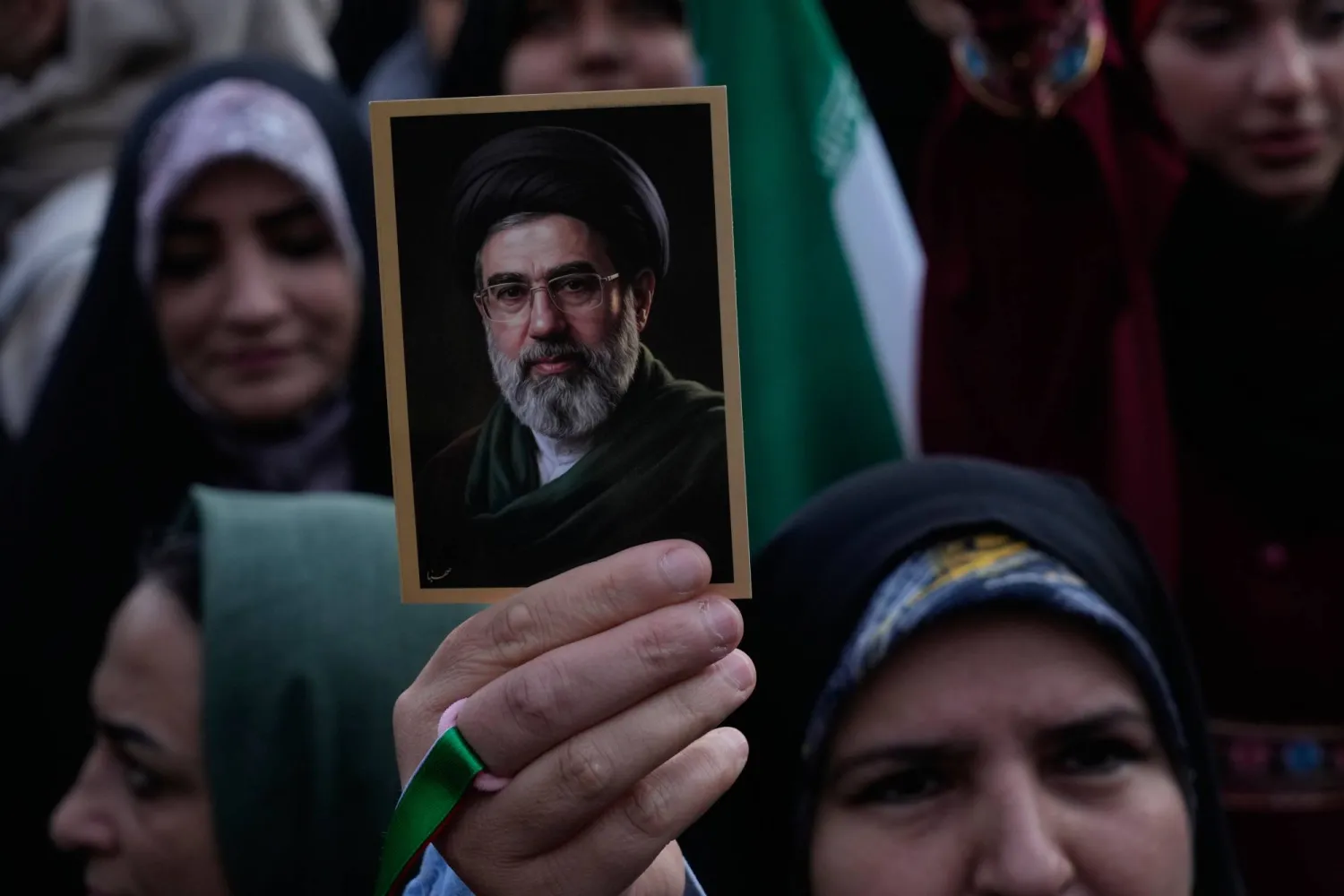
A woman holds up a picture of the Iranian Supreme Leader Mojtaba Khamenei during a state-organized rally in Tehran, Iran, Wednesday, April 29, 2026. (AP)
TT

Iran’s Supreme Leader Vows to Protect Nuclear and Missile Capabilities

A woman holds up a picture of the Iranian Supreme Leader Mojtaba Khamenei during a state-organized rally in Tehran, Iran, Wednesday, April 29, 2026. (AP)

Iran’s supreme leader defiantly vowed Thursday to protect the country’s nuclear and missile capabilities, which US President Donald Trump has sought to curtail through airstrikes and as part of a wider deal to cement the war’s shaky ceasefire.

In a statement read by a state television anchor, Mojtaba Khamenei said the only place Americans belonged in the Gulf is “at the bottom of its waters" and that a “new chapter” was being written in the region's history.

Khamenei has not been seen in public since taking over as supreme leader following the killing of his father in the war’s opening airstrikes.

His remarks come as Iran's economy is reeling and its oil industry is being squeezed by a US Navy blockade halting its tankers from getting out to sea. The world economy is also under pressure as Iran maintains its chokehold on the Strait of Hormuz, through which a fifth of all crude oil is transported. On Thursday, the global benchmark for oil, Brent crude, traded as high as $126 a barrel.

That shock to oil supplies and prices is putting pressure on Trump, who is floating a new plan to reopen the critical passageway used by the Gulf to export their oil and gas.

Under the plan, the US would continue its blockade on Iranian ports, while coordinating with allies to impose higher costs on Iran’s attempts to subvert the free flow of energy, according to a senior administration official, who spoke on condition of anonymity because they were not authorized to comment publicly.

In a cable sent Tuesday, the US State Department instructed American diplomats around the world — except those in Belarus, China, Cuba and Russia — to seek their host government’s support for the Trump administration's call for assistance in establishing a “maritime freedom construct” that would ensure free and unimpeded access to shipping through the strait.

“This commitment reflects broad international consensus on the need for coordinated action to counter Iranian maritime provocations and ensure navigational rights and freedoms in the Strait of Hormuz,” said the cable, a copy of which was obtained by The Associated Press on Thursday.

The initiative, being led by the State Department and the Pentagon’s Central Command, “is a fundamentally defensive response to protect the rights of all countries to navigate international waters freely and safely and to hold Iran accountable for its aggressive and illegal actions to impede the free flow of commerce,” the cable said.

At the same time, Trump has also floated possible changes to US troop presence in allied countries in Europe. The day after the president announced his administration was conducting a review on potentially reducing the US troop presence in Germany, he was asked by a reporter whether he’d weigh pulling US forces out of Italy and Spain — which have sparred with the United States over use of bases for Iran-related operations.

“Why shouldn’t I,” Trump answered. “Italy has not been of any help to us, and Spain has been horrible, absolutely horrible.”

Ceasefire shaken as strait remains shut

The US blockade, which as of Thursday has turned back some 44 commercial vessels, according to US Central Command, is designed to prevent Iran from selling its oil, depriving it of crucial revenue while also potentially creating a situation where Tehran has to shut off production because it has nowhere to store oil.

A recent Iranian proposal would push negotiations on the country’s nuclear program to a later date. Trump said one of the major reasons he went to war was to deny Iran the ability to develop nuclear weapons. Iran has long maintained its program is peaceful, though it enriched uranium at near-weapons-grade levels of 60%.

Pakistan on Thursday said it was still facilitating indirect talks between the US and Iran aimed at easing tensions, but that Islamabad would also welcome direct communication between the two sides, even by phone.

“If the two parties can engage in real-time conversations, that could ease the sticking points,” said Ministry of Foreign Affairs spokesperson Tahir Andrabi at a weekly news briefing. He declined to share details of any Iranian or US proposals.

Khamenei's remarks signaled that nuclear issues and Iran's ballistic missile program wouldn't be traded away.

“Ninety million proud and honorable Iranians inside and outside the country regard all of Iran’s identity-based, spiritual, human, scientific, industrial and technological capacities — from nanotechnology and biotechnology to nuclear and missile capabilities — as national,” Khamenei said.

Khamenei referred to America as the “Great Satan,” a long-hurled insult by Iranian leaders toward the US since the 1979 revolution.

Khamenei signals strait will remain shut

In his remarks, Khamenei seemed to signal Iran would maintain its control over the waterway, which sits in the territorial waters of Iran and Oman. Iran had been charging some ships reportedly $2 million apiece to travel through the strait.

He said that Iran's control of the Strait of Hormuz will make the Gulf more secure, and that Tehran's “legal rules and new management” of the strait will benefit all the region’s nations.

However, the world considered the strait an international waterway, open to all without paying tolls. Gulf Arab nations have decried Iran's control of the strait as akin to piracy.

Crackdown intensifies in Iran

Iran announced Thursday it hanged a 21-year-old man over charges stemming from the nationwide protests in January, the judiciary’s Mizan news agency reported.

The agency identified the executed man as Sasan Azadvar, from Isfahan. It said he was hanged for the crime of “effectively cooperating with the enemy by attacking police officers” during the protests.

Activists and rights groups say a crackdown on dissent, including a wave of executions, has further intensified since the US-Israel war with Iran.

UN Human Rights Chief Volker Turk said on Wednesday at least 21 people have been executed since the start of the war.

Iran routinely holds closed-door trials in which defendants are unable to challenge the accusations they face, rights groups say, warning that several other people remain at risk of execution.

Fighting continues in southern Lebanon

Despite a ceasefire between Israel and Lebanon-based, Iran-backed Hezbollah, the group has continued to claim attacks on Israeli troops in southern Lebanon. Israel's military said one of its soldiers was killed in battle there Thursday, raising the troop casualties to 17 since the Iran war started.

Air raid sirens sounded multiple times in border communities in northern Israel on Thursday, too. The Israeli military said it struck military structures used by Hezbollah, and the Lebanese Health Ministry said 9 were killed in strikes, including women and children.

Late on Thursday, the foreign ministry of United Arab Emirates — which has come under attack by Iran during war — announced a travel ban for its citizens covering Iran, Lebanon and Iraq, and urged those already in those countries to return home.



French FM: US's Hormuz Coalition 'Not in Competition' with France, UK-led Bid

French Minister for Europe and Foreign Affairs Jean-Noel Barrot, French Prime Minister Sebastien Lecornu and French Government Spokesperson Maud Bregeon attend the questions to the government session at the National Assembly in Paris, France, April 28, 2026. REUTERS/Abdul Saboor
TT

French FM: US's Hormuz Coalition 'Not in Competition' with France, UK-led Bid

French Minister for Europe and Foreign Affairs Jean-Noel Barrot, French Prime Minister Sebastien Lecornu and French Government Spokesperson Maud Bregeon attend the questions to the government session at the National Assembly in Paris, France, April 28, 2026. REUTERS/Abdul Saboor

France's top diplomat on Friday said a new US-led coalition to reopen the Strait of Hormuz would complement and not compete with a similar mission spearheaded by France and Britain.

Foreign Minister Jean-Noel Barrot, speaking in Abu Dhabi following a regional tour, said he briefed Gulf allies on the UK-France initiative which was now at an "advanced" stage.

On Thursday, a US official confirmed to AFP that Washington was launching an international coalition dubbed the "Maritime Freedom Construct" to restart shipping in the vital route.

The strait, which normally carries one-fifth of the world's oil and liquefied natural gas, has been effectively blockaded by Iran over the Middle East war, sending prices soaring and choking trade networks.

The UK and France have led talks on a separate maritime effort, recently holding a meeting with more than 50 countries in London.

The US mission is "not of the same nature as the one we established... it comes as a sort of complement", Barrot said in the capital of the United Arab Emirates, following visits to Saudi Arabia and Oman.

"It is not in competition with the initiative we have launched and on which we are focused," he added.

The Wall Street Journal said a reported diplomatic cable called on US embassies to press foreign governments to take part in the US-led effort.

Asked whether France would join Washington's initiative, Barrot said he could not comment at this stage.

The UK-France mission "is now at an advanced stage, the planning has been finalized, and I have come to present the concept of this mission to a number of our closest partners in the region,” he added.

US President Donald Trump has lashed out at allies' reluctance to get involved in the US-Israeli war on Iran, and previously urged oil-reliant nations to take responsibility for reopening the strait.

Iran has vowed not to reopen the waterway as long as the United States blockades its ports. The closure has had a widespread impact on the global economy, with oil prices hitting a four-year high this week.


Prosecutors Release Video of Armed Man Storming Correspondents’ Dinner

White House Correspondents' Association Dinner shooting suspect Cole Tomas Allen sprints past security personnel in a screengrab form security camera video, at Washington Hilton Hotel, Washington DC, US, April 25, 2026. (US Attorney Jeanine Pirro via X/Handout via Reuters)
TT

Prosecutors Release Video of Armed Man Storming Correspondents’ Dinner

White House Correspondents' Association Dinner shooting suspect Cole Tomas Allen sprints past security personnel in a screengrab form security camera video, at Washington Hilton Hotel, Washington DC, US, April 25, 2026. (US Attorney Jeanine Pirro via X/Handout via Reuters)

Federal prosecutors released a video Thursday showing the moment authorities say a man armed with guns and knives tried to storm the White House Correspondents’ Association dinner and attempt to kill President Donald Trump.

Jeanine Pirro, the US attorney for Washington, posted the video on social media amid questions over whose bullet struck a Secret Service officer as Cole Tomas Allen ran through security with a long gun toward the hotel ballroom packed with journalists, administration officials and others.

Prosecutors had previously claimed the agent was shot in the bullet-resistant vest during the melee, but had not confirmed it was Allen who shot the agent. Pirro, however, said Thursday that there is no evidence that the officer was hit by friendly fire.

The video appears to show Allen run through a magnetometer and point his weapon at the agent, who fired back five times, according to authorities. It's not clear from the video at what moment Allen's weapon fires.

Allen was injured but was not shot during the Saturday night attack at the Washington Hilton, which disrupted one of the highest-profile annual events in the nation’s capital.

Allen agreed earlier Thursday to remain jailed while he awaits trial. He did not enter a plea during his brief appearance in federal court.

Secret Service Director Sean Curran defended the agency's security plan for the event and said he would not change it. He said in a Fox News interview that the attack was stopped within seconds at the outermost perimeter of a multi-layered security bubble around the president.

The distance from the magnetometers to the podium where Trump was seated was 355 feet, with two sets of stairs, a doorway and many more armed Secret Service officers in between, he said.

"The site was set up perfectly," Curran said.

The nearly six-minute video released by Pirro shows Allen walking back and forth down a hallway the day before the attack, and briefly checking out the hotel gym. Footage from the security checkpoint shows about a dozen federal officers taking down magnetometers and casually standing around when the gunman emerges from a doorway and starts sprinting toward them. The gunman quickly reaches the officers before most of them appear to notice him.

Only one officer visible in the video appears to have drawn his gun before the gunman passed; Pirro said he's the one who was shot and returned fire.

In court papers pressing for Allen's continued detention, prosecutors wrote Wednesday that Allen took a picture of himself in his hotel room just minutes before the incident, and that he was outfitted with an ammunition bag, a shoulder gun holster and a sheathed knife.

In a message that authorities say sheds light on his motive, Allen referred to himself as a “Friendly Federal Assassin” and alluded obliquely to grievances over a range of Trump administration actions.

Allen’s lawyers agreed during the brief hearing before US Magistrate Moxila Upadhyaya to keep their client behind bars for now after initially arguing in court papers that Allen should be released.

In a court filing Wednesday, the defense wrote that the government’s case is “based upon inferences drawn about Mr. Allen’s intent that raise more questions than answers” and noted that Allen’s writings never mentioned Trump by name. The defense left the door open to pressing in the future for Allen’s release before trial.

“The government’s evidence of the charged offense — the attempted assassination of the president — is thus built entirely upon speculation, even under the most generous reading of its theory,” defense lawyers wrote.

Allen was charged on Monday with that crime, as well as two additional firearms counts, including discharging a weapon during a crime of violence. He faces up to life in prison if convicted of the assassination count alone.

Allen, 31, is from Torrance, California. He worked as a part-time tutor for a test preparation company and is an amateur video game developer.


Russian Attack Hit Port Infrastructure in Ukraine’s Odesa Region, Officials Say

Burned buses following a Russian strike on a residential area in Odesa, southwestern Ukraine, 30 April 2026. (EPA)
TT

Russian Attack Hit Port Infrastructure in Ukraine’s Odesa Region, Officials Say

Burned buses following a Russian strike on a residential area in Odesa, southwestern Ukraine, 30 April 2026. (EPA)

A Russian drone attack overnight damaged port infrastructure in Ukraine's southern Odesa region and wounded two people in the city of ‌Odesa, regional ‌governor Oleh Kiper said ‌on ⁠Friday.

In Odesa, an ⁠apartment was destroyed and the roof caught fire following strikes on a 16-storey building. In another high-rise, the ⁠fire engulfed the ‌12th ‌floor, emergency services said.

They posted ‌photos of a high-rise ‌building ablaze and firefighters working at the sites.

Ukraine's seaports authority said ports ‌in the Greater Odesa hub and on the ⁠Danube ⁠River came under attack.

It said the strikes caused damage to the berthing and storage facilities and started local fires, which were promptly brought under control.

The ports continue to operate, it added.