


Berri to Asharq Al-Awsat: No Point Negotiating with Israel Under Fire

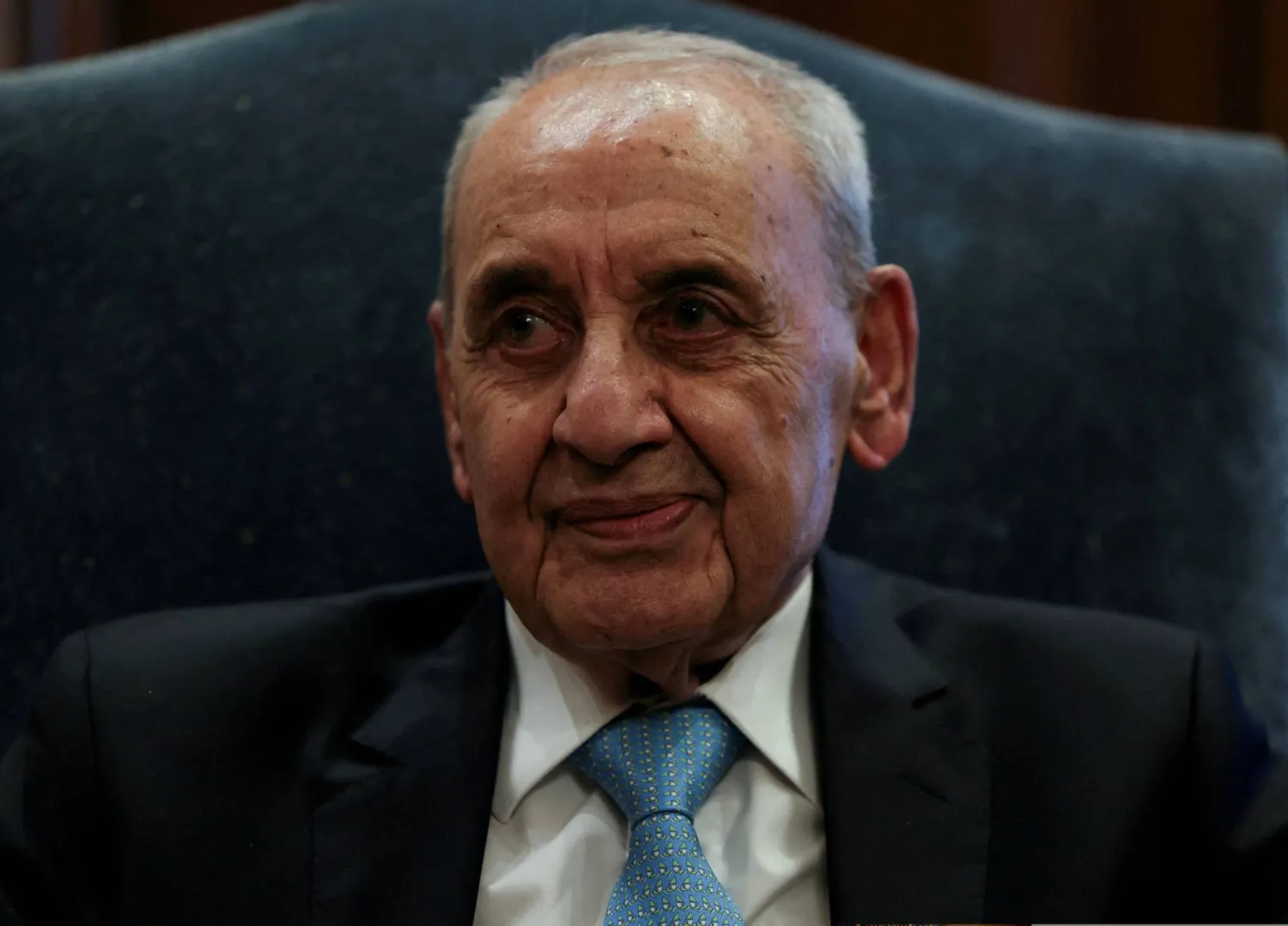
FILE PHOTO: Lebanese Parliament Speaker Nabih Berri meets with Italian Prime Minister Giorgia Meloni (not seen) in Beirut, Lebanon October 18, 2024. REUTERS/Mohamed Abd El Ghany/File Photo
TT

Berri to Asharq Al-Awsat: No Point Negotiating with Israel Under Fire

FILE PHOTO: Lebanese Parliament Speaker Nabih Berri meets with Italian Prime Minister Giorgia Meloni (not seen) in Beirut, Lebanon October 18, 2024. REUTERS/Mohamed Abd El Ghany/File Photo

In his first comment on the statement issued by the US Embassy in Beirut, which called on President Joseph Aoun to hold a direct meeting with Israeli Prime Minister Benjamin Netanyahu, Parliament Speaker Nabih Berri told Asharq Al-Awsat that the statement “speaks for itself, and I have nothing to add.”

He added that his response to the president “came in reply to what he said while receiving economic bodies” (in reference to Aoun’s remarks about full coordination with Berri regarding negotiations). This, he said, explains his apology for not attending the meeting that had been scheduled with President Aoun and Prime Minister Nawaf Salam at the presidential palace.

Berri also addressed the extension of the truce for three weeks, brokered by US President Donald Trump, asking: “Where is this truce?” Has Israel stopped leveling towns, demolishing homes, shedding the blood of children, women and the elderly, preventing rescue teams from saving the wounded and transporting them to hospitals, or retrieving those trapped under rubble until they died?

He also pointed to the targeting of medical bodies and paramedics, which led to the killing of dozens of them, questioning whether all these victims were part of Hezbollah’s military infrastructure, as Israel claims to justify the destruction of southern towns.

He said the so-called truce has allowed Israel to press ahead with its aggression and commit unprecedented massacres, without US intervention to compel it to halt hostilities and entrench a ceasefire, particularly since Washington was behind securing the truce extension.

This, he added, obliges it to honor its commitment to the Lebanese and the international community. Otherwise, what is the point of negotiations under Israeli fire? And what would be said to the families of those killed in what he described as Israeli treachery in the south?

Aoun and Berri: divergence, not a rupture

In this context, a parliamentary source following presidential relations said the emerging dispute between Aoun and Berri remains within the bounds of differing interpretations of the US State Department statement.

The source told Asharq Al-Awsat that mediators intervened to cool tensions between the two sides, ruling out any rupture given the difficult and delicate circumstances Lebanon is going through, which require collective efforts, starting with the presidents, to compel Israel to cease fire and entrench it before asking Lebanon to enter direct negotiations, even if indirect talks would be preferable, as the US administration is expected to pursue.

The source added that as long as the three presidents agree on the necessity of halting hostilities ahead of any negotiation track with Israel, the recalibration of positions on the sidelines of the cabinet session helped ease tensions between Aoun and Berri, opening the way for renewed momentum in presidential relations. None of the presidents, the source said, has an interest in the absence of consultation, which is essential to reach a roadmap for handling the negotiations matter.

The source noted that there is no alternative to renewed coordination among the three presidents as long as they adhere to national constants and do not compromise them, as a prerequisite for launching negotiations that cannot be held without being paired with a firmly established ceasefire. This, he said, calls on Trump to intervene with Israel to stop it from escalating its aggression.
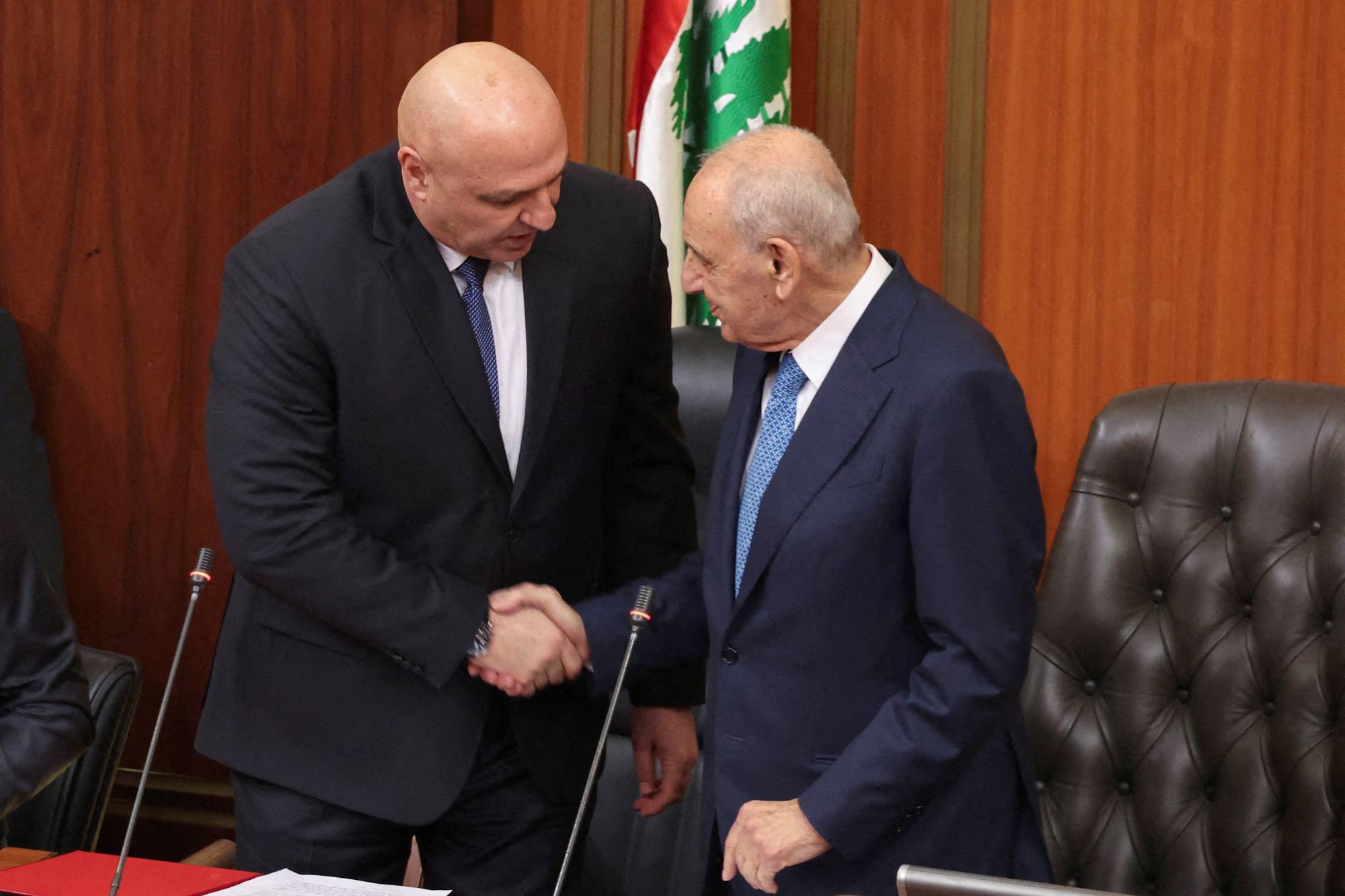
FILE PHOTO: Lebanese Parliament Speaker Nabih Berri shakes hands with Lebanon's army chief Joseph Aoun after he is elected as the country's President at the parliament building in Beirut, Lebanon, January 9, 2025. REUTERS/Mohamed Azakir/File Photo

Berri’s stance on negotiations

The parliamentary source defended Berri’s position, questioning why the US administration has not intervened to compel Israel to implement the ceasefire agreement it sponsored in coordination with France in 2024, which never came into force. Instead, it allowed Israel to continue violating it by expanding its aggression beyond the south to Beirut’s southern suburbs and towns in the Bekaa.

He confirmed that Hezbollah responded to Berri’s position and adhered, to the fullest extent, to the cessation of hostilities, playing, with the party’s authorization, a role in reaching it with the then US mediator Amos Hochstein, under US and French sponsorship. This came, he said, while Israel was given free rein to continue its aggression under the pretext of self-defense through preemptive strikes against what it claims are threats to its northern settlements.

The source said Hezbollah’s commitment to the ceasefire for 15 months, contrasted with Israel’s insistence on violating it, placed it in a difficult position, especially with Washington refraining from pressuring Israel to halt its breaches, leading to an expanded offensive, despite prior commitments to synchronized steps by both sides as a condition for implementing the agreement.

He added that Nawaf Salam’s government, while primarily betting on a diplomatic track to compel Israel to withdraw from the south, faced Israeli defiance of the agreement and continued pressure through fire to force Lebanon to accept its terms.

The three-week truce

The source said the three-week truce remained ink on paper, enabling Israel to turn the south into an open military operations zone, continuing systematic destruction across areas south and north of the Litani River, displacing residents under pressure to evacuate their towns.

He expressed confidence that President Aoun remains committed to his position that securing a ceasefire must come first as a prerequisite for launching direct negotiations between the two countries under US sponsorship, without compromising national constants regardless of pressure.

This position, he added, aligns with his understanding with Berri and Salam, and was reaffirmed in the latest cabinet session when Aoun said negotiations have not yet begun, meaning he rejects any negotiation track before Israel halts its military pressure on Lebanon.

Securing a ceasefire

The source stressed that Aoun will not agree to begin negotiations unconditionally, foremost without a secured ceasefire. From his perspective, US pressure to urgently arrange a meeting with Netanyahu could inflame the domestic atmosphere and raise tensions amid growing disagreements if such pressure is met without guarantees for Lebanon, primarily a ceasefire and the return of displaced people to their villages.

He confirmed his support for Aoun’s preference not to rush into a meeting with Netanyahu, considering the timing premature. Such a meeting, he said, should come as the culmination of an agreement that responds to the national constants upheld by the president, in exchange for ending the state of war between the two countries, with subsequent steps to be addressed later.

He also questioned why the call for Aoun to meet Netanyahu was issued by the US Embassy in Beirut rather than the White House, noting that Aoun raised this matter during his meeting with US Ambassador to Beirut Michel Issa, who had recently returned from Washington, to clarify the reasons behind issuing the statement from the embassy, which he described as unprecedented in the history of relations between the two countries.



US Backing for Al-Zaidi Rattles Baghdad Calculations

Iraq’s prime minister-designate Ali Al-Zaidi attends a Coordination Framework meeting in Baghdad on April 27 (AP)
TT

US Backing for Al-Zaidi Rattles Baghdad Calculations

Iraq’s prime minister-designate Ali Al-Zaidi attends a Coordination Framework meeting in Baghdad on April 27 (AP)

The US administration went beyond its embassy’s congratulatory post in Baghdad for Iraq’s prime minister-designate, Ali Al-Zaidi, and a phone call by its envoy to Syria, Tom Barrack. It stepped up its engagement with a call from US President Donald Trump to Al-Zaidi.

Trump did not stop at the call, he then posted on his social media platform, Truth Social, congratulating Ali al-Zaidi and wishing him “success as he works to form a new Government free from terrorism that could deliver a brighter future for Iraq.”

The US president expanded on that vision, saying, “We look forward to a strong, vibrant, and highly productive new relationship between Iraq and the United States,” and calling it “the beginning of a tremendous new chapter between our Nations — Prosperity, Stability, and Success like never seen before.”

He also invited Al-Zaidi to visit Washington after his government wins a confidence vote.

The US stance appeared decisive and influential across several political forces, particularly within the Shi’ite camp.

Some leaders had been waiting for a signal from Trump rejecting Al-Zaidi’s nomination, which would have returned the process to the Coordination Framework, after it seemed to have temporarily slipped from its grasp with the nomination of an economic figure facing questions tied to previous US restrictions on his bank’s dollar transactions.

The US move unsettled armed factions, especially after three of their leaders were designated on terrorism lists, with financial rewards offered for information about them. Among those was a senior figure in the Coordination Framework who disappeared from view during recent meetings, along with leaders of other factions.

At the same time, additional complications emerged over the positions of political forces and figures previously considered for the premiership, amid talk of an undeclared US veto on some names, alongside clear support for Al-Zaidi.

This reshuffled dynamics within the Shi’ite political landscape.

“The last supper”

Alongside what appeared to be strong US backing, albeit conditional on forming a government “free of terrorism,” Al-Zaidi secured broad regional and international support, placing Iraqi political forces before a new equation.

Within the Shi’ite camp, this backing removed any suggestion that Al-Zaidi’s nomination was merely a political maneuver and weakened the chances of returning to the Coordination Framework's alternative names.

Some factions, despite recognizing his experience in economic files, had hoped to politically contain him, a prospect that has become more complicated under international backing.

Kurdish and Sunni forces had been counting on imposing their terms in forming the government, particularly regarding cabinet portfolios. However, US support for Al-Zaidi reshaped the negotiating balance and weakened his rivals’ ability to deal with him under traditional rules of engagement.

Concerns also surfaced within some political circles that Al-Zaidi could emerge as a strong, internationally backed prime minister, potentially reshaping internal balances and reducing the influence of regional actors, foremost among them Iran, which has yet to announce a clear position on his nomination. This silence has raised questions within Shi’ite circles about its implications.

Domestic moves

In a related development, Al-Zaidi received a phone call from Asif Ali Zardari, who congratulated him on being tasked with forming a government.

During the call on Friday, Al-Zaidi extended a formal invitation to Zardari to visit Iraq. The two sides discussed bilateral relations and ways to strengthen them in both countries’ interests. Al-Zaidi praised Pakistan’s role in easing regional tensions, while the Pakistani president expressed readiness to accept the invitation after the government is formed.

The Coordination Framework nominated Al-Zaidi on April 26 to form the new government, and he is preparing to present his cabinet to parliament within the constitutional deadline.

In parallel, the Coordination Framework plans to establish specialized advisory bodies to support the incoming government.

Aqil al-Rudaini, spokesman for the Victory Alliance, said these bodies would cover vital sectors such as energy, investment and anti-corruption, and aim to provide advice to the prime minister.

Al-Rudaini said the success or failure of the prime minister would be the responsibility of the alliance.

He added that the number of these bodies has yet to be finalized and will be determined after the government is formed, and that they will include experts and advisers across various fields to support government performance.


Israelis No Longer See Netanyahu as Best PM Choice

Israeli Prime Minister Benjamin Netanyahu attends Holocaust Remembrance Day ceremony in Jerusalem, April 14, 2026 (AP)
TT

Israelis No Longer See Netanyahu as Best PM Choice

Israeli Prime Minister Benjamin Netanyahu attends Holocaust Remembrance Day ceremony in Jerusalem, April 14, 2026 (AP)

A new opinion poll shows that Israelis, for the first time since he became their leader, no longer view Benjamin Netanyahu as the most suitable figure for prime minister, with Naftali Bennett overtaking him.

The results also show Bennett is no longer the only challenger, as former general Gadi Eisenkot now outpaces both.

The findings come from a weekly poll by Maariv, conducted with Lazar Research, headed by Menachem Lazar, and Pane4ll. Respondents were asked the standard question, “Who is the most suitable political figure for the post of prime minister?”

For nearly four years, Netanyahu consistently led his rivals, even when party polling suggested his government could fall.

But in the poll published on Friday, Bennett ranked first for the first time, with 46% saying he is more suitable than Netanyahu, who scored 41%. Eisenkot also surpassed Netanyahu, with 44% compared with 42%.

When Netanyahu was excluded from the comparison, Eisenkot edged ahead, winning 33% to Bennett’s 32%, signaling growing public confidence in him.

The poll also points to a shift in the Knesset balance if elections were held now. A joint list between Bennett and Yair Lapid, announced earlier this week, would emerge as the largest party with 28 seats, ahead of Likud with 26.

A previous poll had shown the two could win 31 seats combined if they ran separately, Bennett 24 and Lapid 7, but the joint list would still be positioned to receive the mandate to form a government.

Opposition figures see the alliance as generating fresh momentum and are pressing Eisenkot to join with his party, “Yashar,” to form a bloc strong enough to defeat Netanyahu.

Eisenkot, however, is not rushing to join a lineup that would place him second to Bennett. With his popularity rising, he is waiting for further polls, and if his support continues to climb, he is expected to seek the top spot on a unified list and run as its candidate for prime minister.

The survey also shows a sharp decline for Netanyahu’s coalition, dropping from 68 seats to 50. Likud accounts for the biggest fall, sliding from 36 to 26 seats. Religious parties drop from 18 to 15, while Bezalel Smotrich’s party, currently holding 8 seats, disappears.

The only right-wing party to gain is that of Itamar Ben-Gvir, rising from 6 to 9 seats.

Jewish opposition parties would secure 60 seats, alongside 10 for Arab parties, leaving them short of forming a stable government unless they abandon their refusal to partner with Arab factions or expand their support further.

Netanyahu, however, is far from finished. He is preparing multiple strategies to counter the opposition, including efforts to reunite Ben-Gvir and Smotrich, form a new right-wing party to recover lost votes, and advance legal and administrative measures that could reduce the influence of Arab parties.

Some accuse him of preparing steps that could manipulate elections or sway outcomes using artificial intelligence.

At the same time, the opposition is reassessing its position to strengthen cohesion and avoid internal rifts. Veteran political commentator Nahum Barnea says Eisenkot is best placed to advance steadily in an election battle in a way that would be difficult for Netanyahu to undermine.

Though a former army chief of staff, Eisenkot is seen as modest, and the deaths of his son and nephew in the recent war have brought him closer to the public. Barnea notes that Eisenkot displays a quote attributed to David Ben-Gurion on his wall: “It is good for our enemies to know that Israel’s security is led by an unbreakable man.”

He projects a positive approach to regional issues. Unlike Bennett, he backs a two-state solution and the Oslo Accords. He has openly criticized the war in Iran and Lebanon, describing both fronts as failures, and his stance toward Arab parties is not marked by racism.

Barnea also recounts that “legendary pilot” Iftach Spector asked Eisenkot why he rejects forming a government with an Arab party, noting Arabs make up 20% of Israel’s population.

Eisenkot replied: “Pay attention to what I said. I said I would form a Zionist and official government. ‘Official’ includes Arabs and ultra-Orthodox Jews. Anyone joining must meet three conditions: Israel as a Jewish and democratic state, the values of the Declaration of Independence, and commitment to service, military or civilian.”


Aoun Insists on Ceasefire Before Lebanon-Israel Talks

A billboard depicting Lebanese President Joseph Aoun and sentence reading in Arabic "The decision is up to Lebanon" is seen in the predominantly Christian Ashrafieh neighborhood in Beirut, Lebanon, 01 May 2026. (EPA)
TT

Aoun Insists on Ceasefire Before Lebanon-Israel Talks

A billboard depicting Lebanese President Joseph Aoun and sentence reading in Arabic "The decision is up to Lebanon" is seen in the predominantly Christian Ashrafieh neighborhood in Beirut, Lebanon, 01 May 2026. (EPA)

Lebanese President Joseph Aoun is pushing to lock in a ceasefire and halt Israeli strikes on civilians before Lebanese and Israeli representatives resume bilateral talks in Washington, as Hezbollah continues to vehemently reject the negotiations.

Aoun is under pressure from both sides. The United States is urging direct engagement between Lebanon and Israel, including a meeting between Aoun and Israeli Prime Minister Benjamin Netanyahu. Hezbollah, meanwhile, rejects direct talks outright.

Aoun says diplomacy is the only option to secure a ceasefire, ensure an Israeli withdrawal, and extend state control across all Lebanese territory. But he refuses any meeting with Netanyahu, after rejecting even a phone call with him as part of a US-mediated three-way contact.

Consolidating the ceasefire

Aoun’s push to cement the ceasefire was discussed with US Ambassador to Beirut Michel Issa, hours after the US Embassy said a direct meeting between Aoun and Netanyahu, "facilitated by President Trump, would give Lebanon the chance to secure concrete guarantees on full sovereignty, territorial integrity, secure borders, humanitarian and reconstruction support, and the complete restoration of Lebanese state authority over every inch of its territory -- guaranteed by the United States."

The Lebanese presidency said Aoun met Issa after returning from Washington and reviewed developments, focusing on consolidating the ceasefire and stopping attacks on civilians and civilian facilities, ahead of further Washington talks aimed at securing peace and stability along the border.

Issa reaffirmed the US’s continued support for Lebanon and its institutions. Aoun thanked Washington for its backing.

Prime Minister Nawaf Salam also met Issa to discuss consolidating the ceasefire and negotiations with Israel, the prime minister’s office said.

Sources close to the presidency told Asharq Al-Awsat that a ceasefire and a halt to attacks on civilians and civilian facilities are “the basis for completing negotiations.”

Aoun’s position on a direct meeting “is known and declared,” the sources said. “Anyone who rejected a phone call with Netanyahu will certainly reject meeting him.”

Hezbollah pressure

Alongside US pressure, Aoun faces pressure from Hezbollah, which has vowed to keep fighting Israel in the south, and is holding the state responsible for the path it is taking.

Hezbollah’s Loyalty to the Resistance parliamentary bloc said the authorities’ move toward direct negotiations is “rejected and condemned,” calling it a deviation from national principles, a violation of sovereignty, and a contradiction of the Taif Accord and national consensus.

It said it is “not concerned at all” with their outcomes.

The bloc accused Israel of daily killings of civilians and systematic destruction of border villages, calling them war crimes that will not deter people from defending the country, but instead reinforce support for the resistance- Hezbollah.

It added that such actions should push the authorities to “stop their series of free concessions.”

Geagea

The move toward direct talks with Israel has drawn support from some political forces, led by the Lebanese Forces.

MP Sethrida Geagea said Lebanon’s current phase “cannot tolerate more one-upmanship or populist rhetoric,” which she said has only led to further collapse.

She voiced full support for Aoun’s efforts to end the war through a “clear and explicit negotiating path” aimed at protecting Lebanon and re-establishing the state as the sole authority.