


US Warns Shipping Firms They Could Face Sanctions Over Paying Iranian Tolls in Strait of Hormuz

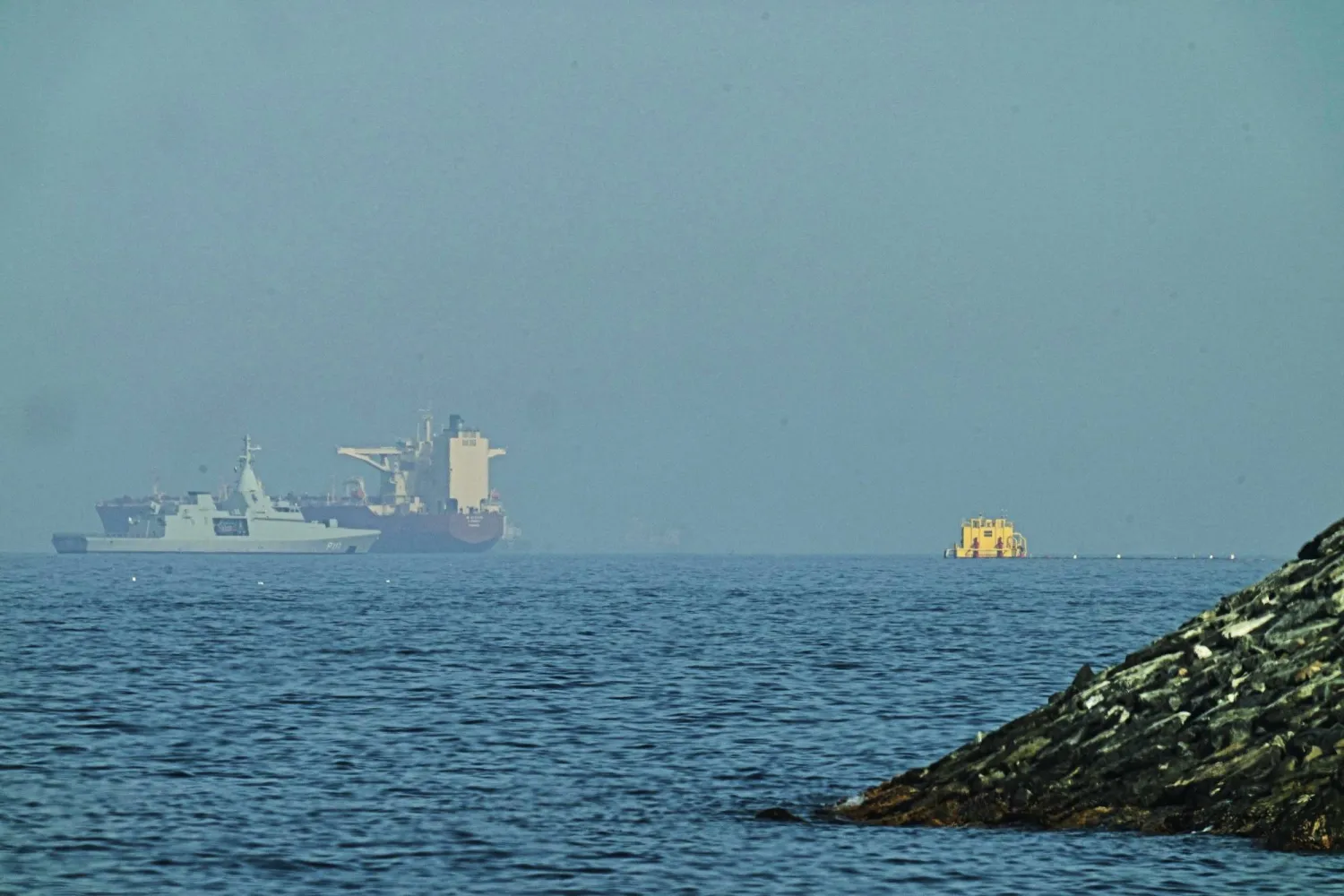
 An Emirati patrol boat, left, is near a tanker anchored in the Gulf of Oman near the Strait of Hormuz, as seen from a coastal road near Khor Fakkan, United Arab Emirates, Friday, May 1, 2026. (AP)
An Emirati patrol boat, left, is near a tanker anchored in the Gulf of Oman near the Strait of Hormuz, as seen from a coastal road near Khor Fakkan, United Arab Emirates, Friday, May 1, 2026. (AP)
TT

US Warns Shipping Firms They Could Face Sanctions Over Paying Iranian Tolls in Strait of Hormuz

 An Emirati patrol boat, left, is near a tanker anchored in the Gulf of Oman near the Strait of Hormuz, as seen from a coastal road near Khor Fakkan, United Arab Emirates, Friday, May 1, 2026. (AP)
An Emirati patrol boat, left, is near a tanker anchored in the Gulf of Oman near the Strait of Hormuz, as seen from a coastal road near Khor Fakkan, United Arab Emirates, Friday, May 1, 2026. (AP)

The United States is warning shipping companies that they could face sanctions for making payments to Iran to safely pass through the Strait of Hormuz. 

The alert posted Friday by the US Office of Foreign Assets Control adds another layer of pressure in the standoff between the US and Iran over control of the Strait of Hormuz. 

About a fifth of the world's trade in oil and natural gas typically passes through the strait at the mouth of the Gulf in peacetime. 

Iran effectively closed the strait to normal traffic by attacking and threatening to attack ships after the US and Israel launched a war on Feb. 28. It later began offering some ships safe passage by detouring them through alternate routes closer to its shoreline, charging fees at times for the service. 

That "tollbooth” effort is the focus of the US sanctions warning. 

The payment demands could include transfers not only in cash but also “digital assets, offsets, informal swaps, or other in-kind payments,” including charitable donations and payments at Iranian embassies, OFAC said. 

“OFAC is issuing this alert to warn US and non-US persons about the sanctions risks of making these payments to, or soliciting guarantees from, the Iranian regime for safe passage. These risks exist regardless of payment method,” it said. 

The US responded to Iran's closure of the strait with a naval blockade of its own on April 13, preventing any Iranian tankers from leaving and depriving Iran of oil revenue it needs to shore up its ailing economy. 

The US Central Command said 45 commercial ships have been told to turn around since the blockade began. 

Trump rejects Iranian proposal  

The warning came as US President Donald Trump swiftly rejected Iran’s latest proposal to end the war between the countries. 

“They want to make a deal, I’m not satisfied with it, so we’ll see what happens,” Trump said Friday at the White House. He didn't elaborate on what he saw as its shortcomings but expressed frustration with the Iranian leadership. 

“It’s a very disjointed leadership,” Trump said. “They all want to make a deal, but they’re all messed up.” 

Iran’s state-run IRNA news agency reported Iran handed over its plan to mediators in Pakistan on Thursday night. 

The shaky three-week ceasefire between the US and Iran appears to be holding, though both countries have traded accusations of violations. The standoff is increasingly putting pressure on the global economy, driving up prices and leading to shortages of fuel and other products tied to the oil industry. 

Negotiations continued by phone after Trump called off his envoys’ trip to Pakistan last week, the president said.  

Iranian Foreign Minister Abbas Araghchi has briefed many of his regional counterparts on the country's initiatives to end the ear, according to his social media. He also held talks Friday with European Union foreign policy chief Kaja Kallas, who is in contact with the EU’s Gulf partners. 

China’s UN envoy urges Iran to lift restrictions  

Fu Cong, the Chinese ambassador to the United Nations, said Friday that maintaining the ceasefire is “the most urgent issue" as well as bringing together the sides to resume good faith negotiations “to make sure that the ground is laid for reopening of Hormuz.” 

Foreign Minister Wang Yi “has been on the phone almost constantly” with representatives from all sides, Fu said, adding that China supports Pakistan’s efforts to mediate between the parties. 

Fu stressed the root cause of the tremendous suffering in Iran and neighboring countries and the growing turmoil in the global economy, especially in developing countries, “is the illegitimate war by the US and Israel.” 


North Korea's Kim Vows to Accelerate Military Buildup

A photo released by the official North Korean Central News Agency (KCNA) shows North Korean leader Kim Jong Un (C) speaking during the Second Plenary Meeting of the Ninth Central Committee of the Workers' Party of Korea (WPK) held from 20-22 June 2026 in Pyongyang, North Korea (issued 23 June 2026). EPA/KCNA
TT

North Korea's Kim Vows to Accelerate Military Buildup

A photo released by the official North Korean Central News Agency (KCNA) shows North Korean leader Kim Jong Un (C) speaking during the Second Plenary Meeting of the Ninth Central Committee of the Workers' Party of Korea (WPK) held from 20-22 June 2026 in Pyongyang, North Korea (issued 23 June 2026). EPA/KCNA

Kim Jong Un vowed to beef up North Korea's defense capabilities, citing military modernization efforts by South Korea and the United States pushing the region "to the brink of a nuclear war", state media reported Tuesday.

Pyongyang is under multiple sets of sanctions over its nuclear program, and the two Koreas remain technically at war because their 1950-53 conflict ended in an armistice rather than a peace treaty, AFP said.

"Comrade Kim Jong Un in his concluding speech reaffirmed the steadfast policy stand of our Party and state to beef up the national defense capabilities faster," the official Korean Central News Agency quoted the leader as saying.

The speech was delivered as Kim presided over a three-day meeting of the Workers' Party of Korea that wrapped up on Monday, during which senior officials reviewed policy initiatives, KCNA said.

It quoted Kim as saying "the US and the ROK are pushing forward with the ROK's possession of a nuclear submarine while getting evermore undisguised in their moves towards the reinforcement and modernization of armed forces in the region", referring to South Korea by the acronym of its official name.

According to KCNA, Kim said such moves were "pushing the situation in the Korean peninsula to the brink of a nuclear war".

In the face of such developments, it was the "steadfast stand" of the North to "further expand and strengthen the powerful and absolutely reliable deterrent for self-defense", Kim said.

- 'Line of no retreat' -

KCNA said the meeting "unanimously recognized that to steadily expand and strengthen the nuclear forces... is the most correct and unique way to actively and confidently cope with the unpredictable international military and political situation".

It added the North's development of a war deterrent "with nuclear technology as a basis" would proceed "at increasing speed".

Pyongyang has repeatedly declared itself an "irreversible" nuclear state since a 2019 summit between Kim and Trump in Hanoi collapsed over the scope of denuclearization and sanctions relief.

Kim's powerful sister, Yo Jong, said this month the North's nuclear policy was a "line of no retreat", reiterating the regime's position that it has no intention of giving up its nuclear arsenal.

South Korean President Lee Jae Myung said last week that US counterpart Donald Trump had told him it was time to "pay attention to the North Korea issue".

He told reporters he had told Trump at a meeting of the G7 in France that sanctions on the North were "ineffective."

"I also said that we can no longer deal with the North Korean nuclear issue in the same way we deal with other countries, and President Trump agreed," Lee added.


US Authorizes Iranian Oil Sales Amid Talks on Final Peace Deal

US Treasury Secretary Scott Bessent attends a bilateral meeting during the G7 Summit in Evian-les-Bains, France, June 17, 2026. (Reuters)
TT

US Authorizes Iranian Oil Sales Amid Talks on Final Peace Deal

US Treasury Secretary Scott Bessent attends a bilateral meeting during the G7 Summit in Evian-les-Bains, France, June 17, 2026. (Reuters)

The United States authorized Iranian oil sales on Monday, easing decades-old sanctions as it pushes toward a final peace deal with Tehran in return for commitments on nuclear inspections and free transit through the Strait of Hormuz.

The general license, announced by the Treasury Department, allows the sale of crude oil and petrochemical and petroleum products of Iranian origin through August 21.

The license says Iranian oil can be imported into the US when necessary to complete ‌its sale, delivery ‌or offloading. The US has not meaningfully imported Iranian ‌oil ⁠since Washington imposed measures ⁠after the 1979 revolution.

"In line with the ongoing productive talks in Switzerland, Iran has committed to free and open transit in the Strait of Hormuz and to permit International Atomic Energy Agency (IAEA) inspectors into their country," Treasury Secretary Scott Bessent wrote on X.

"As part of the framework, Treasury has issued a temporary 60-day general license authorizing the production, delivery and sale of Iranian oil."

Under a memorandum of ⁠understanding signed last week between Washington and Tehran, the US ‌agreed to issue waivers for the export ‌of Iranian crude oil, petroleum products and derivatives, and all associated services, including banking transactions, insurances ‌and transportation.

Payment of funds to Iran may be made in US dollar-denominated ‌funds, according to the license.

Cuba, North Korea and Crimea are among those excluded from the license.

Washington first sanctioned Iran in 1979 when revolutionary students seized the US embassy in Tehran, holding diplomats hostage. Numerous additional sanctions have been imposed since then over the ‌nuclear program and Iran's support for groups the US deems terrorist organizations.

Independent Chinese refiners have been the main buyers ⁠of sanctioned Iranian ⁠oil, taking advantage of deep discounts as others avoided such purchases. India, South Korea, Japan, Italy, Greece, Taiwan and Türkiye were also major buyers of Iranian crude before US sanctions were reimposed in 2018.

Mediators said on Monday that Washington and Tehran made "encouraging progress" at the first round of talks aimed at reaching a final peace deal. The talks began under the terms of the memorandum of understanding reached last week to extend a tenuous ceasefire from April for at least another 60 days.

Oil prices had risen sharply when Tehran started blockading the Strait of Hormuz, prompting a US blockade of Iranian ports, but after the interim deal, fell to their lowest since before the war began on February 28 with US-Israeli attacks on Iran.


Taiwan Begins 5-Day Military Drill with Tanks Patrolling Streets

This picture taken and released by Taiwan's Central News Agency (CNA) on June 22, 2026 shows a row of armored military vehicles driving along the highway in Taoyuan, Taiwan. (AFP photo / CNA Photo)
TT

Taiwan Begins 5-Day Military Drill with Tanks Patrolling Streets

This picture taken and released by Taiwan's Central News Agency (CNA) on June 22, 2026 shows a row of armored military vehicles driving along the highway in Taoyuan, Taiwan. (AFP photo / CNA Photo)

Taiwan kicked off a five-day set of military drills on Monday aimed at boosting the island's combat readiness in case of a Chinese military attack.

In the city of Taoyuan, home to the island's largest international airport, tanks drove down city streets and highways, videos and photos of the exercise showed, as armored vehicles from the Army’s 269th Infantry Brigade conducted combat readiness patrols morning.

The Immediate Combat Readiness Exercises are meant to test how rapidly military units can deploy, especially in the face of a possible sudden escalation of Chinese grey-zone warfare. Grey-zone tactics refer to a range of aggressive tactics that vary from navy ship patrols to drone flights, but fall short of direct combat.

The exercises, announced Sunday afternoon, are meant to be realistic, the Ministry of Defense said in a statement, with an emphasis on “real-time, live-fire and on-site."

These exercises are designed to simulate what would happen before enemy forces launched their ships, according to Taiwan's semi-official Central News Agency. The series of exercises could also include impromptu ones in the future, including real-time responses to Chinese military drills.

China's People's Liberation Army sent 23 aircraft towards Taiwan from Sunday into Monday morning, according to Taiwan's defense ministry. That was accompanied by seven navy ships and five other Chinese government ships. China sends war planes, drones and navy ships towards the island on a daily basis.

Taiwan regularly conducts combat readiness drills as it seeks to bolster its defense capabilities amid ongoing military pressure from China, which claims the self-governed island as its own territory and has not ruled out the use of force to bring it under its control. Earlier in June, Taiwan fired rockets in China's direction for the first time as part of a military exercise.
