


Australia, Japan Strengthen Critical Minerals Ties

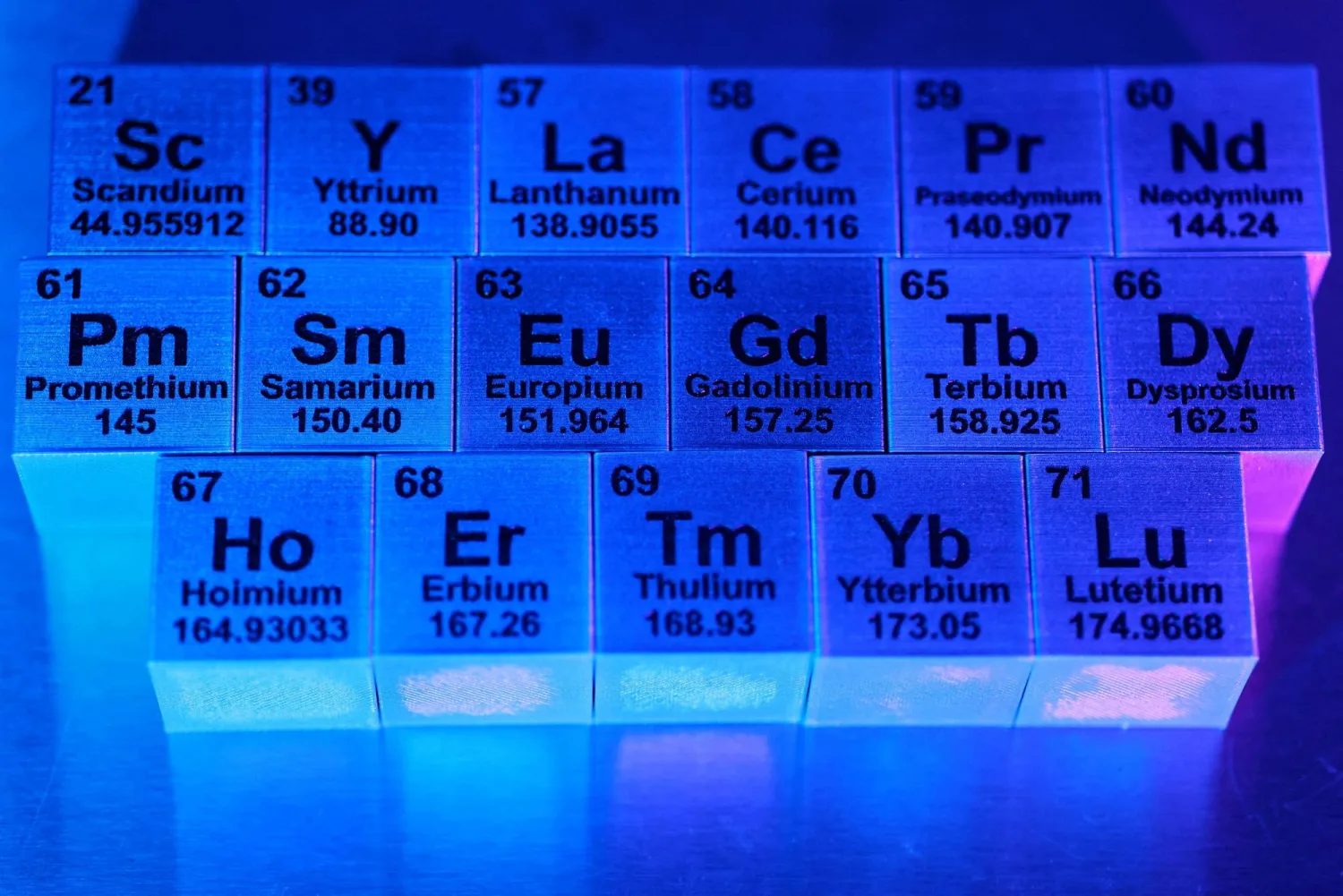
FILE PHOTO: Blocks with symbols and atomic numbers of Rare Earth Elements (REE), in this illustration taken January 21, 2026. REUTERS/Dado Ruvic/Illustration/File Photo
TT

Australia, Japan Strengthen Critical Minerals Ties

FILE PHOTO: Blocks with symbols and atomic numbers of Rare Earth Elements (REE), in this illustration taken January 21, 2026. REUTERS/Dado Ruvic/Illustration/File Photo

Australia and Japan have beefed up their cooperation around critical minerals amid a state visit by Japan's prime minister, with the countries providing A$1.67 billion ($1.20 billion) in support for the sector and flagging more to come.

Australia and Japan will focus on strategic projects to address the most urgent supply chain vulnerabilities in mining, refining and manufacturing in the two countries, Reuters quoted the Australian government as saying in a statement.

Australia plans to provide up to A$1.3 billion, while the government of Japan has provided approximately A$370 ⁠million in investments and grants, ⁠and plans to provide further investments and grants as projects develop, the statement said.

The projects build on the long-time backing by Sojitz and Japan Organization for Metals and Energy Security (JOGMEC) for Australia's Lynas Corp, the world's largest producer of rare earths outside ⁠China, Reuters reported.

Projects that may be in line for government funding include:

Alcoa, with Sojitz and the Japanese government, is working to develop gallium recovery at one of its operating alumina refineries in Western Australia, for use in semiconductors, LEDs, and solar cells.

Magnium Australia, in Western Australia, plans to produce high purity magnesium used in the automotive and aerospace sectors

Tivan's Speewah Fluorite project in Western Australia is set to produce acid-grade ⁠fluorite, a ⁠key raw material for hydrofluoric acid used in semiconductors, electric vehicles, and other advanced applications

The Copi Critical Minerals Project in New South Wales is a mineral sands project looking to supply critical minerals and rare earth elements. The project is owned by RZ Resources, with participation from JX Advanced Metals and Marubeni.

Ardea Resources' Kalgoorlie Nickel project, Goongarrie, is one of the largest nickel cobalt resources in Australia. It is being developed as a joint venture with Sumitomo Metal Mining and Mitsubishi.



Oil Slips After Trump Says US Will Assist Ships Stranded in Strait of Hormuz

The oil tanker Safeen Elizabeth sails across the Bosphorus, in Istanbul, Türkiye, Saturday, May 2, 2026. (AP)
TT

Oil Slips After Trump Says US Will Assist Ships Stranded in Strait of Hormuz

The oil tanker Safeen Elizabeth sails across the Bosphorus, in Istanbul, Türkiye, Saturday, May 2, 2026. (AP)

Oil prices eased on Monday after President Donald Trump said the United States would begin an effort to assist ships stranded in the Strait of Hormuz, but the lack of a US-Iran peace deal kept the market supported above $100.

Brent crude futures fell 6 cents, or 0.1%, to $108.11 a barrel by 0400 GMT after settling ‌down $2.23 on Friday. ‌US West Texas Intermediate was at $101.50 ‌a barrel, ⁠down 44 cents, ⁠or 0.4%, following a $3.13 loss on Friday.

"The broader market remains tightly supported by persistent supply disruptions and geopolitical uncertainty," said Priyanka Sachdeva, analyst at Phillip Nova.

"Unless there is a clear and sustained resolution that restores normal flows through the Strait of Hormuz, oil prices are likely to remain elevated, with risks ⁠still tilted toward further upside."

Trump said on Sunday ‌that the US will ‌guide ships safely out of the Strait of Hormuz, but oil prices ‌stayed above $100 a barrel, with no peace deal in ‌sight and shipping through the strategic waterway still constrained.

Negotiations between the US and Iran continued over the weekend with the countries assessing responses from each other.

Trump has made securing a nuclear deal ‌with Tehran a priority, but Iran wants to defer nuclear talks until after the war and ⁠first lift ⁠rival blockades on Gulf shipping.

On Sunday, the Organization of the Petroleum Exporting Countries and their allies, or OPEC+, said they will raise oil output targets by 188,000 barrels per day in June for seven members, the third consecutive monthly rise.

The increase is the same as that agreed for May minus the share of the United Arab Emirates, which left OPEC on May 1.


UAE Exits Arab Oil Exporter Group OAPEC

(FILES) An Emirati man stands at the oil terminal of Fujairah during the inauguration ceremony of a dock for supertankers on September 21, 2016. (Photo by Karim SAHIB / AFP)
TT

UAE Exits Arab Oil Exporter Group OAPEC

(FILES) An Emirati man stands at the oil terminal of Fujairah during the inauguration ceremony of a dock for supertankers on September 21, 2016. (Photo by Karim SAHIB / AFP)

The United Arab Emirates has left the Organization of Arab Petroleum Exporting Countries (OAPEC), ⁠a statement from the intergovernmental organization that is headquartered in Kuwait showed on Sunday.

The ⁠statement follows UAE's announcement on April 28 of its departure from the OPEC and OPEC+ producer groups, to prioritize boosting its ⁠own ⁠output.

OAPEC was formed in 1968 with the aim of boosting cooperation among Arab oil exporters.


Lebanon’s Central Bank Governor: 90% of Depositors Are a Priority, IMF Deal is ‘Last Credible Pathway’

Lebanese Central Bank Governor Kareem Said (AP)
TT

Lebanon’s Central Bank Governor: 90% of Depositors Are a Priority, IMF Deal is ‘Last Credible Pathway’

Lebanese Central Bank Governor Kareem Said (AP)

Lebanon’s central bank Governor Karim Souaid said on Sunday a prioritization of smaller depositors that make up mostly 90 percent of accounts is both economically rational and socially necessary, adding that an agreement with the International Monetary Fund is “the last credible pathway to anchor reforms.”

In an opinion piece for Britain’s Financial Times headlined “Lebanon needs help to secure its economic recovery,” Souaid wrote that the country’s “economic crisis is often described as complex. It is not. It is the predictable result of fiscal indiscipline by dilettante governments, monetary mismanagement by the central bank and the concentrated misallocation of private savings by the banking sector.”

Yet, he praised the government’s “policy adjustments,” which he said “are moving the country in the right direction.”

“Fiscal balances have improved, largely through higher tax collection and constrained spending. This is key, but not enough to resolve all impediments towards recovery,” he wrote.

Restructuring of banks

According to Souaid, the central bank’s proposed banking restructuring framework considers that “losses must be allocated between principal stakeholders — the state, the central bank and the commercial banks — before a turnaround can take shape.”

He stressed that “the prioritization of smaller depositors — the overwhelming majority of accounts at almost 90 percent — is both economically rational and socially necessary.”

Souaid added that “a banking system cannot be rebuilt on impaired assets and inadequate capital. It must be recapitalized with fresh equity or seriously downsized, to reflect economic reality. Anything in between merely prolongs stagnation.”

The cash economy and fighting corruption

Souaid warned against a cash-based economy, saying it weakens tax collection, damages growth and facilitates illegal financial activities. He called for restoring trust in the formal banking system by reversing this trend.

He added that the central bank is supporting criminal and civil actions, in Lebanon and abroad, against former officials and banking principals implicated in fraud. "The objective is clear — reclaim this misappropriated money and uphold the rights of depositors whose funds have long borne the cost of such abuses."

Armed conflict and the negotiations with the IMF

“There is still one factor that no economic model can easily absorb: armed conflict,” said Souaid. “War brings uncertainty that deters investment, accelerates capital flight and erodes gains from policy reforms. Under such conditions, even sound economic measures yield diminished returns.”

The governor wrote that “the IMF is deeply engaged with the government in negotiations that aim towards a constructive resolution plan — arguably the last credible pathway to anchor reforms and a sustainable recovery. Lebanon has little room to impose any counter-conditions so the chance of an accord is rather positive.”

Message to the international community

Souaid lamented that “international actors have provided sound advice in abundance. Friends and neighbors have offered support, in principle. However, financial support has been more limited.”

“This reflects a familiar hesitation: a preference for policy correction before capital commitment. Yet stabilization often requires both to proceed. Without a bridge, even well-designed reforms risk exhaustion before they take hold.”

Souaid said he was sending a “clear” message to the international community, by saying “support a reform-driven government now or defer assistance and risk a far more destabilized reality, after conflict has taken its toll and without the assurance of the institutional capacity needed to implement it.”