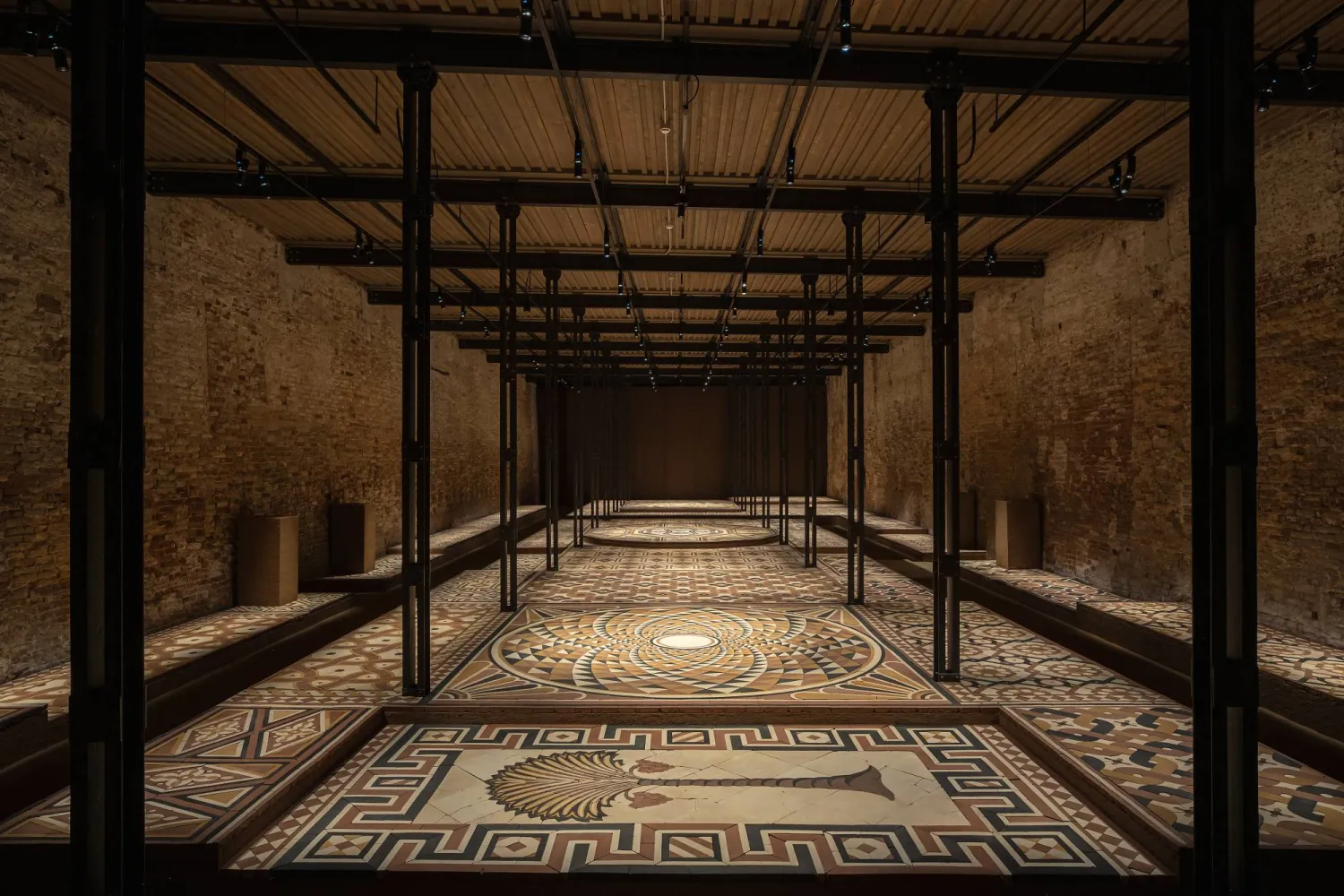

In the Saudi Pavilion at the Venice Biennale, a Saudi artist of Palestinian origin, Dana Awartani, takes us on an immersive journey to discover an artistic map of archaeological and historical landmarks destroyed by war. It is not a geographical map, but rather a magnificent mosaic composed of thousands of clay pieces, molded and baked under the Riyadh sun, then colored with natural pigments to form geometric patterns and designs.
These patterns are drawn from historical sites, buildings, and monuments that stood for centuries in the Arab region, witnessing the rise and fall of states and kingdoms, until they too were destroyed, stripped of their place and significance in the collective Arab heritage.

In her work, Awartani has consistently depicted these waves of demolition and destruction. Her monumental piece at the first Riyadh Contemporary Art Biennale, which encapsulated a part of the history of the Great Mosque in Aleppo, Syria, and the tiles of the Hammam al-Samra in Gaza, which she presented at the Bukhara Contemporary Art Biennale last year, was unforgettable.
Documentation with Clay and Colors
Awartani has been working on this theme for years, convinced that we must document what we lose daily, through destruction and attempts at erasure.
She speaks of her research to learn more about the increasing number of buildings and archaeological sites that are being demolished. Her work coincides with escalating violence in the region, thus providing an immediate commentary as events unfold.
In Venice, her work documents twenty-three sites of significant historical importance, each possessing immense cultural and material value.
The Beginning in Riyadh
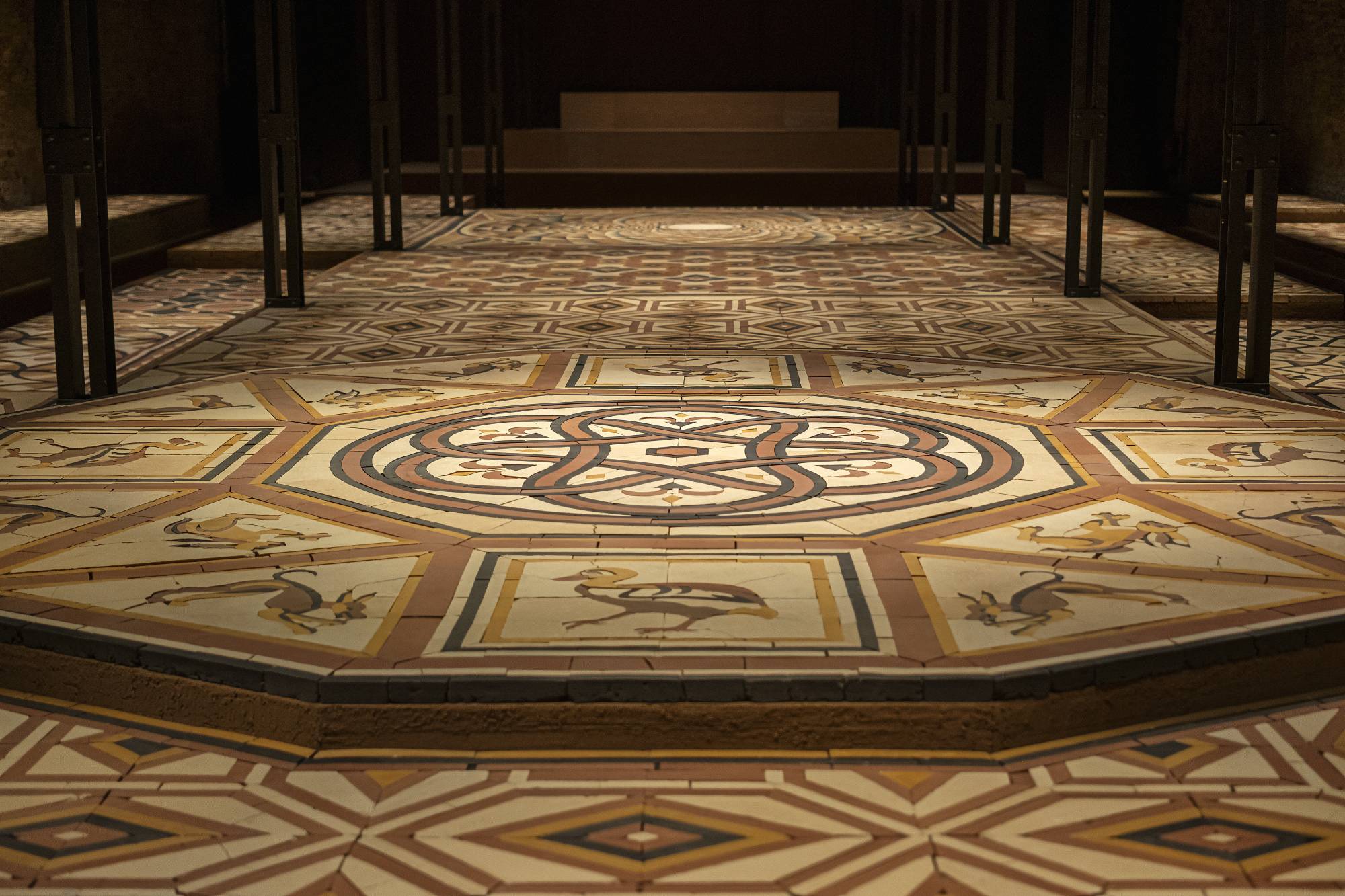
In her studio in Riyadh, Awartani began working on the monumental piece that represents Saudi Arabia at this year’s Biennale. Under the scorching Arabian sun, workers and craftsmen were engrossed in shaping and arranging clay molds according to a meticulously detailed blueprint. Awartani would be there, overseeing the craftsmen’s labors, discussing how their pieces fitted into the larger concept.
For her Venice piece, she chose a title inspired by the poetry of Abu Nuwas: "May your tears never dry, you who weep over the ruins." However, for the poet such behaviour was a waste of time. Awartani begs to differ.
The theme of ruins is a recurring motif in her work. She has described numerous Arab monuments whose virtual destruction merits our tears. Her work involves a unique perspective on these remnants, incorporating them into her art.
During our interview, she spoke about archaeological sites, mosques, churches, and several synagogues that were reduced to rubble by an aggressive attack that disregarded history and culture.
In contrast to Abu Nuwas, she draws upon the melancholy of these places: “I believe that these stones carry their history and tell the stories of the people who lived here for hundreds of years. These stones were all that remained after the living had passed away. Therefore, I did not agree with that poem, but I quoted that particular sentence out of context and used it to illustrate my point of view.”
The Mosaic Carpet
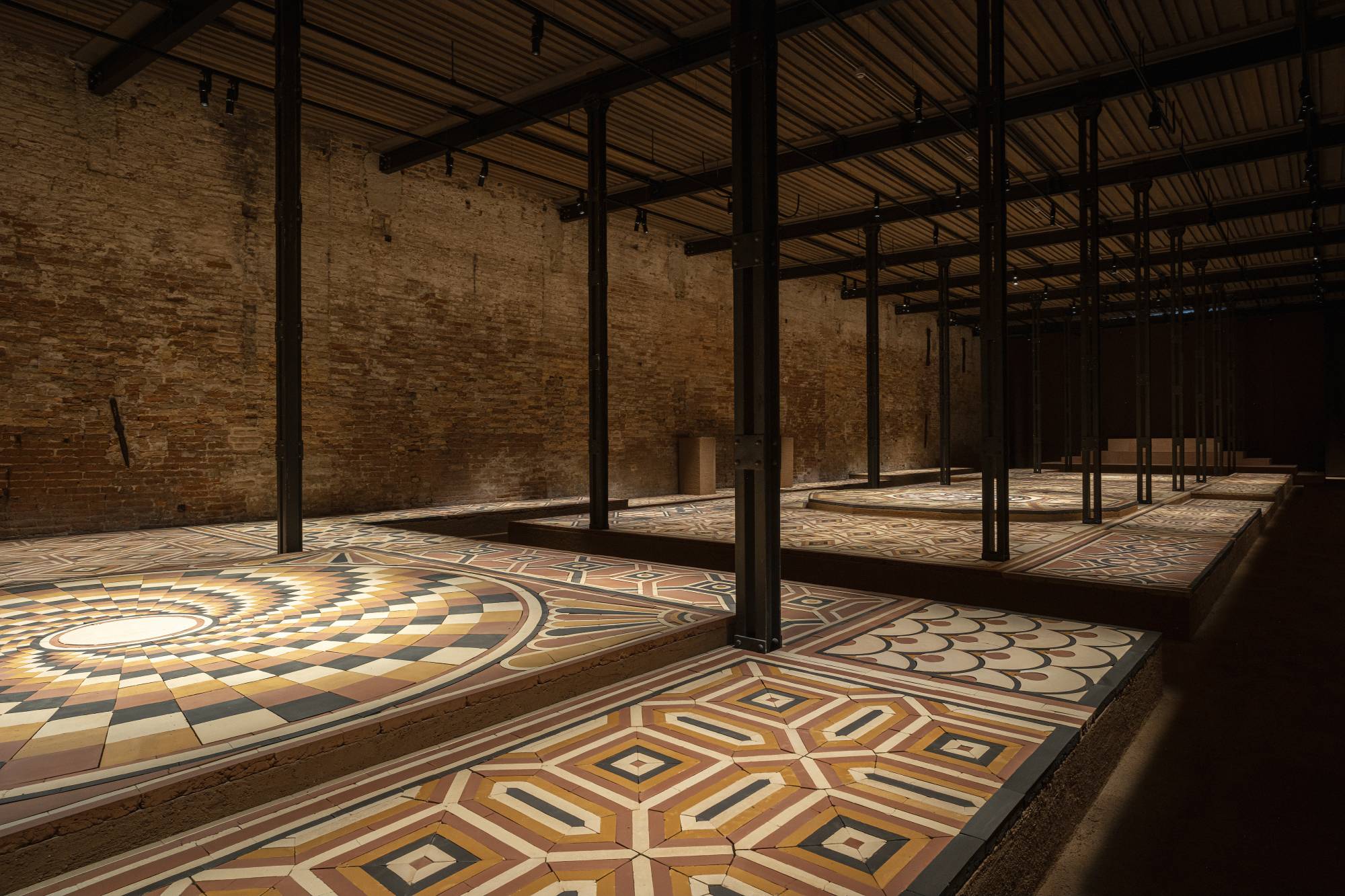
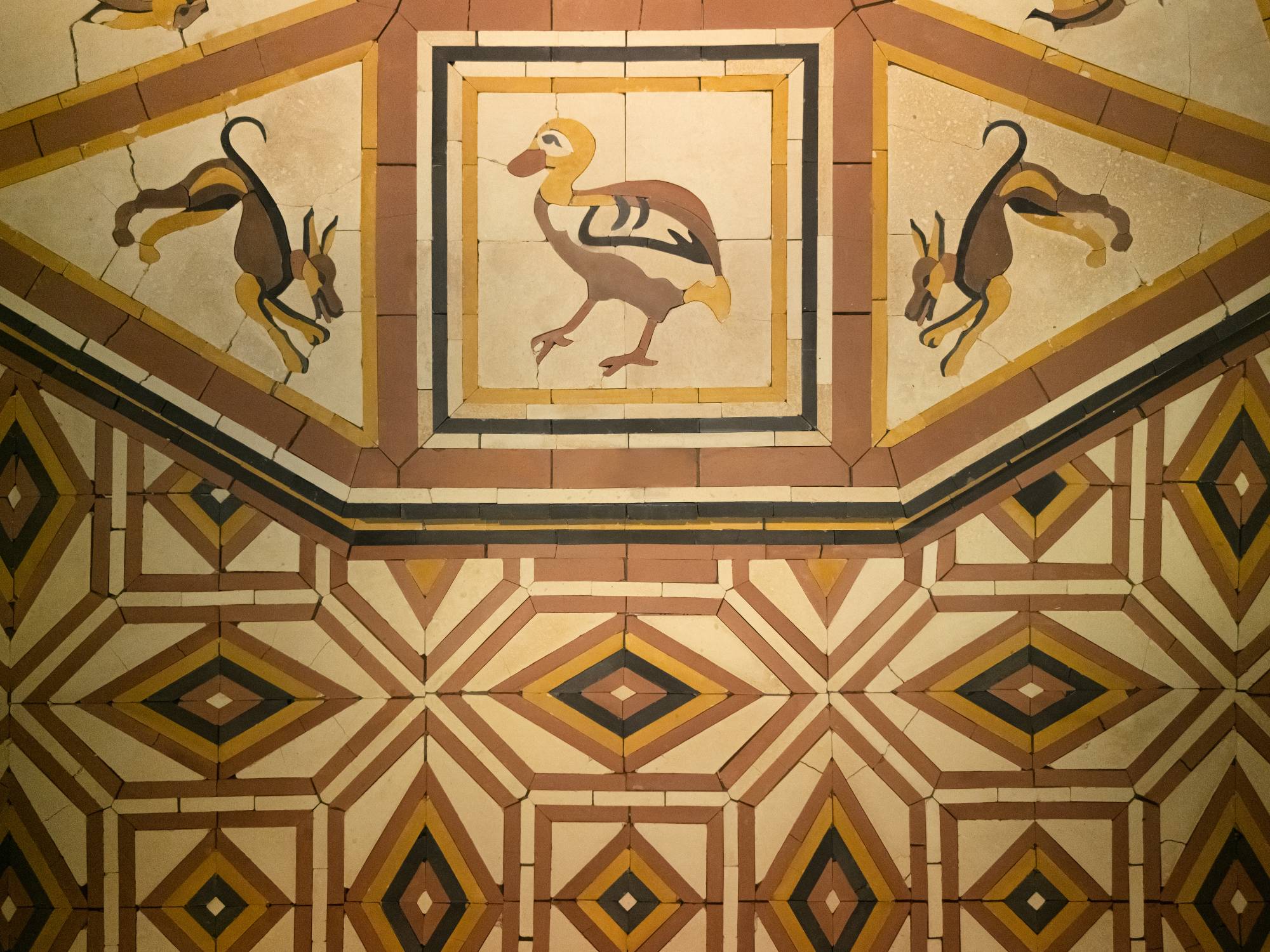
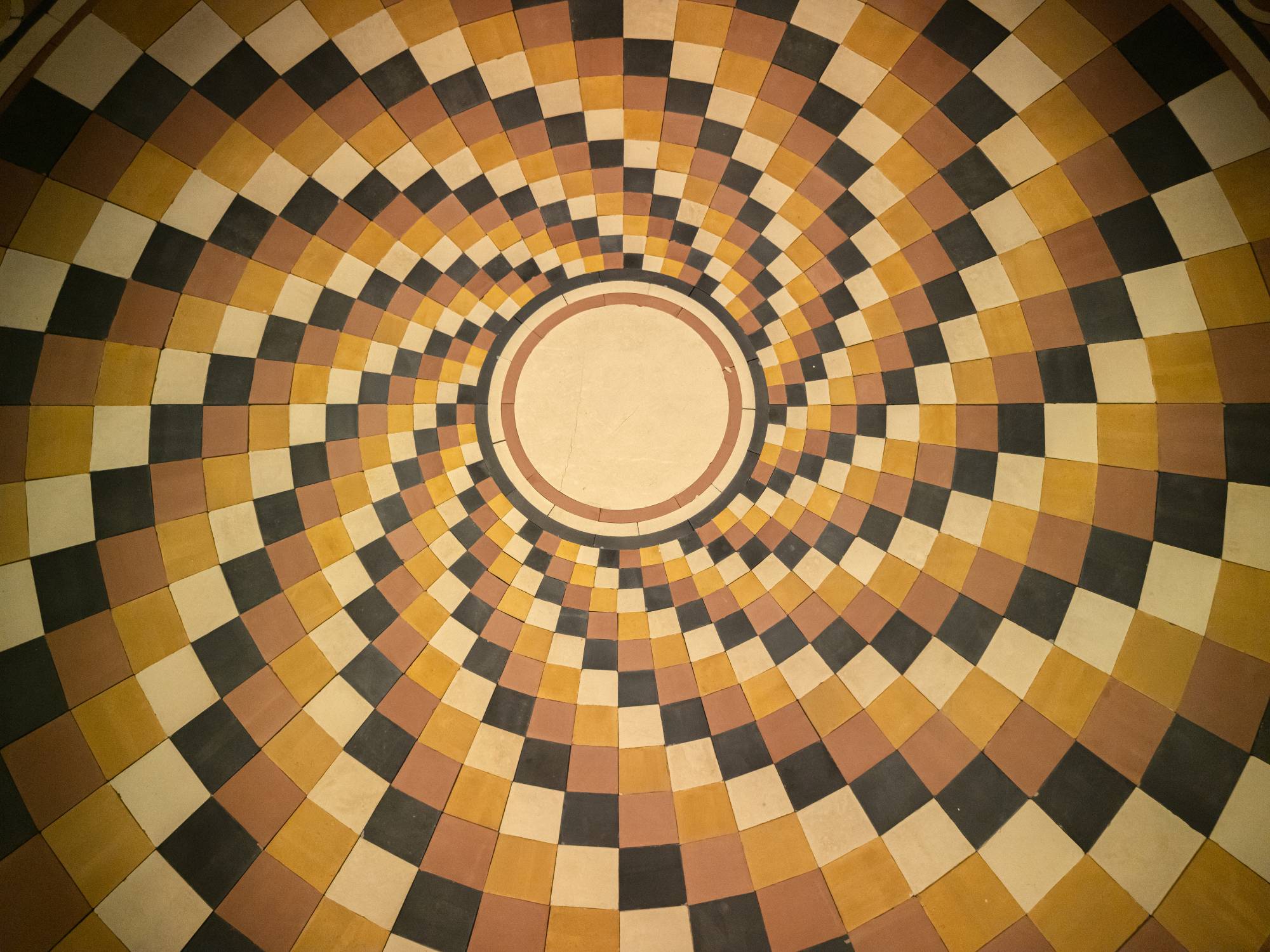
Awartani's work dominates the space of the Saudi pavilion, resembling a mosaic made from colorful bricks. The piece is divided into different visual themes, all inspired by the Middle East, as she explained during a special tour of her studio outside Riyadh last January. "All the motifs I used here are taken from different places in the Middle East, and all of them have been destroyed," she said.
In her research, she documented the damaged sites and what happened to them, then extracted distinctive artistic forms and motifs from each location. She points out that the shapes and decorations vary in origin and history, including Roman and Byzantine styles: "There are many shapes and designs, but I make sure that every design I present includes a reference to a place that’s been destroyed."
At the Venice exhibition, all this information is displayed on one of the walls.
An Imagined Archaeological Site
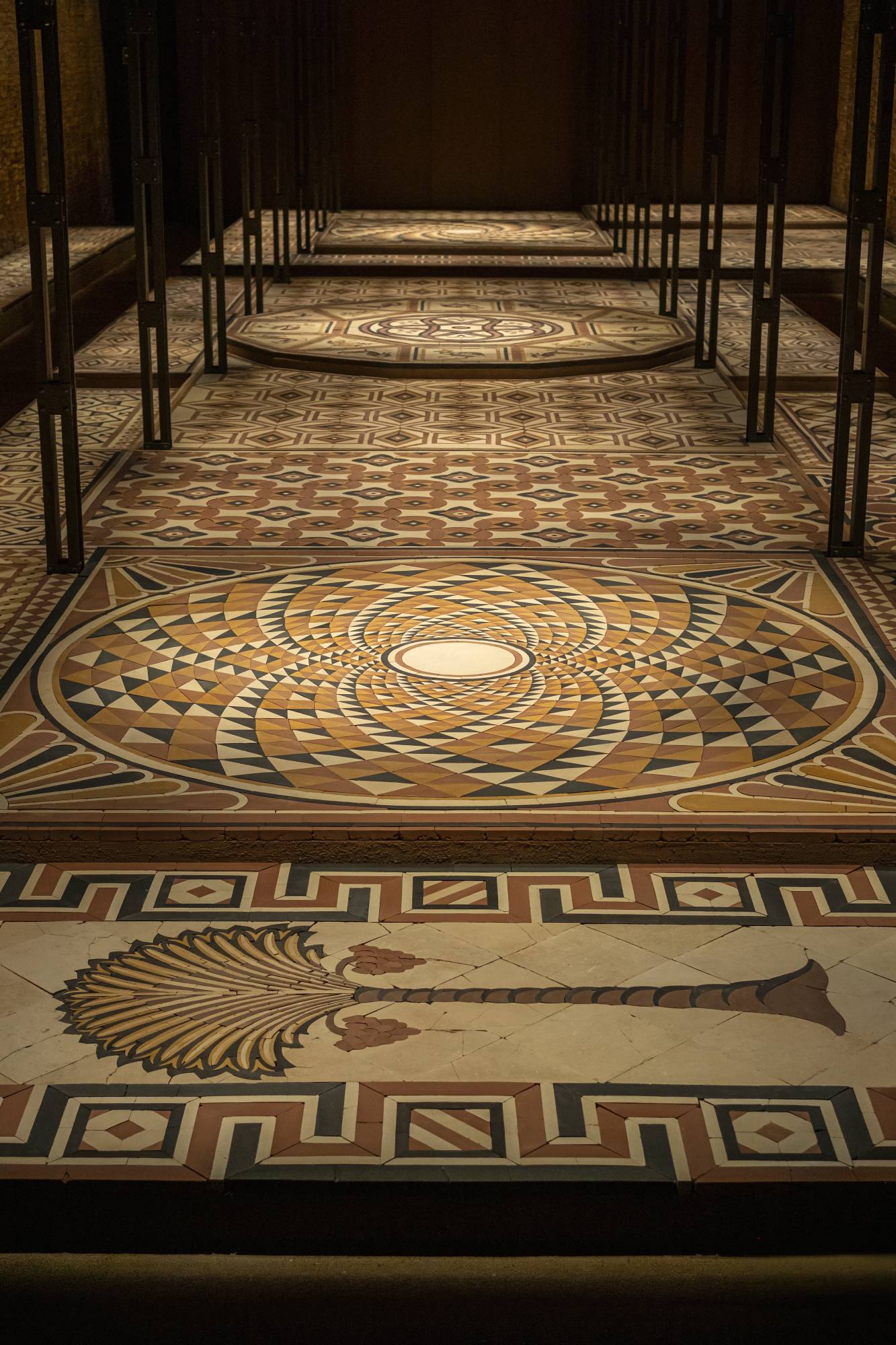
The location of the Saudi pavilion offered the artist a tremendous opportunity to showcase her work. The space is vast and abstract, and Awartani had the choice of several ways to present her piece, but she rejected the traditional modes of presentation. To convey the idea of "liberating antiquities from a colonial perspective," she wanted the viewer to be on the same level as the artwork, not gazing down at it from above. She also aimed to create an immersive experience, drawing visitors into the work. They walk through designated pathways between adjacent mosaic tiles, raised on wooden bases, without artificial or imposed boundaries. "I wanted the audience to feel like they were part of the work, walking among these elements," she says. "It's like an imagined archaeological site. That's why the entire floor is covered in earth."
She describes the work as an "immersive ground installation" that incorporates a mixture of different designs. "I didn't want to create a map showing the origin of each pattern, because many of these patterns exist in multiple locations. It's a shared heritage, and you can't simply say: this is a Palestinian pattern, this is a Syrian pattern, and this is a Lebanese pattern. They are all very similar; our heritage is shared and important to us all."
She explains the visual patterns and geometric designs used in the work: “There are two patterns from Gaza, one from the Al-Bureij mosaic, and the other from the Monastery of St. Peter. There is also a collection of forms from Beiteddine Palace in Lebanon, and a palm tree from a monastery in Syria. Upon entering the building, the visitor finds a wall plaque detailing the main concepts and listing all the sites. Most are residential spaces, such as houses or living rooms, but many are Christian sites: monasteries, churches, the Church of the Nativity, the Church of All Nations, and Bethlehem and Jerusalem, which have suffered historical damage. This is because mosaics are used extensively in these places.”
Fragile Beauty
From the moment we enter the hall, the pieces unfold before us with serene and fragile beauty. We follow different patterns, noticing that each belongs to a specific place. Some are cracked and appear as if they have just arrived from their actual geographical location, a place of destruction and fragmentation. But this fragile state stems from the artist's desire for the work to reflect the condition of the damaged archaeological sites. In the clay mixture used, she omitted adding straw, which helps bind the pieces together, and left the clay pieces to the effects of nature. She believes that the occurrence of cracks is natural and serves the idea. She did the same when using natural colors to paint the brick pieces and did not try to fix them with artificial materials.
"It won't stay this vibrant, because the colors are natural and are absorbed by the clay, but I also didn't want to put a sealant or anything artificial on it."
Mosaics.. From East to West and Back
The artist chose to use mosaics as an embodiment of the connections between East and West. "During my research, I discovered that the first mosaics appeared in Mesopotamia, specifically in Iraq. They then spread to the Roman Empire, and mosaic art flourished in Italy, where it was widely used in Christian places of worship. When the Byzantines reached Palestine, Syria, and Lebanon, they brought this art back to the region. Therefore, most of the patterns I use here are inspired by traditional mosaics from that era."
The mosaics seem right at home in Venice, whose churches boast exquisite examples of them.
A Collaborative Endeavor
The work required over 30,000 hours of labor, involving thirty-two artisans from Riyadh and beyond. Awartani has regularly collaborated with traditional artisans and there is a philosophy behind this. She sees it as essential to her work: “I try to think of it this way: I wouldn’t go to a factory and ask them to carve the stones by machine. I prefer working with people in the traditional way because I also care about preserving the old techniques. The same applies to this project. It was done using an old kind of clay, but I modified the technique slightly. Traditional mud bricks contain sand and straw to make them strong and prevent cracking. I deliberately omitted these to make them crack. Moreover, mud bricks were used in building standing structures, but I use them as flooring. So, it’s essential to understand the craft we’re working with. I make sure to involve people throughout the process. They will see images of the project, and their names will be credited as my collaborators.”
*The Saudi Pavilion is commissioned by the Visual Arts Commission of the Ministry of Culture, under the supervision of curator Antonia Carver and assistant curator Hafsa Al-Khudairi.