



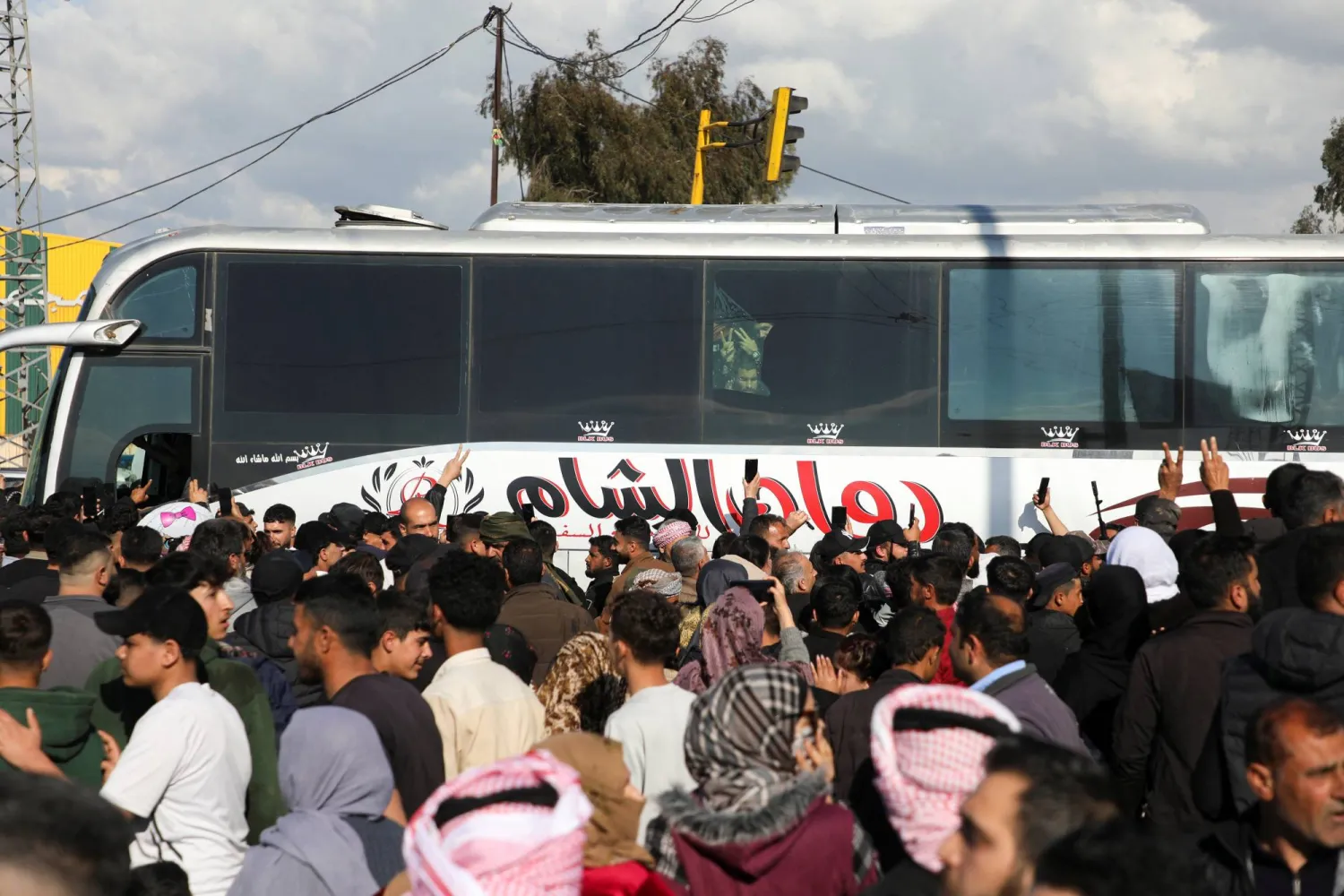

Syrian authorities released a new group of SDF-linked detainees on Friday, in a sign that the government is pressing ahead with a prisoner release clause under an integration agreement with the Syrian Democratic Forces.
The move came as the government insisted Arabic remains Syria’s only official language under current laws, a position that drew renewed attention after SDF-affiliated Revolutionary Youth attacked the Justice Palace in Hasakah and its staff on Thursday.
The incident coincided with arrangements to hand the building over to the government and formally reopen it.
The detainees, SDF members held by the state after being arrested during law enforcement operations, left on Friday afternoon for the Melabiya area south of Hasakah ahead of their release.
The Hasakah Media Directorate said the move was supervised by the presidential team and came in implementation of the Jan. 29 agreement.
Sources had told the ANHA agency that the government was expected to release about 300 prisoners on Thursday or Friday. They said intensive preparations had been underway since Tuesday to speed up the release of a new batch.
At the time, ANHA quoted sources as saying the number of detainees still held by the government was estimated at between 500 and 600. No exchanges had been recorded since April 11.
The release went ahead despite Thursday’s disruption of the planned handover of the Justice Palace in Hasakah.
Members of the SDF-affiliated Revolutionary Youth attacked the building and its staff as arrangements were underway to hand it over to the government and reopen it.
Kurdish websites said dozens of residents had protested after Kurdish was removed from the Justice Palace sign, leaving only Arabic and English.
Hasakah Deputy Governor Ahmad al-Hilali, spokesman for the presidential team tasked with implementing the integration agreement, said in a Facebook statement that the Justice Palace is an official institution bound by Syrian state laws.
“Regarding what has been misunderstood about placing a sign on the Justice Palace building in Hasakah that does not include the Kurdish language, it is important to clarify that the Justice Palace represents an official institution that embodies justice and commitment to the laws in force in the Syrian state,” Hilali said.
He said Decree No. 13 recognizes Kurdish as a national language and allows it to be taught in public and private schools in areas where Kurds make up a notable share of the population, through optional curricula or cultural and educational activities.
But Hilali said Arabic remains the only official language of the Syrian Arab Republic under the constitution and current legislation, and must be used in official institutions, education, legal documentation, and state transactions.
He said protecting Arabic and using it exclusively in official correspondence and transactions were part of state sovereignty and public order.
These laws, he added, cannot be bypassed at this stage under the constitutional declaration except through future constitutional and legal amendments approved by the relevant legislative bodies, foremost among them the Syrian People’s Assembly, which is expected to convene soon.
The Justice Ministry strongly condemned the unrest and vandalism targeting the Justice Palace in Hasakah, saying in a statement on its official accounts that the acts violated public order, state authority and the rule of law.
It said it would take all necessary legal measures against those involved.
The integration of judicial institutions has been faltering since its implementation began in April.
Shalal Kedo, head of the Kurdish Left Party in Syria, said the attack by dozens of members of the Revolutionary Youth, affiliated with the SDF and the Autonomous Administration linked to the Democratic Union Party, pointed to divisions within that structure over the integration agreement.
Kedo, whose party is part of the Kurdish National Council, told Asharq Al-Awsat that some parties within the structure were moving toward implementing the agreement and integrating institutions, while others were trying to obstruct it.
“It is clear that there are parties within this structure moving toward implementing the agreement and integrating institutions, as we are seeing on the ground, while other parties, such as the Revolutionary Youth, are trying to create obstacles and put sticks in the wheels to disrupt the course of understandings,” he said.
Kedo said the Kurdish language issue, which sparked Thursday’s events in Hasakah, remains a natural and legitimate right for Syria’s Kurds. Kurdish, he said, should be the country’s second official language.
He said Decree No. 13 on Kurdish rights carries important implications that should be built on, developed and included in the new Syrian constitution.
“In all cases, the Kurdish language issue cannot be reduced to the integration agreement, because the Kurdish issue is much older and deeper than that. It has existed since the emergence of the modern Syrian state,” Kedo said.
“As for the SDF issue, that is a different matter. The SDF, as a military faction, signed an agreement to integrate into the Syrian army, while the institutions affiliated with the Autonomous Administration are being integrated into Syrian state institutions,” he said.
“For our part, we support normalization, the Jan. 29 agreement, and the integration of the Autonomous Administration’s institutions and its security and military formations into Syrian state institutions and the Syrian army,” Kedo added.
“At the same time, however, the demand to establish Kurdish as a second official language and as a language of education, culture and media is a legitimate demand.”


