


Iran Ceasefire Tested as Cargo Ship Catches Fire and Kuwait Reports Drone Attack

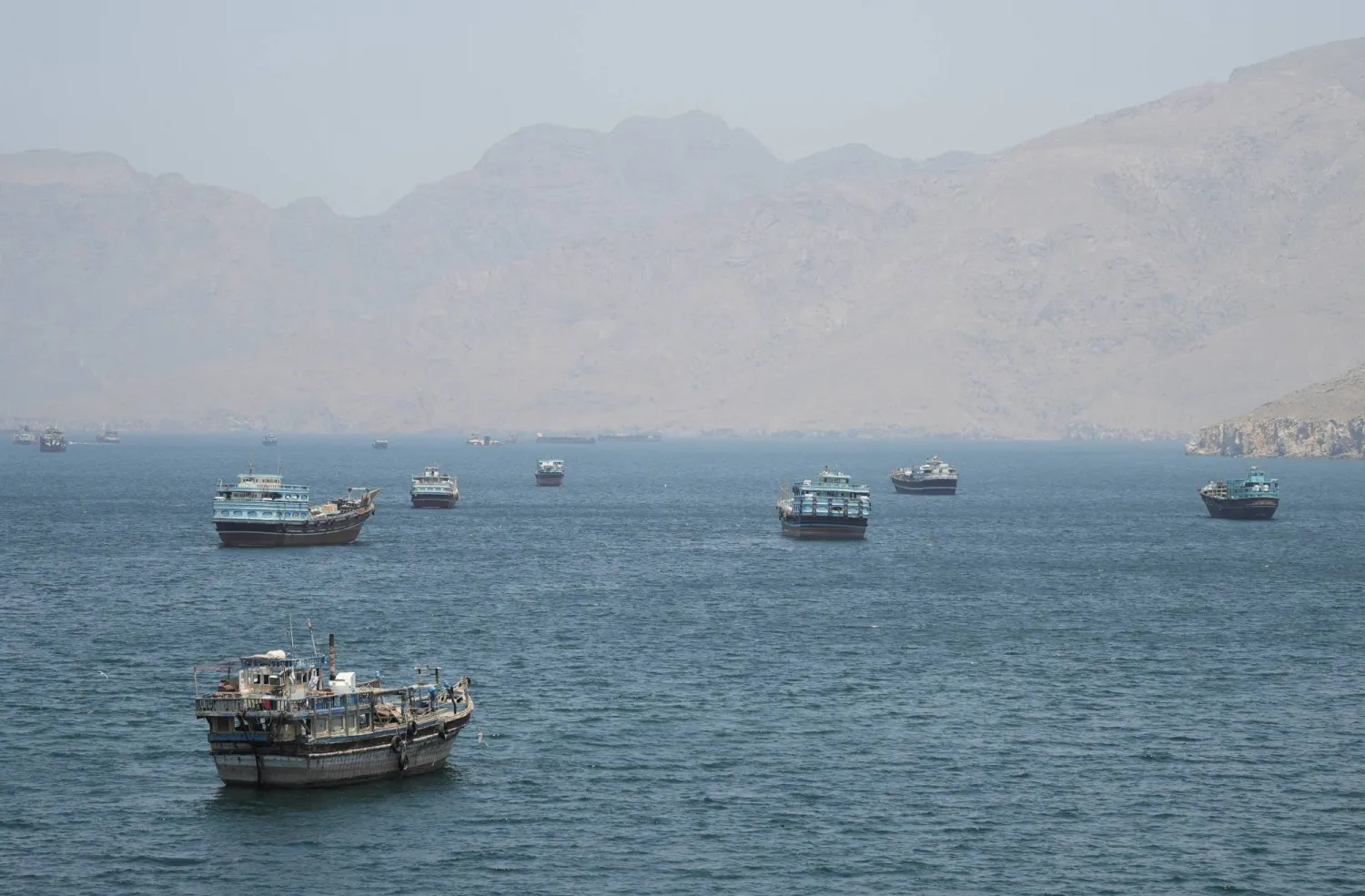
Vessels in the Strait of Hormuz, Musandam, Oman, May 8, 2026. REUTERS/Stringer
TT

Iran Ceasefire Tested as Cargo Ship Catches Fire and Kuwait Reports Drone Attack

Vessels in the Strait of Hormuz, Musandam, Oman, May 8, 2026. REUTERS/Stringer

The shaky ceasefire in the Iran war was tested again on Sunday when a cargo ship caught fire after being hit by an unknown projectile off Qatar’s coast, and Kuwait's military reported an attack by drones, without specifying where they came from.

The attacks were the latest threats to a month-old ceasefire, which the Trump administration says remains in effect. It has faced difficulties, with Iran restricting traffic through the Strait of Hormuz, a strategic waterway key to the global flow of oil, and the US imposing a blockade of Iranian ports.

Washington has been awaiting Iran’s response to a new proposal for a deal to end the war, reopen the strait to shipping and roll back Iran’s nuclear program.

One of the main sticking points in the negotiations is the fate of Iran’s stockpile of highly enriched uranium. The UN nuclear agency says Iran has more than 440 kilograms (970 pounds) of uranium that is enriched up to 60% purity, a short, technical step from weapons-grade levels.

In an interview with Iranian state media, a spokesman for the Iranian military said that forces were on “full readiness” to protect nuclear sites where the uranium is stored.

“We considered it possible that they might intend to steal it through infiltration operations or heliborne operations,” Brig. Gen. Akrami Nia told the IRNA news agency late Saturday. He didn’t offer further details.

The majority of Iran’s highly enriched uranium is likely still at its Isfahan nuclear complex, International Atomic Energy Agency Director-General Rafael Mariano Grossi told The Associated Press last month.

The Isfahan facility was bombarded by US-Israeli airstrikes in the 12-day war last year, and faced less intense attacks in this year’s war.

In Sunday’s naval attack, the United Kingdom Maritime Trade Operations Center said that the strike caused a small fire on the ship, which was extinguished. The attack happened 23 nautical miles (43 kilometers) northeast of Qatar’s capital, Doha, the UKMTO said.

There were no reported casualties, it said. It gave no details on the owner or origin of the ship, and there was no claim of responsibility.

But there have been several attacks against ships in the Arabian Gulf over the past week. On Friday, the US struck two Iranian oil tankers after it said that the vessels were trying to breach its blockade of Iran’s ports.

Iran’s Revolutionary Guard navy on Sunday reiterated its warning that any attack on Iranian oil tankers or commercial vessels would be met with a “heavy assault” on one of the US bases in the region and enemy ships.

In Kuwait, Defense Ministry spokesman Brig. Gen. Saud Abdulaziz Al Otaibi said that hostile drones entered Kuwait’s airspace early Sunday, and that forces responded “in accordance with established procedures.” There were no immediate reports of casualties.

US President Donald Trump has reiterated threats to resume full-scale bombing, if Iran doesn’t accept an agreement to reopen the strait and roll back its nuclear program. Iran has mostly blocked the critical waterway for global energy since joint strikes on Feb. 28 by the US and Israel launched the war, which has caused a global spike in fuel prices and rattled world markets.


Iran's Supreme Leader Briefs Military Chief on 'New Guiding Measures'

An Iranian woman walks a mosque decorated with a banner depicting Iran's current leader Mojtaba Khamenei, in the capital Tehran on May 9, 2026. (Photo by ATTA KENARE / AFP) /
TT

Iran's Supreme Leader Briefs Military Chief on 'New Guiding Measures'

An Iranian woman walks a mosque decorated with a banner depicting Iran's current leader Mojtaba Khamenei, in the capital Tehran on May 9, 2026. (Photo by ATTA KENARE / AFP) /

The head of Iran's armed forces unified command met Supreme Leader Mojtaba Khamenei and received from him "new guiding measures to pursue military operations and ‌firmly confront ‌adversaries", the ‌semi-official Fars ⁠news reported on ⁠Sunday.

The Fars report said that Ali Abdollahi, who commands the Khatam al-Anbiya Central ⁠Headquarters, had briefed ‌Khamenei ‌on the readiness of ‌the country’s armed ‌forces. It did not say when their meeting took place, Reuters said.

"The ‌armed forces are ready to confront any ⁠action ⁠by the American-Zionist (Israeli) enemies. In case of any error by the enemy, Iran's response will be swift, severe, and decisive," Abdollahi was reported as saying.


Ukraine Reports Battlefield Clashes, Drone Strikes Despite Ceasefire

In this photo provided by Ukraine's 93rd Kholodnyi Yar Separate Mechanized Brigade press service, a Ukrainian soldier prepares an FPV drone to fire towards Russian positions in Druzhkivka, Donetsk region, Ukraine, Thursday, May 7, 2026. (Iryna Rybakova/Ukraine's 93rd Mechanized Brigade via AP)
TT

Ukraine Reports Battlefield Clashes, Drone Strikes Despite Ceasefire

In this photo provided by Ukraine's 93rd Kholodnyi Yar Separate Mechanized Brigade press service, a Ukrainian soldier prepares an FPV drone to fire towards Russian positions in Druzhkivka, Donetsk region, Ukraine, Thursday, May 7, 2026. (Iryna Rybakova/Ukraine's 93rd Mechanized Brigade via AP)

Ukrainian officials reported ‌on Sunday Russian drone strikes and nearly 150 battlefield clashes over the past 24 hours despite a US-brokered ceasefire between Kyiv and Moscow.

US President Donald Trump said on Friday that Russia and Ukraine had agreed to a three-day ceasefire from May 9 to May 11, as a broader peace effort to end the more than four-year-old war has stalled.

One person was killed ‌and three ‌people were wounded in Russian strikes ‌on ⁠Ukraine's southeastern Zaporizhzhia ⁠region, governor Ivan Fedorov said on Sunday morning.

In the northeastern Kharkiv region, governor Oleh Syniehubov said eight people, including two children, were wounded in drone attacks on the regional capital and nearby settlements.

Seven people including a child were ⁠wounded in the southern Kherson region ‌by Russian drone ‌and artillery strikes since early Saturday, regional governor Oleksandr Prokudin ‌said on Sunday.

A child was also wounded ‌and infrastructure damaged in Russian attacks on the southeastern Dnipropetrovsk region, said regional head Oleksandr Hanzha.

Separately, Kyiv's air force said Russia had launched 27 long-range drones ‌at Ukraine overnight - a lower number than usual - but that air defenses had ⁠downed ⁠all of them.

In its morning report, Ukraine's General Staff said 147 clashes had taken place along the front line.

Despite the reports, Ukrainian officials have not publicly commented on any violations of the US-brokered ceasefire, which was also meant to include a swap of 1,000 prisoners of war from each side.

Earlier this week, Russia and Ukraine had each announced separate ceasefires - starting on Friday and Wednesday respectively - but quickly accused one another of breaking them.


Feared Iran Oil Slick Smaller, May Be from Infrastructure, Says Group

This satellite image obtained from Copernicus Sentinel Data 2026 on May 8, 2026, appears to show an oil slick spreading off the coast of Kharg Island, a key oil export terminal for Iran. (Handout / Copernicus Sentinel Data 2026 / AFP)
TT

Feared Iran Oil Slick Smaller, May Be from Infrastructure, Says Group

This satellite image obtained from Copernicus Sentinel Data 2026 on May 8, 2026, appears to show an oil slick spreading off the coast of Kharg Island, a key oil export terminal for Iran. (Handout / Copernicus Sentinel Data 2026 / AFP)

Iran's oil infrastructure may be the source of a suspected slick off a key island export terminal, but satellite images showed it was "much reduced" Saturday, an environmental group said.

Satellite images in past days appeared to show an oil slick spreading off the coast of Iran’s Kharg Island.

It was not immediately clear what had caused the apparent spill off the west coast of the small Gulf island.

"The cause and origin of the slick remain unknown and cannot be determined conclusively from the available imagery alone," a UK-based non-governmental organization, the Conflict and Environment Observatory, told AFP.

"While offshore infrastructure in the wider area could be a potential source, we are unable to identify a definitive point of origin or attribute the spill to a specific cause at this time," said Leon Moreland from the observatory.

But he added "the slick appears visually consistent with oil based on analysis" of imagery from the Copernicus Data Space browser.

Some media reports, including by Fox News, suggested Iran's oil storage facilities may be coming under strain as a US naval blockade disrupts the country's ability to export or store crude.

Moussa Ahmadi, head of the Iranian parliament's energy commission, told ISNA news agency on Saturday there was "no official report so far confirming" that Iran's oil facility was leaking due to strained storage facilities.

"Production in various oil fields in the country continues incessantly and without any problem," he said.

Earlier, Jafar Pourkabgani, a lawmaker representing the coastal city of Bushehr, dismissed the reports as "false".

"The stains observed in satellite images around the resilient Kharg Island are related to oil and ballast water waste from oil tankers, which was dumped into the sea by a European oil tanker to the detriment of the environment," he said, according to state television.

Moreland said there was "no obvious evidence of additional active spills around the island, although the earlier slick can still be observed moving south".

Copernicus images on Saturday appeared to show that the suspected slick was "much reduced" from the first pictures seen on Wednesday, the observatory added.

It put the spread of the original slick at about 44 square kilometers (17 square miles).

But Orbital EOS, which monitors oil spills, told The New York Times the spill appeared to cover more than 20 square miles (52 square kilometers) as of Thursday.

Kharg Island is at the heart of Iran's oil export industry, a lynchpin of the country's battered economy. It sits off Iran's Gulf coast, hundreds of kilometers northwest of the narrow, strategic Strait of Hormuz.

Iran largely closed the strait at the start of its conflict with the United States and Israel on February 28. The United States has since imposed a blockade of Iranian ports. Many tankers are stranded in the area as a result of both blockades.
