


Eyeing Migrant Returns, EU Pushes to Revive Syria Ties

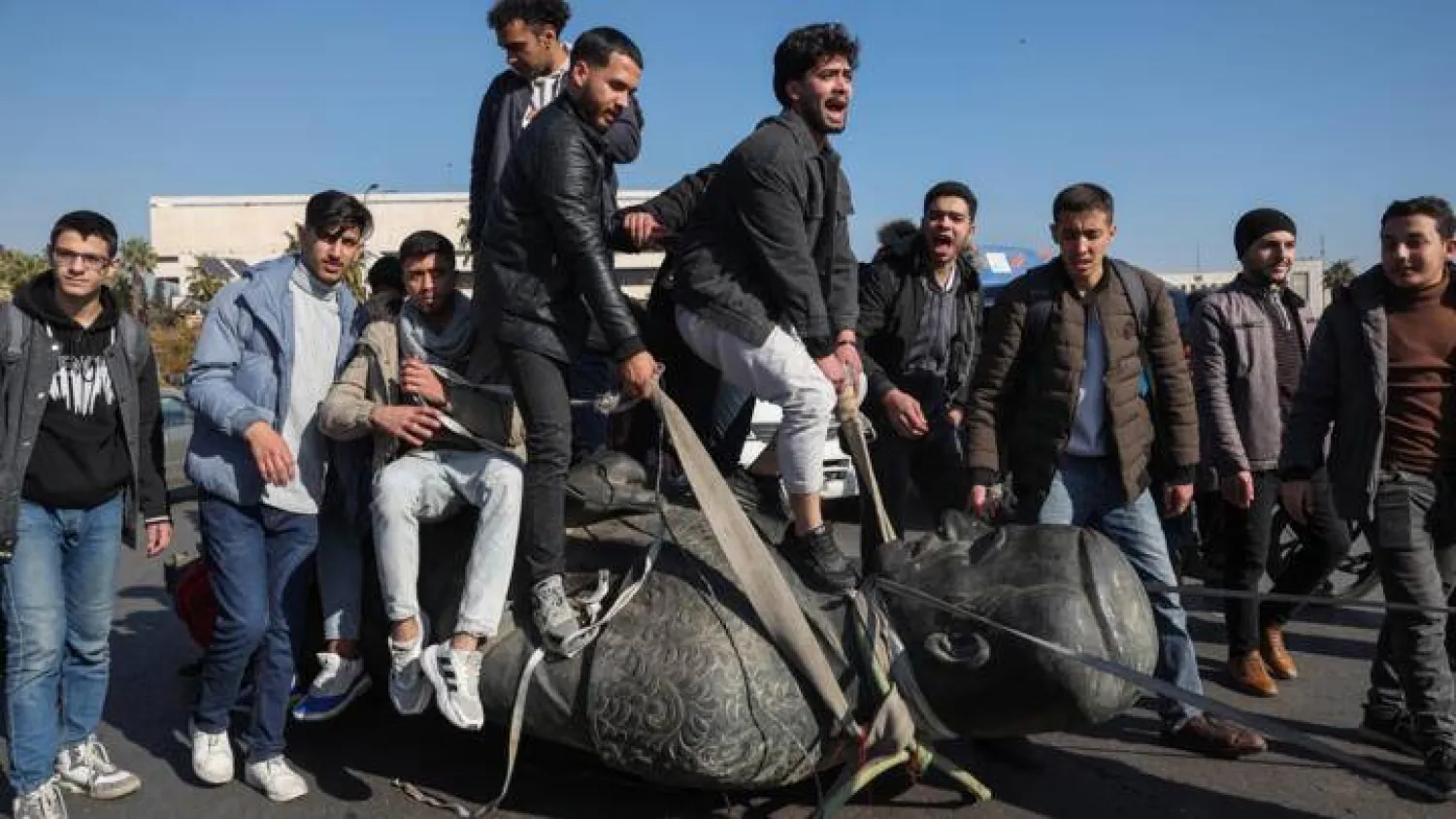
Students stand on the toppled statue of late president Hafez al-Assad during a rally near the campus of the Damascus University in the Syrian capital on December 15, 2024. Omar Haj Kadour, AFP
TT

Eyeing Migrant Returns, EU Pushes to Revive Syria Ties

Students stand on the toppled statue of late president Hafez al-Assad during a rally near the campus of the Damascus University in the Syrian capital on December 15, 2024. Omar Haj Kadour, AFP

The European Union is to push Monday for a revival of ties with Syria as it looks to bolster the war-ravaged country -- with an eye on prospects for Syrian migrants in Europe to one day return home.

The bloc's foreign ministers will meet in Brussels with Syrian top diplomat Asaad al-Shaibani to kick off a high-level "political dialogue" 18 months after the ouster of strongman Bashar al-Assad.

An EU official said the aim was to back reconstruction of the country devastated by more than a decade of civil war that sent millions fleeing abroad, and where "the reality on the ground is still appalling".

Some 13 million Syrians -- nearly half the population -- depend on food assistance, the official said. Needs are enormous, and the EU has already pledged 620 million euros ($730 million) in aid for the 2026-2027 period.

But Syria's stability also interests many EU countries because its nationals have made up the lion's share of asylum-seekers in the bloc over a decade -- and there is a push for large numbers to eventually go back home.

"We need the Syrian transitional government to succeed in bringing stability to the country, because that's in our interest," said one EU diplomat.

- Several deals in cards -

The 27-nation bloc launched a new chapter with Syria after Assad was swept from power in December 2024.

European Commission chief Ursula von der Leyen promised after meeting President Ahmed al-Sharaa in Damascus in January that Europe would "do everything it can" to support Syria's recovery.

Last month, the commission proposed that EU states fully reactivate the bloc's cooperation agreement with Syria -- a step expected to be approved Monday.

The deal -- abolishing duties on imports of most industrial products from Syria -- was partially suspended in 2011 when Assad ruthlessly cracked down on protests at the start of the civil war.

Before, Syria-EU trade had peaked at more than seven billion euros ($9.1 billion at the 2010 exchange rate) in 2010. By 2023, EU imports from the country had dwindled to 103 million euros, while European exports to Syria stood at 265 million euros.

Looking ahead, the EU wants a more ambitious association agreement, similar to those struck with other countries in the region such as Egypt, Israel and Lebanon -- though officials say that goal remains a way off.

In the meantime, the EU wants to facilitate access to financing for Syrians -- crucial to revive the economy -- and to support farmers, for example with irrigation pumps.

It is also on track to sign a deal to rehabilitate a major hospital in the western Homs region.

- Voluntary returns -

On the sensitive matter of Syrian migrant returns, Germany -- home to the EU's largest Syrian diaspora at more than a million -- is on the front line.

Chancellor Friedrich Merz has embraced tougher migration policies as he seeks to counter the far right -- and he triggered a backlash by declaring during a visit by Syria's president last month that he hoped 80 percent of Syrian refugees would return home within three years.

He later clarified this was a figure put forward by Sharaa himself.

Danish authorities have been outspoken in pushing for Syrians to go home.

But at the EU level there is no question of forcing Syrians to leave, a European official said.

There is a consensus that the conditions are not ready for large-scale voluntary returns, said Julien Barnes-Dacey, Middle East and North Africa director at the European Council on Foreign Relations.

"Most Europeans are cognisant of the reality that for the moment conditions on the ground are not improving fast enough, particularly in the economic sphere, to persuade Syrians to pack up their lives in Europe and head home," he said.

An EU official said the focus was "working on stability, on Syria's economic recovery -- because that really is the path for people to be able to go home in sustainable conditions."

But the commission also wants to establish a "straight and regular dialogue" on returns with Damascus, the official added, saying the matter "will obviously feature" in Monday's talks.



Iraqi PM to Visit Tehran This Week

Iraqi Prime Minister Ali al-Zaidi attends a meeting with US President Donald Trump (not pictured) in the Oval Office of the White House in Washington, DC, USA, 14 July 2026. (EPA)
TT

Iraqi PM to Visit Tehran This Week

Iraqi Prime Minister Ali al-Zaidi attends a meeting with US President Donald Trump (not pictured) in the Oval Office of the White House in Washington, DC, USA, 14 July 2026. (EPA)

Iraqi Prime Minister Ali al-Zaidi will visit Tehran ‌within ‌the coming ‌week, ⁠the Iraqi state ⁠news agency reported on ⁠Sunday.

During ‌the visit, ‌the prime minister will ‌sign memoranda of ⁠understanding in ⁠Tehran in areas of cooperation.

Al-Zaidi had visited the United States earlier this week where he met with President Donald Trump.

Trump praised the new PM, saying the US is “going to have a long-term relationship with Iraq. We're going to have a long-term relationship with a man that will be a great leader.”

“It's a great honor to have the Prime Minister of Iraq with us. He's been a great fighter, and he's been a great fan of America,” he went on to say.

Iraq signed 48 agreements and partnerships with American companies, many in the oil sector, during al-Zaidi's visit.

Al-Zaidi, a businessman, came to power this year with US blessing after Trump vetoed another candidate.

He has vowed to boost Iraq's fragile economy and disarm pro-Iran armed groups in Iraq that have targeted US facilities.

Iraq has long walked a tightrope between the competing influences of allies the United States and neighboring Iran.


Rubio Hails Lebanon for Peace Efforts After Meeting Aoun

Lebanese President Joseph Aoun attends a press conference, at the presidential palace, in Baabda, Lebanon January 17, 2025. (Reuters)
TT

Rubio Hails Lebanon for Peace Efforts After Meeting Aoun

Lebanese President Joseph Aoun attends a press conference, at the presidential palace, in Baabda, Lebanon January 17, 2025. (Reuters)

US Secretary of State Marco Rubio met with Lebanese President Joseph Aoun in Washington on Sunday, praising the country for its "move towards peace" after the latest round of Lebanon-Israel talks. 

It was the first trip to the US capital by a Lebanese head of state since Michel Suleiman was received by Barack Obama in 2009. 

Aoun and Rubio held talks at the State Department, and Lebanese officials said Aoun is due to meet with President Donald Trump on Tuesday. 

Rubio commended the Lebanese government for its "determined effort to reclaim Lebanon's sovereignty, disarm Hezbollah and dismantle its terrorist infrastructure, and move towards peace," the State Department said following the talks. 

Lebanon and Israel, which do not have formal diplomatic relations, began US-sponsored negotiations in April aimed at reaching a peace deal and permanently ending the Israel-Hezbollah war. 

On June 26, they reached a framework agreement in Washington under which the Israeli military is to withdraw from southern Lebanon and the Lebanese army is to deploy, starting with two "pilot zones." 

But the agreement is contingent on the disarmament of Iran-backed group Hezbollah, which has flatly rejected both the deal and the Israel-Lebanon negotiations that underpin it. 

Following the latest round of talks last week in Rome, Israel and Lebanon agreed on the structure and guidelines for implementing the pilot zones, according to the United States. 

Rubio said Washington was committed "to supporting the successful implementation of the Trilateral Framework and to backing the Government of Lebanon's efforts to deliver peace, economic recovery, and a better future for the Lebanese people." 

Hezbollah pulled Lebanon into the Middle East war on March 2, when it began striking Israel in support of its backer Iran. 

Israel responded with airstrikes and a ground invasion, and despite a ceasefire it continues sporadic attacks and holds territory in the south in what it describes as a "security zone." 

While in Washington, Aoun planned talks "on the situation in Lebanon and ways to strengthen the ceasefire" as well as on "the withdrawal of Israel from the Lebanese regions it occupies," his office said earlier. 

The United States carried out airstrikes on Sunday to "punish" Iran after the first US military deaths since open hostilities rekindled the Middle East war. 


Jordan Summons Iranian Diplomat Over ‘Unjustified’ Attacks

The Jordanian capital, Amman. Petra file photo
TT

Jordan Summons Iranian Diplomat Over ‘Unjustified’ Attacks

The Jordanian capital, Amman. Petra file photo

Jordan has summoned Iran's charge d'affaires in Amman over what it ‌called "unjustified ‌and blatant Iranian ‌attacks" ⁠and "provocative and inflammatory ⁠statements targeting the Kingdom's territory," Jordan's ministry of foreign affairs ⁠said in ‌a ‌statement on ‌Sunday. 

Over the ‌last week, Jordan has repeatedly said that ‌it has intercepted Iranian missiles flying ⁠over ⁠its territory, including three that it shot down on Sunday, according to the country's military.