


Sudden ‘Veto’ from Iran Thwarts Govt Formation Efforts in Iraq

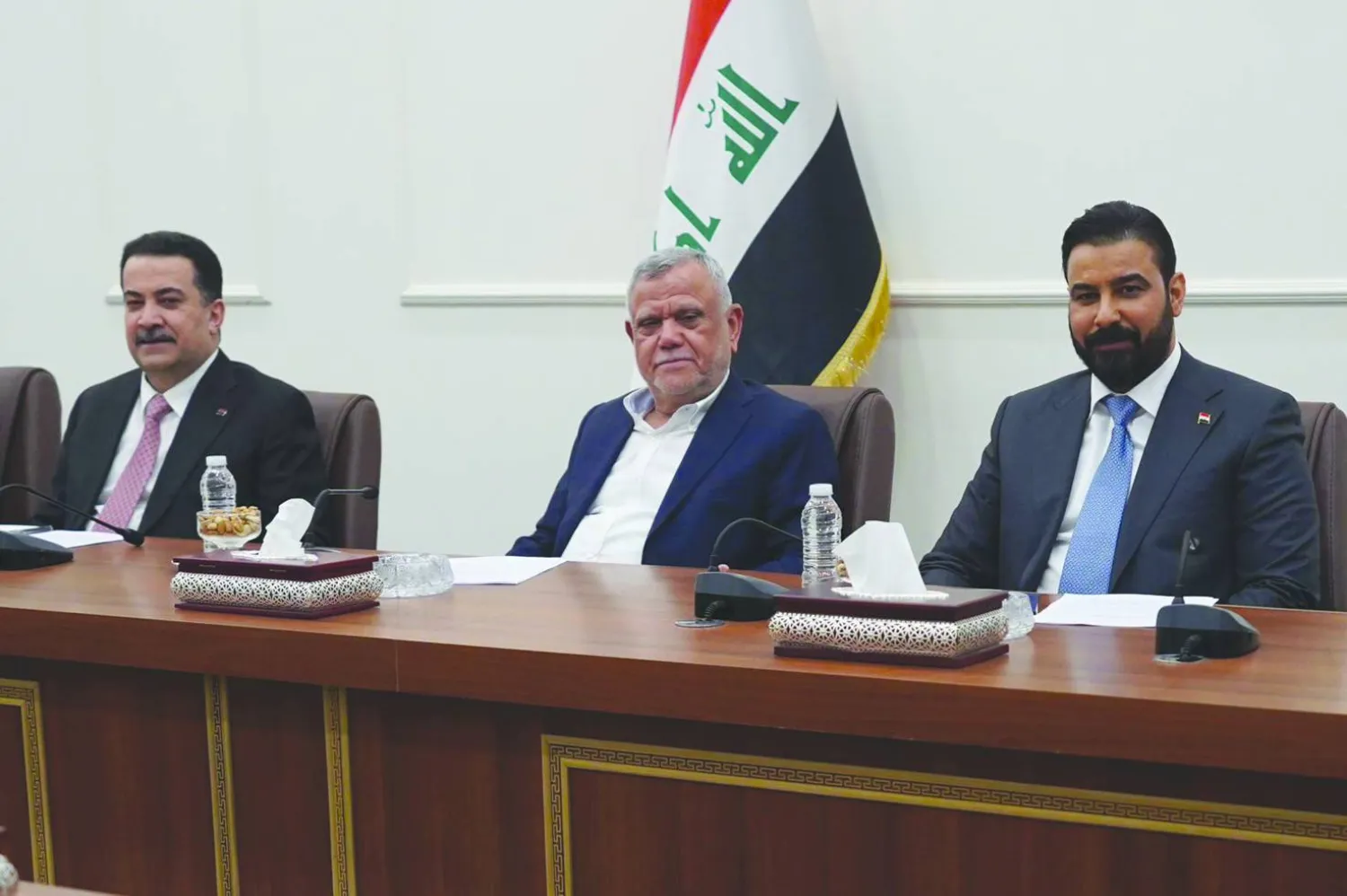
From right to left: Prime Minister-designate Ali al-Zaidi, Coordination Framework member Hadi al-Amiri, and caretaker Prime Minister Mohammed Shia al-Sudani. (Coordination Framework)
TT

Sudden ‘Veto’ from Iran Thwarts Govt Formation Efforts in Iraq

From right to left: Prime Minister-designate Ali al-Zaidi, Coordination Framework member Hadi al-Amiri, and caretaker Prime Minister Mohammed Shia al-Sudani. (Coordination Framework)

Two Iraqi officials revealed on Sunday that a sudden “veto” from Iran has thwarted efforts to form a new Iraqi government. Iran has expressed its objection to keeping pro-Tehran armed factions out of the new government.

Tehran has demanded that the ruling Shiite Coordination Framework refrain from voting in favor of a cabinet lineup that “harms the influence of its allies” in the Iraqi state, the officials told Asharq Al-Awsat.

Amid these developments, reports said that Esmail Qaani, commander of Iran’s Quds Force, the foreign arm of the Iranian Revolutionary Guards Corps (IRGC), made a surprise visit to Baghdad as Prime Minister-designate Ali al-Zaidi had reportedly been making progress in the government formation process.

Significant throughout these developments is the United States’ pressure on al-Zaidi to keep the armed factions out of the new government, reflecting mounting tensions with Tehran that are playing out on a larger scale in the region over Hormuz and the war on Iran.

Sources said Qaani had arrived in Baghdad in recent hours with a message that “Tehran objects” to Iraq’s “complete subservience to Washington.”

An official compared to Asharq Al-Awsat the tensions in Iraq over the government to the tensions between Washington and Tehran over Hormuz.

‘Purely American government’

The two officials said Iran wants to prevent Iraq from forming a “purely American government,” amid US pressure on Baghdad to curb the activity of the pro-Iran armed factions.

Al-Zaidi was named PM-designate on April 27, receiving unprecedented American backing from President Donald Trump himself, who described his appointment as a victory for the Washington administration.

A PM-designate has no more than 30 days to present a cabinet lineup to parliament for a vote of confidence. Time is of the essence with several MPs travelling to Saudi Arabia for the Hajj, meaning the necessary quorum for the parliament session to be held may not be met.

American officials are expected to arrive in Baghdad within days. Sources said Washington not only wants the armed factions out of the government, but it wants to ensure that they will not seek “alternate arrangements” that would get them in the cabinet. This prompted Iran to resort to its “veto” and throttle the government negotiations.

The disagreements over the government in Iraq largely reflect the negotiations between the US and Iran in the region that have been ongoing for weeks without reaching a final settlement.

One of the Iraqi officials quoted a prominent member of the Framework as describing as “unprecedented” the US involvement in the formation of the government. He warned that the differences could turn into an “open conflict” between Washington and Tehran, concerns that were heightened with Qaani’s arrival in Baghdad ahead of American officials who are expected there soon too.

Should Iran resort to informing the Framework MPs to refrain from voting for al-Zaidi's cabinet, Washington may in turn increase pressure on Baghdad, such as imposing sanctions and cutting off support, to get its way, a senior advisor in an influential Shiite party told Asharq Al-Awsat.

The ongoing dispute between Washington and Tehran may lead to al-Zaidi quitting as PM-designate, he warned.

The Iraqi officials, who are involved in the government formation efforts, revealed that al-Zaidi had received messages from several parties, including the US, over the need to from a cabinet that “does not have Iranian influence.”

Negotiators have said that Washington “is now interfering in the tiniest detail” in the formation process and it has “accurate information about how the factions operate to try to outmaneuver” American conditions.

The conditions are not only limited to the government, but also include restricting the factions’ economic and political connections with Tehran, especially issues related to water resources, oil, and independence of political decision-making, revealed political sources.

Al-Zaidi has tried to keep sovereign portfolios out of the hands of the armed factions and granting them “lesser” ministries. The move has angered Iran, which was hoping that it would retain influence over powerful ministries.

An informed source said noted the Asa’ib Ahl al-Haq movement, which boasts 27 MPs in parliament and has been demanding that its political weight be reflected in cabinet. It has been demanding that it be granted the Oil Ministry, putting it at great odds with Washington.



Baghdad Remains Silent about Makeshift Israeli Base that Operated against Iran from Iraq

 An Iraqi farmer drives his combine harvester through the wheat field in the Iraqi town of Al-Mishkhab south of Najaf. Iraq, Saturday, May 9, 2026. (AP)
An Iraqi farmer drives his combine harvester through the wheat field in the Iraqi town of Al-Mishkhab south of Najaf. Iraq, Saturday, May 9, 2026. (AP)
TT

Baghdad Remains Silent about Makeshift Israeli Base that Operated against Iran from Iraq

 An Iraqi farmer drives his combine harvester through the wheat field in the Iraqi town of Al-Mishkhab south of Najaf. Iraq, Saturday, May 9, 2026. (AP)
An Iraqi farmer drives his combine harvester through the wheat field in the Iraqi town of Al-Mishkhab south of Najaf. Iraq, Saturday, May 9, 2026. (AP)

The revelations about a clandestine makeshift military base that Israel had set up in Iraq during the US-Israeli war on Iran has caused uproar in Iraq.

With western media revealing details about the base, Iraqi authorities have yet to comment on the revelations.

Israeli forces established a makeshift base using an old airstrip in Iraq's desert during the war against Iran, two security officials told AFP on Sunday, confirming a report by The Wall Street Journal.

Early in the war, which was ignited by joint US-Israeli attacks on Iran on February 28, the troops were detected in the Najaf desert in the country's southwest and clashed with Iraqi forces, killing one soldier and wounding two others.

The security official said "Israeli forces established a base in an abandoned airstrip in the Najaf desert".

"There are no longer forces there, but they may have left equipment," he said, adding that the Israeli operation "was in coordination with the US".

It was unclear how long the forces were there or what their mission was.

Iraq was drawn into the Middle East war from the outset, with strikes blamed on the US and Israel targeting Iran-backed armed groups, which in turn launched hundreds of attacks on US interests in Iraq and across the Gulf region.

Reports of foreign troops in the Najaf desert emerged early in the war after a shepherd reported seeing military activity.

On Saturday, the Wall Street Journal reported that "Israel set up a clandestine military outpost in the Iraqi desert to support its air campaign against Iran", quoting people familiar with the matter including US officials.

The report said that "Israel built the installation, which housed special forces and served as a logistical hub for the Israeli air force, just before the war started with the knowledge of the US".

Israel’s Maariv said on Sunday that the "clandestine Israeli base in the Iraqi desert" boasted Israeli commandos.

The Israeli military did not respond to an AFP request for comment.

Following the WSJ report, an Iraqi security spokesperson referred journalists to a previous statement issued on March 5.

At the time, Qais al-Mohamadawi, Iraq's deputy commander of joint operations, had told state media that Iraq protested to the US-led anti-ISIS coalition stationed in the country about an air raid in Najaf.

He said that after receiving reports of "individuals or movement in the Najaf" desert, Iraq's military sent a force to investigate.

The troops came under heavy aerial fire, leaving one soldier dead and two others wounded.

Reinforcements later searched the area, but "did not find anything", Mohamadawi said.

He added that at the site in Najaf, "one force was providing support to another that was conducting reconnaissance or setting up equipment".

He said no foreign troops were authorized to be in that location.

Another security official told AFP on Sunday that there were "indications that the operation involved an Israeli technical team under American military protection".

"There are no longer military personnel there," though they left equipment behind, including a radar, probably used for jamming.

The site was hidden in a valley, "a location chosen carefully to avoid Iranian missile strikes", the official said.

The Najaf desert is vast and largely uninhabited, making it difficult for Iraqi forces to maintain tight security there.

The WSJ's sources said that Israel "deployed search-and-rescue teams there so they could respond more quickly if needed for emergency rescue missions".

‘Grave’ security flaws

Iraqi authorities have come under strong criticism over the past two days. A source close to the government said the revelations about the Israeli base underscore the "grave flaws in the Iraqi security forces’ ability in protecting the country and securing its borders."

The source told Asharq Al-Awsat that "Iraq boasts over 1.5 million security forces and over 6 billion dollars a year are spent on them, and yet, they failed in protecting the country."

Security expert Mukhlid Hazem revealed to Asharq Al-Awsat that the Israeli force remained in Iraq around five to seven days before Iraqi security commanders made intense contacts with the Americans to make them leave.

He said prominent military commanders in the Defense Ministry were aware of the foreign forces that were deployed there, but they did not know where they came from.

They contacted the anti-ISIS coalition to inquire about them and were informed that they also were not aware of them.

Hazem said the Israelis chose to deploy in that area to establish an advanced operations center that would secure the passage of their jets over the region and also provide telecommunications technology for the aircraft that were operating over Iran.

The location was chosen because it lies in a remote desert area that is not protected by Iraqi forces, he explained.

The authorities had also closed Iraq’s airspace and banned the use of drones, "which allowed the hostile forces to exploit the situation," he added.

"The development is a dangerous violation of Iraqi sovereignty. We need an integrated security vision for the upcoming phase to handle similar situations," urged Hazem.


Eyeing Migrant Returns, EU Pushes to Revive Syria Ties

Students stand on the toppled statue of late president Hafez al-Assad during a rally near the campus of the Damascus University in the Syrian capital on December 15, 2024. Omar Haj Kadour, AFP
TT

Eyeing Migrant Returns, EU Pushes to Revive Syria Ties

Students stand on the toppled statue of late president Hafez al-Assad during a rally near the campus of the Damascus University in the Syrian capital on December 15, 2024. Omar Haj Kadour, AFP

The European Union is to push Monday for a revival of ties with Syria as it looks to bolster the war-ravaged country -- with an eye on prospects for Syrian migrants in Europe to one day return home.

The bloc's foreign ministers will meet in Brussels with Syrian top diplomat Asaad al-Shaibani to kick off a high-level "political dialogue" 18 months after the ouster of strongman Bashar al-Assad.

An EU official said the aim was to back reconstruction of the country devastated by more than a decade of civil war that sent millions fleeing abroad, and where "the reality on the ground is still appalling".

Some 13 million Syrians -- nearly half the population -- depend on food assistance, the official said. Needs are enormous, and the EU has already pledged 620 million euros ($730 million) in aid for the 2026-2027 period.

But Syria's stability also interests many EU countries because its nationals have made up the lion's share of asylum-seekers in the bloc over a decade -- and there is a push for large numbers to eventually go back home.

"We need the Syrian transitional government to succeed in bringing stability to the country, because that's in our interest," said one EU diplomat.

- Several deals in cards -

The 27-nation bloc launched a new chapter with Syria after Assad was swept from power in December 2024.

European Commission chief Ursula von der Leyen promised after meeting President Ahmed al-Sharaa in Damascus in January that Europe would "do everything it can" to support Syria's recovery.

Last month, the commission proposed that EU states fully reactivate the bloc's cooperation agreement with Syria -- a step expected to be approved Monday.

The deal -- abolishing duties on imports of most industrial products from Syria -- was partially suspended in 2011 when Assad ruthlessly cracked down on protests at the start of the civil war.

Before, Syria-EU trade had peaked at more than seven billion euros ($9.1 billion at the 2010 exchange rate) in 2010. By 2023, EU imports from the country had dwindled to 103 million euros, while European exports to Syria stood at 265 million euros.

Looking ahead, the EU wants a more ambitious association agreement, similar to those struck with other countries in the region such as Egypt, Israel and Lebanon -- though officials say that goal remains a way off.

In the meantime, the EU wants to facilitate access to financing for Syrians -- crucial to revive the economy -- and to support farmers, for example with irrigation pumps.

It is also on track to sign a deal to rehabilitate a major hospital in the western Homs region.

- Voluntary returns -

On the sensitive matter of Syrian migrant returns, Germany -- home to the EU's largest Syrian diaspora at more than a million -- is on the front line.

Chancellor Friedrich Merz has embraced tougher migration policies as he seeks to counter the far right -- and he triggered a backlash by declaring during a visit by Syria's president last month that he hoped 80 percent of Syrian refugees would return home within three years.

He later clarified this was a figure put forward by Sharaa himself.

Danish authorities have been outspoken in pushing for Syrians to go home.

But at the EU level there is no question of forcing Syrians to leave, a European official said.

There is a consensus that the conditions are not ready for large-scale voluntary returns, said Julien Barnes-Dacey, Middle East and North Africa director at the European Council on Foreign Relations.

"Most Europeans are cognisant of the reality that for the moment conditions on the ground are not improving fast enough, particularly in the economic sphere, to persuade Syrians to pack up their lives in Europe and head home," he said.

An EU official said the focus was "working on stability, on Syria's economic recovery -- because that really is the path for people to be able to go home in sustainable conditions."

But the commission also wants to establish a "straight and regular dialogue" on returns with Damascus, the official added, saying the matter "will obviously feature" in Monday's talks.


Lebanon Says Two Paramedics Affiliated with Hezbollah Killed by Israeli Strikes in South

A photograph taken from the southern area of Marjeyoun shows trails of smoke during Israeli shelling on the outskirts of the village of Yohmor on May 10, 2026. (AFP)
TT

Lebanon Says Two Paramedics Affiliated with Hezbollah Killed by Israeli Strikes in South

A photograph taken from the southern area of Marjeyoun shows trails of smoke during Israeli shelling on the outskirts of the village of Yohmor on May 10, 2026. (AFP)

Lebanon's health ministry said two paramedics from the Hezbollah-affiliated Islamic Health Committee were killed and five others wounded on Sunday in two Israeli strikes on the country's south despite a ceasefire.

As the state-run National News Agency (NNA) reported Israeli airstrikes and artillery shelling on a variety of other south Lebanon areas, Israel's army warned residents of three villages to evacuate, saying it would act forcefully against the Iran-backed group there.

Israel has kept up strikes despite a ceasefire in place since April 17 that was supposed to halt hostilities with Hezbollah, while the armed group has pressed on with its own attacks, mainly on Israeli troops operating in southern Lebanon but also across the border.

A Lebanese health ministry statement said that Israel "directly targeted, with two strikes, two Health Committee sites", killing one paramedic and wounding three others in Qalaway, and killing another paramedic and wounding two others in Tibnin.

The statement decried what it called Israel's continued "violation of international laws".

The Israeli military said in a statement that on Sunday its forces had struck "more than 20 terror infrastructure" targets in southern Lebanon, including Hezbollah weapons storage facilities and headquarters.

Israel has expanded its strikes in recent days, and the health ministry on Sunday raised the overall death toll from Israeli strikes since war erupted to 2,846 killed, including 108 health and emergency workers.

Israeli raids have killed dozens of people in Lebanon since the ceasefire.

Under the terms of the truce released by Washington, Israel reserves the right to act against "planned, imminent or ongoing attacks".

Its troops are operating behind an Israeli-declared "yellow line" which runs around 10 kilometers (six miles) north of Lebanon's border.

Residents have been warned not to return to the area.

On Saturday, the NNA reported heavy Israeli strikes in various parts of Lebanon including one that killed seven people, and several raids around 20 kilometers south of Beirut outside Hezbollah's traditional strongholds.

Lebanon and Israel are preparing to hold a third round of talks on May 14-15 in Washington, with veteran Lebanese diplomat Simon Karam recently appointed by President Joseph Aoun to lead his country's delegation.

A first landmark meeting between the countries, which have no diplomatic relations, was held days before US President Donald Trump announced the ceasefire, while the second round came as he announced a three-week truce extension.

Hezbollah drew Lebanon into the Middle East conflict on March 2 when it launched rockets at Israel to avenge the killing of Iran's supreme leader in US-Israeli strikes.