Gaza Wedding Cheers Drown Out Sound of Israeli Airstrikeshttps://english.aawsat.com/features/5271884-gaza-wedding-cheers-drown-out-sound-israeli-airstrikes
Gaza Wedding Cheers Drown Out Sound of Israeli Airstrikes
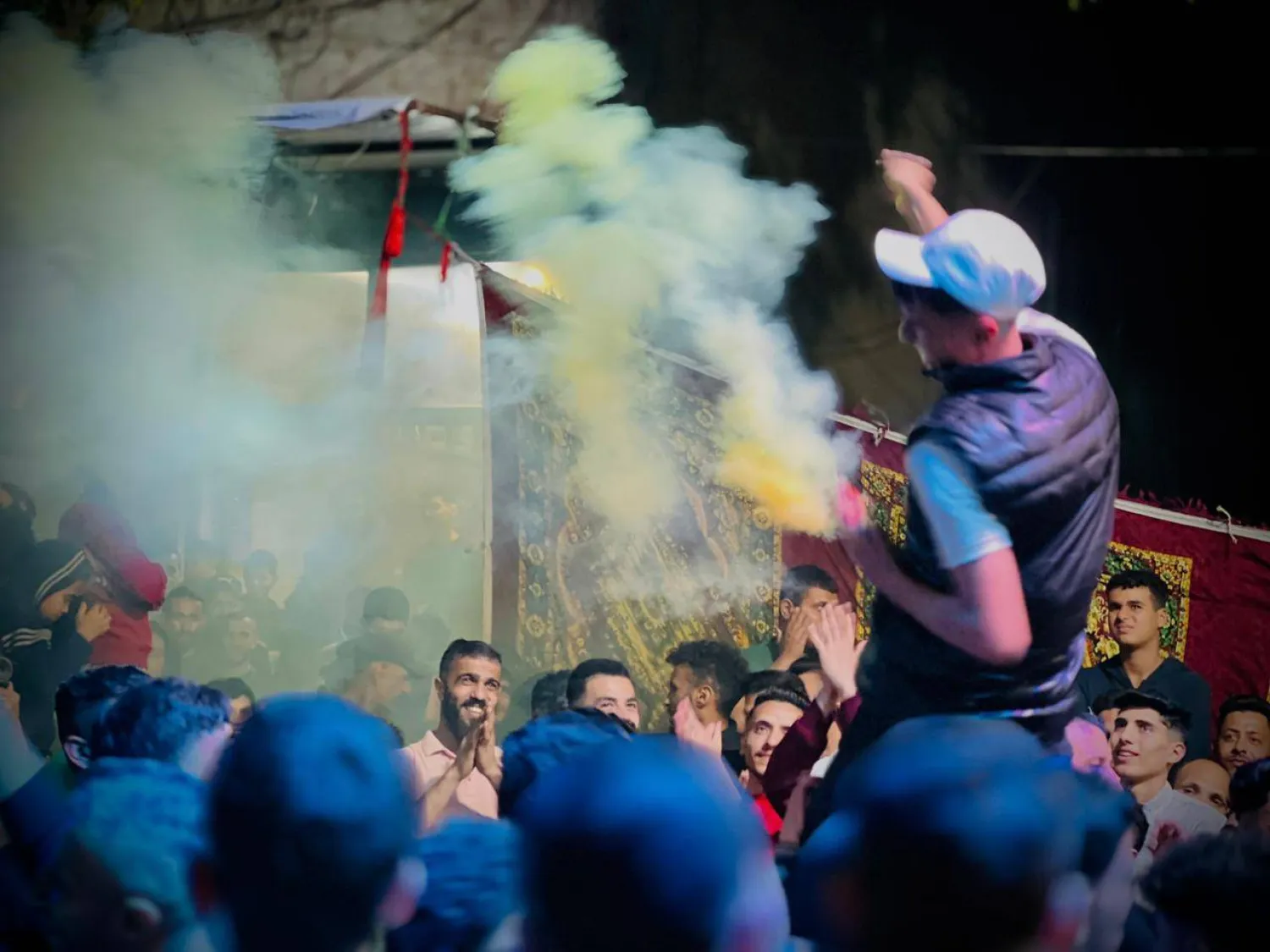
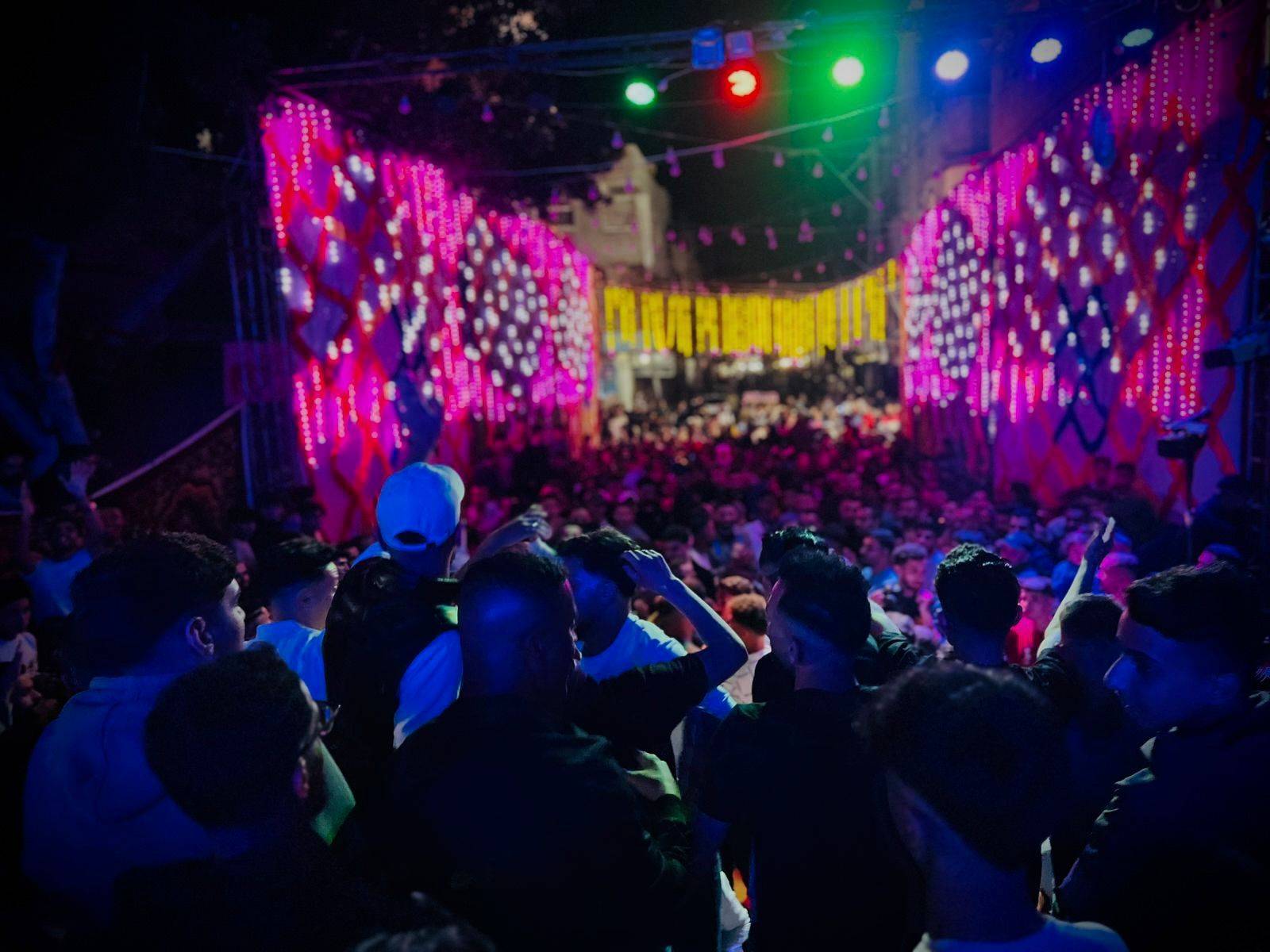
Palestinians gather at a wedding in the Al-Nasser neighborhood, west of Gaza City, in April. (Asharq Al-Awsat)
Since the announcement of a ceasefire agreement in Gaza last October, Israeli violations have continued and the toll of dead and wounded has climbed. Yet, that has not stopped residents of the Palestinian enclave — almost entirely devastated by war — from breaking into celebratory wedding cheers that, if only briefly, cut through the buzz of drones and the thunder of airstrikes.
In recent weeks, residents in Khan Younis, Al-Shati refugee camp, Shujaiya and other areas have held public wedding celebrations attended by relatives and neighbors, reviving scenes absent from Gaza throughout more than two years of war.
Alaa Moussa, 33, from the Sheikh Nasser area of Khan Younis in southern Gaza, lost her husband in an Israeli strike in mid-2024. She said she married in late April a man four years older than her who had also lost his wife and two children in a strike that hit displaced persons’ tents in the Al-Mawasi area of the same city.
“I accepted only a symbolic dowry of no more than 1,500 Jordanian dinars ($2,100), because it has become insignificant under these difficult circumstances,” Moussa told Asharq Al-Awsat.
She held what she described as a “modest wedding” among the tents of displaced families in Al-Mawasi, where one of the tents has become the couple’s new home.
“The war has not stopped, yet like many others we are searching for moments of joy despite all the pain we have endured and continue to endure in Gaza amid unrelenting attacks,” she remarked.
Moussa, who had no children with her late husband, said she saw no issue in marrying a man with three children “despite some criticism” from relatives and those around her.
“I will raise them as though they were my own,” she added.
Palestinians gather at a wedding in the Al-Nasser neighborhood, west of Gaza City, in April. (Asharq Al-Awsat)
‘Social criticism’
Israel has imposed restrictions and a tight blockade on Gaza since the early 1990s, tightening them further after Hamas seized control of the enclave nearly 19 years ago. Unemployment rose from 29.7 percent in 2007 to 45 percent in 2023, the year the war erupted at its close.
Abdullah Farhat, 29, from Al-Shati refugee camp west of Gaza City, was among those whose hopes of marriage and starting a family were delayed for years by Gaza’s harsh economic conditions.
Farhat told Asharq Al-Awsat he recently married a woman two years older than him who had lost her husband at the start of the current war.
He said he paid little attention to what he described as “social criticism” over “marrying a widow or the age difference.”
“My convictions did not change, especially after we found mutual acceptance,” he stated.
Return of wedding halls
Months after the ceasefire, wedding gatherings gradually returned in some areas. Youth parties have also resurfaced, and some wedding halls have reopened to customers.
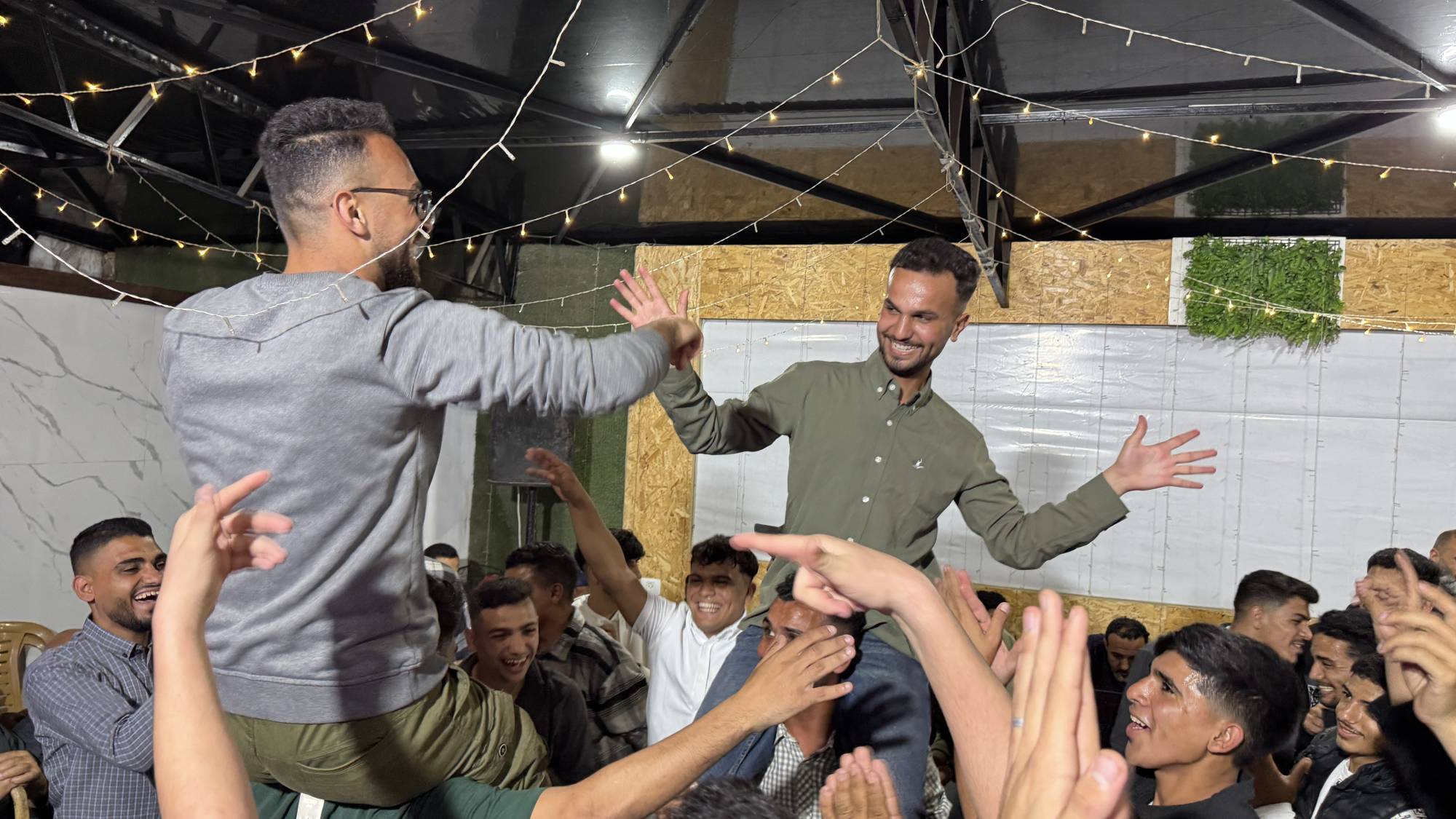
Ayman Muhaysin, 26, from the Shujaiya neighborhood east of Gaza City, who is displaced in a school turned shelter in the Rimal district, held his wedding last month in a wedding hall in his neighborhood.
He said he paid 4,000 shekels (about $1,300) for the venue and a similar amount for a separate gathering for male relatives and friends, in keeping with Gaza traditions in which the groom’s celebration is held one day with male relatives and friends, followed the next day by a reception attended by women inside the hall, while close male relatives from both families gather outside.
Ayman Muhaysin celebrates his wedding in the Rimal neighborhood of Gaza City in April. (Photo provided by Muhaysin)
Muhaysin works in a shop earning 1,500 shekels a month. After the wedding, he moved into a classroom where he had been living with his four brothers, who relocated to a neighboring classroom to stay with their parents and three sisters.
Muhaysin said he had to borrow heavily to finance the wedding but did not regret it.
“I lost my brother during the war, along with many relatives, but this is life. We are searching for whatever brings joy to our hearts despite the hardships we face,” he told Asharq Al-Awsat.
Exorbitant prices
Dozens of wedding halls built along Gaza’s Mediterranean coast were destroyed by Israeli forces during the war. Some restaurants and investors have since opened new venues west of Gaza City, though many residents consider their prices exorbitant.
Mohammed Ghanem, an owner of a wedding hall in Gaza City, explained that prices are high because of the cost of constructing these halls.
“The lack of electricity, operating private generators and securing fuel for them all add to expenses, in addition to the salaries of male and female employees providing wedding services,” he underlined.
Ghanem said prices were “close to what wedding halls charged before the war,” but noted that the new venues “do not have the same level of amenities and equipment that halls once had.”
Recently, Arab and Islamic charitable organizations have begun sponsoring mass wedding ceremonies in Gaza and providing financial support to newlyweds as part of efforts “to ease the burden on young people, tens of thousands of whom rushed to register for such an opportunity.”
Policing of France's School Protests Clouds Macron's Final Months and Sparks Uproarhttps://english.aawsat.com/features/5330245-policing-frances-school-protests-clouds-macrons-final-months-and-sparks-uproar
France's President Emmanuel Macron delivers a speech during the "Bpifrance Inno Generation (BIG)" event, in Paris, France, October 8, 2026. Julien De Rosa/Pool via REUTERS
Policing of France's School Protests Clouds Macron's Final Months and Sparks Uproar
France's President Emmanuel Macron delivers a speech during the "Bpifrance Inno Generation (BIG)" event, in Paris, France, October 8, 2026. Julien De Rosa/Pool via REUTERS
On one side, legions of determined teenagers protesting for their future by blockading schools and taking part in marches that have sometimes spiraled into violence.
On the other, one of the largest internal security forces in Europe, deployed by the government of an unpopular and outgoing president, The Associated Press said.
The result, playing out almost daily outside high schools and on the streets of France, is a nationwide storm of unrest. The mayhem of recent weeks — with mass arrests and hundreds of injured — has sparked an uproar in a country steeped in a centuries-old culture of protest. Even some police have turned on the government's handling of the demonstrations.
Discontent shrouds Macron's final months
For President Emmanuel Macron, who leaves office in May, it’s hardly the dream ending to his decade in power. He has faced a succession of protest movements that sapped his popularity and fueled broad criticism of how his ministers use police against demonstrators.
With the high schoolers, the outcry has grown particularly loud. That's partly because the vast majority of the 8,000 people arrested in recent weeks are under 18 and because police riot-control weapons are blamed for life-changing injuries suffered by some young teens.
The protesters' push for better-resourced schools, particularly in poorer Paris suburbs and other cities and towns, also has a sympathetic audience as France hurts from record poverty and record public debt.
But police complain that they're facing violent rioters who are latching onto the protests and using the crowds as cover to attack officers, pelting them with rocks, fireworks and other projectiles and wreaking havoc with fires, vandalism and other destruction. By the government's count, more than 900 officers and more than 150 teachers and other school staffers have been injured. More demonstrations, by a variety of groups with broader complaints beyond schools, are planned Saturday.
French history partly explains why protests are veering into confrontations between riot police and some demonstrators who come ready to fight in masks and black clothes, says Walid Hrar, a police officer and union representative in the northern suburbs of Paris.
“This is the country of the French Revolution. Everyone boasts about it, in fact. Some political parties don’t hesitate to say that we need to disobey the law. That’s what Robespierre and other revolutionaries taught us in 1789,” he said.
“France always tends to react rather than anticipate,” he added. "In other words, we’re always going to extremes.”
Attention focusing on police weaponry
The police have drawn sharp scrutiny for their efforts to control crowds using a variety of so-called non-lethal weaponry, particularly grenades and other projectiles, but also tear gas, water cannons and riot shields equipped with powerful strobe lights.
"We’re sending poorly equipped, untrained public security police officers to violent demonstrations who are likely to become agitated very quickly out of anger and fear,” said Jean-Marie Godard, an author who specializes in French policing.
Hrar said some of his police colleagues “aren’t specialized in crowd control and aren’t equipped for it. We send them in because we need the manpower, so we have officers wearing uniforms that aren’t flame-resistant. And if you’re hit by a firework mortar and your uniform isn’t flame-resistant, you can catch fire. We also have officers with worn-out helmets. We have shields that aren’t suitable."
He said officers who haven't been given permission to use riot-control projectiles and grenades sometimes struggle to keep attackers at a safe distance.
“So unfortunately we make do,” he said. “You’ll inevitably end up in direct physical confrontation. When that happens, there are injuries on both sides.”
His Alliance police union announced this week that it is filing a legal complaint against the state, accusing it of endangering lives. It alleged that officers are being issued with vague and contradictory orders, leaving them “isolated, betrayed, abandoned, exposed to violence."
Probes of alleged misconduct grow French Interior Minister Laurent Nunez said this week that security forces have used crowd-control weapons at least 18,000 times during the protests — mostly smoke and tear gas but also projectiles and grenades.
They include a deafening launcher-fired grenade that Nunez said was used “about 40 times” before he suspended its deployment against high schoolers, after a 15-year-old lost a hand.
“All this equipment, all these forces, all these intermediate weapons, are used whenever necessary, with proportionality, to mark an escalation of the response, to keep people at a distance or sometimes to put them out of action,” he said.
The minister said rules governing the use of riot-control projectiles are “very clear, very strict.”
“We avoid everything above the neck,” he said.
Still, an officer suspected of firing a round that partially blinded a 16-year-old was this week charged with aggravated violence.
That case is among a growing number of investigations — totaling 36 as of Tuesday — into alleged police misconduct.
Four involve “mutilating injuries,” another six involve “significant injuries” and others are for “blows, insults and suspected sexual assaults” and include the case of an officer accused of attempting to drown a protester, Nunez said.
Expert says different groups get different policing France has more than 250,000 police and gendarmes.
Sebastian Roché, a policing specialist at France's National Center for Scientific Research, said their use can depend on the political needs of the government, which commands them. Officers have been less forgiving with the teenagers than they previously were with farmers, a powerful lobby in France, who doused government buildings with manure, blocked roads and set fires.
“It’s the political definition of the movement that defines the police response,” Roché said.
Public perceptions of the police also change and are influenced by what people see on social media, said Hrar, who noted that officers were applauded for their bravery during terror attacks in 2015.
"When you bombard people every single day with images of police intervening with batons, shields and tear gas, you’re inevitably going to create a negative impression.”
War in the Heart of Hebron: 500 Settlers Share Daily Life with Thousands of Palestinianshttps://english.aawsat.com/features/5329945-war-heart-hebron-500-settlers-share-daily-life-thousands-palestinians
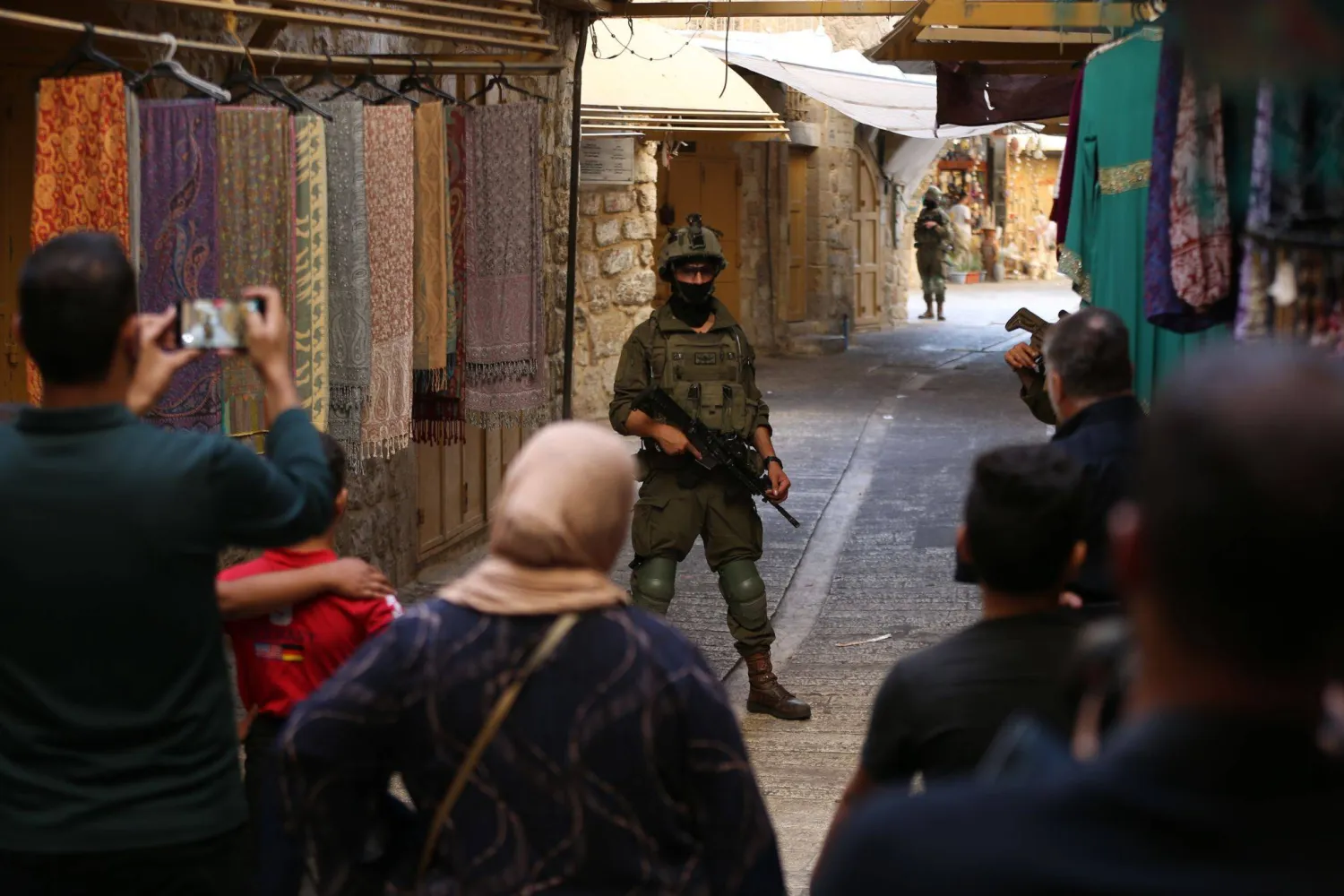
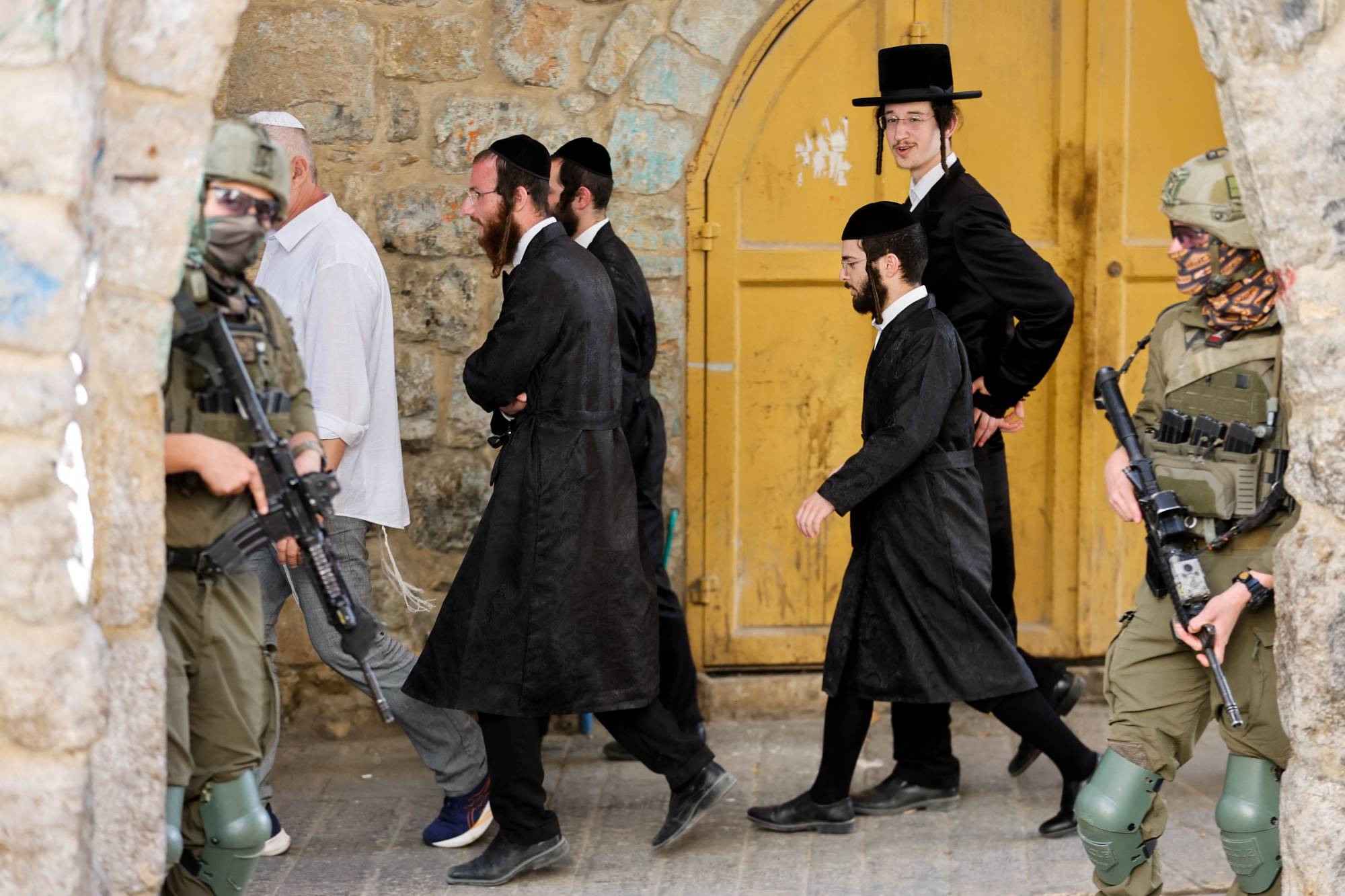
10 October 2026, Palestinian Territories, Hebron: Israeli soldiers stand guard during a tour by Israeli settlers in the Old City of Hebron. Photo: Mamoun Wazwaz/APA Images via ZUMA Press Wire/dpa
War in the Heart of Hebron: 500 Settlers Share Daily Life with Thousands of Palestinians
10 October 2026, Palestinian Territories, Hebron: Israeli soldiers stand guard during a tour by Israeli settlers in the Old City of Hebron. Photo: Mamoun Wazwaz/APA Images via ZUMA Press Wire/dpa
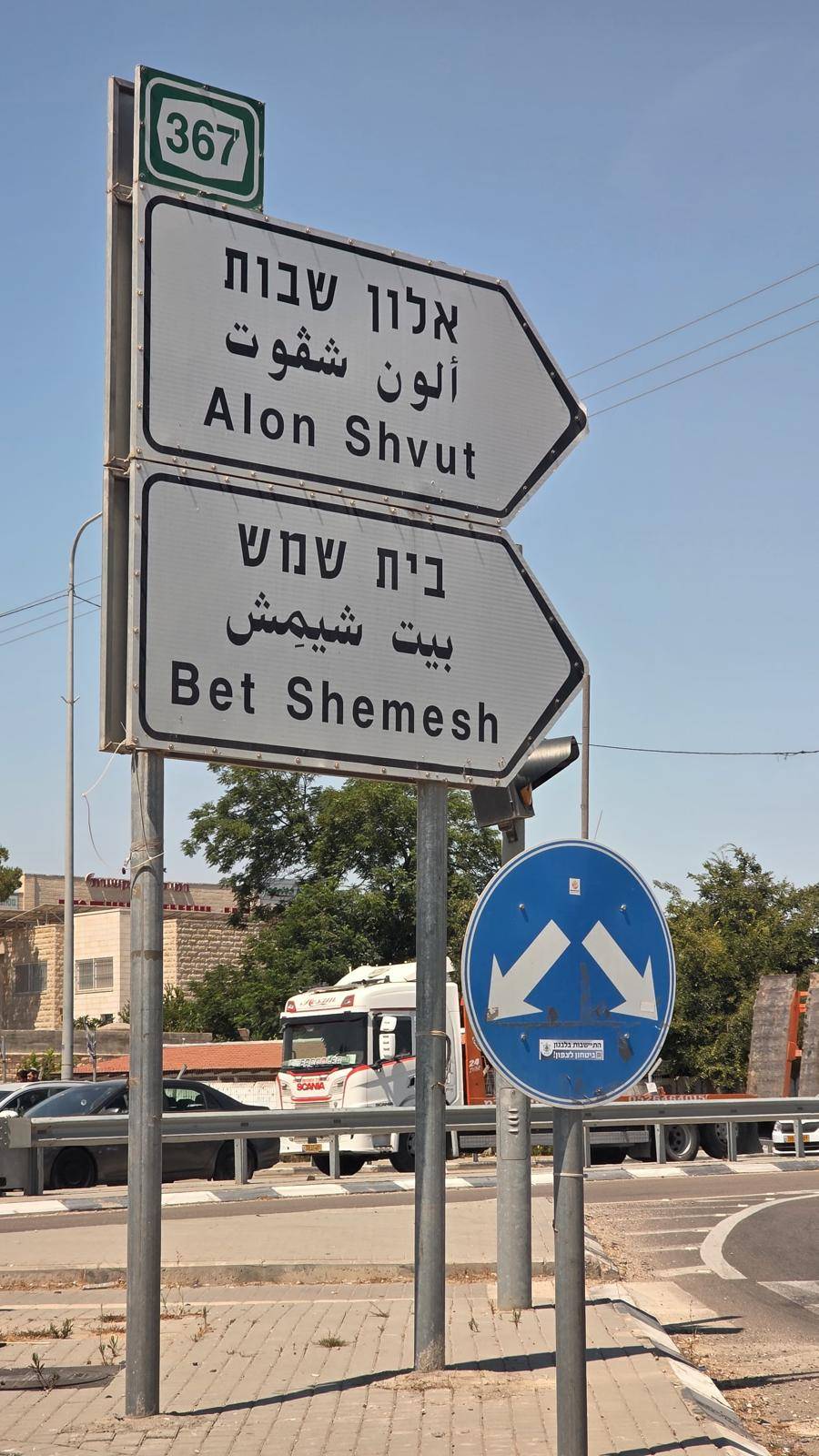
Before reaching the city of Hebron, about 35 kilometers south of Jerusalem in the West Bank, travelers on the fast bypass road known as Route 60 encounter numerous road signs directing people of different nationalities, religions and denominations to their destinations. Written in Hebrew, English and Arabic, the signs point to Palestinian and Israeli destinations, and sometimes places farther afield: Karmei Tzur, Halhul, Beit Ummar, Kiryat Gat, Al-Arroub refugee camp, Kiryat Arba, the Ibrahimi Mosque and others.
No Entry
Shortly before the city's main entrance, a large sign warns Israelis against entering Area A, which is designated off-limits and "dangerous" to them. Yet the warning ignores the fact that 500 settlers live within it, occupying the heart of the West Bank's largest city, its Old City, where they share streets, houses, shops, squares, balcony views and the Ibrahimi Mosque with Palestinian residents.
Every day, the settlers attempt to drive out their neighbors in a long and exhausting struggle that has become considerably more intense since October 7, 2023.
At the beginning of Shuhada Street, near the bustling Bab al-Zawiya district, known for its crowds and commercial activity, Israeli soldiers stand on alert. Their mission is to prevent Palestinians from entering the area, except for the few who still live in its old, dilapidated and surrounded houses and have refused to leave.
Even these residents face thorough searches every day as they enter and leave, treated as perpetual suspects.
Before and After October 7
Before October 7, we had entered the street after receiving permission from the soldiers. But just 100 meters farther along, a soldier stopped us and said we could go no farther because of our "Arab appearance," claiming he could not guarantee our safety.
Today, entry is prohibited from the very first meter.
Intersection in the city of Hebron (Asharq Al-Awsat)
We entered the Old City through other routes that remained open, only to find that many of its streets had been closed. We could not reach several areas, including Al-Sahla Street behind the Ibrahimi Mosque, which, like Shuhada Street, had been closed to all Palestinians except the few "troublesome" residents who still lived there.
Islam al-Fakhouri came out to meet us in streets that were not closed off, including the once-busy Laban Market, which stood deserted. Shops were shuttered, with no merchants, residents or shoppers in sight. The market is part of a network of interconnected streets in the Old City.
Al-Fakhouri told Asharq Al-Awsat that he prefers to leave his home only once a day before returning for the last time, to avoid the numerous humiliating and difficult procedures.
"They treat us as suspects all the time. Your name has to be on a special list, and you undergo a search when you leave and when you return. They check your identity documents before allowing you through," he explained.
Al-Fakhouri is among the few Palestinians who have remained in their homes on Al-Sahla Street, near the Ibrahimi Mosque, which lies at the center of the conflict for both Palestinians and Israelis.
He said he stayed because he could not accept the idea of abandoning his home and because he "does not want to leave it to them."
"If I leave the house, they will immediately take it over. That is exactly what they want. Everything happening here is designed to force us out of our homes. Why does the army make our lives so difficult? Why all these restrictions? Why do settlers attack us? Because they want the entire place," he said.
Al-Fakhouri described how he and other residents had repeatedly been subjected to attacks and assaults, but insisted that he would not give up.
"I'm not leaving, and I'm not giving up my home," he said.
His determination did not waver after October 7, even as the struggle to remain became more difficult and costly.
Since that date, settlers across the West Bank have intensified their hostile actions, carrying out deadly attacks across large areas, killing Palestinians, burning their homes, properties and places of worship, destroying crops, and seizing land, houses, hilltops and even livestock.
"After October 7, every settler became a government unto himself," Al-Fakhouri said.
"We used to move around more freely, and there was less friction. But after October 7, everything changed. They closed the gates and increased the checkpoints. Every movement here is now restricted. On top of that, we face constant attacks and assaults without any accountability or oversight. They attack homes and assault us in the streets. Every day there is a problem. Every single day."
Al-Fakhouri's account helps explain why large parts of the Old City have lost their residents and why so many shops remain closed.
A Battle That Began in 1978
The closures did not begin after October 7. They date back much further. The settlers' struggle is decades old, although it has intensified significantly since that date.
According to the Palestinian National Information Center, the first settlement outposts inside the Old City were established in 1978, when a group of settlers occupied the Al-Dabouya building in the city center. They later renamed it Beit Hadassah.
Following the well-known 1980 Al-Dabouya attack, Israeli authorities demolished dozens of homes to expand the strategically located settlement outpost.
In 1983, another outpost, known as Beit Romano, was established near the Al-Dabouya building after settlers took control of the Osama ibn Munqidh School, claiming it was Jewish property.
In 1984, a new settlement outpost, Avraham Avinu, was established on an archaeological site in Tel Rumeida. Israeli authorities also closed the Old City's central vegetable market, which was later handed over to settlers to establish another outpost. Other outposts included Beit Chason and Beit Schneerson.
The Palestinian National Information Center said Israel was seeking to take control of the area and expand the settlement outposts. To achieve this, it said, Israeli authorities had adopted discriminatory policies against Arab residents, installing dozens of barriers and checkpoints and completely closing certain streets and markets in an effort to pressure residents into leaving.
The center estimated that approximately 1,829 commercial establishments had closed, including 520 shut by specific military orders. The remainder were closed by their owners because roads had been blocked and barriers and checkpoints installed throughout the narrow streets.
Residents of the Old City whom we met briefly said the struggle with settlers was longstanding but had intensified during two pivotal periods: after the Second Intifada in 2000 and following October 7, 2023.
To date, most of the Old City's 40,000 residents have left.
The Ibrahimi Mosque, Just a Stone's Throw Away
The Ibrahimi Mosque, which Palestinians describe as the oldest sacred site in the world, was just a stone's throw away.
As we approached, signs of life began to emerge. A handful of shops were open, with artisans and craftspeople displaying jewelry, pottery, wood carvings, maps of Palestine, embroidered items, decorated mugs, incense and Turkish delight produced in an exceptionally old factory, one that predates the occupation itself.
One shop window featured a portrait of the late Palestinian poet Mahmoud Darwish painted on a piece of mother-of-pearl, accompanied by his famous words: "On this earth, there is what makes life worth living."
Beside it was a portrait of the Lebanese singer Fairuz, with the lyrics "I belong to my beloved, and my beloved belongs to me." Other pieces of pottery seemed almost disconnected from the present moment.
But across from the Ibrahimi Mosque, an armed Israeli soldier stood alert behind security gates, monitoring those who wished to pray and allowing them through only when a green light appeared.
We passed through turnstiles, which Palestinians sarcastically call "the wringers," and then electronic security gates. A soldier checked each person's identification before we proceeded to security booths under surveillance cameras and the watch of armed guards. There, a female soldier inspected our identification documents once again before permitting us to enter the mosque.
The few steps felt more like crossing an international border or entering a defense ministry headquarters than approaching a mosque for prayer.
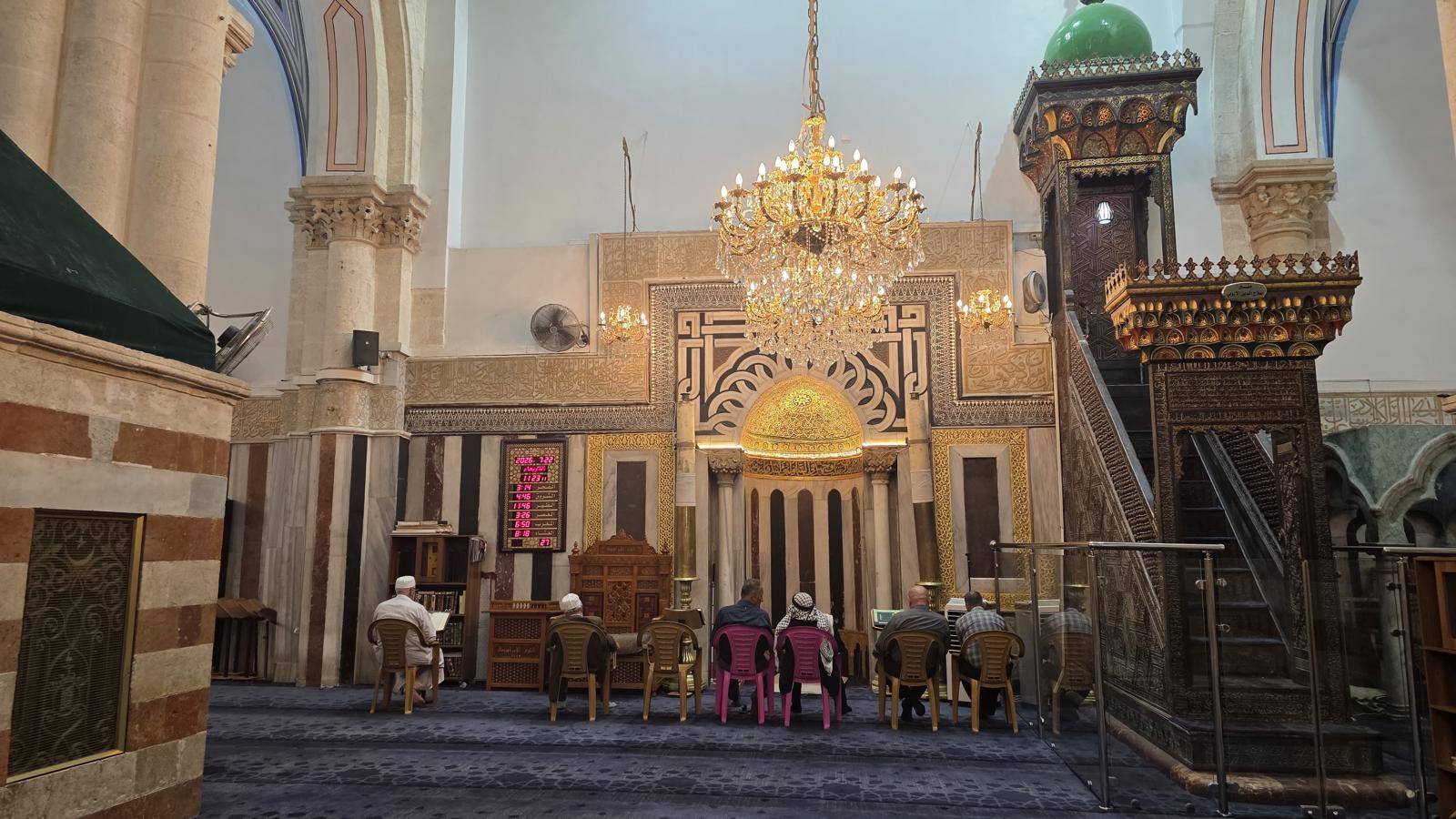
The site, deeply sacred to Muslims, retained its solemn atmosphere, but only a few worshippers were present.
Some visitors were entering for the first time in their lives. They examined the tombs of the prophets with astonishment, discovering ancient corners of the building under the watchful eyes of Israeli cameras.
Cameras were everywhere. Wherever you turned, another camera recorded every movement and every word.
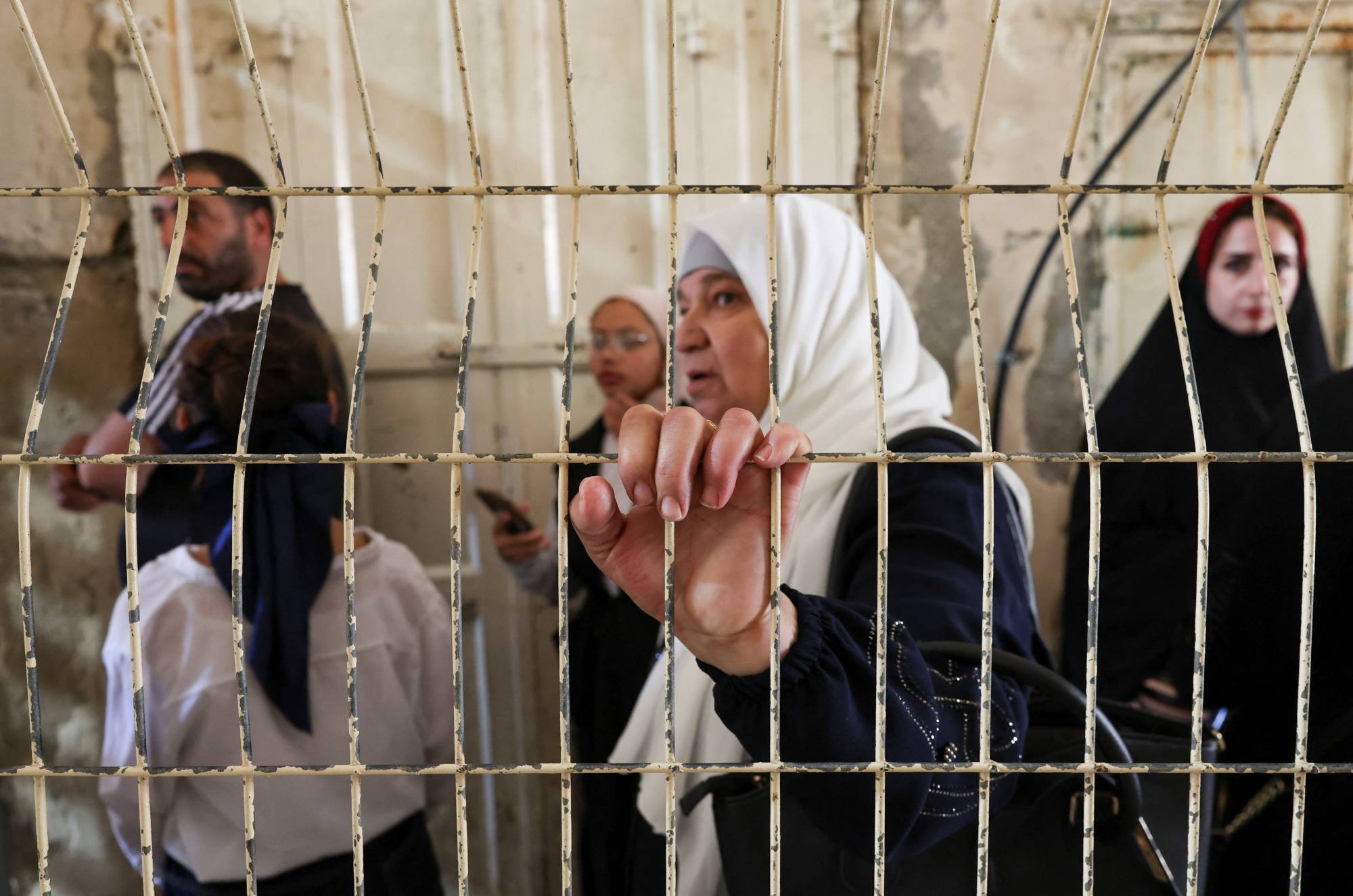
Palestinians wait at an Israeli checkpoint as they head for prayer at the Ibrahimi Mosque, also known as the Cave of Patriarchs, in the old city of Hebron, in the Israeli-occupied West Bank, June 17, 2026. REUTERS/Ammar Awad
Mosque Director: They Instill Fear in Us
Sheikh Mutaz Abu Sneineh, director of the Ibrahimi Mosque, was reluctant to give us a tour, even without cameras or filming, for fear that Israeli forces might use it as a pretext to enter the site.
We had, of course, arrived without cameras or microphones, since bringing such equipment would have meant hours of questioning and waiting for approvals that might never come.
Israeli authorities had expanded the mosque's surveillance system to cover every corner with audio and video recording. They had also compelled the mosque administration to install designated pathways over the carpets so soldiers could enter the mosque quickly at any time.
"You can see for yourself. Anyone entering here feels as though they are entering a military barracks, under surveillance," Abu Sneineh told Asharq Al-Awsat.
"Checkpoints, gates, thorough inspections, searches and identity checks. These are daily procedures imposed on everyone entering the Ibrahimi Mosque, and people are sometimes subjected to humiliation and degrading treatment.
"That includes the mosque's custodians, employees and administration. Everyone who enters this place is under intense audio and video surveillance."
For the mosque director, these measures are part of a broader policy intended to impose a new reality, empty the mosque of worshippers and turn it into a place for Jews.
The mosque was indeed largely empty, and Abu Sneineh confirmed that conditions had changed dramatically since October 7, to the point that Palestinians under the age of 25 were now completely prohibited from entering.
"They instill fear and terror in those who come here," he said.
Worshippers inside the Ibrahimi Mosque (Asharq Al-Awsat)
Division by Time and Space
Another section of the mosque remained entirely off-limits to us, much like parts of the Old City.
Following the 1994 Ibrahimi Mosque massacre, in which Baruch Goldstein, an Israeli army doctor and settler, killed 29 Muslim worshippers, Israel took control of 63 percent of the mosque and designated it exclusively for Jewish use.
Goldstein was an activist in the extremist Kach movement, founded by Meir Kahane.
"Sixty-three percent has been off-limits to Muslims ever since," Abu Sneineh said.
Behind a separating door, Jewish religious prayers and noisy celebrations take place, accompanied by the blowing of the shofar.
Muslims are allowed into that section on only ten days each year, including Fridays during Ramadan, Laylat al-Qadr, Eid al-Fitr, Eid al-Adha, the Prophet Muhammad's birthday, the anniversary of the Hijra and the commemoration of Isra and Mi'raj.
Conversely, Muslims are entirely barred from the mosque for ten days associated with Jewish religious holidays.
This arrangement is known as the division of the site by time and space, a model Palestinians fear could also be imposed at Al-Aqsa
Mosque in Jerusalem.
The muezzin rose to lead the call to prayer before the small congregation, having previously been prevented from reaching his room, which is located in the section controlled by Israeli authorities.
He had also been prohibited from broadcasting the call to prayer through loudspeakers outside the mosque.
Previously, the muezzin had to wait for Israeli soldiers to arrive and escort him to his room. After issuing the call to prayer, he would leave under their escort, completing a short journey fraught with danger.
Even this arrangement does not apply to every prayer. He is barred from reaching the room during specified periods on Saturdays and Fridays and at certain hours of the night.
Shared Tombs and a Battle Over Historical Narratives
The tombs of Abraham, Jacob, Isaac and Joseph were among the most visited places and popular spots for commemorative photographs.
Jews regard these tombs as evidence that the site belongs to them as well. The conflict here is therefore not only about occupation, but also about competing historical and religious narratives and the identities they represent.
"They are trying to erase our narrative and identity," Abu Sneineh said.
"They say this place is theirs. We say it is an exclusively Islamic site. They believe they are descended from Abraham and claim that, as descendants of his son, they have a right to this place. But we have a greater claim to the prophets. Abraham was not Jewish."
The mosque director's account reflects the Palestinian and Muslim narrative, but it is not accepted in Israel.
Israelis also revere the Ibrahimi Mosque, which they call the Cave of the Patriarchs, or the Cave of Machpelah, because it contains the burial place of the Prophet Abraham and his wife Sarah in a cave beneath the present building.
Smotrich Declares Mosque 'Sovereign Property'
Shortly after our visit, far-right Israeli Finance Minister Bezalel Smotrich visited the Ibrahimi Mosque and declared it the "first sovereign property of the Jewish people."
At the site, where he had come to inaugurate the roofed areas previously mentioned by Abu Sneineh, Smotrich asserted that the mosque would forever remain a symbol of Israeli sovereignty in the West Bank.
Israel's Channel 14 reported that Smotrich, who presided over an event marking the completion of extensive roofing and restoration work at the site, was taking a historic step following his earlier decision to terminate the Hebron agreements and withdraw the Palestinian municipality's relevant powers in Hebron's Old City.
Smotrich had announced last June the cancellation of the Hebron Agreement governing the city, which he calls the land of the patriarchs.
Speaking at a ceremony inaugurating the new Doron settlement in the Hebron Hills at the time, he said:
"We have canceled the Hebron agreements. For many years, one of the most absurd provisions of Oslo remained in effect, under which authority over Jewish settlements in Hebron and the holy sites was granted to the Hebron municipality."
The decision announced by Smotrich, following its approval by the Higher Planning Council of the Israeli military's Civil Administration, stripped the Hebron municipality of its planning and construction powers in Area H2, which includes the Old City.
Hebron Turns the Page on Oslo
Hebron is the only Palestinian city in the West Bank to have been subject to a special agreement in 1997 that divided it into two areas, H1 and H2.
Known as the Protocol Concerning the Redeployment in Hebron, the arrangement followed the 1995 Oslo II Accord and the Israeli-Palestinian peace process launched under the Oslo Accords in 1993.
Under the Hebron agreement, Israel withdrew its forces from Area H1, which accounts for approximately 80 percent of the city, and the Palestinian Authority assumed responsibility for security and civilian affairs there.
In return, Israel retained security control over Area H2, comprising the remaining 20 percent of the city, including the Old City, the Ibrahimi Mosque and the Jewish settlement in Hebron, while civilian powers were transferred to the Palestinian Authority.
"This is much more than a planning measure. It is a historic correction," Smotrich said.
"We are continuing the settlement revolution, strengthening governance and deepening Israeli sovereignty in Judea and Samaria," he added, using the Israeli term for the West Bank.
According to Smotrich, the measure applies to all religious and historical sites in Hebron.
In effect, the move marked the end of the Oslo era in the Old City, at the heart of Hebron.
Palestinians rejected the decision. The Palestinian presidency warned of its dangers, saying it undermined Hebron's political and legal status and the bilateral agreements signed concerning the city.
Hebron's municipality also rejected the move and said it would not accept it.
On the ground, however, a different reality has emerged. Israel now exercises greater control over virtually everything in central Hebron, including the Ibrahimi Mosque.
Just one day after Smotrich announced the "cancellation of the Hebron agreements," a major construction project for a Jewish religious school near the mosque was approved.
Israel's Yedioth Ahronoth newspaper reported that the project had been approved without requiring authorization from the Palestinian municipality, for the first time in decades.
Speaking at the Ibrahimi Mosque during a celebration marking the roofing work, Smotrich said:
"The Cave of Machpelah, the Ibrahimi Mosque, is the first sovereign property of the people of Israel. The place purchased by our forefather Abraham has become a symbol of our sovereignty over this land."
Visits to Preserve Historical Memory
But not everything can be imposed by force.
Outside the main prayer hall, a group of schoolchildren was visiting the mosque as their teachers explained its history, religious significance and the massacre that took place there.
Teacher Sharifa Dweik told Asharq Al-Awsat that she had decided to take the risk of bringing the children to the mosque after realizing they knew almost nothing about it.
The children were excited, as though embarking on an adventure. They eagerly described how they had passed the soldiers without being searched and said they would return.
Dweik said it was essential for the children to visit a place that, in her view, Jews wanted every Palestinian to forget.
Hajj Abdulaziz Abu Haltam said he had traveled from the distant town of Tarqumiya to visit the mosque and the Old City.
"I don't come often because of the risks and the long hours of waiting. But I decided to take the chance, and I really did spend a long and exhausting time waiting before reaching the mosque," he told Asharq Al-Awsat.
Jewish visitors face none of these difficulties. Instead, they arrive accompanied by extensive security protection in what is presented as an effort to emphasize the site's Jewish identity.
Approximately 1,500 Israeli soldiers guard the 500 settlers living in central Hebron.
Israeli flags also surround the walls of the Ibrahimi Mosque, another attempt to reinforce the Israeli narrative through visual symbols wherever possible.
Many of these flags can also be seen throughout large parts of the city's Arab neighborhoods.
Israeli soldiers stand guard during a weekly settlers' tour in Hebron, in the Israeli-occupied West Bank, May 16, 2026. REUTERS/Mussa Qawasma
Neighbors and Enemies
From a vantage point overlooking an area not far from the mosque, the extent to which the two communities occupy the same spaces in large parts of the Old City was striking.
Jewish settlers live above shops that once belonged to Arabs, while only walls separate their homes from those of Palestinians.
Before October 7, when Palestinians were still able to open their shops, shopkeepers had been forced to install wire mesh above the street to protect themselves from objects thrown down by settlers living overhead.
Today, all those shops have closed.
While settlers in Beit Avraham, Beit Hadassah, Beit Romano and Tel Rumeida enjoy extensive protection, many Palestinians have been killed in the area over previous years on allegations that they had stabbed, or intended to stab, soldiers and settlers.
Despite this, Mahmoud Mahamra has refused to leave his home, behind which a tightly secured wooden gate has been installed to separate it from Shuhada Street.
Israeli authorities wanted to prevent any possible contact.
That gate was part of a wider network of barriers closing off Old City streets, alongside checkpoints and security cameras.
Mahamra, who describes himself as the closest Palestinian neighbor to the settlers in his area, said he lives in constant anxiety, which has turned into a nightmare since October 7.
"They always used to harass us, but after October 7, life became unbearable," he told Asharq Al-Awsat.
He recalled a period of relative prosperity before the Second Intifada, although it did not last long.
"We used to live alongside one another. There was life here. But not anymore," he said.
Standing on the roof of his home, Mahamra looked out over neighborhoods that had once been entirely Arab and were now entirely Jewish.
Settlers take over homes and raise Israeli flags above them.
Yet Mahamra has no intention of leaving.
"I'm not leaving this place," he said.
"We are not leaving" has become a slogan embraced by Palestinians across the West Bank. But not everyone is able to live up to it, as they face what the article describes as the most extreme Israeli government and the most violent settlers in the history of the conflict.
The Israeli government is now working to implement what is known as the Decisive Plan, which is based on the premise that the territory between the Jordan River and the Mediterranean Sea has room for only one legitimate national claim: the Zionist claim to full Jewish sovereignty.
Israeli human rights organization B'Tselem has accused Israel of implementing a series of simultaneous policies in the West Bank as part of a broader project aimed at erasing Palestinians as a people.
All of this is unfolding today in Hebron's Old City. For Israel, Hebron may represent a rehearsal for what could happen across the rest of the West Bank.
We left the mosque and the Old City, passing one of the oldest shops, where a large map of Palestine was displayed.
Inscribed on it were Mahmoud Darwish's familiar words:
"She used to be called Palestine. And she is still called Palestine."
Sudan’s Day Laborers Struggle to Survive as War Devastates Livelihoodshttps://english.aawsat.com/features/5329643-sudan%E2%80%99s-day-laborers-struggle-survive-war-devastates-livelihoods
Sudan’s Day Laborers Struggle to Survive as War Devastates Livelihoods
Farmers harvest arugula in Khartoum on Oct. 5, 2026. (AP)
In Khartoum, where life is struggling to regain its rhythm after years of war, many doors remain closed to day laborers who once lived on each day's earnings.
A day without work can leave a family without food, a child without money for school or a patient forced to stop treatment because medicine is out of reach.
On sidewalks, in markets and at workshops, day laborers search for any job to get them through the day. More people are competing for fewer jobs, while rising prices and a weakening Sudanese pound erode their wages.
As the gap between earnings and living costs widens, many face a stark choice: accept less pay or go home empty-handed.
Compounding burdens
Labor unionist Abdullah Youssef says the vast majority of workers "lost their jobs because of war, displacement and homelessness." Daily work available before the war is now scarce.
Most workers support families with five or six children at different stages of schooling, he told Asharq Al-Awsat. Economic hardship has pushed some families into debt. Some people have been jailed for failing to meet their financial obligations.
For day laborers, a wage is measured not just in hours worked but in the needs of an entire family. With food and service prices climbing, their earnings have lost much of their purchasing power before they reach home.
Babiker Khalifa, a day laborer and father of three, says the war "destroyed the economy." His family gets by mainly on small meals of fava beans and lentils. Meat, fruit and vegetables are beyond their reach much of the time.
His children need money each day for school, but there is not enough food at home to meet their needs, he told Asharq Al-Awsat. On some nights, they "cry from hunger."
Babiker al-Taher faces much the same hardship. He fled to Gedaref after the war broke out, then returned to Khartoum to find even harsher economic conditions.
"Sometimes we eat, and other times we don't," he said of his family, which includes four children. Rising prices and inflation have sharply cut the real value of a day laborer's pay.
With more people seeking work, laborers often have to accept lower wages to avoid returning to their families empty-handed, he said.
“We need a miracle”
Even tradespeople and craftspeople still in work face shrinking purchasing power and rising living and production costs.
Abdul Karim Ibrahim, a tailor supporting two sons and two daughters, says his daily earnings no longer meet his family's needs.
The economic situation "needs a miracle," he said. Food is now unaffordable for many families, and medical treatment adds to the burden.
Young barber Othman Ali says rising prices and a weakening currency have left his income insufficient for basic needs.
Long power outages and disruptions to the banking apps his customers use for transfers also make it harder to collect payments.
The war forced Ali to leave secondary school and work to help support his large family. He is part of a generation whose education has paid a direct price for the conflict.
The war is no longer the only source of pressure on citizens, Youssef said. Higher levies and fees, a higher exchange rate used to calculate customs duties and bans on some imported goods have compounded the strain and widened the gap in markets, he said.
He called for higher wages and better conditions for pensioners. Some employees receive very little pay, while some retirees receive sums that do not reflect their years of service, he said.
Youssef urged the government to act quickly to help workers and their families. The persistent gap between wages and prices is leaving millions of families facing severe hardship, he said.
“The most vulnerable”
Day laborers are among those hardest hit by Sudan's war, economist Mohammed al-Nayer said. Halted construction and declining craft activity have stripped large numbers of their livelihoods.
"These groups face extremely difficult living conditions amid lost job opportunities and unprecedented increases in the prices of goods and services, alongside a decline in the national currency's value and rising inflation, unemployment and poverty," he told Asharq Al-Awsat.
A comprehensive reconstruction program could employ large numbers of day laborers in construction and related activities, he said. But they remain among the hardest hit as their sources of income remain disrupted.
Al-Nayer said the state must fulfill its responsibility to protect vulnerable and poor people. He called for a comprehensive social protection program to address current economic challenges and support those most affected by the war.
These accounts echo International Labor Organization warnings about the war's deep impact on Sudan's labor market: lost jobs, shrinking economic activity and disrupted livelihoods. Workers in the informal economy are among the most vulnerable.
لم تشترك بعد
انشئ حساباً خاصاً بك لتحصل على أخبار مخصصة لك ولتتمتع بخاصية حفظ المقالات وتتلقى نشراتنا البريدية المتنوعة