
Hezbollah Leader Urges Lebanon to Quit Direct Talks with Israel

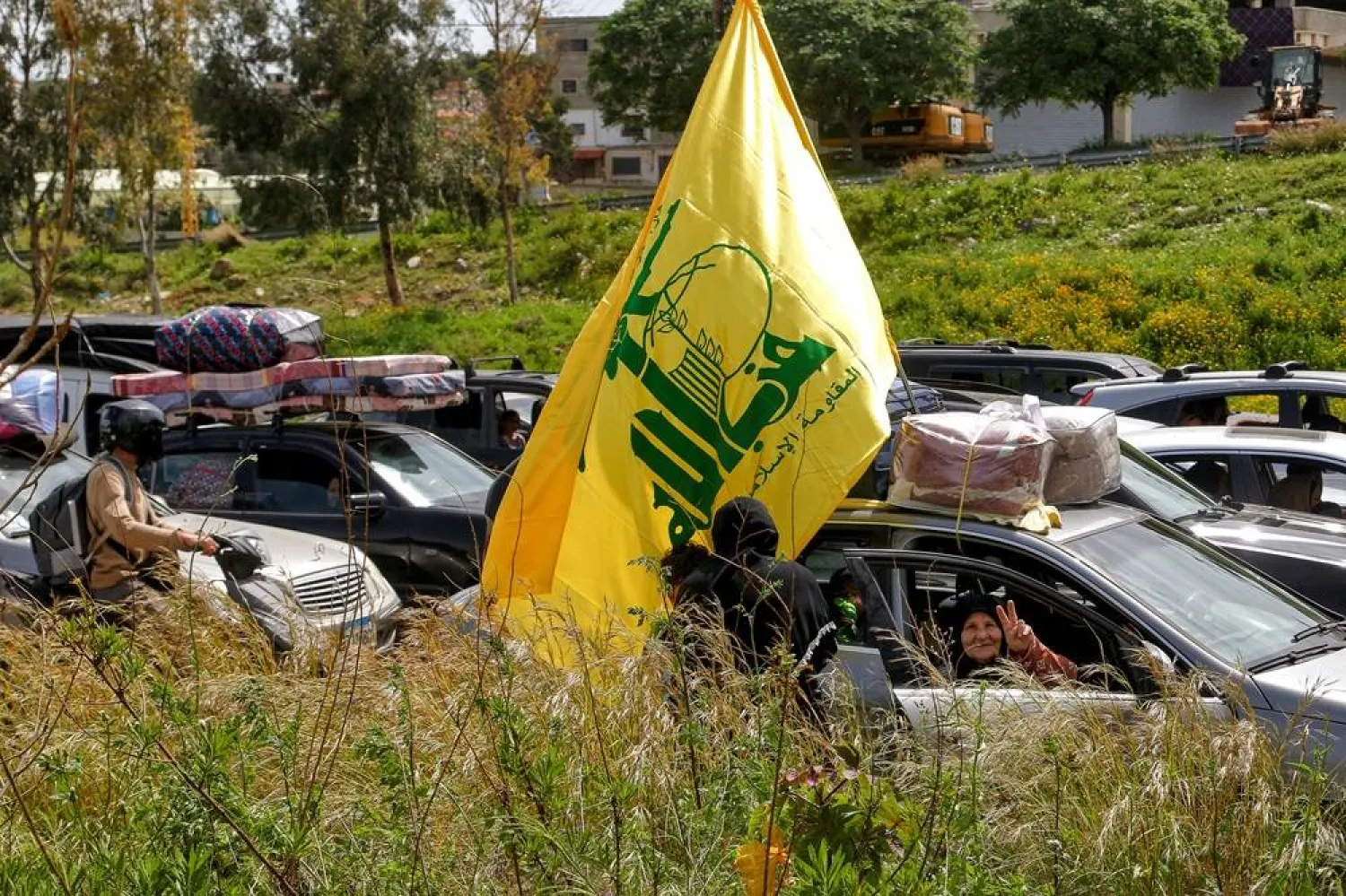
17 April 2026, Lebanon, Jiyyeh: A displaced Lebanese woman flashes the victory sign and displays Hezbollah and Iranian flags as they drive along the highway linking Beirut to southern Lebanon in the Jiyyeh area. (dpa)
TT

Hezbollah Leader Urges Lebanon to Quit Direct Talks with Israel

17 April 2026, Lebanon, Jiyyeh: A displaced Lebanese woman flashes the victory sign and displays Hezbollah and Iranian flags as they drive along the highway linking Beirut to southern Lebanon in the Jiyyeh area. (dpa)

The leader of Lebanon’s Hezbollah group called on the government Tuesday to withdraw from direct talks with Israel, calling them a concession and urging “indirect negotiations.” 

Lebanon and Israel are scheduled to hold two days of talks in Washington starting Thursday in an attempt to end the latest fighting that broke out two months ago, following the Iran war, and discuss the future of relations between the two sides that have been at war since Israel was created in 1948. 

Hezbollah leader urges indirect talks Naim Qassem said in a letter directed to the group’s officials that direct negotiations benefit Israel and that they are “concessions by Lebanese authorities.” He said Lebanon’s government should instead resort to indirect negotiations with Israel, as in previous years, such as when a ceasefire was reached in November 2024. 

Indirect talks are usually done through a third party. 

Qassem also said the dispute over Hezbollah’s possession of weapons was an internal affair and shouldn't be part of the talks with Israel. The Lebanese government has sought the disarmament of the armed group after the latest round of fighting broke out in early March, calling all military activities by the group illegal. 

Lebanese authorities have also demanded cessation of hostilities, Israeli withdrawal from Lebanon, deployment of Lebanese troops south of the Litani River, the release of Lebanese prisoners held in Israel and the return of displaced people to their homes. 

Qassem said Tuesday his group is ready to cooperate to help achieve the five points demanded by the country's government. 

Israel and Lebanon trade attacks despite the ceasefire  

Despite the US-brokered ceasefire, which went into effect on April 17, Israel and Hezbollah have continued carrying out daily attacks. 

Lebanese Health Minister Rakan Nassereddine told reporters Tuesday that since the ceasefire went into effect, 380 people have been killed and 1,122 wounded. 

He added that since the latest war started on March 2, when Hezbollah fired rockets into northern Israel two days after the US and Israel attacked Iran, the death toll in Lebanon has reached 2,882 dead and 8,786 wounded. 

Since the early hours of Tuesday, Israel’s air force carried out strikes in different parts of southern Lebanon as well as the village of Sohmor in the eastern Bekaa Valley, state-run National News Agency reported. NNA said airstrikes on the village of Jibchit killed three and wounded four on Tuesday. 

The Israeli military had earlier issued an evacuation warning to the residents of Sohmor and four villages in southern Lebanon. 

The National News Agency reported that an Israeli force entered parts of the southern village of Deir Mimas on the Litani River and blew up a water pumping station that uses solar energy and supplies the village with fresh water. The agency said that the blast at the station at around 5 a.m. (0200 GMT) caused wide damage. 

The Israeli military posted photos of troops along the Litani River, without providing exact location details. 

Hezbollah issued a statement saying that its fighters struck Israeli troops Tuesday morning near the Litani River in the village of Deir Seryan with rockets. It gave no further details. 

Also Tuesday, Hezbollah confirmed that one of its military commanders was killed in an airstrike near Beirut last week. The group released a photo of Ahmed Ghaleb Balout describing him as a commander who spent much of his life on the battlefield. 

Balout was killed May 6 in an airstrike on a southern suburb of Beirut. 

It was the first airstrike near Beirut since the ceasefire went into effect. 

The Israeli military said Thursday it had killed Balout, who it identified as a commander in Hezbollah’s elite Radwan Force, along with two other fighters. 


Syria Hopes for Terrorism Delisting to Spur Economic Recovery

01 June 2026, Syria, Deir Ezzor: A view of the war-damaged buildings in Deir Ezzor. (dpa)
TT

Syria Hopes for Terrorism Delisting to Spur Economic Recovery

01 June 2026, Syria, Deir Ezzor: A view of the war-damaged buildings in Deir Ezzor. (dpa)

The Syrian government is betting that removal from Washington’s list of state sponsors of terrorism, a designation in place since 1979, will clear the biggest political and legal hurdle to its economic recovery.

Alongside remaining sanctions, the designation has blocked any tangible gains from what was billed as a near-comprehensive lifting of international sanctions about a year ago.

Sources in Damascus said the US hesitation was tied to Israel’s opposition to lifting sanctions. Other sources pointed to a mix of regional, international and domestic factors.

In a recent phone call with US President Donald Trump, Syrian President Ahmed al-Sharaa asked for the remaining sanctions to be lifted, saying the move was essential to revive Syria’s economy, improve living conditions and attract investment.

Syria remains caught in a complex sanctions web despite limited easing in recent months. Those measures covered Sharaa himself, the interior minister, the central bank, Syrian Airlines, the ports of Latakia and Tartus, and the Syrian Petroleum Company.

Researcher and economic expert Ziad Arbash told Asharq Al-Awsat that the sanctions still in place include the Caesar Act, which has only been suspended repeatedly and temporarily for 180 days at a time, not permanently repealed, leaving investors facing uncertainty.

They also include the state sponsor of terrorism designation, as well as broad secondary sanctions, including hundreds of measures still imposed by the United States, the European Union and the United Kingdom on individuals and entities.

Other restrictions remain on technology exports, above all strict US curbs on dual-use civilian and military technologies, along with personal sanctions on fugitive former president Bashar al-Assad and his inner circle.

Arbash said removing Syria from the state sponsors of terrorism list would unlock direct US investment, which had been fully banned, help reconnect Syrian banks to the global financial system, ease bank transfers and bolster international confidence.

Washington says sanctions will continue to target people it accuses of human rights abuses, Captagon traffickers and other actors it sees as destabilizing the region.

That position comes as US policy in the Middle East rests on the view that a US-centric balance of power works best when allies are encouraged to become more self-reliant and to share burdens through their interdependence and integration with one another.

This is according to Tom Barrack’s first comments after taking up his new duties as special presidential envoy for Syria and Iraq.

But Trump’s policy may be colliding with the realities of a Syria emerging from war.

Abbas Sharifa, a researcher in international relations, said keeping Syria on the state sponsors of terrorism list raises “fundamental problems” that clash with the US view of Syria as a partner in the fight against terrorism.

He said the United States arranged its withdrawal from Syria on the basis that “the Syrian state has become capable of confronting the threat of terrorism.”

Reality also undermines the designation, he said, because “Syria today plays an important role in pursuing ISIS, has no relationship with Iranian militias and provides no support to any groups Washington considers terrorist organizations.”

Sharifa said the delay in lifting the remaining sanctions was likely tied to political positions held by some pro-Israel members of Congress.

Trump’s Syria policy, he said, has long run counter to Israel’s view, but “there appears to be Israeli pressure in some decision-making circles to obstruct this measure and link it to the signing of the security agreement with Israel, which has faltered because of Israeli intransigence.”

He ruled out Syria’s commercial and military ties with Russia as an obstacle, saying that “the US administration itself granted exemptions for the export of Russian oil.”

Across Syria, frustration has replaced the optimism that followed the partial lifting of sanctions. A year on, the economy remains far from real recovery, and the impact on daily life has been very limited, Arbash said.

He said the reasons are complex. Remaining sanctions still prevent Western banks and companies from operating freely in the Syrian market.

The United States and European countries will not move toward a full lifting of sanctions without the implementation of United Nations Security Council resolution 2254, an improved human rights record and guarantees for the safe return of refugees.

Full repeal of the Caesar Act also requires approval from the US Congress, a lengthy process with political hurdles.

“Even if sanctions were lifted completely today, the positive effects, such as investment inflows, would need months or years to appear on the ground,” Arbash said.

He also pointed to international concern that aid or investment “could fund corruption unless there are transparent mechanisms to ensure it reaches the Syrian people.”

Internal divisions are another obstacle. Some areas remain outside central government control, making it harder to apply unified economic decisions. Added to all these factors is Israeli opposition to lifting sanctions.


Iraq’s Asaib Ahl Al-Haq Says It Will Start Handing Its Weapons to the State

Members of the Iraqi Popular Mobilization Forces parade of the Asaib Ahl al-Haq, participate in a Quds Day march in Baghdad, Iraq, Friday, July 1, 2016. (AP)
TT

Iraq’s Asaib Ahl Al-Haq Says It Will Start Handing Its Weapons to the State

Members of the Iraqi Popular Mobilization Forces parade of the Asaib Ahl al-Haq, participate in a Quds Day march in Baghdad, Iraq, Friday, July 1, 2016. (AP)

One of Iraq’s most powerful Iran-backed armed groups said Tuesday it would begin putting its weapons under government control, a major step in the new government’s effort to bring armed factions that have long operated on their own under state command.

Asaib Ahl al-Haq said it had formed a committee to oversee the move, including an inventory of its fighters, weapons and equipment, and to coordinate with the commander-in-chief of the armed forces. The group cast the decision as a response to calls by Iraq’s top Shiite religious authority and the Iran-aligned Coordination Framework, the largest bloc in parliament that dominates Iraqi politics.

The war in the Middle East has exposed the fragility of Iraq’s state institutions and their limited ability to restrain these groups. A parallel confrontation between Washington and the factions has deepened the crisis, with factions acting as an extension of Iran’s regional campaign and escalating attacks on US assets in Iraq before a tenuous ceasefire deal was reached in April.

The first significant move came a week ago, when the influential Shiite cleric Moqtada al-Sadr said his Saraya al-Salam faction would split from his political movement and integrate into state institutions.

Under pressure from Washington, Prime Minister Ali al-Zaidi has been working to assert state authority over weapons.

Zaidi, a 40-year-old banker sworn in last month has made a state monopoly on arms a centerpiece of his program. The Trump administration has warned against any government influenced by Iran-linked factions and tied defense cooperation and funding to efforts to curb them.

Many Iran-backed factions are funded through the Iraqi state budget and embedded within the security apparatus, although not under the government's control. This has drawn criticism from the United States and other countries that have borne the brunt of their attacks and say Baghdad has failed to take a tougher stance.

Several armed factions aligned with Iraq’s Coordination Framework have taken a different stance on efforts to bring weapons under state control. Two important groups, Kataib Hezbollah and Harakat al-Nujaba, have rejected disarmament, tying the issue to Iraq’s sovereignty and the presence of foreign troops.

Kataib Hezbollah welcomed moves by other factions to place weapons under state authority but said its own armed activity will continue as part of what it describes as “resistance work." In a recent statement attributed to its Abu Mujahid al-Assaf, the group said it would offer coordination with the Popular Mobilization Forces rather than surrendering arms.

The PMF, a state-backed umbrella of armed groups, was formed in 2014 to fight the ISIS group. Many of its groups still keep their own command and ties to Iran.


Lebanon’s Berri to Guarantee Hezbollah Respect for ‘Global’ Truce with Israel, Says Adviser

 Rescue workers use excavators, as they search for victims under the rubble of a building that was hit Monday in an Israeli airstrike in the southern port city of Tyre, Lebanon, Tuesday, June 2, 2026. (AP)
Rescue workers use excavators, as they search for victims under the rubble of a building that was hit Monday in an Israeli airstrike in the southern port city of Tyre, Lebanon, Tuesday, June 2, 2026. (AP)
TT

Lebanon’s Berri to Guarantee Hezbollah Respect for ‘Global’ Truce with Israel, Says Adviser

 Rescue workers use excavators, as they search for victims under the rubble of a building that was hit Monday in an Israeli airstrike in the southern port city of Tyre, Lebanon, Tuesday, June 2, 2026. (AP)
Rescue workers use excavators, as they search for victims under the rubble of a building that was hit Monday in an Israeli airstrike in the southern port city of Tyre, Lebanon, Tuesday, June 2, 2026. (AP)

Lebanese parliament Speaker Nabih Berri, a key Hezbollah ally, will guarantee the Iran-backed group's adherence to a "global ceasefire" with Israel, his adviser told AFP on Tuesday.

Berri, who heads the Hezbollah-allied Amal party, has long acted as an intermediary between the group and the United States, which considers Hezbollah a "terrorist" organization.

US President Donald Trump said late Monday that Israeli Prime Minister Benjamin Netanyahu had agreed to call off a military raid on Beirut while Hezbollah agreed "all shooting will stop".

Despite the announcement Israeli drone strikes on southern Lebanon on Tuesday killed eight people, including a father and his son and daughter.

Adviser Ali Hamdan told AFP that "speaker Berri's main demand is a global ceasefire. If a global ceasefire deal is reached, he will guarantee Hezbollah's respect for it."

Hamdan said a "global ceasefire means a halt to Israeli strikes by air, land or sea, and that it will not carry out detonations or demolitions" in the south, where Israel is accused of razing entire villages.

Trump had said that "through highly placed Representatives, I had a very good call with Hezbollah, and they agreed that all shooting will stop -- That Israel will not attack them, and they will not attack Israel."

Netanyahu said late Monday that he had told Trump "that if Hezbollah does not cease attacking our towns and our citizens, Israel will strike terrorist targets in Beirut".

Hezbollah has not released a statement on the announcement.

Lebanon's embassy in the United States said on Monday that Hezbollah had accepted a US proposal on a "mutual cessation of attacks".

"Under the proposed arrangement, Israeli strikes on Dahieh would cease in exchange for Hezbollah refraining from launching attacks against Israel, with the ceasefire framework to be expanded to encompass all Lebanese territory," the embassy statement released by the Lebanese presidency added, referring to Beirut's southern suburbs.

Iran has insisted that a ceasefire in Lebanon remains a key condition for any deal with the United States to end the Middle East war.

Iran's parliament speaker Mohammad Bagher Ghalibaf, who is also the country's chief negotiator, said on Monday night that he and Berri had spoken by phone.

Ghalibaf told his Lebanese counterpart that "if the Israeli aggression on Lebanon continues, we will not just stop the negotiation process, but we will be in a direct confrontation with the enemy", he said on X, referring to Israel.

Iran's Tasnim news agency reported on Monday that Tehran was no longer engaging in talks with Washington because of Israel's offensive on Lebanon, although there was no official confirmation of this.