

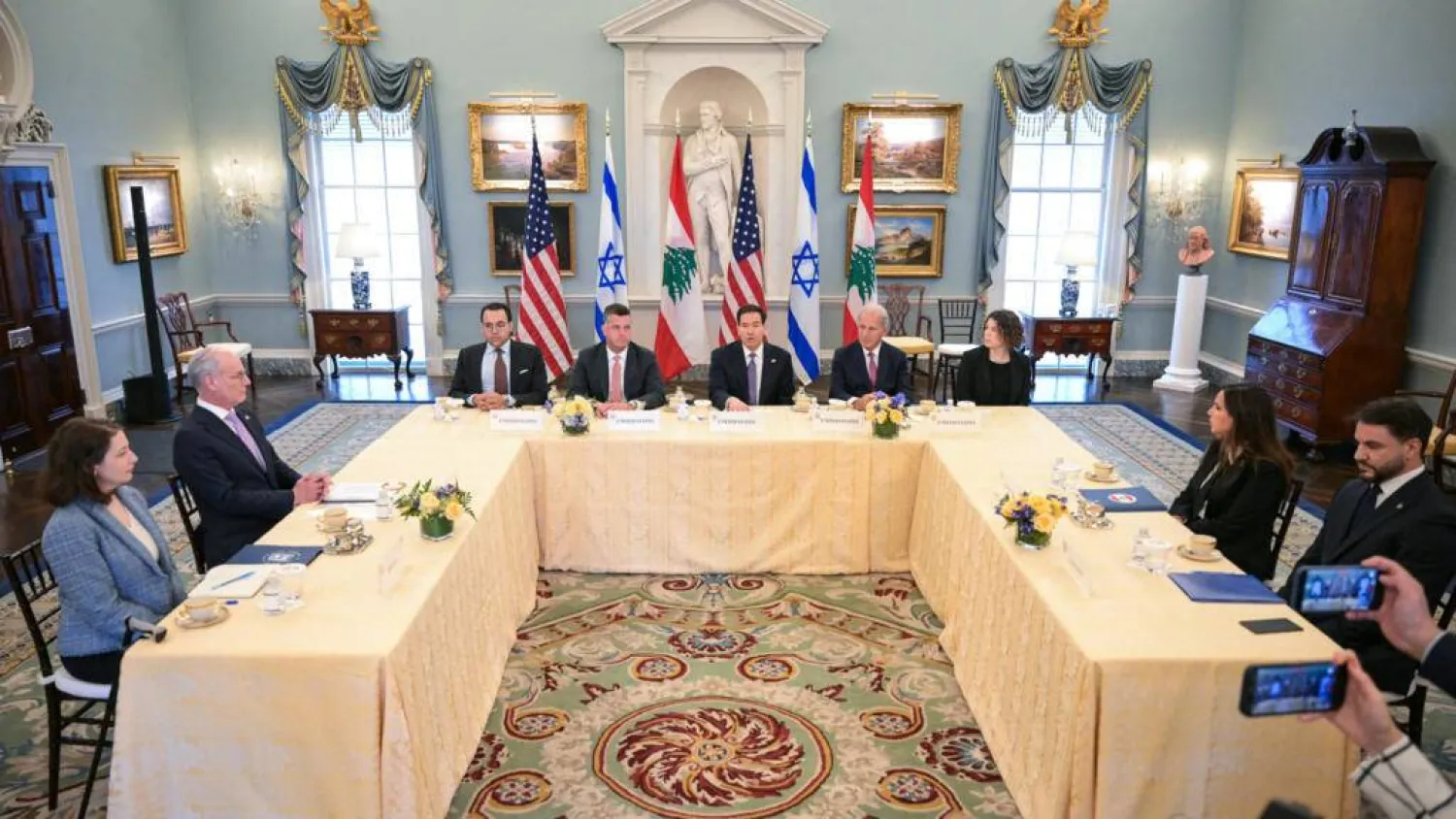

The Veteran Envoys Leading Lebanon-Israel Direct Talks

US Secretary of State Marco Rubio (C) speaks during a meeting with Lebanon's Ambassador to the US Nada Hamadeh Moawad (2R) and Israeli Ambassador to the US Yechiel Leiter (2L) at the State Department in Washington, DC, on April 14, 2026. AFP, Oliver Contreras
TT

The Veteran Envoys Leading Lebanon-Israel Direct Talks

US Secretary of State Marco Rubio (C) speaks during a meeting with Lebanon's Ambassador to the US Nada Hamadeh Moawad (2R) and Israeli Ambassador to the US Yechiel Leiter (2L) at the State Department in Washington, DC, on April 14, 2026. AFP, Oliver Contreras

Lebanon's Simon Karam and Israel's Yechiel Leiter, both political veterans with entrenched views, will come face to face in Washington for talks Thursday after decades in a state of war.

Lebanon and Israel have no formal ties, but US President Donald Trump is hoping for a historic breakthrough even as Israeli forces remain deployed in south Lebanon to fight Iran-backed Hezbollah.

While Lebanon is seeking to consolidate a ceasefire in the latest war and to obtain the withdrawal of Israeli troops, Israel wants to ensure Hezbollah is disarmed, said AFP.

Here are profiles of the envoys leading their countries' third round of negotiations:

- Karam: the quiet negotiator -

Simon Karam, a lawyer known for his decades in politics and fierce defense of Lebanon's sovereignty, was appointed by President Joseph Aoun last month for the thorny task of helming the direct talks with Israel.

Beirut insists Israel must end its attacks before starting negotiations, while Hezbollah rejects outright any direct engagement between the two countries.

A former ambassador to Washington and independent politician, 76-year-old Karam is known for his defense of Lebanese unity in a country riven by sectarian divisions.

He is also known for his support for extending state sovereignty across all of Lebanon, where Hezbollah has long kept a huge arsenal and thrown the country into war after war.

Late last year, Karam was appointed as Lebanon's civilian representative to a committee comprising Lebanon, Israel, the United States, France and UN peacekeepers that was tasked with monitoring a 2024 ceasefire.

Karam is known for his calm demeanor and makes few media appearances, but those who know him say he has remained uncompromising in his convictions on a sovereign, stable Lebanon.

During his participation in two previous ceasefire monitoring committee meetings, Karam "was a decisive and rational negotiator", a source familiar with the talks told AFP on condition of anonymity.

"He was particularly insistent on the demand that southern residents return to their towns, and spoke at length about the emotional ties linking villagers to their lands," the source added.

Political analyst Ali al-Amin, who has known Karam for decades, praised his upstanding character.

"He doesn't make deals under the table," Amin said, noting Karam had not sought high office despite his connections.

Karam entered public life in 1990, first being appointed governor of east Lebanon's Bekaa region and then Beirut.

He was named ambassador to Washington in 1992 but stepped down the following year, in a move observers said was linked to his diverging views from authorities who at the time were under the influence of Syria, whose occupation Karam opposed.

Karam, who is fluent in Arabic, French and English, hails from south Lebanon's Jezzine district and is married with three children.

- Leiter: the Netanyahu ally -

Israel's ambassador to the United States, Yechiel Leiter, is a longtime ally of Prime Minister Benjamin Netanyahu.

Well-versed in Israeli settler politics, conservative activism and hard-edged diplomacy, Leiter, 67, took up his post as Israel's top envoy to Washington in January 2025.

Born in the United States, he emigrated to Israel at 18 and later served as a combat medic in the military in 1982, when Israel invaded Lebanon.

Leiter first gained prominence in the 1990s as a leading figure in the Yesha Council, the umbrella organization representing Israeli settlers in the occupied West Bank.

During some of the most divisive years of the Israeli-Palestinian peace process, Leiter became a forceful advocate for the settlement movement and a prominent nationalist.

His influence later extended into government, holding several senior positions in the ministries of education, finance and transportation.

Leiter served as chief of staff to Netanyahu when the latter served as finance minister in the early 2000s, helping cement a longstanding political alliance.

A member of Netanyahu's Likud party, he also worked as a strategist and adviser to several right-wing Israeli think tanks.

The war in Gaza struck him personally.

In November 2023, his son, Moshe Leiter, was killed in combat in the Gaza Strip, a month after Hamas's October 7 attack on Israel.

Leiter was also an outspoken critic of President Joe Biden, before Trump returned to the White House.

In a 2024 interview with Israel's Channel Tov, he denounced what he described as "American pressure" on Israel under Biden during the war in Gaza.

After being appointed ambassador, Leiter renounced his US citizenship as Israelis with dual citizenship are not permitted to serve as diplomats in countries where they hold a citizen status.

In May 2025, he was summoned by the foreign ministry after accusing Netanyahu's opponents of spreading "blood libels" against the prime minister -- breaching norms against Israeli diplomats making political statements, according to media reports.

Leiter has positioned himself as an advocate for a broader regional realignment, and following talks in Washington with his Lebanese counterpart in April, he praised what he called a "wonderful exchange".

His portfolio also includes normalization talks with Syria, according to the Israeli embassy in Washington.


Yemeni Military Chief: We Rebuilt the Army, Military Decision-Making Is Now Unified

Bin Aziz said the relationship with Saudi Arabia goes beyond coordination and has become a genuine partnership on the ground (Saba)
TT

Yemeni Military Chief: We Rebuilt the Army, Military Decision-Making Is Now Unified

Bin Aziz said the relationship with Saudi Arabia goes beyond coordination and has become a genuine partnership on the ground (Saba)

Yemen's Chief of the General Staff and Commander of Joint Operations, Lieutenant General Sagheer bin Aziz, said the military leadership and decision-making process have been unified as part of efforts to bring all military formations under the umbrella of the Ministry of Defense and the General Staff.

He revealed that the Yemeni armed forces have completed about 80 percent of their operational and administrative arrangements since the 2022 truce began, adding that the military has continued over the past several years to rebuild its units, improve combat readiness, and strengthen its capabilities in confronting the Iran-backed Houthi group.

Speaking to Asharq Al-Awsat from Marib, bin Aziz said the effort included reorganizing military units, defining their sectors and missions in line with military standards, training and qualifying large numbers of armed forces personnel, and restructuring administrative systems in accordance with the Armed Forces Service Law.

The army chief stressed that "the leadership is now unified, the military decision-making process is unified, and we are on the right path toward bringing all military formations under the umbrella of the Ministry of Defense and the General Staff."

Restructuring

He added: "Since the truce began in 2022, we have made excellent progress in both operational and administrative arrangements. We reorganized military units, their sectors, and their missions in accordance with military standards. We also trained and qualified large numbers of armed forces personnel and restructured the administrative framework of military units in line with the law."

Bin Aziz explained that since 2015 the Yemeni military has fought a different kind of war from any it had faced before. The armed forces were assembled from former army units as well as newly established formations while fighting a conflict that continued until 2022, during which the military suffered "tens of thousands of martyrs and wounded."

He continued: "The army withstood an arsenal backed by Iran. There were setbacks, but our resilience was greater because it preserved what remained of the Republic of Yemen and the institutions of the state."

According to bin Aziz, one of the most significant achievements in recent years has been the introduction of a smart ID card system for armed forces personnel, which has now been implemented in about 95 percent of military units. He described it as an important step in eliminating overlap and duplication within the armed forces.

He said: "This is an important achievement because it removes doubts and concerns about overlapping units, duplication, and related issues. We are satisfied with what has been accomplished so far, and the work is continuing."

Integrating Military Formations

On integrating military formations, bin Aziz said unifying the administration of the armed forces is one of the most important requirements for success on the battlefield and for achieving security and stability in Yemen. He noted that the process requires time and multiple steps to incorporate the various formations under the umbrella of the Ministry of Defense and the General Staff.

He added: "Reforming the military establishment and unifying its administration is a goal shared by everyone. We believe that unifying the military's command structure is one of the fundamental pillars for achieving success in the battle and securing stability in the Republic of Yemen."

He said work on this effort is continuing under the leadership of the chairman of the Presidential Leadership Council, the supreme commander of the armed forces, together with the council's members. He stressed that the most important achievement at this stage is that the leadership has become unified, both within Yemen and across the Coalition to Restore Legitimacy.

He said: "What matters to us now is that the leadership has become unified and the military decision-making process is unified. We are on the right path toward bringing all military formations under the umbrella of the Ministry of Defense and the General Staff."

Lieutenant General Sagheer bin Aziz, Chief of the General Staff (Saba)

Lessons Learned

Asked about the military lessons drawn from years of war, Yemen's army chief said the nature of warfare has changed dramatically, with drones, ballistic missiles, electronic jamming systems, and smart weapons becoming decisive factors in modern warfare.

At the same time, he stressed that technology does not eliminate the role of ground forces. While smart weapons may influence offensive operations and the scale of losses, he said controlling and securing territory ultimately depends on personnel on the ground.

He said: "War today has become a different kind of conflict. Drones, ballistic missiles, electronic jamming systems, and smart weapons have become the decisive factors. But no matter how advanced technology becomes, ground forces, particularly the infantry, remain among the most important factors in success on the battlefield."

He added: "Drones, ballistic missiles, and smart systems cannot remain on the ground and secure it. The infantry soldier remains the decisive factor in holding territory, and controlling the ground is more important than any other weapon."

Modern Technologies

On the use of modern technologies, bin Aziz said the Yemeni armed forces are making "good" use of these capabilities. He said the military has specialized units for drones, smart weapons, and electronic jamming systems, in addition to experienced personnel who have gained extensive battlefield expertise over years of war.

He said: "Our training and qualification in this field are of the highest standard. We have specialized units for drones, smart weapons, and electronic jamming systems, along with highly capable personnel who possess extensive battlefield experience as well as advanced training."

Saudi Partnership and Support

The Yemeni army chief praised Saudi Arabia's support in military training and qualification, noting that the Kingdom has trained hundreds of Yemeni military personnel across various fields.

He said: "Our brothers in Saudi Arabia are also committed to training and qualification. We highly value and appreciate the continued military cooperation they have provided."

He added that the relationship with Saudi Arabia goes beyond coordination and has become "a genuine partnership on the ground" across multiple fields, particularly in confronting Houthi threats that target not only Yemen but also Saudi Arabia and the Arab region as a whole.

He continued: "The Saudis have stood with us through every circumstance and at every stage. We can never fully repay them for the support and cooperation they have provided in what we regard as our sacred battle against the Houthi group."

Bin Aziz stressed that Saudi Arabia's support for Yemen is not driven by political or economic objectives, but by its conviction that the security of Yemen and Saudi Arabia is indivisible.

He said: "We know that Saudi Arabia has no political or economic ambitions in its cooperation with the Republic of Yemen. Its primary objective is the belief that its security is inseparable from Yemen's, and Yemen's security is inseparable from its own. This is a sincere, brotherly stance and the response of generous men standing by their brothers in Yemen."

Concluding the interview, the Yemeni army chief said the current phase marks a transition from coordination to a genuine partnership.

He said: "Today, we are no longer in a phase of coordination alone. We are in a phase of genuine partnership on the ground, militarily, economically, politically, and socially, to defeat the enemy that threatens Yemen, Saudi Arabia, and the entire Arab world."


Gaza Health Officials Say 3 Killed in Israeli Drone Strike

Mourners sit inside a vehicle as they carry the body of Palestinian child Malik Abu Shawish, on the day of the funeral of Palestinians who were killed in an Israeli strike, according to medics, at Al-Aqsa Martyrs Hospital in Deir al-Balah, in the central Gaza Strip, June 29, 2026. REUTERS/Mahmoud Issa
TT

Gaza Health Officials Say 3 Killed in Israeli Drone Strike

Mourners sit inside a vehicle as they carry the body of Palestinian child Malik Abu Shawish, on the day of the funeral of Palestinians who were killed in an Israeli strike, according to medics, at Al-Aqsa Martyrs Hospital in Deir al-Balah, in the central Gaza Strip, June 29, 2026. REUTERS/Mahmoud Issa

Gaza health officials said on Monday that an Israeli drone strike killed three civilians, including a child, the latest violence to hit the Palestinian territory despite a ceasefire.

Israel and Hamas trade near-daily accusations of truce violations and the Gaza Strip remains gripped by bloodshed as progress stalls on permanently ending their war.

"Three people were killed and several injured when an Israeli drone struck a group of civilians," Al-Aqsa hospital said in a statement.

Gaza's civil defense agency, which acts as a rescue force under Hamas, said the strike hit an area in Deir el-Balah, one of the least damaged towns in central Gaza.

The hospital said the fatalities were two men and an 8-year-old while a third man was wounded.

Israel's military identified the target as Zaher Abu Salem, who it said was a member of Islamic Jihad and was involved in the Oct. 7, 2023, attack on Israel that triggered the war.

At least 1,041 Palestinians have been killed in Gaza since the ceasefire took effect on October 10 last year, according to the territory's health ministry.

The Israeli army has reported six deaths in its ranks during the same period.


Al-Zaidi: We Will Continue Anti-Corruption Efforts in Iraq to Recover Public Funds

This handout picture released by the Iraqi Prime Minister's Media Office shows PM Ali al-Zaidi giving an address after assuming office in Baghdad on May 16, 2026. (Photo by IRAQI PRIME MINISTER'S PRESS OFFICE / AFP)
TT

Al-Zaidi: We Will Continue Anti-Corruption Efforts in Iraq to Recover Public Funds

This handout picture released by the Iraqi Prime Minister's Media Office shows PM Ali al-Zaidi giving an address after assuming office in Baghdad on May 16, 2026. (Photo by IRAQI PRIME MINISTER'S PRESS OFFICE / AFP)

Iraqi Prime Minister Ali al-Zaidi has stressed that the government was determined to continue fighting corruption to recover public funds.

In remarks published Monday following a cabinet session held on Sunday night, al-Zaidi said that “the recent offensive against corruption is just a first phase, and the government will continue to combat corruption to recover public funds.”

The government “is tasked with protecting the interests of the Iraqi people, and there will be no leniency,” said al-Zaidi.

He added that “the situation can no longer be tolerated, and our concern for the welfare of Iraqis compels us to assure our people that there are strong guardians of public funds.”

Iraq “has endured eras of wars, chaos, and combating terrorism. Today, the government's path is different by ... not allowing the corrupt to be part of the state's apparatus with the aim of stealing public funds.”

Dozens of Iraqi political officials have been arrested on corruption charges, Iraq’s state-run Iraqi News Agency reported Sunday.

It said the arrests were based on a statement made by former Deputy Minister of Oil Adnan al-Jumaili, who was arrested last month, and “included members of Parliament whose immunity had been lifted.”
