
War Worsens Lebanon's Economic Crisis with Job Losses, Price Gouging and Slow Business

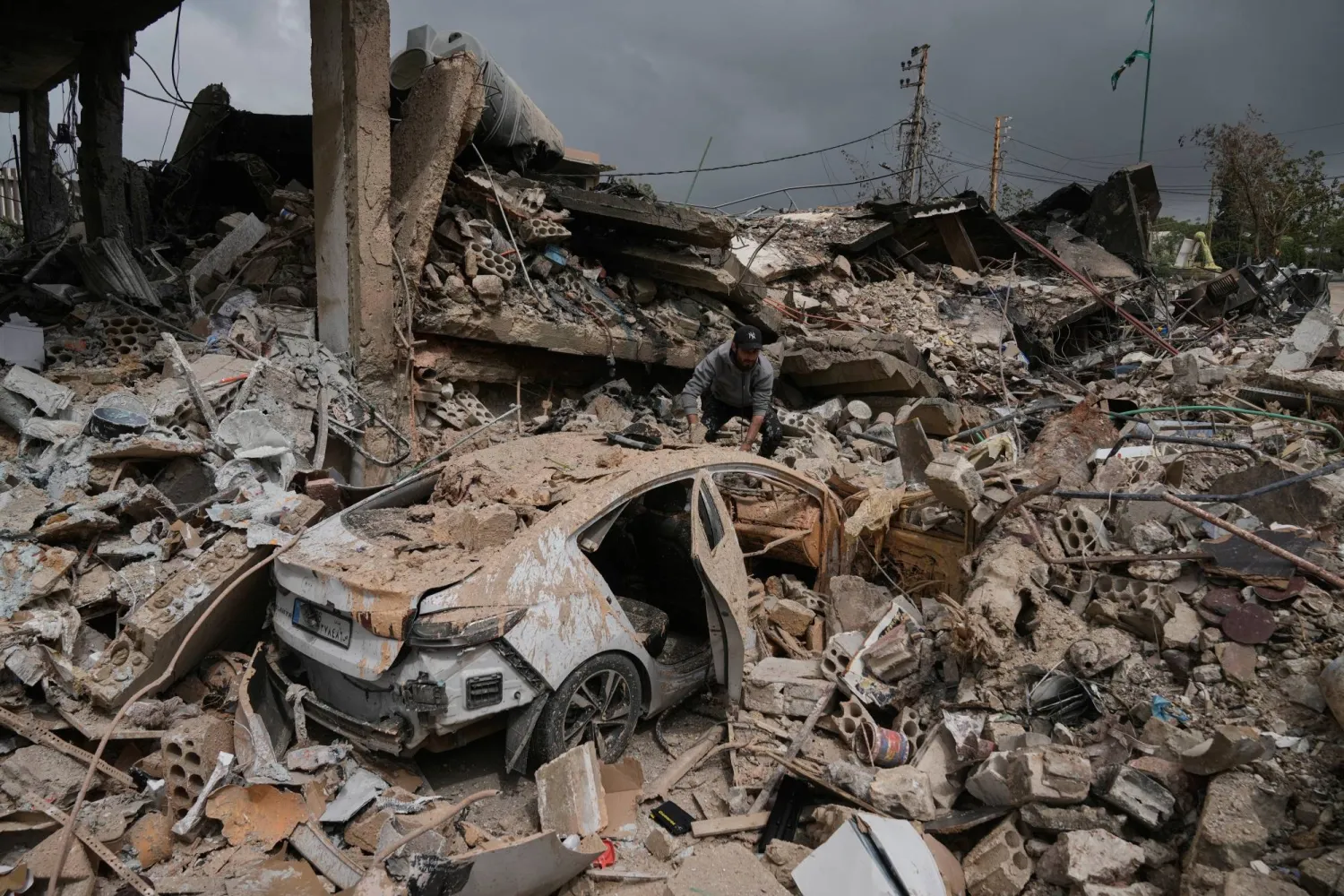
A man inspects his damaged car amid the rubble of shops destroyed in previous Israeli airstrikes in the Hosh neighborhood of Tyre, southern Lebanon, April 19, 2026. (AP Photo/Bilal Hussein)
TT

War Worsens Lebanon's Economic Crisis with Job Losses, Price Gouging and Slow Business

A man inspects his damaged car amid the rubble of shops destroyed in previous Israeli airstrikes in the Hosh neighborhood of Tyre, southern Lebanon, April 19, 2026. (AP Photo/Bilal Hussein)

Ayman al-Zain watched on a recent afternoon as a bulldozer cleared the rubble of what used to be his sports clothing store, which was one of dozens of buildings destroyed in Israeli strikes against the Hezbollah militant group.

With a nominal truce in place that has reduced but not halted the fighting, Al-Zain tried to assess whether to rebuild the shop in Beirut’s southern suburbs that he once hoped to pass down to his kids. But it's unlikely he will be able to do so anytime soon, and not only because of the fear of more airstrikes.

“Everything is expensive,” he told The Associated Press. “If I want to open a new store and get mannequins, hangers and some accessories, the prices are very different than before.”

The US-Israeli war with Iran, and the closure of the Strait of Hormuz, have sent economic shock waves across the Mideast. In Lebanon, those woes have been compounded by the country's existing economic problems and by largely unregulated markets that are vulnerable to price gouging.

“This continues to be a major economic shock, one of honestly an existential nature,” said Economy Minister Amer Bisat, who is part of the Lebanese Cabinet that came into office over a year ago on a reformist agenda.

Problems have piled up for years

Since 2019, the tiny Mediterranean country has been in the throes of an economic crisis that pulverized the value of its local currency and its banking system.

That's when Lebanese banks collapsed, which evaporated depositors’ savings and plunged about half of the population of 6.5 million into poverty, after decades of rampant corruption, waste and mismanagement. The country suffered some $70 billion in losses in its financial sector, further compounded by about $11 billion in the 2024 war between Israel and Hezbollah, according to the World Bank. The Lebanese pound has since lost over 90% of its value against the US dollar.

The cash-strapped state electricity company provides only a few hours of power a day, and most Lebanese rely on diesel generators to make up the difference. That makes the economy particularly vulnerable to fuel price increases.

Lebanon was already “grappling with multiple rounds of crises,” said Mohamad Faour, professor of finance at the American University of Beirut. "So this round of war only made an already fragile situation more fragile.”

With this new war, 1.2 million Lebanese have been displaced, largely from southern Lebanon and Beirut's southern suburbs. Many are sheltering in schools with no work or draining whatever money they have renting out apartments or hotel rooms.

Economy suffers job losses and crippling inflation

In an interview with the AP from his office, Bisat estimated that the country faces an economic loss of around 7% of its gross domestic product due to the war because “companies are closing, people are losing their jobs, tourists are not showing up.”

Evidence of inflation abounds.

In the usually bustling produce market in Sabra, south of Beirut, vendor Ahmad al-Farra looked dejected as an elderly woman shopping for watermelon, tomatoes and potatoes walked away without buying anything after checking the price tags.

Prices have spiked since the US and Israel launched a war against Iran on Feb. 28, followed quickly by a resurgence of war between Israel and Hezbollah.

“We're keeping our prices low so we can sell, and even then we're not selling,” al-Farra said as the sound of an Israeli drone whizzed overhead.

Even consumers who can afford to spend are anxious and cutting back on nonessential purchases, leaving many businesses empty.

Riad Aboulteif, who runs several restaurants and bars in the capital, said his revenue has dropped by some 90% since the war began, as Lebanon’s shrinking middle class cuts costs.

People are saving more money for their survival and not making plans to celebrate birthdays or other special occasions, he said at one of his bars in the bustling Hamra district of Beirut, where the loud chatter of customers once overpowered the jazz music coming through the sound system.

That night, only a few tables were occupied. He's had to downsize his staff and restructure his menus to offer more affordable items.

War fuels price gouging

Meanwhile, the country’s bankrupt government has struggled to crack down on unfair and illicit profiteering and the hoarding of fuel and other essential items.

Many agricultural areas in southern and eastern Lebanon are no longer accessible because of airstrikes and clashes, but al-Faraa believes suppliers have raised prices beyond what is necessary to cover cost increases.

Some of the starkest increases have been in generator bills.

Families and businesses for years have paid multiple utility bills to cover privately supplied electricity and water in the absence of government services. Neighborhood generator owners charge a monthly fee, and some landlords have their own generators and charge the cost to tenants.

Frustrated business owners have said that generator bills have doubled at times, forcing them to shorten their hours of operation or even close on some days to cut costs.

“If we didn’t take these measures, we cannot continue,” Aboulteif said.

Bisat said his ministry has conducted over 4,000 inspections of private generators, gas stations and shops across the country since the start of the war in March and lodged dozens of complaints to the courts. But the issue will not be quickly resolved.

In the meantime, the government has little ability to crack down on the handful of companies that import and distribute fuel and other goods.

No sign of relief on the horizon

With no end to the war in sight, the economic situation shows no sign of easing.

A tenuous ceasefire is in place between the US and Iran, but talks between Washington and Tehran are gridlocked. A nominal truce between Israel and Hezbollah has reduced but not stopped the fighting in Lebanon.

For now, Lebanese families and business owners are confronting the challenges day by day and hoping for the best.

“Only God knows how we’ve been trying to manage ourselves," al-Farra said.


Palestinians in Gaza Mark Anniversary of 1948 Mass Expulsion and Say Today's Catastrophe is Worse

Palestinians attend a rally marking 'Nakba' day in the West Bank city of Ramallah, 12 May 2026. EPA/ALAA BADARNEH
TT

Palestinians in Gaza Mark Anniversary of 1948 Mass Expulsion and Say Today's Catastrophe is Worse

Palestinians attend a rally marking 'Nakba' day in the West Bank city of Ramallah, 12 May 2026. EPA/ALAA BADARNEH

Blink and you might miss the few stone walls that are all that’s left of the village that Yusuf Abu Hamam’s family was forced to flee when he was an infant in 1948.

The village, al-Joura, was demolished by the Israeli military at the time. It has since vanished under neighborhoods of the southern Israeli city of Ashkelon and the grounds of a national park.

The neighborhood where Abu Hamam’s family ended up — and where he spent most of his life — now lies also largely in ruins. Buildings in the Shati Camp in the northern Gaza Strip have been razed and wrecked by Israeli bombardment and demolitions during the past 2½ years of war, The Associated Press said.

On Friday, Abu Hamam and millions of Palestinians mark the 78th anniversary of the Nakba, Arabic for “catastrophe,” referring to the mass expulsion and flight of some 750,000 Palestinians from what is now Israel during the 1948 war surrounding Israel’s creation. It’s the third commemoration of the Nakba since the war in Gaza began.

The 78-year-old Abu Hamam, one of a dwindling number of Nakba survivors, says the current war is an even greater catastrophe.

More than six months after an October ceasefire, he and the rest of Gaza’s more than 2 million people are now crammed into less than half of the 25-mile-long strip along the Mediterranean coast, surrounded by an Israeli-controlled zone encompassing the rest of the territory.

“There is no country left,” Abu Hamam said, speaking next to his home, which was heavily damaged by Israeli shelling earlier in the war. “A square kilometer and a half extending from the sea, this is what we are living in ... It’s indescribable, unbearable.”

What was the Nakba? For Palestinians, the Nakba meant the loss of most of their homeland. Some 80% of the Palestinians who lived in the area that became Israel were driven from their homes by forces of the nascent state before and during the war. The fighting began when Arab armies attacked following Israel’s establishment as a home for Jews in the wake of the Holocaust. Palestinians who remained behind hold Israeli citizenship.

After the war, Israel refused to allow Palestinian refugees to return to ensure a Jewish majority within its borders. Palestinians became a seemingly permanent refugee community that now numbers some 6 million, with most living in refugee camps in the Israeli-occupied West Bank, Lebanon, Syria, Jordan and Gaza.

Around 530 Palestinian villages in what became Israel were destroyed, according to the Palestinian Bureau of Statistics.

Abu Hamam’s birth village was one of them. Al-Joura was seized by the Israeli military as it advanced against Egyptian forces in November 1948. Soldiers were ordered to destroy every home in al-Joura and neighboring villages to ensure their Palestinian populations couldn’t come back, according to military archives cited by Israeli historian Benny Morris.

Refugees swelled the population of the tiny patch of territory along the southern coast that became the Gaza Strip. They stayed in tent camps, run by a newly created UN agency for Palestinians, UNRWA, which provided aid and schooling. Those camps, like Abu Hamam’s Shati Camp, grew into dense urban neighborhoods over the decades, before many were flattened during the latest Gaza war by Israeli bombardment.

In Gaza, Palestinians live a new Nakba

The ancestors of Ne’man Abu Jarad and his wife, Majida, were already living in what would become the Gaza Strip in 1948. They both recall stories from their families about refugees streaming in by foot from areas further north, like the village Abu Hamam came from.

Though they avoided the original Nakba, there was no escaping from what Majida now calls “our Nakba.”

Their hometown has been wiped off the map. Over the past year, Israeli bulldozers and controlled detonations have razed nearly every building in the northern Gaza towns of Beit Lahiya and Beit Hanoun. A new Israeli military base stands about 700 meters (765 yards) from where the Abu Jarads’ house once stood, according to satellite photos.

Also gone is the southern Gaza city of Rafah, once home to a quarter million people, and other villages and neighborhoods located in the Israeli-held half of the Gaza Strip. The military says it is destroying positions used by Hamas and preparing the area for reconstruction. Satellite photos show nearly every structure reduced to rubble.

Over the last 31 months of war, the Abu Jarads and their six daughters have been displaced more than a dozen times as they fled Israeli bombardment and offensives. They currently live in a camp in the southern city of Khan Younis. Their tent offers little shelter from biting winter winds or summer heat, Majida said.

Their daughters have been out of school for over two years now.

“The Nakba of ’48, I don’t think it can be compared to our Nakba,” Majida said. “In ’48, they say people were displaced once and settled in one place, and they are still there until now. But our Nakba, honestly, is more severe because our displacement has happened multiple times. There is no stability.”

Around 90% of Gaza’s more than 2 million people have lost their homes, according to UN estimates, with most of them now sheltering in huge tent camps with rat infestations and pools of sewage. They are dependent on aid to survive.

Israel’s offensive has killed over 72,700 Palestinians, according to local health officials. It was triggered by Hamas’ Oct. 7, 2023, attack on southern Israel that killed some 1,200 people. Militants also abducted 251 hostages.

In the northern West Bank, tens of thousands of Palestinians are entering their 15th month of displacement, after the Israeli military ordered them out of their refugee camps as it launched an operation it said was targeting militant groups.

Since then, troops have demolished or heavily damaged at least 850 structures across the refugee camps of Nur Shams, Jenin and Tulkarem, according to an analysis of satellite imagery by Human Rights Watch released in December.

Saving what was lost, again and again

The 1948 Nakba also brought the loss of Palestinians’ history, as those fleeing struggled to keep hold of the documents and possessions tying them to their homes.

One of the largest archives of Palestinian documents dating back to the Nakba belongs to UNRWA.

UNRWA staff members, who fled their offices in Gaza after Israel ordered the north evacuated, had to leave behind the agency’s extensive archive.

The staff then launched a mission to rescue the most crucial documents — birth, death and marriage certificates and refugee registration cards, according to Juliette Touma, a former senior UNRWA official.

Without those documents, Palestinians could lose their rights and refugee status. Staffers crammed their personal suitcases full of papers and carried them through checkpoints and out of the territory, Touma said.

The current war has cost Palestinians in Gaza what little remained of their personal histories. Majida’s parents’ home in Beit Hanoun was destroyed, and with it family photos.

“There is nothing left,” she said.

Abu Hamam, too, says everything has been lost.

“When this war came, it devoured trees, stones and people,” he said. “Entire families were erased from the civil registry. Hundreds of families are still buried under the rubble.”


Morocco and Syria Establish Joint Business Council

Moroccan Foreign Minister Nasser Bourita (R) meets with Syrian Foreign Minister Asaad al-Shaibani (L) in Rabat, Morocco, 14 May 2026. (EPA)
TT

Morocco and Syria Establish Joint Business Council

Moroccan Foreign Minister Nasser Bourita (R) meets with Syrian Foreign Minister Asaad al-Shaibani (L) in Rabat, Morocco, 14 May 2026. (EPA)

Syrian Foreign Minister Asaad al-Shaibani reopened on Thursday his country’s embassy in the Moroccan capital Rabat.

The FM was on an official visit to the kingdom at the head of a ministry delegation. He met with his Moroccan counterpart Nasser Bourita, hailing the historic ties between their countries.

Speaking at a joint press conference with Bourita, he also praised Morocco’s “noble humanitarian, moral and political stance the kingdom’s leadership adopted by supporting the aspirations of the Syrian people throughout the past 14 years.”

He expressed his gratitude to the kingdom for swiftly restoring political ties with Syria after the ouster of the Assad regime in December 2024.

The first contacts were held with Morocco 20 days after the collapse of the regime, he remarked.

Bourita was invited to visit Damascus, he added, saying that an agreement was reached on a comprehensive course for relations between their countries that would kick off with the political path and later cover economic, educational and trade aspects.

He added that the two sides also agreed to establish a joint business council and expand cooperation by drawing on Morocco’s experience in several sectors, reported Syria’s state news agency SANA.

“Syrian-Moroccan relations are moving in an upward direction, and we will continue working to strengthen and advance them,” Shaibani said.

For his part, Bourita said the reopening of the Syrian embassy in Morocco was evidence that relations between them have returned to normal after over ten years.

“The kingdom, under the leadership of King Mohammed VI, was always clear in supporting the aspirations of the Syrian people for freedom and dignity,” he added, while underscoring Rabat’s backing of Syria’s sovereignty and territorial unity.

He noted that the new Syrian authorities’ political, security, economic and judicial steps are steering the country towards stability and ending the “dark period” it had endured for years despite the regional challenges.


Iraq PM Vows Monopoly on Arms as Parliament Approves Government

 Iraqi lawmakers attend the session to approve the new government in Baghdad, Iraq, Thursday, May 14, 2026. (Iraqi Presidency Office via AP)
Iraqi lawmakers attend the session to approve the new government in Baghdad, Iraq, Thursday, May 14, 2026. (Iraqi Presidency Office via AP)
TT

Iraq PM Vows Monopoly on Arms as Parliament Approves Government

 Iraqi lawmakers attend the session to approve the new government in Baghdad, Iraq, Thursday, May 14, 2026. (Iraqi Presidency Office via AP)
Iraqi lawmakers attend the session to approve the new government in Baghdad, Iraq, Thursday, May 14, 2026. (Iraqi Presidency Office via AP)

Iraqi lawmakers approved a new government on Thursday led by Prime Minister Ali al-Zaidi, who vowed to ensure a state monopoly on weapons amid growing US pressure to dismantle Tehran-backed groups.

Iraq has long walked a tightrope between the competing influences of its allies, neighboring Iran and the United States.

Iraq's parliament voted in favor of Zaidi's government and program, just a few weeks after he was designated following months of political deadlock.

Zaidi's program includes "reforming the security apparatus by restricting weapons to state control and strengthening the capabilities of the security forces", state news agency INA quoted the parliament media office as saying.

In Iraq, a government wins a confidence vote when parliament approves half plus one of its ministries.

Only 14 ministerial nominations out of 23 posts were approved on Thursday, as key political parties continue to negotiate several portfolios.

Zaidi, Iraq's youngest prime minister at the age of 40, was chosen to form the new government late last month.

His nomination followed months of political wrangling after the United States vetoed the previous frontrunner, former premier Nouri al-Maliki.

He is backed by the Coordination Framework, a ruling alliance of Shiite groups with varying ties to Iran.

Iraq's Prime Minister-designate Ali al-Zaidi, front left, arrives at the Iraqi parliament to attend the voting of his government in Baghdad, Iraq, Thursday, May 14, 2026. (AP)

- Divisions? -

Senior US diplomat Tom Barrack meanwhile said his government was ready to work with Zaidi "to advance our shared goals of prosperity for the Iraqi people and the elimination of terrorism, which is always an impediment to the people's progress".

Iran's Foreign Minister Abbas Araghchi congratulated Iraq's new government following the approval from parliament.

"Strengthening the friendly and brotherly relations between Tehran and Baghdad has always been at the top of the priorities of our foreign policy," he wrote on X.

The US has recently piled pressure on Baghdad to disarm Iran-backed groups, which it designates as terrorist organizations.

After the United States and Israel attacked Iran on February 28, those groups intervened in support of Tehran and hit US facilities in Iraq more than 600 times before a ceasefire was announced, according to a US official.

Washington also struck their positions and bases, killing dozens of fighters.

Iraqi lawmakers attend the session to approve the new government in Baghdad, Iraq, Thursday, May 14, 2026. (Iraqi Presidency Office via AP)

- Challenges -

Recently, several powerful Iraqi politicians have also called for a state monopoly on weapons, revealing divisions over the sensitive issue.

While some armed groups showed readiness to cooperate, others remain adamant that the issue should not be discussed under US pressure.

Hussein Mounes, the head of a parliamentary bloc close to the Kataib Hezbollah group, criticized the "clear and direct American interference in shaping the political scene".

He told journalists that the question of the state's monopoly on arms cannot be achieved through "pressure".

The new premier faces other daunting tasks.

His government will also need to repair Iraq's relations with Gulf countries, which have protested attacks by Tehran-backed groups on their territory during the war.

His program has also set economic reforms as a main priority, with an emphasis on diversification and investment, in a country where almost the entire economy relies on oil.

Iraq has lost significant income due to the disruption in the Strait of Hormuz, given that oil exports make up about 90 percent of the country's budget revenues.