
India Raises Retail Fuel Prices for First Time Since Iran War Started

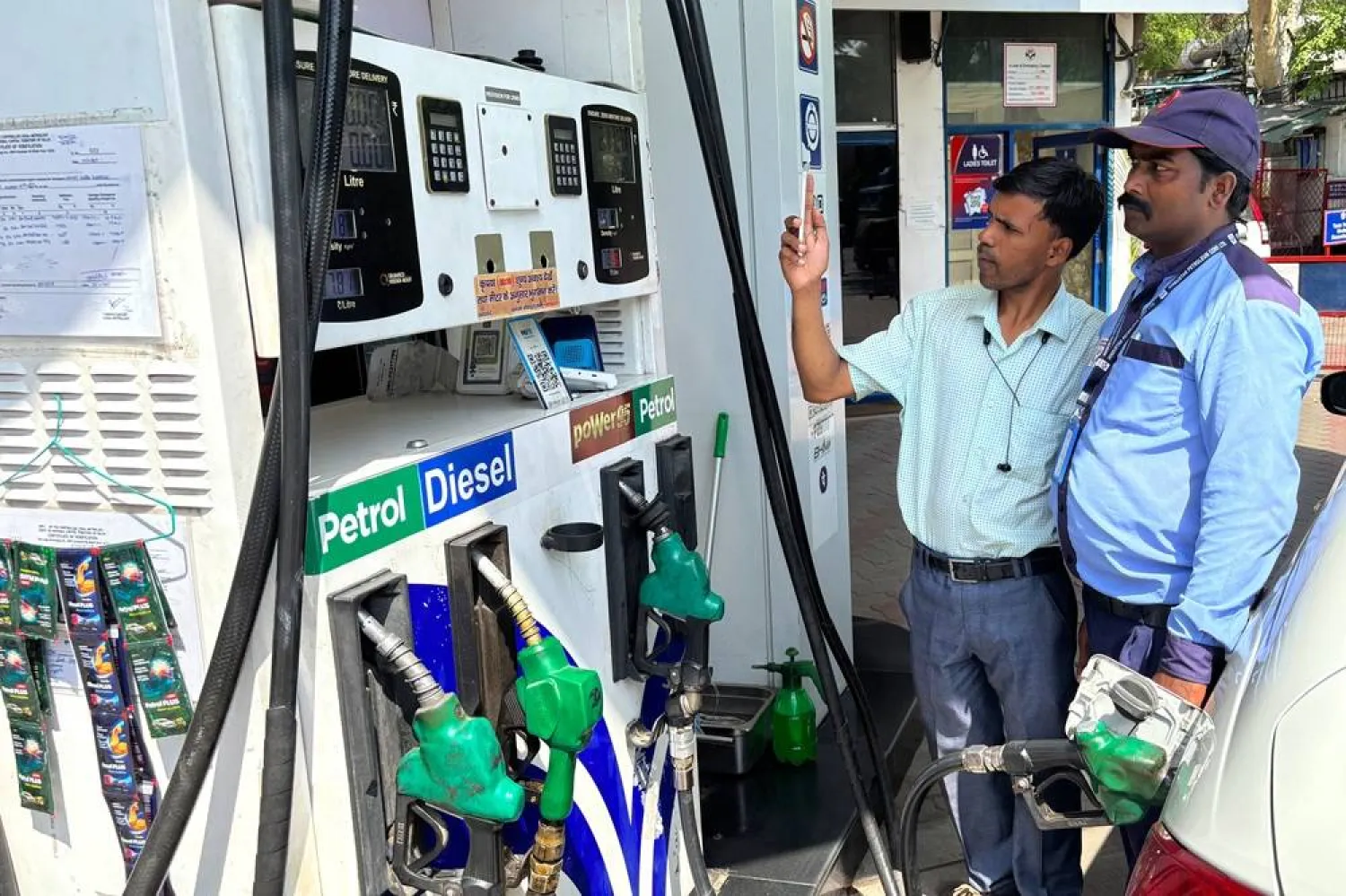
 A commuter monitors the meter as an attendant refuels his vehicle at a filling station in New Delhi, India, Friday, May 15, 2026. (AP)
A commuter monitors the meter as an attendant refuels his vehicle at a filling station in New Delhi, India, Friday, May 15, 2026. (AP)
TT

India Raises Retail Fuel Prices for First Time Since Iran War Started

 A commuter monitors the meter as an attendant refuels his vehicle at a filling station in New Delhi, India, Friday, May 15, 2026. (AP)
A commuter monitors the meter as an attendant refuels his vehicle at a filling station in New Delhi, India, Friday, May 15, 2026. (AP)

India's state-run fuel retailers have raised petrol and diesel prices for the first time in four years by 3 rupees ($0.03) per liter, or more than 3%, according to dealers, to recoup some of the losses incurred due to higher global crude oil prices.

India - the world's third-biggest oil importer and consumer - is one of the last major economies to raise retail fuel prices following the disruption to shipping through the Strait of Hormuz by the war started by US-Israeli attacks on Iran.

State-run Indian Oil Corp, Hindustan Petroleum Corp and Bharat Petroleum Corp, which together control more than 90% of India's 103,000 fuel stations, tend to set diesel and petrol prices in tandem.

A BPCL spokesperson confirmed the price increase at its retail outlets. Indian ‌Oil and HPCL ‌did not immediately respond to a request for comment.

Diesel in Delhi will cost ‌90.67 ⁠rupees a liter ⁠and petrol 97.77 rupees, reflecting increases of 3.4% and 3.2%, respectively, from 87.67 rupees and 94.77 rupees a liter.

Global oil prices spiked to more than $120 a barrel, before pulling back to around $100 to $105.

Shares of fuel retailers were down between 2.4% and 3.6% on Friday. Indian Oil Corp fell 2.4%, HPCL dropped 3.3% and BPCL was down 3.6% as of 0550 GMT.

The direct impact of the higher fuel prices would be muted at about 15 basis points on consumer price inflation, although the indirect impact will be larger, said Madhavi Arora, chief economist at Mumbai-based Emkay Global Financial Services .

"The hikes are not ⁠enough but could be the start of multiple staggered hikes," she said.

FUEL AUSTERITY STEPS

To ‌curb fuel consumption and rein in oil import bills, New Delhi has ‌rolled out austerity measures as policymakers brace for a prolonged energy shock.

On Sunday, Prime Minister Narendra Modi urged a spate ‌of measures including fuel conservation, work-from-home practices, and limits on travel and imports, as surging global energy prices put pressure ‌on the country's foreign exchange reserves.

Some states have issued notices to government departments this week to restrict travel, avoid physical events and shift meetings online, while also asking them to work from home two days a week, with offices half-staffed.

India is likely to widen the measures to cover millions of employees across the federal government, state-run banks and public sector firms, signaling a system-wide ‌tightening of expenditure and operations as financial risks mount.

The government did not respond to a Reuters email seeking comment.

PRICE INCREASE TO HIT DEMAND

Analysts say the increase is ⁠modest and leaves plenty ⁠of scope to raise prices further to compensate for revenue losses.

"India's petrol demand growth will be impacted, although the price hike is modest, but other fuel conservation steps such as work from home will dent demand growth," said Prashant Vashisth, vice president and co-head of corporate ratings at Moody's Indian arm, ICRA Ltd.

ICRA has revised its growth rate for gasoline use to 3%-4% this year compared with 5%-6% before the war, due to the price increase. For gasoil or diesel, ICRA expects growth to be flat from an earlier estimate of 2%-3%.

Analysts and opposition parties said state retailers had delayed raising prices during key state elections. The polls ended this month, with Modi's BJP winning two of four states and expanding its influence.

Oil ministry official Sujata Sharma said in April that higher oil prices after the war started caused Indian retailers to lose about 100 rupees per liter on diesel and about 20 rupees a liter on petrol.

In late March, Russia-backed Indian private refiner Nayara Energy raised its pump prices to mitigate some of its revenue losses from retail sales.


Google to Pay Musk $920 Million a Month for AI Computing Capacity

The headquarters of Space Exploration Technologies Corp. (SpaceX) in California. (AFP)
TT

Google to Pay Musk $920 Million a Month for AI Computing Capacity

The headquarters of Space Exploration Technologies Corp. (SpaceX) in California. (AFP)

SpaceX on Friday signed a blockbuster cloud computing agreement under which Google will pay the Elon Musk-founded rocket company $920 million per month for access to a massive cluster of AI chips, according to a disclosure in its initial public offering filing.

The deal, which will bolster SpaceX's finances ahead of its IPO on June 12, covers a computing infrastructure of approximately 110,000 Nvidia GPUs -- the crucial hardware needed to power Google's Gemini AI models.

The filing says Google will begin paying the full monthly rate in October 2026, with a reduced fee applying during a ramp-up period until then, AFP reported.

The agreement runs through June 2029, implying total payments of roughly $30 billion over the life of the contract.

The deal resembles one struck with AI giant Anthropic, in which SpaceX leased compute capacity at its Colossus data centers in Memphis, Tennessee for $1.25 billion a month.

The facilities were originally built to power Musk's rival AI venture, xAI.

SpaceX's IPO filing revealed that xAI last year posted an operating loss of $6.4 billion on total revenue of $3.2 billion.

"This is a short-term, timely agreement to ensure we have bridge capacity to meet surging customer demand for our agent platform, Gemini Enterprise, which has been even higher than we expected," a Google Cloud spokesperson said in an email to AFP.

The filing adds that after December 31, "the agreement may be terminated by either party upon 90 days' notice."

The deals with Google and Anthropic come just days ahead of SpaceX's IPO, which will be the biggest in history, valuing the company at $1.8 trillion.

That valuation is largely based on faith that Musk can deliver on his ambitions to vastly expand his Starlink satellite business, put data centers into space using SpaceX rockets, as well as begin colonizing Mars.


Rosneft: US Companies Benefit from Strait of Hormuz Closure

Igor Sechin, Chief Executive Officer of Rosneft, during the St. Petersburg International Economic Forum, June 5, 2026 (Reuters).
TT

Rosneft: US Companies Benefit from Strait of Hormuz Closure

Igor Sechin, Chief Executive Officer of Rosneft, during the St. Petersburg International Economic Forum, June 5, 2026 (Reuters).

Rosneft Chief Executive Igor Sechin said on Saturday that US energy companies were the main beneficiaries of the closure of the Strait of Hormuz but warned that continued tensions in the artery for one fifth of the world's crude would undermine long-term demand for oil.

Iran blockaded the Strait, the main route for about a fifth of world oil supplies and other vital goods including fertilisers, after the United States and Israel attacked Iran and killed Supreme Leader Ali Khamenei in February. The US has blockaded Iranian ports.

Sechin, a close ally of President Vladimir Putin and one of the most influential men in Russia's energy sector, cast the US actions as an attempt to change the fundamental contours of the global energy markets to suit US interests, but added that the strategic risks had not been fully assessed.

"The closure of the Strait of Hormuz is an attempt to reshape global energy market regulations to benefit the United States. The measures taken to block the strait were aimed at Iran, but backfired on the entire world. The strategic risks were underestimated," Sechin said at the St. Petersburg International Economic Forum.

"The main beneficiaries, of course, were American companies, which gained non-competitive advantages and the ability to secure high-cost supplies," he said.

"Continued tension in the Strait of Hormuz for a long time undermines the long-term demand for oil. It may also trigger another surge of interest in alternative energy."

If the Strait opens in the near future, then the oil price will be at $95 to $96 per barrel by the end of the year, and in a year it will drop to $80 to $85, and by the second half of 2027 there will be a return to market fundamentals, he said.


First Two of Riyadh Air’s Custom-Built 787-9 Dreamliners Arrive in Saudi Arabia

The arrival of Riyadh Air's two aircraft marks a historic milestone in the company's journey towards launching its flights (SPA)
TT

First Two of Riyadh Air’s Custom-Built 787-9 Dreamliners Arrive in Saudi Arabia

The arrival of Riyadh Air's two aircraft marks a historic milestone in the company's journey towards launching its flights (SPA)

Riyadh Air, Saudi Arabia’s new national carrier and a company wholly owned by the Public Investment Fund (PIF), has announced the arrival of its first two custom-built Boeing 787-9 Dreamliners at King Khalid International Airport in Riyadh.

The aircraft arrived in tandem on Friday at approximately 10 a.m. local time, receiving a water cannon salute upon touchdown.

The aircraft – using the call signs Riyadh 1 and Riyadh 2 and registered as HZ-RXAA and HZ-RXAB – are the first of Riyadh Air’s 72 state-of-the-art Dreamliners.

Their arrival marks the commencement of the carrier's broader strategy to expand its fleet to more than 180 narrow-body and wide-body aircraft.

Leveraging Saudi Arabia’s strategic location at the crossroads of Asia, Africa, and Europe, Riyadh Air aims to connect the capital to over 100 global destinations by 2030, with plans to fly to nearly 20 destinations by the end of this year.

Commenting on the arrival, Riyadh Air CEO Tony Douglas said: “To see our very first custom-built Dreamliners touch down in Riyadh is a truly historic moment for us, and a momentous day for Saudi aviation as part of Vision 2030. I could not be more excited or more confident about the future and the legacy we are creating.”

“Not only are we building an airline, we are opening a new gateway to the world from the heart of the Kingdom. We are absolutely ready and excited to welcome the world to Riyadh,” he added.