


Indonesia's 1st Giant Panda Cub Growing and Healthy Before Public Debut

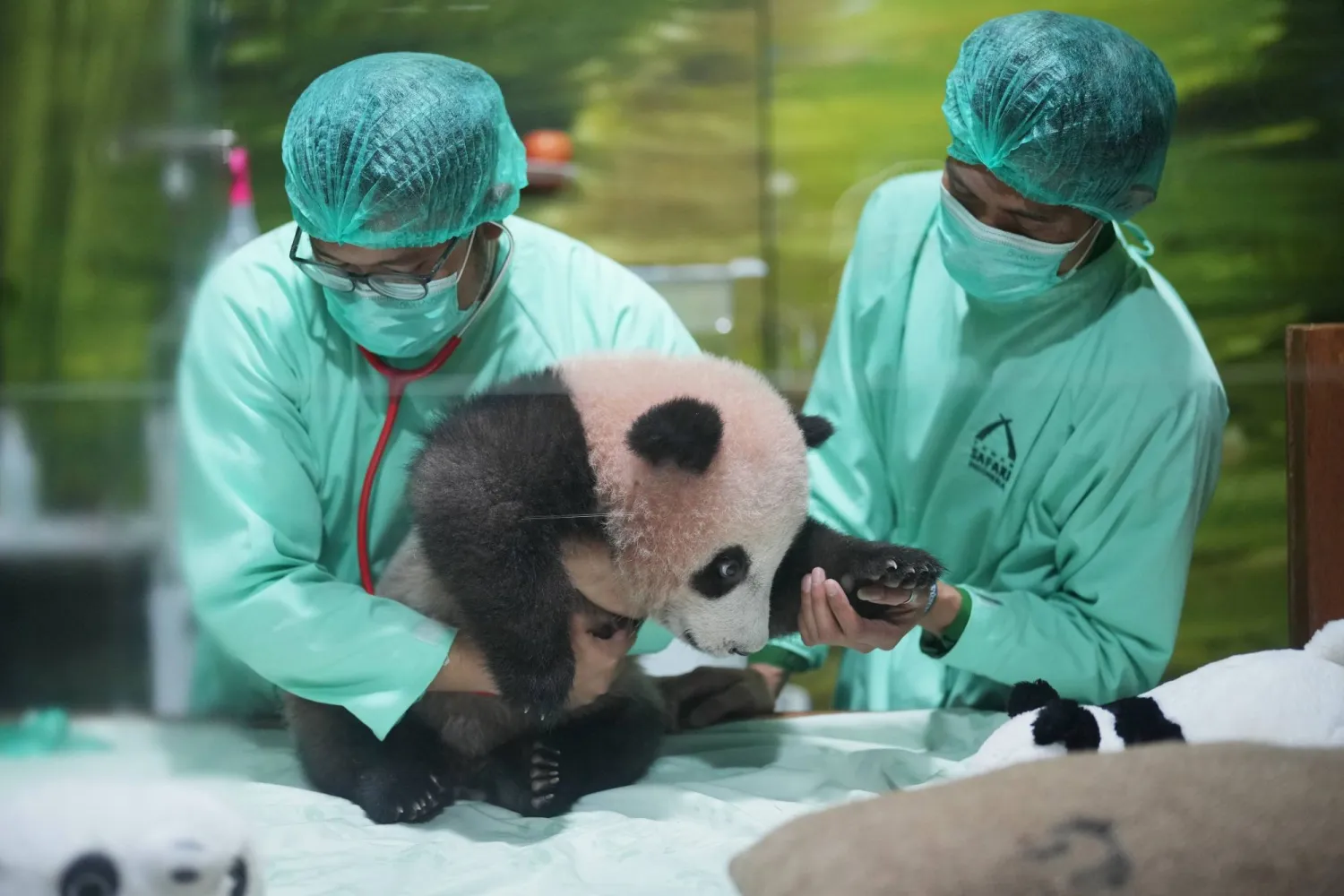
Veterinarians treat Satrio Wiratama, nicknamed "Rio," the first giant panda cub born in Indonesia, during a media preview at Indonesia Safari Park in Bogor, West Java, Indonesia, Friday, May 15, 2026. (AP Photo/Achmad Ibrahim)
TT

Indonesia's 1st Giant Panda Cub Growing and Healthy Before Public Debut

Veterinarians treat Satrio Wiratama, nicknamed "Rio," the first giant panda cub born in Indonesia, during a media preview at Indonesia Safari Park in Bogor, West Java, Indonesia, Friday, May 15, 2026. (AP Photo/Achmad Ibrahim)

The first giant panda born in Indonesia squirmed as veterinarians checked his hearing and eyesight and confirmed the furry cub was growing and healthy Friday before his public debut later this month.

Satrio Wiratama, nicknamed “Rio,” can walk on his own, climbs on his mother and has started eating bamboo shoots. He has grown to 10 kilograms (22 pounds) at 169 days old, The Associated Press reported.

Veterinarians are monitoring his development to determine how well he might adapt to the crowds when he debuts at Indonesian Safari Park outside the capital, Jakarta.

“What’s important to note is that all of Rio’s senses are active; he has the ability to understand the environment, assess the situation, adapt to more people, and hear sounds, even in certain levels of noise. We will train him gradually,” said Bongot Huaso Mulia, a veterinarian who monitors Rio’s progress.

His growth in some ways is faster than average, especially his teeth, according to Mulia.

Rio was born Nov. 27 to his mother, Hu Chun, and a male panda, Cai Tao, who are both 15 years old. The pair arrived in Indonesia in 2017 on a 10-year conservation partnership with China. They live in an enclosure built for them at the park about 70 kilometers (43 miles) from the capital in Cisarua, West Java province.

The two adult pandas have a large fan base in Indonesia. Rio’s birth has drawn many panda enthusiasts, and his public debut has been eagerly anticipated, with numerous requests on social media to see him soon.

The three of them are living in a three-tier temple known as the Panda Palace on a hill surrounded by about 5,000 square meters of land (1.2 acres) and equipped with an elevator, sleeping area, medical facilities and indoor and outdoor play areas.

Rio's name symbolizes the hope, resilience, and shared commitment of Indonesia and China in protecting endangered species.

Pandas are China’s unofficial mascot and Beijing's loans of the animals to overseas zoos have long been seen as soft-power “panda diplomacy.”

Giant pandas have difficulty breeding and births are particularly welcomed. There are less than 1,900 giant pandas in their only wild habitats in the Chinese provinces of Sichuan, Shaanxi and Gansu.

Rio was born through artificial insemination. Besides having a new individual, Rio also provides new genetic data on giant pandas, which can help research in Indonesia and in China, said Aswin Sumampau, president director of the park.

“This is the moment we’ve all been waiting for, a small victory for us, as we’ve managed to breed a species that is extremely difficult to breed. Just imagine, for the past two years, no pandas were born at any ex-situ conservation facility worldwide. Taman Safari has managed to do that,” Sumampau said.



Film Commission Raises Film Incentives to 60% to Support Film Production in Saudi Arabia

The update includes raising incentive rates to up to 60% of eligible expenditures, alongside enhanced evaluation mechanisms to ensure sustainable value for film projects
TT

Film Commission Raises Film Incentives to 60% to Support Film Production in Saudi Arabia

The update includes raising incentive rates to up to 60% of eligible expenditures, alongside enhanced evaluation mechanisms to ensure sustainable value for film projects

The Saudi Film Commission has announced the updated cash rebate program as part of efforts to support the growth of the Kingdom’s film production sector, attract high-quality projects, and strengthen Saudi Arabia’s position as a global destination for filmmaking.

The update includes raising incentive rates to up to 60% of eligible expenditures, alongside enhanced evaluation mechanisms to ensure sustainable value for film projects.

The announcement was made during the commission’s participation at the 79th edition of the Cannes Film Festival, where filmmakers, producers, and investors from around the world gather each year.

The updated cash rebate program introduces a set of practical enablers that support every stage of production through clear processes, streamlined pathways, and competitive financial support.

These updates include improved and accelerated disbursement processes, enhancing cash flow efficiency for production companies and creating a more supportive operating environment for project delivery in line with production timelines.

As part of its efforts to further strengthen an integrated support ecosystem, the commission is working with several national entities, most notably the Cultural Development Fund, to launch an enhanced model for managing and disbursing incentives.

This model will improve the overall beneficiary experience, increase operational efficiency, expedite processing timelines, and provide integrated financing solutions to support film projects.

“The announcement represents an extension of the Kingdom’s vision to build a sustainable film sector rooted in empowerment and partnership,” Film Commission CEO Abdullah Al-Qahtani said.

“Over the past period, we have worked on developing a number of regulatory and operational aspects related to the incentives program, most notably the launch of the financial audit and disbursement procedures guide, with the aim of improving implementation efficiency and providing filmmakers with greater clarity,” he said.

“Through the program, we are focused on developing an integrated ecosystem that enables filmmakers to work with confidence, empowers the private sector, and attracts quality investments that contribute to transferring expertise and knowledge to local talent,” Al-Qahtani added.

He noted that the program “marks an additional step toward strengthening the Kingdom’s position as a production hub connected to opportunity, and reflects a continued ambition to develop the sector.”

Cultural Development Fund CEO Majed AlHugail stated: “The efforts to enhance the mechanisms for disbursing incentives come as part of a broader strategy for the cultural sector, through the development of financial and operational solutions that support the sustainability of cultural projects.”

“Today, the speed and clarity of procedures have become key factors shaping production and investment decisions in the global film industry. Through this program, we aim to provide a more efficient and flexible experience that meets the needs of projects at various stages and strengthens the Kingdom’s position as a reliable partner for international productions,” he added.

The update comes as part of the Film Commission’s ongoing efforts to develop an integrated production ecosystem that includes infrastructure, production services, and national talent development, in line with the goals of Saudi Vision 2030 to develop creative industries as well as maximize the economic and cultural impact of the film sector.


Rubio Denies Fashion Inspiration from Maduro

 US Secretary of State Marco Rubio watches as US President Donald Trump talks to the media before leaving the South Lawn of the White House, Washington, DC, USA, 12 May 2026. (EPA)
US Secretary of State Marco Rubio watches as US President Donald Trump talks to the media before leaving the South Lawn of the White House, Washington, DC, USA, 12 May 2026. (EPA)
TT

Rubio Denies Fashion Inspiration from Maduro

 US Secretary of State Marco Rubio watches as US President Donald Trump talks to the media before leaving the South Lawn of the White House, Washington, DC, USA, 12 May 2026. (EPA)
US Secretary of State Marco Rubio watches as US President Donald Trump talks to the media before leaving the South Lawn of the White House, Washington, DC, USA, 12 May 2026. (EPA)

US Secretary of State Marco Rubio has no love for Venezuela's deposed leader Nicolas Maduro, and says he doesn't take fashion inspiration from him.

Flying with President Donald Trump to China, a picture of Rubio went viral as he was decked out in a grey Nike tracksuit.

The suit -- in brand and color, if not size -- resembled the Nike Tech Fleece attire sported by Maduro when he was photographed handcuffed in a helicopter after US forces snatched him in his sleep.

Steven Cheung, the White House communications director, posted on social media that Rubio was "rocking the Nike Tech 'Venezuela' on Air Force One!"

In his first public remarks on the viral picture, Rubio made clear he did not have Maduro in mind.

"You know what -- he copied me because I had it before. I mean, I don't know when he bought his," Rubio said of Maduro in an interview with "NBC Nightly News" from Beijing.

"The bottom line is that that's a suit, that it's comfortable," Rubio said.

"There was no message. I didn't even know he was taking the picture."

Rubio, a Cuban-American, is a sworn foe of Latin America's leftists and helped lay the groundwork for the January 3 operation to oust Maduro, a longtime nemesis of the United States.

US prosecutors charged Maduro and his wife with drug trafficking, which they deny.

Maduro's vice president Delcy Rodriguez took over Venezuela with support of the United States.


War Imperils Rare Vultures’ Yearly Odyssey to the Balkans

This file photo taken on September 12, 2024 shows an Egyptian vulture (Neophron percnopterus) flying over Gjirokaster, Albania. (AFP)
TT

War Imperils Rare Vultures’ Yearly Odyssey to the Balkans

This file photo taken on September 12, 2024 shows an Egyptian vulture (Neophron percnopterus) flying over Gjirokaster, Albania. (AFP)

Endangered Egyptian vultures, with their vivid yellow face and white plumes, would usually be nesting across the Balkans in their dozens by April.

But experts tracking the rare birds say local teams have struggled to find more than a handful in recent weeks, raising fears that the wars in the Middle East may have further disrupted their already perilous journey from Africa.

"The war is adding to the risks already present along this species' migration route," Nikolai Petkov, project manager at the Bulgarian Society for the Protection of Birds, told AFP.

From electrocution to poaching, the scavenger faces many hazards on its 5,000-kilometer (3,100-mile) annual migration to its Balkan breeding sites.

"The Middle East is a crucial migration corridor, and the war can have a considerable impact on this already sharply declining population," said Xhemal Xherri from the group Protection and Preservation of Natural Environment in Albania (PPNEA).

With thousands of people killed in bombing campaigns and the threat of further military action, any information on the impact on wildlife is hard to find, even for experts.

"Bombardments disturb not only Egyptian vultures, but also many other birds," he said, warning that the decline of the specific species could be a wider signal.

- A stark decline -

In the last 30 years, their numbers have fallen by 80 percent in the Balkans, according to Petkov, and the International Union for Conservation of Nature classifies the species as endangered worldwide.

Due to their key role in clearing carcasses, which prevents the spread of disease, conservationists and NGOs have long pushed efforts to protect the animal across their range.

Protecting resting places along with breeding programs has helped their numbers improve slightly in Bulgaria, where the majority of the vultures now nest in the Balkans, Petkov said.

But they remain particularly vulnerable to accidental poisoning from bait use on farmland, which often means the birds eat tainted carrion.

- A hopeful wait -

In the rugged wilderness of southern Albania, the shepherds of Salaria are usually the first to notice the vultures return as a signal of the coming European spring.

As the season nears its end, they have recently spotted two soaring over their flocks.

Even for experts like Xherri, it took hours of scouring mountainous nesting sites to confirm the shepherds' report.

"Good news!" he exclaimed, as he squinted through binoculars at the white dot descending onto a ledge about 400 meters up a rockface.

He would have another long wait before confirming that a second of Europe's smallest vultures had also safely returned to its lofty perch.

The painstaking nature of the work makes it almost impossible to know how many animals actually reached nests in Albania, even before the war.

But Petkov remained optimistic, suggesting they may have delayed their journey due to colder weather earlier this year.

"So they might be a bit late, but hopefully, as we often say, you count the birds in autumn."