

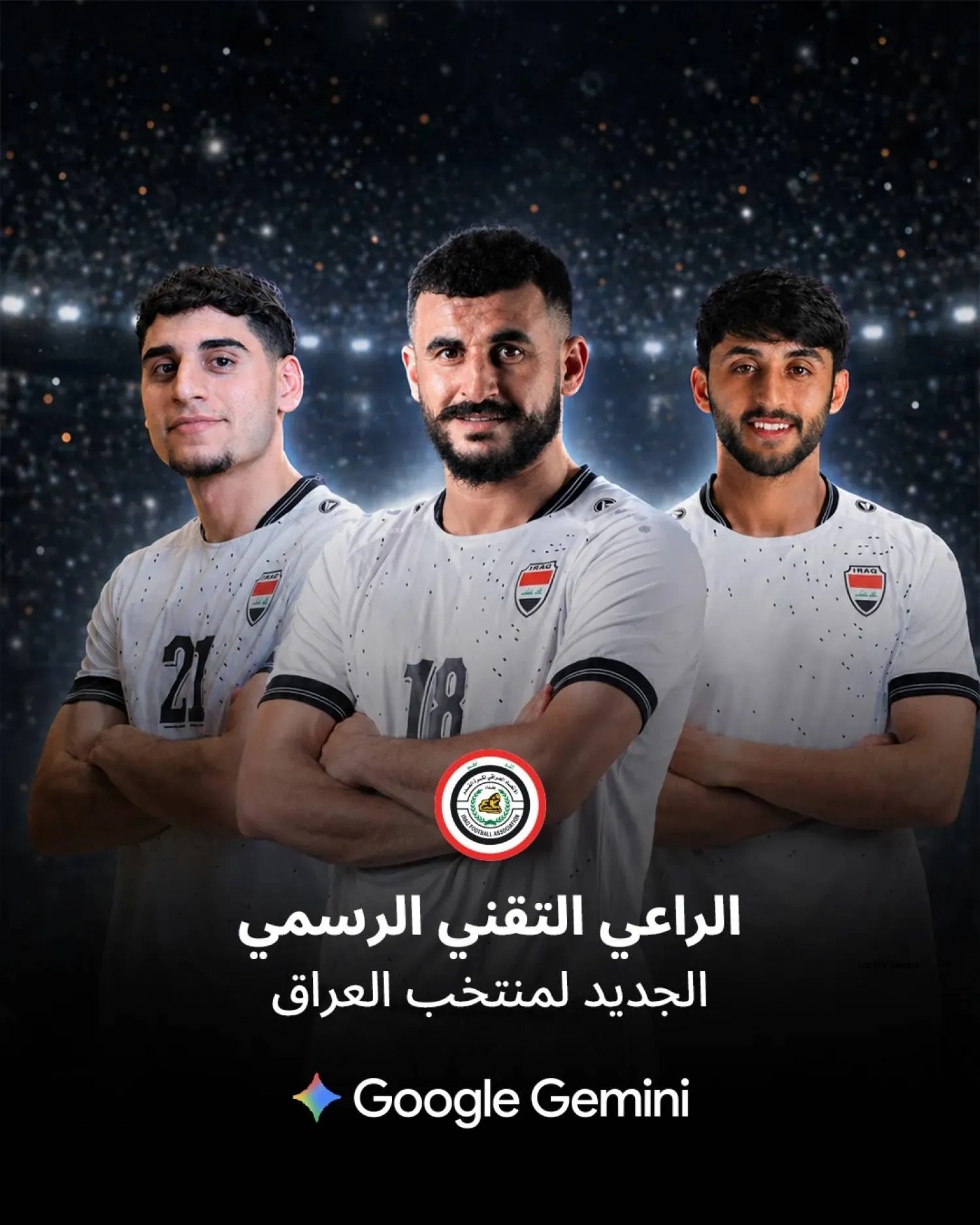

Google Gemini Enters Arab Football Stands, From Sponsorship to Fan Experience

Google chose Gemini as the official technology sponsor of Iraq and Morocco’s national football teams (Google)
TT

Google Gemini Enters Arab Football Stands, From Sponsorship to Fan Experience

Google chose Gemini as the official technology sponsor of Iraq and Morocco’s national football teams (Google)

Technology sponsorship in sports is no longer just a logo on a billboard or an advertising campaign around matches. As artificial intelligence moves into content creation and fan engagement, technology sponsors are trying to redefine the relationship between fans and their teams.

Google has chosen Gemini, its AI-powered assistant, as the official technology sponsor of Iraq’s and Morocco’s national football teams, in a regional partnership aimed at using AI tools to develop the digital fan experience.

According to the announcement, the partnership will use Gemini to bring teams closer to fans by improving digital communication, creating interactive content, and offering new ways to engage with players and teams.

But the significance of the move goes beyond linking Google’s name to two Arab teams with large fan bases. It raises a broader question: can AI turn fans into partners in shaping the experience, rather than passive consumers of content?

Beyond the logo

Najeeb Jarrar, Google’s regional marketing director for the Middle East and North Africa, told Asharq Al-Awsat that describing Gemini as a “technology sponsor” does not mean another advertising placement. It means “integrating technology as an essential part of the football experience.”

Jarrar said Gemini would become an interactive tool for fans, especially through experiences linked to content generation.

The first features fans are expected to see include creating supporter images through Nano Banana’s text-to-image tool, composing stadium chants and motivational music with Lyria’s text-to-music model, and receiving real-time analysis and match-related predictions.

That moves the sponsorship beyond traditional advertising. Fans are not just watching a prepared message. They are using tools to create images, music, or other content in support of their national team.

The bet is that AI can add a personal layer to fandom. Instead of a single campaign for everyone, a fan could ask Gemini to create an image showing their support, a motivational song, or a simple explanation of a tactical idea that emerged during a match.

Jarrar said the difference between this kind of experience and traditional sponsorship is that the latter offers “static and one-way content,” while Gemini provides a “fully personalized interactive experience.”

The fan as content creator

Under this model, the fan becomes part of the content cycle. The role is no longer limited to watching a video or sharing a ready-made post. Fans can request content that matches their language, team, emotional moment, or even their name.

Jarrar said a fan could ask Gemini to explain a complex tactical plan used in a match, or write a customized chant for the “Atlas Lions” or the “Lions of Mesopotamia.”

But that level of engagement will not happen simply because the tool exists. Google plans to launch a marketing campaign showing fans how to use different Gemini models to generate images, music, video, and text.

The company will also provide ready-made templates, which Jarrar described as “ready templates,” containing selected and tested prompts from Google’s team. The aim is to help fans who may not know how to write precise AI prompts.


That matters because many AI tools do not fail because their capabilities are weak. They fail because it is hard to turn them into a clear, everyday experience for ordinary users. Ready templates can lower the first barrier to engagement, especially in a broad fan base where users are not expected to know how to write prompts or understand AI models.

Products and platforms

The expected experience will not be limited to the Gemini app. Jarrar said Google is working to offer fans a distinctive experience before and during the football season over the next three months.

One example is allowing users to try selected prompts that generate images and videos, as if they were on the pitch with the Iraqi and Moroccan teams.

These formats are expected to appear on Google pages and on the pages of the Iraqi Football Association and the Royal Moroccan Football Federation. Google will also introduce users to features available through other products, including Google Search and YouTube, to create a more integrated experience that brings together content, search, video, and AI.

This opens the door to a new model of sports sponsorship, one in which the technology presence is not confined to a single platform. A fan may search for information, watch content on YouTube, use Gemini to generate an image, song, or summary, and then share it on social media.

In that sense, sponsorship becomes more like an integrated digital structure around the team than a seasonal campaign.

Arabic dialects

Language is the central challenge in an experience aimed at Iraq and Morocco. Arab fans do not speak in a single linguistic register, and sports content depends heavily on local expressions, belonging, and emotional tone.

Iraqi dialect and Moroccan darija carry strong and distinctive expressions of support. Content that sounds artificial or overly formal could feel detached from the stands.

Jarrar said Gemini’s advanced models had been trained to understand different Arabic dialects “with high accuracy,” including Iraqi dialect and Moroccan darija.

He said Gemini would rely on understanding the cultural and sporting context around the game in both countries, so it can respond in “natural, enthusiastic language that is close to the hearts of local fans,” while maintaining the accuracy of sports information.

But the test will come in real use. The challenge is not just translating words. It is understanding cultural references, players’ names, team histories, fan sensitivities, and the accepted tone in a competitive sports setting. Language, therefore, is not a side issue. It is central to judging the experience.

Accuracy and limits

Using AI in football raises two immediate questions: accuracy and safety. If a fan asks for analysis, a prediction, or a historical fact, the system should not produce false information. If a fan asks for supporter content, it should not slide into fanaticism, offensive speech, or political content.

Jarrar said Google is committed to responsible AI principles and that Gemini models include built-in safety filters to prevent the generation of hate speech, sports fanaticism, or political content.

Regarding sports information and match analysis, he said the model would be linked to official, reliable data sources, including data issued by football associations and accredited sports statistics providers, to ensure accurate results and analysis.

That makes the experience more complex than generating an image or a short text. The closer AI gets to match information, players, and predictions, the greater the need for trusted sources and clear lines between analysis, speculation, and entertainment.

The Arab sports environment also requires linguistic and cultural sensitivity, especially when fan enthusiasm overlaps with competition and national identity.

Beyond fan engagement

Although the partnership begins with fans, Jarrar said Gemini’s potential could extend to the work of the football associations themselves.

He said the partnership could strengthen “commercial and marketing value” by helping media offices draft press releases, translate them instantly into multiple languages, plan digital content schedules, and improve accessibility for people with disabilities through text-to-speech and speech-to-text tools.

AI could also analyze fan engagement data to help marketing departments make better decisions, Jarrar said. He added that Google would continue exploring different opportunities with football associations in the Arab world, suggesting that practical uses inside sports institutions may develop gradually after the first fan-focused experiences are launched.

That path could matter for associations managing large audiences across several platforms and languages. The challenge is no longer just publishing a statement or designing a post. It is building a continuous content cycle around the team, measuring engagement, personalizing messages, and reaching fans at home and abroad.

Testing the value

The final question is whether AI will add real value or simply another layer to the digital experience.

Jarrar acknowledged that this is the first time Google has supported football associations in the Arab world in this way, and said the company is “very excited about the upcoming results.”

He said the aim is to develop the digital fan experience, allowing supporters to cheer for their teams through images, video, or music as if they were on the pitch, even when they cannot travel or attend matches in person.

The role of technology, he said, is to “bring fans closer to the teams, and the teams closer to the fans,” while monitoring digital engagement across platforms in the coming period.

In that sense, the partnership is an early test of how AI can enter Arab sports. Its success will not be measured only by how many images, songs, or clips fans produce. It will depend on whether these tools make fans feel closer to their teams, and whether football associations can use technology to improve communication, rather than simply add to the digital noise around matches.



Morocco Beat France to Ayyoub Bouaddi in Major World Cup Boost

Football - Ligue 1 - AS Monaco v Lille - Stade Louis II, Monaco - May 10, 2026 Lille's Ayyoub Bouaddi in action with AS Monaco's Thilo Kehrer. (Reuters)
TT

Morocco Beat France to Ayyoub Bouaddi in Major World Cup Boost

Football - Ligue 1 - AS Monaco v Lille - Stade Louis II, Monaco - May 10, 2026 Lille's Ayyoub Bouaddi in action with AS Monaco's Thilo Kehrer. (Reuters)

Morocco ‌have won the international tug-of-war for highly rated Lille midfielder Ayyoub Bouaddi, who was born in France to Moroccan parents, after FIFA approved his switch of allegiance, handing the Atlas Lions a significant boost just weeks before the World Cup in North America.

The Royal Moroccan Football Federation said on Friday it had received a decision from FIFA’s Players’ Status Chamber approving its request to ‌change the ‌sporting nationality of Bouaddi, making him ‌immediately ⁠eligible to represent ⁠Morocco in all international competitions.

Bouaddi, 18, had represented France at youth level, most recently captaining the under-21 side in a European Championship qualifier against Luxembourg, but opted to commit his senior international future to Morocco.

The midfielder is regarded ⁠as one of Ligue 1’s brightest ‌young talents, having established ‌himself as a regular in Lille’s lineup in recent ‌seasons.

He has made more than 90 appearances ‌for the club across all competitions over three campaigns. He was the youngest player to feature in a European club competition match, aged 16 years and ‌three days.

Morocco have built a strong track record of recruiting dual-nationality players ⁠to strengthen ⁠their squad. They recently convinced Fulham defender Issa Diop, who was born in France to a Moroccan mother, to commit to the North African nation, as did Ajax Amsterdam’s Rayane Bounida, a former Belgium under-19 captain.

The World Cup will be held in the United States, Canada and Mexico from June 11 to July 19.

Morocco, the first African and Arab country to reach a World Cup semi-final, are drawn in Group C alongside Brazil, Haiti and Scotland.


The Last Dance: Messi and Ronaldo Get Ready for Sixth and Final World Cup

Portugal's Cristiano Ronaldo celebrates after scoring during a World Cup 2026 group F qualifying soccer match between Portugal and Hungary in Lisbon, Oct. 14, 2025. (AP)
TT

The Last Dance: Messi and Ronaldo Get Ready for Sixth and Final World Cup

Portugal's Cristiano Ronaldo celebrates after scoring during a World Cup 2026 group F qualifying soccer match between Portugal and Hungary in Lisbon, Oct. 14, 2025. (AP)

Lionel Messi's career seemed complete after he led Argentina to victory at the 2022 World Cup, but the motivation to keep playing is still there for him and his great rival Cristiano Ronaldo as the duo prepare to make history at this year's tournament in North America.

This will be the last dance for Messi and Ronaldo, who will become the first players to appear in six different World Cups, two decades on from their fresh-faced debuts at the finals.

They have since become icons far beyond the football pitch, two of the most recognizable people on the planet as they head into middle age and contemplate retirement.

Messi appeared to suggest that there would not be much point in carrying on after he skippered Argentina to victory in Qatar.

"Obviously I wanted to finish my career with this. I can't ask for any more," he said after dragging Lionel Scaloni's side to victory over France on penalties in that World Cup final in Doha.

"My career is coming to an end because these are my final years. What more could there be after this?"

Plenty more, it turns out.

Messi was in the middle of an underwhelming spell at Paris Saint-Germain then, and six months later he departed for Major League Soccer.

There he is excelling with Inter Miami, with whom he won the MLS Cup last year.

He might no longer be playing at the very highest level every week, but he remains crucial for Argentina.

The Barcelona legend captained his country to victory at the Copa America in the US in 2024, and was the top scorer in South American World Cup qualifying.

"I love playing football, and I'm going to do it until I can't anymore," he said recently.

At one stage there were some doubts as to whether he would play at another World Cup, a tournament he first graced in 2006, when aged 18 he scored in a 6-0 demolition of Serbia and Montenegro in Gelsenkirchen.

- 200 caps, goals record in sight -

"I will do everything to make sure he is there," insisted Scaloni, with Messi now just two games away from reaching 200 caps.

He is set to add to his record of 26 appearances in World Cup matches, including their run to the 2014 final in Brazil.

Messi has 13 World Cup goals, meaning Miroslav Klose's record of 16 is within striking distance, especially as Argentina's group opponents do not appear the toughest.

They will begin against Algeria and Austria before tackling Jordan in Dallas, three days after Messi's 39th birthday.

He has a couple of years on Ronaldo, but the 41-year-old Portuguese talisman was determined to carry his international career on in the hope of landing the ultimate prize.

Ronaldo was a teenager when he lost the Euro 2004 final with Portugal on home soil, but he made up for that by captaining them to victory at Euro 2016.

Yet the World Cup has proven harder, at least after Portugal got to the 2006 semi-finals.

Portugal have won only one World Cup knockout match since, when they hammered Switzerland 6-1 in 2022 with Ronaldo dropped to the bench.

- 'Exemplary commitment' -

Roberto Martinez became coach after that and restored Ronaldo as the first-choice striker, which he remains despite not scoring at Euro 2024 when Portugal lost in the last eight.

He is the most-capped men's player of all time with 226 international appearances, and the former Real Madrid and Manchester United superstar is now set to win the Saudi title with Al Nassr.

Ronaldo confirmed recently this would be his last World Cup, insisting: "I'm going to be 41 years old and I think it will be the moment."

Portugal, who go into a group with Colombia, Uzbekistan and DR Congo, are genuine contenders to win it even if there are doubts as to whether Ronaldo is holding back a talented squad.

Personally, Ronaldo will be seeking to add to his eight World Cup goals, and finally get a first in the knockout stages.

"He is more than just a football player, but for the national team that is all he is," said Martinez in an interview with Portuguese broadcaster RTP.

"He is the captain and he shows exemplary commitment to his country. He is incredible."

Lifting the World Cup at 41 would be quite the way for Ronaldo to finish -- and if both Portugal and Argentina top their groups, he and Messi would be on course to meet in the quarter-finals in Kansas City on July 11.


US Team ‘Devastated’ by Lack of Home Support, Says World Cup Doc Maker

 Passengers stand beside a giant replica of the World Cup trophy displayed at Mexico City International Airport, ahead of the World Cup starting on June 11, in Mexico City, Mexico, May 15, 2026. (Reuters)
Passengers stand beside a giant replica of the World Cup trophy displayed at Mexico City International Airport, ahead of the World Cup starting on June 11, in Mexico City, Mexico, May 15, 2026. (Reuters)
TT

US Team ‘Devastated’ by Lack of Home Support, Says World Cup Doc Maker

 Passengers stand beside a giant replica of the World Cup trophy displayed at Mexico City International Airport, ahead of the World Cup starting on June 11, in Mexico City, Mexico, May 15, 2026. (Reuters)
Passengers stand beside a giant replica of the World Cup trophy displayed at Mexico City International Airport, ahead of the World Cup starting on June 11, in Mexico City, Mexico, May 15, 2026. (Reuters)

For most national football teams, playing a tournament on home turf is a huge advantage. For the United States, it can be the opposite.

In the Gold Cup final last year, the US lost in a Houston stadium overwhelmingly packed with rival Mexico fans. The semi-final in St Louis, Missouri, was a sea of light blue for their opponents Guatemala.

There were similar scenes at the US-hosted Copa America a year earlier.

It is a huge concern for the US players under extraordinary pressure to deliver as co-hosts at this summer's World Cup, documentary filmmaker Rand Getlin told AFP.

"It devastates them. It hurts them. It makes them sad. They're disappointed in themselves for not giving fans more to cheer for," said Getlin, who spent the past four years embedded with the US team for an HBO series.

"They're like, 'I want to go out and I want to do something spectacular with this men's national team at the World Cup, so we can change the way the sport is viewed in this country forever,'" he explained.

Getlin's five-part docuseries is appropriately titled "US Against the World."

It takes viewers into the homes and locker rooms of several US stars including Christian Pulisic and Weston McKennie.

The series charts their journeys from humble backgrounds in a then-football skeptical country to unlikely success playing for Europe's top clubs.

It also depicts the sacking of Gregg Berhalter and the arrival of Mauricio Pochettino as head coach less than two years before the World Cup.

Pochettino, the Argentine former coach of Tottenham Hotspur, was quick to note the contrast between the ferocity of the "unbelievable" Guatemala fans and US supporters.

"That is the connection that we would like to see in the World Cup. That connection that makes you fly," said following the Gold Cup clash.

"To see (Guatemala), how they fight, how the fans behave, that is an important thing that we need to learn in this country," he added.

- 'Pressure' -

Football has boomed in North America over the past decade or so. But the focus of fans' support is often glamorous European clubs or, for immigrant communities, their nation of ancestry.

In recent weeks, outlets including The Athletic have reported below-expectation ticket sales for the United States' World Cup games, though sky-high prices are mainly deemed responsible.

The US will play more Latin American opposition in the group stage opener, against Paraguay, before coming up against Australia and Türkiye.

In the documentary, both Pochettino and the players are careful to avoid blaming the US fans for being frequently outnumbered.

For one thing, Getlin said, they are meticulously media trained, especially in "what not to say."

The series shows the vitriol Pulisic received just for opting not to play in the Gold Cup after an exhausting season, in part to prepare for the World Cup.

Pulisic had to delete social media and hurled his phone at the wall in anger at his treatment. In the series, he discusses the mental health toll it took.

"It was brave of him to invite us home at that time," said Getlin, who considers the sometimes prickly Pulisic a "profoundly misunderstood" character.

But there is also a sense among US players that have not yet earned the vast, vociferous home support and loyalty that they witness from other nations.

The US failed to qualify for the 2018 World Cup, did respectably at the 2022 edition, but then suffered embarrassing failures at the Copa America and last year's Nations League.

For every recent loss and poor performance, there is "pressure that's mounting toward the World Cup," admits goalkeeper Matt Turner.

Getlin's hope is that the documentary -- which was made in association with the US Soccer Federation -- can give American fans an "emotional on-ramp" to get behind their side at the World Cup.

"We wanted to give the United States something to cheer for," said Getlin.

"And in order to cheer for this team, I think you have to know and care about them before the tournament kicks off."
