


Whale That Was Rescued After Stranded in Germany Found Dead in Denmark

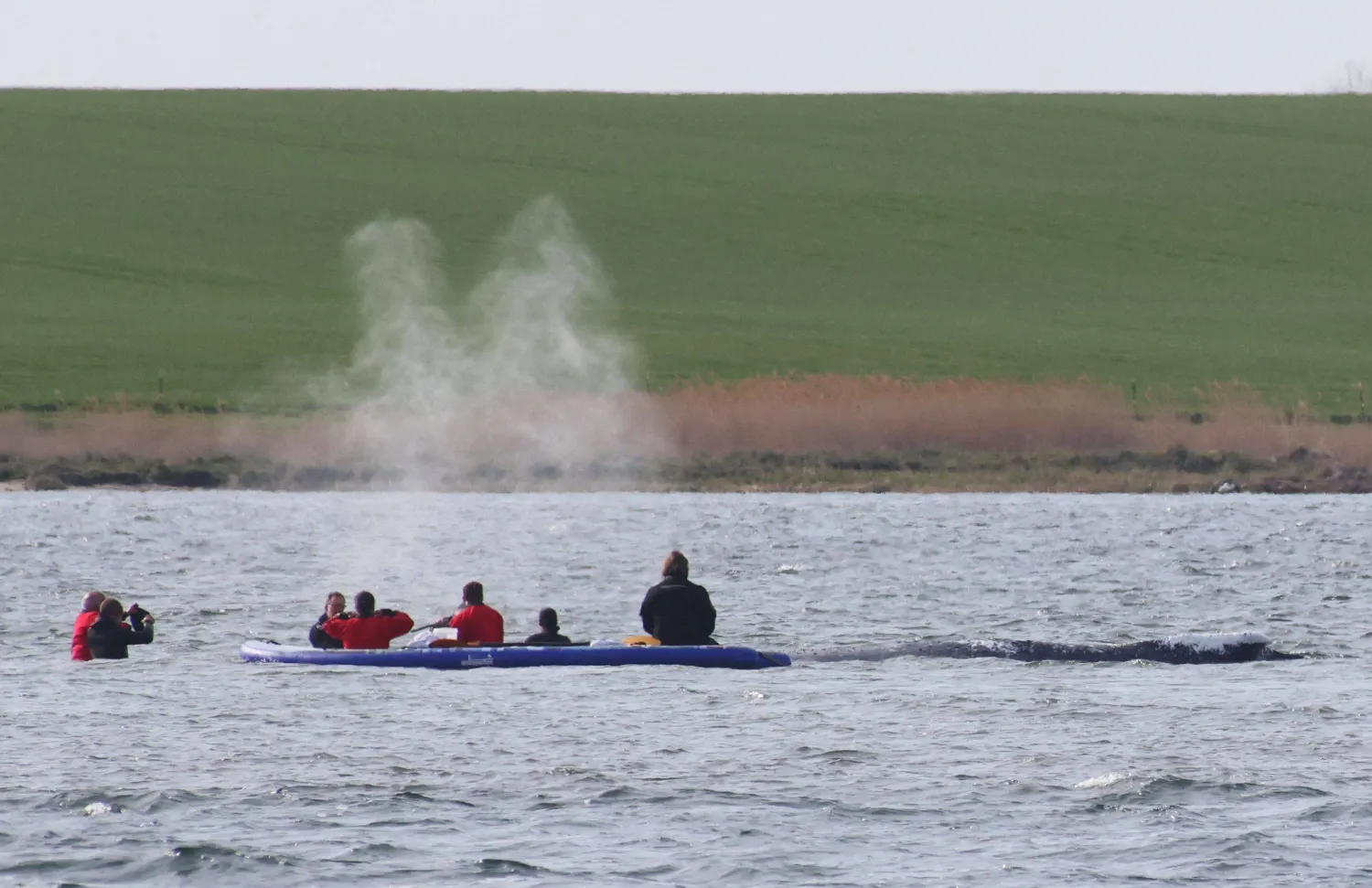
A rescue team is seen close to a stranded humpback whale in the Wismarer Bucht bay of the Baltic Sea off the island of Poel, northern Germany, on April 27, 2026. (AFP)
TT

Whale That Was Rescued After Stranded in Germany Found Dead in Denmark

A rescue team is seen close to a stranded humpback whale in the Wismarer Bucht bay of the Baltic Sea off the island of Poel, northern Germany, on April 27, 2026. (AFP)

A humpback whale that underwent a rescue operation in Germany two weeks ago after beaching itself there has been found dead near a Danish island, officials said Saturday.

"It can now be confirmed that the stranded humpback whale near Anholt is the same whale that was previously stranded in Germany and was the subject of rescue attempts," Jane Hansen, division head at the Danish Environmental Protection Agency, said in a statement to AFP.

The whale, dubbed "Timmy" in Germany's media, was initially spotted stuck on sandbank on March 23. After various failed attempts it was finally put in a barge and released into the North Sea off Denmark on May 2.

The whale carcass was first spotted off the coast of the Danish island Anholt in the Kattegatt sea between Sweden and Denmark on Thursday but authorities were at first not able to confirm it was the same whale.

"Conditions today made it possible for a local employee from the Danish Nature Agency to locate and retrieve an attached tracking device that was still fastened to the whale's back. The position and appearance of the device confirm that this is the same whale that had previously been observed and handled in German waters," Hansen said.

Hansen added that "at this time, there are no concrete plans to remove the whale from the area or to perform a necropsy, and it is not currently considered to pose a problem in the area."

The Danish Environmental Protection Agency said that while it understood "the considerable public interest in this particular whale," it stressed that people should keep a safe distance and refrain from approaching the whale.

"This is because the whale may carry diseases that can also be transmitted to humans, and there may also be a risk of explosion," as decomposition creates large volumes of gases, it said.

In Germany, the whale was first seen on the sandbank near the city of Luebeck, on Germany's Baltic Sea coast, before freeing itself but then becoming stuck again several times.

Various attempts to save it failed, and authorities had announced they were giving up. But then two wealthy entrepreneurs, Karin Walter-Mommert and Walter Gunz, stepped in to finance the rescue, whose cost was estimated at 1.5 million euros ($1.7 million).

They came up with what many saw as a long-shot plan: coax the whale into the water-filled hold of a special barge and tow it back to its natural habitat.

Some experts at the time criticized the privately financed rescue plan, saying it would only cause the animal more distress.



Man Dies After Shark Bite Off Western Australia Coast

State authorities ‌advised people ‌to take extra caution in the water at ‌Rottnest Island, a popular tourist ‌destination. (AFP file)
TT

Man Dies After Shark Bite Off Western Australia Coast

State authorities ‌advised people ‌to take extra caution in the water at ‌Rottnest Island, a popular tourist ‌destination. (AFP file)

A ‌man attacked by a shark off Western Australia's coast on Saturday died of his injuries, police said, in what is the second fatal shark attack in Australia so far this year.

The 38-year-old victim, yet to be identified, was bitten on Saturday morning at Horseshoe ‌Reef near ‌Rottnest Island, about 31 km (19.2 ‌miles) ⁠west of state ⁠capital Perth, police said in a statement.

The man was taken to shore but could not be revived, police said, adding that a report would be prepared ⁠for the coroner.

State authorities ‌advised people ‌to take extra caution in the water at ‌Rottnest Island, a popular tourist ‌destination.

Aerial footage from the Australian Broadcasting Corporation showed a police boat, police officers, and a rescue helicopter with a ‌stretcher at the scene.

The attack follows the death in ⁠January ⁠of a boy bitten by a shark in Sydney Harbor, after a series of shark attacks along the country's east coast.

Most shark attacks occur along the east and southeast seaboard of Australia, which averages around 20 such incidents a year, according to Australia's Institute of Health and Welfare.


Wordle Heads to Primetime as Media Seek Puzzle Reinvention

This photo illustration shows a person playing online word game Wordle on a mobile phone. Michael Draper / AFP/File
TT

Wordle Heads to Primetime as Media Seek Puzzle Reinvention

This photo illustration shows a person playing online word game Wordle on a mobile phone. Michael Draper / AFP/File

News organizations are racing to add puzzles and games to their digital offerings, hoping to replicate the success of a strategy The New York Times has been quietly perfecting for years -- and is now taking to primetime television.

US broadcaster NBC is producing a game show based on the word puzzle Wordle to be hosted by morning TV news anchor Savannah Guthrie, with a premiere set for 2027.

For Jonathan Knight, the Times' head of games, it is the logical extension of a property that has become a global phenomenon.

"Wordle kind of blew the doors open in terms of being very approachable -- anybody can do it," Knight told AFP on the sidelines of the Web Summit in Vancouver, Canada.

The road to greenlight the TV show took around two and a half years, Knight said, with the Times insisting on co-producing rather than simply licensing the name.

"It's Hollywood, you never know. Everyone believed in the idea of it. But then, will it be good? Will it be true to Wordle? Those are all questions we had to answer through a development process."

The television deal is the latest chapter in a growth story that evolved over time.

Knight arrived at the Times games division in 2020 to find Spelling Bee and the traditional crossword as the main app attractions.

Spelling Bee, launched in 2018 and adapted from a print puzzle, had already begun pulling in a younger audience with its mobile format and ranking system.

By 2019, Knight said, the trajectory was clear enough that the company began investing heavily in a full portfolio.

"You could really see the opportunity -- not just for a crossword puzzle, but for a collection of games," he noted.

Then Wordle arrived and reset all expectations.

Created by Welsh software engineer Josh Wardle as a personal project, the game grew from 90 players in November 2021 to more than two million just weeks later.

The Times acquired it in early 2022, and in Knight's telling, it "turbocharged" everything the team had been putting in place.

"It kind of blew the doors open in terms of a very approachable, anybody-can-do-it game. Everybody solves it, whether it's in two tries or six. It doesn't take that long and it feels great."

- Come for the games -

The Times has since reported its games were played more than eight billion times in a single year, the majority by Wordle players.

The business logic underpinning all of it is a subscription model that distinguishes the Times sharply from traditional game companies.

"A lot of people come just for the games... And that's great, because it grows our overall subscriber base, and eventually some of those folks are going to experiment with everything else we have to offer," Knight said.

The model has not gone unnoticed, with news media companies pushing their own games products.

In the most recent example, Time magazine this week launched Time Games, featuring online word puzzles and jigsaws made from its iconic magazine covers.

Microsoft-owned LinkedIn hired three-time world Sudoku champion Thomas Snyder as its first-ever puzzlemaster and initially launched three daily puzzle games modeled on the short, habit-forming design the Times pioneered -- a number that has grown.

Netflix has made similar moves.

- 'Understand your audience' -

Knight said he constantly fields questions from international media executives, but urges caution about treating the Times' playbook as a simple template.

"You have to understand your audience at its core," he said. "Users will reject it if you're just trying to shove a puzzle down their throat that has no connection to your core values as a company."

Internally, the division remains in constant experimentation mode. Games are tested and cut if they fail to clear the bar.

Innovation continues on existing titles as well, including puzzle variants, cross-game challenges and themed days that have developed a devoted following.

"April Fools' is sort of our Super Bowl," Knight said.


Pretty in Pink: Dallas World Cup Venue Chasing Perfect Pitch

Pink grow lights designed to encourage photosynthesis flood a newly laid grass field at the AT&T Stadium in Texas where World Cup matches will be held. RONALDO SCHEMIDT / AFP
TT

Pretty in Pink: Dallas World Cup Venue Chasing Perfect Pitch

Pink grow lights designed to encourage photosynthesis flood a newly laid grass field at the AT&T Stadium in Texas where World Cup matches will be held. RONALDO SCHEMIDT / AFP

Dangling above field level at the biggest stadium of the 2026 World Cup, eighteen giant metal arms flood a newly laid grass pitch in an eerie pink glow.

The mission: make sure the turf at the AT&T Stadium is match-ready -- and controversy free -- by the time the tournament kicks off.

The 94,000-capacity venue in Arlington, Texas, the home of the Dallas Cowboys NFL team, will host more matches than any other venue during the World Cup, including group games involving Lionel Messi's Argentina and Harry Kane's England, as well as a semi-final, said AFP.

Like other repurposed NFL stadia being used at the World Cup, organizers have replaced the synthetic turf with fresh grass.

A specially engineered natural grass pitch was laid last Tuesday, some 60 centimeters above the Cowboys' normal playing surface.

By Thursday, the seams between each individual roll of turf -- each measuring 1.2 meters wide and 15 meters long -- were still clearly visible.

AT&T Stadium general manager Tod Martin is confident, though, that the surface will be in pristine condition by the time the Netherlands face Japan in the first game at the venue on June 14.

- Copa controversy -

"Over the next few days and weeks, those will absolutely go away as that grass gets established and then just the grooming, the maintenance continues," Martin said.

"By the time match day one gets here, it'll just be completely flush."

The elaborate efforts to ensure perfect pitches at the World Cup come two years after playing surfaces at the Copa America held in the United States faced sharp criticism.

Peru coach Jorge Fossati said the hastily laid grass pitch at the AT&T Stadium at the Copa in 2024 may have contributed to an Achilles injury suffered by defender Luis Advincula.

"It came out of nowhere," Fossati said at the time. "I realize that this is a grass field today but it's not normal grass."

Similar criticism was leveled at the surface used at Atlanta's Mercedes-Benz Stadium in 2024, another venue which will feature prominently at the World Cup.

"You're playing on a football field, with laid grass that's all patchy and it breaks up every step you take -- it's frustrating," USA midfielder Weston McKennie said at the time.

- Nothing to chance -

In Dallas, stadium chiefs are leaving nothing to chance as they aim to avoid a repeat of the Copa America controversies.

Martin says some 45,000 man hours were used to install the new pitch, which was made up of a Kentucky ryegrass blend of sod grown in Colorado before being transported to Texas on 24 refrigeration trucks.

A full irrigation system will ensure the surface is properly watered, while the pitch will also be reinforced with plastic fibers ahead of the World Cup.

The metal arms suspended from the roof of the stadium and lowered above the pitch house grow lights that bathe the grass in a striking pink, but more importantly, boost photosynthesis.

Martin devised the system after visiting Wembley Stadium and Tottenham Hotspur Stadium in London, where similar pitch maintenance techniques are in place.

"We specifically went to Wembley and Tottenham and talked with those guys ... and it was a sight to see for sure," Martin said.

Wembley's grow lights are mounted on wheeled structures rolled onto the pitch, while Tottenham's system is raised hydraulically from the sidelines.

Dallas's set-up uses a similar technique, with frames suspended from the ceiling that can be raised.

Ewen Hodge, FIFA's Head of Pitch Infrastructure, described the Dallas set-up as a "very innovative step forward by the stadium."