


Pretty in Pink: Dallas World Cup Venue Chasing Perfect Pitch

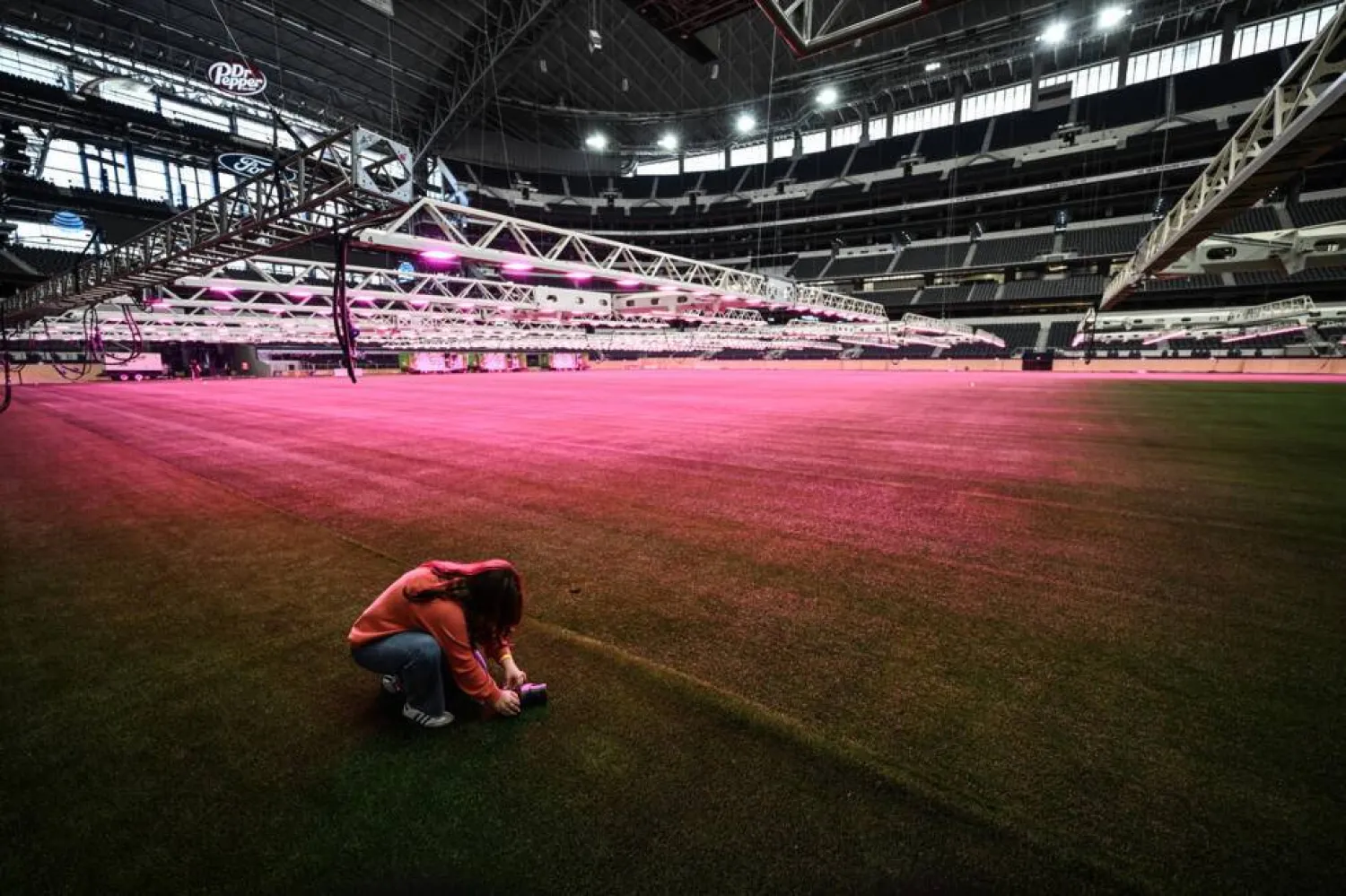
Pink grow lights designed to encourage photosynthesis flood a newly laid grass field at the AT&T Stadium in Texas where World Cup matches will be held. RONALDO SCHEMIDT / AFP
TT

Pretty in Pink: Dallas World Cup Venue Chasing Perfect Pitch

Pink grow lights designed to encourage photosynthesis flood a newly laid grass field at the AT&T Stadium in Texas where World Cup matches will be held. RONALDO SCHEMIDT / AFP

Dangling above field level at the biggest stadium of the 2026 World Cup, eighteen giant metal arms flood a newly laid grass pitch in an eerie pink glow.

The mission: make sure the turf at the AT&T Stadium is match-ready -- and controversy free -- by the time the tournament kicks off.

The 94,000-capacity venue in Arlington, Texas, the home of the Dallas Cowboys NFL team, will host more matches than any other venue during the World Cup, including group games involving Lionel Messi's Argentina and Harry Kane's England, as well as a semi-final, said AFP.

Like other repurposed NFL stadia being used at the World Cup, organizers have replaced the synthetic turf with fresh grass.

A specially engineered natural grass pitch was laid last Tuesday, some 60 centimeters above the Cowboys' normal playing surface.

By Thursday, the seams between each individual roll of turf -- each measuring 1.2 meters wide and 15 meters long -- were still clearly visible.

AT&T Stadium general manager Tod Martin is confident, though, that the surface will be in pristine condition by the time the Netherlands face Japan in the first game at the venue on June 14.

- Copa controversy -

"Over the next few days and weeks, those will absolutely go away as that grass gets established and then just the grooming, the maintenance continues," Martin said.

"By the time match day one gets here, it'll just be completely flush."

The elaborate efforts to ensure perfect pitches at the World Cup come two years after playing surfaces at the Copa America held in the United States faced sharp criticism.

Peru coach Jorge Fossati said the hastily laid grass pitch at the AT&T Stadium at the Copa in 2024 may have contributed to an Achilles injury suffered by defender Luis Advincula.

"It came out of nowhere," Fossati said at the time. "I realize that this is a grass field today but it's not normal grass."

Similar criticism was leveled at the surface used at Atlanta's Mercedes-Benz Stadium in 2024, another venue which will feature prominently at the World Cup.

"You're playing on a football field, with laid grass that's all patchy and it breaks up every step you take -- it's frustrating," USA midfielder Weston McKennie said at the time.

- Nothing to chance -

In Dallas, stadium chiefs are leaving nothing to chance as they aim to avoid a repeat of the Copa America controversies.

Martin says some 45,000 man hours were used to install the new pitch, which was made up of a Kentucky ryegrass blend of sod grown in Colorado before being transported to Texas on 24 refrigeration trucks.

A full irrigation system will ensure the surface is properly watered, while the pitch will also be reinforced with plastic fibers ahead of the World Cup.

The metal arms suspended from the roof of the stadium and lowered above the pitch house grow lights that bathe the grass in a striking pink, but more importantly, boost photosynthesis.

Martin devised the system after visiting Wembley Stadium and Tottenham Hotspur Stadium in London, where similar pitch maintenance techniques are in place.

"We specifically went to Wembley and Tottenham and talked with those guys ... and it was a sight to see for sure," Martin said.

Wembley's grow lights are mounted on wheeled structures rolled onto the pitch, while Tottenham's system is raised hydraulically from the sidelines.

Dallas's set-up uses a similar technique, with frames suspended from the ceiling that can be raised.

Ewen Hodge, FIFA's Head of Pitch Infrastructure, described the Dallas set-up as a "very innovative step forward by the stadium."



Bear Mauls Man to Death in Bulgaria

A bear smells a brick of ice on a hot afternoon at the Veermata Jijabai Bhosale Udyan and Zoo in Mumbai on May 10, 2026. (Photo by Punit PARANJPE / AFP)
TT

Bear Mauls Man to Death in Bulgaria

A bear smells a brick of ice on a hot afternoon at the Veermata Jijabai Bhosale Udyan and Zoo in Mumbai on May 10, 2026. (Photo by Punit PARANJPE / AFP)

A bear mauled to death a man at Vitosha, a mountainous region just outside Bulgarian capital Sofia, police told AFP on Sunday.

"The findings of the medical examiner and a wildlife expert show that marks found on the body are those of a female bear accompanied by her cub," a Sofia police spokesperson said.

Police did not disclose the age of the victim, but Bulgarian media reported him as being in his 30s.

His body was located Saturday afternoon near a road connecting two chalets in the northwestern part of the mountainous area around half an hour by road out of Sofia rising to 2,295 meters (7,500 feet) and located about 30 minutes from Sofia.

Vitosha is a popular hiking destination for residents of the Sofia, being home to a range of wild animals, including deer, roe deer, wild boars and wolves.

The area is believed to be home to around a dozen bears.

The last recorded case of a person killed by a bear in Bulgaria dates back to 2010, in the Rhodope Mountains in the country's south.


Saudi Arabia: Imam Turki Reserve Authority Reaffirms Commitment to Protecting Endangered Species

The Imam Turki bin Abdullah Royal Nature Reserve Development Authority logo
TT

Saudi Arabia: Imam Turki Reserve Authority Reaffirms Commitment to Protecting Endangered Species

The Imam Turki bin Abdullah Royal Nature Reserve Development Authority logo

The Imam Turki bin Abdullah Royal Nature Reserve Development Authority reaffirmed its commitment to protecting endangered wildlife species through a comprehensive ecosystem of environmental programs and initiatives aimed at preserving biodiversity, restoring ecological balance, and developing natural habitats within the reserve, coinciding with Endangered Species Day.

The authority emphasized that its efforts align with the objectives of Saudi Vision 2030 and the Saudi Green Initiative through a scientific and field-based approach focused on wildlife protection, the reintroduction of endangered species, and enhancing environmental sustainability within one of the Kingdom’s largest royal reserves.

These efforts contribute to preserving the national natural heritage for future generations.

The authority explained that the reserve is home to rich biodiversity, including several wildlife species of high environmental value. Environmental protection and monitoring teams continue to track wildlife, limit practices that negatively affect natural habitats, and implement specialized breeding and rehabilitation programs aimed at enhancing the survival and growth of threatened species in their natural environments.

The authority stressed that protecting endangered species is not only an environmental responsibility, but also an investment in ecosystem sustainability and quality of life.

It added that the development of vegetation cover, protection of natural resources, and promotion of community awareness constitute key pillars of its environmental strategy.

The impact of these efforts has been reflected in increased biodiversity and improved natural habitats within the reserve in recent years.


Spacecraft to Probe How Earth Fends Off Raging Solar Winds

This photograph shows the Smile spacecraft (gold) fixed to a Vega-C rocket adaptor (black cone) on 25 March 2026, in Kourou, French Guiana, in preparation for liftoff from Europe's Spaceport. (Photo by ESA / AFP)
TT

Spacecraft to Probe How Earth Fends Off Raging Solar Winds

This photograph shows the Smile spacecraft (gold) fixed to a Vega-C rocket adaptor (black cone) on 25 March 2026, in Kourou, French Guiana, in preparation for liftoff from Europe's Spaceport. (Photo by ESA / AFP)

A joint European-Chinese spacecraft is set to blast off Tuesday to investigate what happens when extreme winds and giant explosions of plasma shot out from the Sun slam into Earth's magnetic shield.

Particularly fierce solar storms can knock out satellites, threaten astronauts -- and create colorful auroras in the skies of northern and southern latitudes.

To find out more about this little-understood space weather, the van-sized SMILE spacecraft is tasked with making the first-ever X-ray observations of Earth's magnetic field.

The spacecraft is scheduled to launch on a Vega-C rocket at 0352 GMT on Tuesday from Europe's spaceport in Kourou, French Guiana, on the northeastern coast of South America.

Lift-off was originally planned for April 9, but was postponed due to a technical issue.

SMILE -- or the Solar Wind Magnetosphere Ionosphere Link Explorer -- is a joint mission between the European Space Agency (ESA) and the Chinese Academy of Sciences.

"What we want to study with SMILE is the relationship between the Earth and the Sun," explained Philippe Escoubet, an ESA scientist working on the project.

Solar wind is a stream of charged particles shot out from the Sun. Sometimes this wind is kicked up into a huge storm by massive eruptions of plasma called coronal mass ejections.

Hurtling at around two million kilometers (1.2 million miles) an hour, these powerful blasts take a day or two to reach Earth. When they arrive, Earth's magnetic field acts as a shield, deflecting most of the charged particles.

However, during particularly intense events, some particles can penetrate our atmosphere, where they have the potential to take out power grids or communication networks. They also create dazzling auroras known as the northern or southern lights, AFP reported.

During the worst geomagnetic storm on record in 1859, bright auroras were seen as far south as Panama -- and telegraph operators around the world were given electric shocks.

Solar winds can now also pose a danger to satellites orbiting Earth, as well as astronauts sheltering inside space stations.

Given these threats, scientists want to learn more about space weather, so the world can better forecast and prepare for big blasts in the future.

To help with this endeavor, the SMILE mission plans to detect the X-rays emitted when charged particles from the Sun interact with the neutral particles of Earth's upper atmosphere.

The spacecraft will observe this phenomenon from several important locations, including the magnetopause -- where the magnetic shield deflects solar particles.

It will also soar above the Earth's poles, where X-ray photons are visible, according to Dimitra Koutroumpa of France's CNRS institute who is working on the mission.

On Tuesday, the spacecraft will be placed 700 kilometers above Earth before heading on an extremely elliptical orbit.

SMILE will be at an altitude of 5,000 kilometers when it flies over the South Pole, where it will transmit data to a research station in Antarctica called Bernardo O'Higgins.

But the spacecraft will be 121,000 kilometers above Earth when it swings over the North Pole, to take in a far wider view over a longer period of time.

Among other things, this will allow the mission to "observe the northern lights non-stop for 45 hours at a time for the first time ever", according to the ESA.

The spacecraft has four scientific instruments, including a UK-built X-ray imager, as well as a UV imager, ion analyzer and magnetometer all made by the Chinese Academy of Sciences.

SMILE is expected to start collecting data just an hour after it is put into orbit.

The mission is designed to run for three years, but could be extended if all goes well.