
Spacecraft to Probe How Earth Fends Off Raging Solar Winds

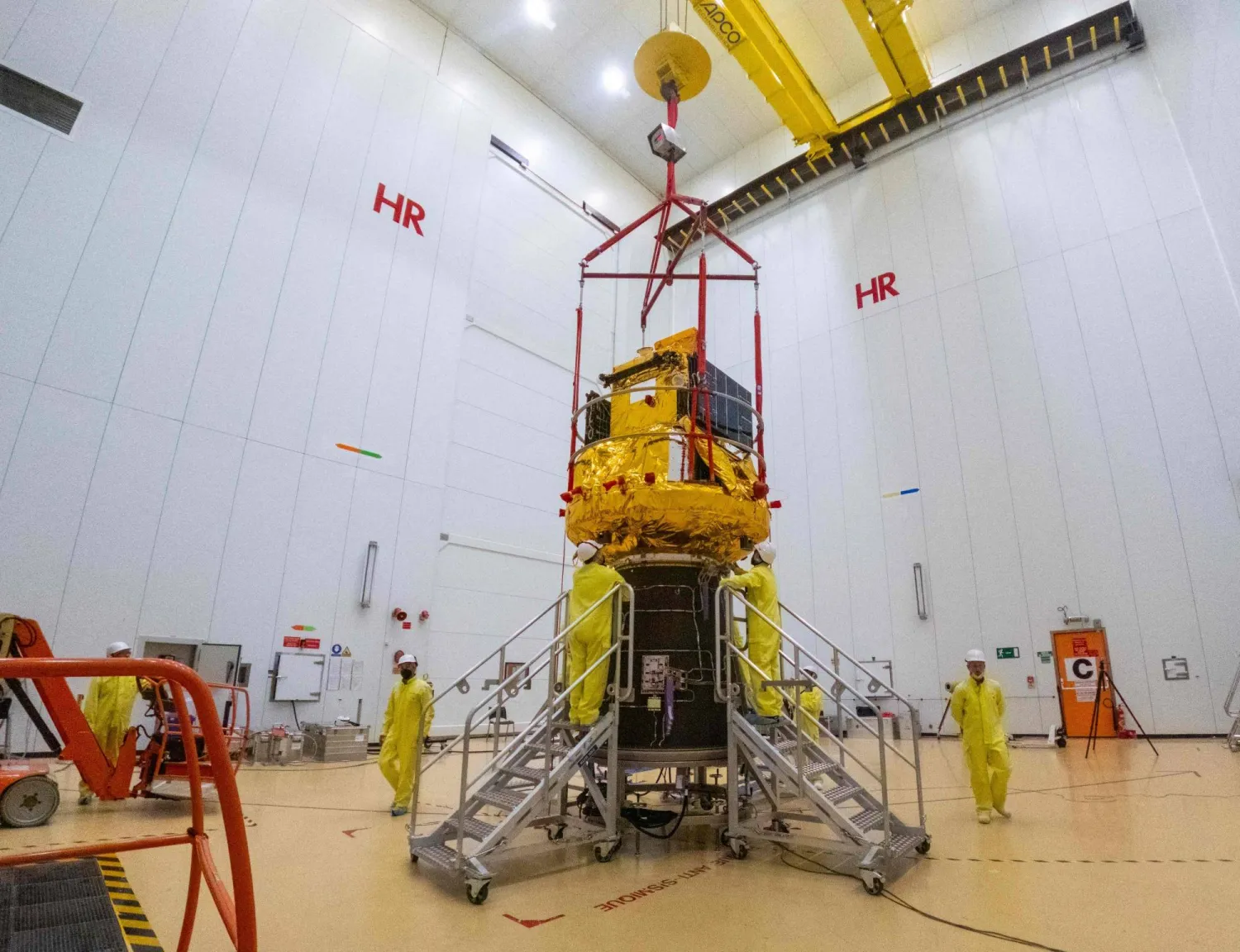
This photograph shows the Smile spacecraft (gold) fixed to a Vega-C rocket adaptor (black cone) on 25 March 2026, in Kourou, French Guiana, in preparation for liftoff from Europe's Spaceport. (Photo by ESA / AFP)
TT

Spacecraft to Probe How Earth Fends Off Raging Solar Winds

This photograph shows the Smile spacecraft (gold) fixed to a Vega-C rocket adaptor (black cone) on 25 March 2026, in Kourou, French Guiana, in preparation for liftoff from Europe's Spaceport. (Photo by ESA / AFP)

A joint European-Chinese spacecraft is set to blast off Tuesday to investigate what happens when extreme winds and giant explosions of plasma shot out from the Sun slam into Earth's magnetic shield.

Particularly fierce solar storms can knock out satellites, threaten astronauts -- and create colorful auroras in the skies of northern and southern latitudes.

To find out more about this little-understood space weather, the van-sized SMILE spacecraft is tasked with making the first-ever X-ray observations of Earth's magnetic field.

The spacecraft is scheduled to launch on a Vega-C rocket at 0352 GMT on Tuesday from Europe's spaceport in Kourou, French Guiana, on the northeastern coast of South America.

Lift-off was originally planned for April 9, but was postponed due to a technical issue.

SMILE -- or the Solar Wind Magnetosphere Ionosphere Link Explorer -- is a joint mission between the European Space Agency (ESA) and the Chinese Academy of Sciences.

"What we want to study with SMILE is the relationship between the Earth and the Sun," explained Philippe Escoubet, an ESA scientist working on the project.

Solar wind is a stream of charged particles shot out from the Sun. Sometimes this wind is kicked up into a huge storm by massive eruptions of plasma called coronal mass ejections.

Hurtling at around two million kilometers (1.2 million miles) an hour, these powerful blasts take a day or two to reach Earth. When they arrive, Earth's magnetic field acts as a shield, deflecting most of the charged particles.

However, during particularly intense events, some particles can penetrate our atmosphere, where they have the potential to take out power grids or communication networks. They also create dazzling auroras known as the northern or southern lights, AFP reported.

During the worst geomagnetic storm on record in 1859, bright auroras were seen as far south as Panama -- and telegraph operators around the world were given electric shocks.

Solar winds can now also pose a danger to satellites orbiting Earth, as well as astronauts sheltering inside space stations.

Given these threats, scientists want to learn more about space weather, so the world can better forecast and prepare for big blasts in the future.

To help with this endeavor, the SMILE mission plans to detect the X-rays emitted when charged particles from the Sun interact with the neutral particles of Earth's upper atmosphere.

The spacecraft will observe this phenomenon from several important locations, including the magnetopause -- where the magnetic shield deflects solar particles.

It will also soar above the Earth's poles, where X-ray photons are visible, according to Dimitra Koutroumpa of France's CNRS institute who is working on the mission.

On Tuesday, the spacecraft will be placed 700 kilometers above Earth before heading on an extremely elliptical orbit.

SMILE will be at an altitude of 5,000 kilometers when it flies over the South Pole, where it will transmit data to a research station in Antarctica called Bernardo O'Higgins.

But the spacecraft will be 121,000 kilometers above Earth when it swings over the North Pole, to take in a far wider view over a longer period of time.

Among other things, this will allow the mission to "observe the northern lights non-stop for 45 hours at a time for the first time ever", according to the ESA.

The spacecraft has four scientific instruments, including a UK-built X-ray imager, as well as a UV imager, ion analyzer and magnetometer all made by the Chinese Academy of Sciences.

SMILE is expected to start collecting data just an hour after it is put into orbit.

The mission is designed to run for three years, but could be extended if all goes well.



Nepali Duo Break Own Records on Everest

Mountaineers participate in a training session at the Khumbu Icefall as they prepare for their ascent to the summit of Mount Everest, Nepal, Saturday, May 2, 2026. (AP Photo/Pasang Rinzee Sherpa)
TT

Nepali Duo Break Own Records on Everest

Mountaineers participate in a training session at the Khumbu Icefall as they prepare for their ascent to the summit of Mount Everest, Nepal, Saturday, May 2, 2026. (AP Photo/Pasang Rinzee Sherpa)

A Nepali climber dubbed the "Everest Man", Kami Rita Sherpa, scaled Mount Everest for a record 32nd time Sunday, while Lhakpa Sherpa broke her own women's record with an 11th summit.

"This is another milestone in Nepal's mountaineering history," Himal Gautam, spokesperson for Nepal's Tourism Department, told AFP.

Kami Rita Sherpa, 56, first stood on the top of Mount Everest in 1994 while working for a commercial expedition.

Since then, he has climbed Everest almost every year, guiding clients.

Lhakpa Sherpa, 52, known as the "Mountain Queen", first stood on the top of Everest in 2000, becoming the first Nepali woman to successfully summit and descend the world's highest peak.

"Their record gives greater excitement to other climbers," Gautam added.

"By breaking records through healthy competition on Everest, will help make climbing safer, more dignified, and better managed."

Kami Rita Sherpa, speaking in 2024, after another ascent of the 8,849-meter (29,032-foot) peak said that he was "just working" and did not plan on setting records.

A climbing boom has made mountaineering a lucrative business since Edmund Hillary and Tenzing Norgay Sherpa made the first ascent in 1953.

Nepal has issued a record 492 Everest permits this season, with a city of tents set up at the foot of Everest for climbers and support staff.

As most mountaineers attempt the ascent with the help of at least one Nepali guide, about a thousand climbers are expected to head for the summit in the next few days.

The high numbers have rekindled concerns about overcrowding on the mountain, especially if poor weather shortens the climbing window.


UK: Celebrities, Artists’ Paintings Feature in Support of School Art Festival

Headteacher Beccy Harris said the theme reflected the school vision “to help children soar on wings like eagles” (St Barnabas Primary School)
TT

UK: Celebrities, Artists’ Paintings Feature in Support of School Art Festival

Headteacher Beccy Harris said the theme reflected the school vision “to help children soar on wings like eagles” (St Barnabas Primary School)

St Barnabas Primary School in Oxford is hosting an exhibition bringing together bird-inspired artworks by children, local artists and well-known public figures.

Dame Joanna Lumley and Bill Bailey are among the celebrity artists whose paintings will feature in support of the school arts festival, according to BBC.

The exhibition will raise funds for the school and community projects. Artworks will be available both to purchase in person and via an online auction.

Headteacher Beccy Harris said the theme “reflects our school vision to help children soar on wings like eagles.”

The school's chair of governors Charlie Arbuthnott posted painting sets and miniature canvases to several celebrities, inviting them to share their creations.

“It all went very quiet for the first couple of weeks and then, excitedly, the first canvas arrived and we couldn't quite believe it,” Harris said, adding the first one they opened was from chef and TV star Dame Prue Leith.

Wallace and Gromit creator Nick Park has sent a work he titled Red-Legged Partridge Dancing.
Actor and campaigner Lumley is taking part with Dove and comedian Bailey is the artist behind Swallows.

Harris said the pupils were “so excited” by the celebrity contributions.

The exhibition, which runs on May 16-17 and 23-25, is part of Oxford Art Weeks.

Funds raised will support projects including improving the school's deteriorating adventure playground and restoring heavily used community green space.


Street Child World Cup Wraps in Mexico with Trophies, Music and U2

Irish rock band U2 lead singer Bono applauds beside guitarist The Edge during the match between Indonesia and Argentina for the Boys’ Shield final at the fifth Street Child World Cup football tournament, bringing together street-connected young people from 28 countries, in Texcoco, near Mexico City, Mexico, May 14, 2026, as the 2026 FIFA World Cup approaches in Mexico. REUTERS/Henry Romero
TT

Street Child World Cup Wraps in Mexico with Trophies, Music and U2

Irish rock band U2 lead singer Bono applauds beside guitarist The Edge during the match between Indonesia and Argentina for the Boys’ Shield final at the fifth Street Child World Cup football tournament, bringing together street-connected young people from 28 countries, in Texcoco, near Mexico City, Mexico, May 14, 2026, as the 2026 FIFA World Cup approaches in Mexico. REUTERS/Henry Romero

Brazil's boys danced on a bus and Mexico's girls lifted a trophy on home soil, while U2 enjoyed the festivities as the Street Child World Cup brought music, football and celebration to Mexico.

Street-connected young people from 28 teams representing more than 20 countries gathered for the fifth edition of the tournament, which began on May 6 and held its semi-finals and finals in Texcoco, outside Mexico City, on Thursday.

The Irish rock band added star power to the finals, with drummer Larry Mullen Jr. flipping the coin before the boys' Shield final, while Bono, the Edge and Adam Clayton applauded from the sidelines.

At one point, ⁠Bono gestured for ⁠people to turn around and focus on the young players on the pitch.

"This is the fifth Street Child World Cup. It's about creating a global platform for young people's voices to be heard. On their demands on identity, access to education, protection from violence and gender equality," Street Child United CEO and co-founder John Wroe told Reuters.

"And we invite them to play a world cup where the World Cup is. And it's all about getting the eyes of the ⁠world's media on them so they can amplify their voices and bring about lasting change on behalf of street-connected children all over the world."

Brazil's boys beat India in the Cup final, sparking jubilant celebrations, while Mexico's girls won the girls' Cup division against Kenya. Indonesia's boys and Brazil's girls topped the Shield divisions.

Brazil boys captain Joao JV, 18, from Rio de Janeiro, said the victory marked the end of a long journey.

"I want to thank God, first of all. It's a once-in-a-lifetime experience to be here in Mexico, especially to be with my teammates. We've been training for a long time, two years. And so, it is so gratifying for us to be here because we've all dreamt of this.

"To represent Brazil outside ⁠the country is indescribable. ⁠And so, we're all really happy. And I thank God for us getting the title."

Players also spoke about the experience beyond the pitch, from meeting teams from other countries to taking part in workshops on issues affecting street-connected youth.

"The thing I like the most about being at the World Cup is the opportunity to mingle with players from other countries. I also really liked the light show," said India girls captain Pavithra Vellaiyangiri, 17, from Chennai.

The tournament ended in festival style, with American rapper and singer Paul Russell performing as players celebrated nearby.

"Yeah, it's wild to hear that for some of them, it's their first time on a plane; for some of them, it's their first time meeting someone from another country. So, it's cool you can see the way it's just broadening their own understanding of the world and of their place in it. Yeah, it's super cool to see," Russell said.