


Israel’s Army Wants a ‘Political Breakthrough' for Its War in Lebanon

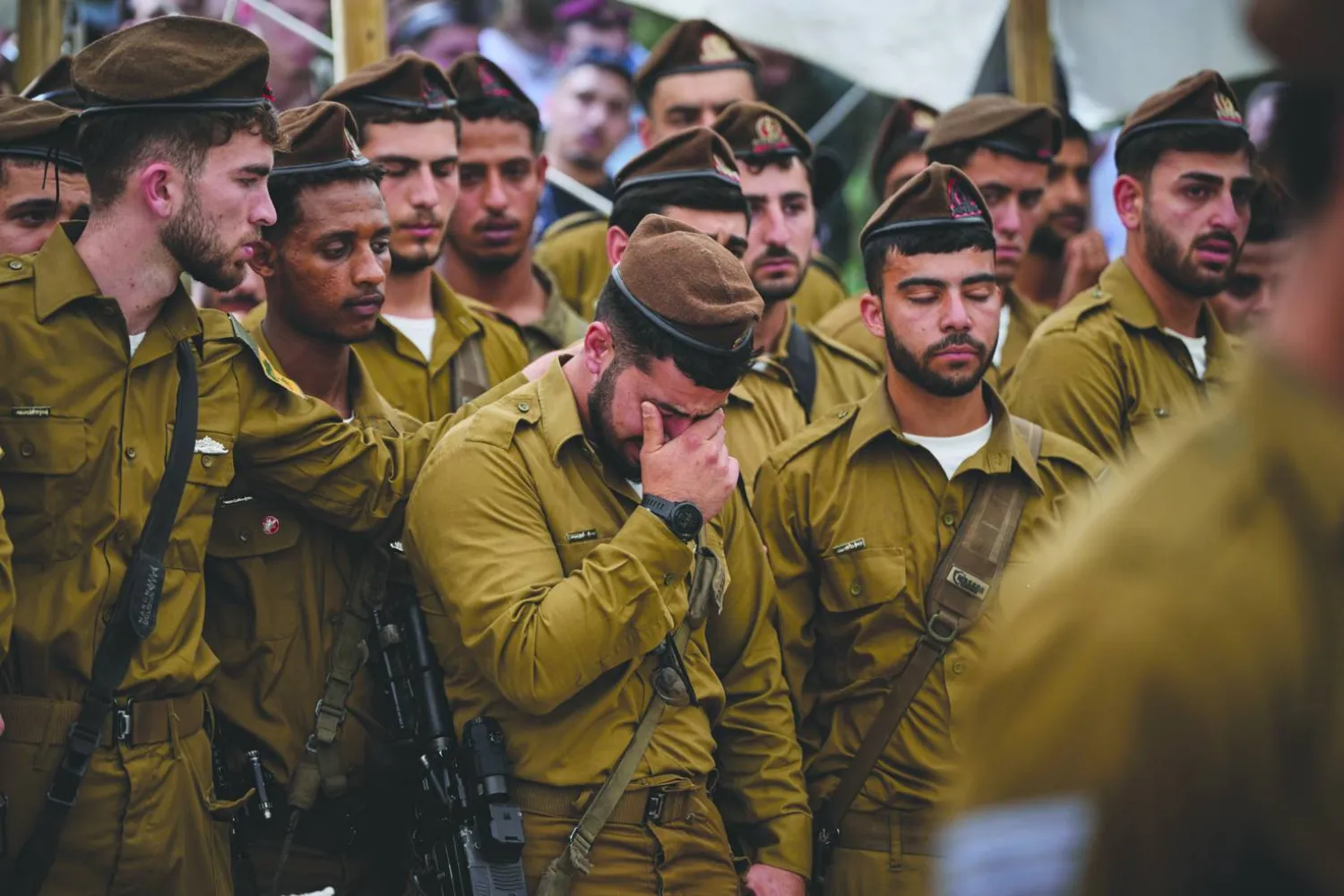
Israeli soldiers attend the funeral of Capt. Maoz Israel Recanati, who was killed in a Lebanese drone attack in southern Lebanon, at Mt. Herzl Military Cemetery in Jerusalem Sunday, May 17, 2026. (AP Photo/Ohad Zwigenberg)
TT

Israel’s Army Wants a ‘Political Breakthrough' for Its War in Lebanon

Israeli soldiers attend the funeral of Capt. Maoz Israel Recanati, who was killed in a Lebanese drone attack in southern Lebanon, at Mt. Herzl Military Cemetery in Jerusalem Sunday, May 17, 2026. (AP Photo/Ohad Zwigenberg)

Israel has widened its military operations against Lebanon’s Iran-back Hezbollah group while Israeli media outlets have published leaks from the military indicating that it is urging the government of Prime Minister Benjamin Netanyahu to achieve a political solution.

According to the leaks, the Israeli military believes there is no military solution to disarm Hezbollah, and that even if it were to occupy all of Lebanon, it could not guarantee eliminating the group’s last drone.

Israel has expanded its airstrikes into the eastern Bekaa Valley and carried out dozens of raids, while Hezbollah has intensified its drone attacks targeting Israeli soldiers in occupied areas and towns across the Galilee.

Netanyahu’s criticism

The Israeli PM accused the military of shortcomings. At the beginning of a cabinet meeting on Sunday, Netanyahu said that six years ago he had warned about the danger posed by Hezbollah acquiring Iranian drones and had instructed the army to take action against it.

His remarks were considered an attempt to incite the public opinion against the army’s leadership, which has failed to address the problem for six years.

Israeli Dissatisfaction

The exchange of accusations emerged as the US administration and Lebanon’s government announced positive progress during the third round of talks between the two delegations in Washington on Thursday.

The two sides agreed to extend the ceasefire for 45 days and to launch a fourth round of direct Lebanese-Israeli negotiations at the political level on June 2 and 3, as well as military-level talks at the Pentagon on the 29th of May under the supervision of the US Department of Defense.

Israeli officials dismissed the optimistic tone surrounding the talks, saying Hezbollah still refuses to disarm and is demanding changes to the terms set after the November 2024 ceasefire.

Continued Escalation

The Israeli army considers Hezbollah’s continued drone strikes against Israel allows it to maintain its occupation of five strategic military points in Lebanon and to freely strike the party’s positions and operatives but views this situation as “unsustainable and futile”.

According to a report in Yedioth Ahronoth, Israeli analysts believe it will be difficult to resolve the Lebanese crisis through an agreement without first addressing the Iranian crisis.

According to Israeli security sources cited by Kan 11, even a full occupation of southern Lebanon would not eliminate Hezbollah’s remaining drones or missiles. They say military action may weaken the group, but it cannot fully resolve the underlying threat.

Comprehensive Agreement

The sources added that the Israeli military adopts various and costly defensive measures to counter Hezbollah’s drone attacks but has also stressed that a “military solution alone is not enough”, and that the matter requires a “political breakthrough” alongside military deterrence.

According to Maariv, the reported Israeli demands include the full disarmament of Hezbollah, enhanced Israeli monitoring north of the border, and the creation of a demilitarized zone in southern Lebanon up to the Litani River, along with a 3–5 km security buffer zone along the border restricting Lebanese access.

However, the political leadership in Israel is reportedly using military operations as leverage in parallel with talks in Washington, arguing that a political settlement depends on external actors. It views Iran as decisive in shaping Hezbollah’s stance and believes that escalating military pressure in Lebanon could help influence Iranian negotiators.



UN Demands Israel Prevent 'Genocide' in Gaza

Hundreds of thousands of people are still living in tents in the Gaza Strip, pictured in January, and conditions remain dire despite the ceasefire. Bashar Taleb / AFP/File
TT

UN Demands Israel Prevent 'Genocide' in Gaza

Hundreds of thousands of people are still living in tents in the Gaza Strip, pictured in January, and conditions remain dire despite the ceasefire. Bashar Taleb / AFP/File

The United Nations demanded Monday that Israel take measures to prevent acts of "genocide" in Gaza, and decried indications of "ethnic cleansing" in the Palestinian territory and in the occupied West Bank.

In a fresh report, the UN rights office said Israel's actions in Gaza since the start of the war in October 2023 involved "gross violations" of international law, amounting in many cases to "war crimes and other atrocity crimes".

UN rights chief Volker Turk called in the report on Israel to ensure compliance with a 2024 International Court of Justice order that it take measures to prevent acts of genocide in Gaza, AFP reported.

Israel, he said, should ensure "with immediate effect that its military does not engage in acts of genocide, (and take) all measures to prevent and punish incitement to commit genocide".

Israel has repeatedly and forcefully denied allegations of genocide, which have previously been brought by rights groups like Amnesty International and Human Rights Watch, as well as independent UN experts, but never by the United Nations directly.

- 'Unlawful killings' -

Monday's report, which covered the period from October 7, 2023, when Hamas's unprecedented attack inside Israel sparked the Gaza war, up to May 2025, also condemned "serious violations" including some amounting to war crimes, by Palestinian armed groups during the initial attack and after.

The Hamas attack resulted in the deaths of 1,221 people on the Israeli side, most of them civilians, according to an AFP tally based on official data.

Monday's report highlighted the abuse suffered by the hostages seized by the Palestinian armed groups, many of whom reported torture and sexual abuse as they were held "in inhumane conditions" for months on end.

"Most hostages who died in Gaza died while held in secret detention, either killed by their captors or impacts of the conflict occurring around them," it said.

Most of the focus however was on Israel's actions in Gaza, where its retaliatory military campaign has killed more than 72,000 people, according to the health ministry in the Hamas-run territory, whose figures are considered reliable by the UN.

Hundreds of thousands of people are still living in tents and conditions remain dire despite a ceasefire that took effect in October last year.

"The ceasefire diminished the immense scale of violence up to that point, and opened some modest humanitarian space," Ajith Sunghay, head of the UN rights office in the occupied Palestinian territories, told reporters in Geneva.

"But killings and the destruction of infrastructure have continued on an almost daily basis, and the overall humanitarian situation remains dire," he warned.

A large proportion of the killings since the start of the war "appear unlawful", the report said.

It also highlighted how Israel had "directed attacks on civilian or protected objects, including healthcare and medical facilities and attacks on civilians, including journalists, civil defenders, health workers, humanitarian actors and police in a routine and repeated fashion".

Israel's conduct in Gaza had rendered living conditions in much of the territory "incompatible with Palestinians continued existence as a group", it warned.

The report also looked at the situation in the West Bank, where violence has spiralled since the start of the war in Gaza, pointing out that "the use of unnecessary and disproportionate force (there had) led to hundreds of unlawful killings".

- 'Collective punishment' -

"Force displacement on a mass scale" had been seen in both Gaza and the West Bank, it said.

It charged that "the deliberate and unlawful destruction of wide swathes of Gaza", coupled with "the emptying and destruction of large parts of refugee camps in northern West Bank", had contributed to forcing Palestinians from their homes, "with strong indications that Israel intends their displacement to be permanent".

Taken together, Israel's repeated violations across the occupied Palestinian territories indicated a pattern aimed at doling out "collective punishment of Palestinians", and "forced displacement, emptying and ethnic cleansing of large parts of the Occupied Palestinian Territory", said the report.

"Incitement and derogatory and dehumanising language targeted at Palestinians as a group from Israeli officials was also observed with no accountability," it warned.

The rights office stressed that it was "essential that there is due reckoning" for all violations listed in the report through "credible and impartial judicial bodies".

Sunghay warned that "in a context like this, lack of action is not passivity. It is a license".


Syria to Join G7 Finance Talks in Paris in Sign of Growing Status

Syrian Finance Minister Yisr Barnieh - Reuters
TT

Syria to Join G7 Finance Talks in Paris in Sign of Growing Status

Syrian Finance Minister Yisr Barnieh - Reuters

Syria will take part in a closed-door session with G7 finance ministers and central bank governors in Paris on Monday, a person familiar with the matter said, in a sign of its growing status less than two years after the ousting of Bashar al-Assad.

Syrian Finance Minister Yisr Barnieh is expected to attend the meeting, the person said, adding that the discussions will focus on Syria's sustainable recovery and reintegration into the global financial system, according to Reuters.

The two-day G7 finance chiefs' meeting is dominated by global economic imbalances, trade tensions and the fallout from conflicts in the Middle East and Ukraine.

Syria's economy remains deeply damaged by years of war and isolation. While most sanctions have been eased or lifted since former president Assad's removal, recovery has been slow, with investors and banks still wary of compliance risks and the practical difficulty of reconnecting Syria to the global financial system.

Syria and Ukraine are expected to be present in parts of the discussions, underscoring the G7's emphasis on stabilizing countries seen as central to regional and global security.

The person familiar with the matter said Syria's participation was part of preparations for the G7 leaders' summit in June and reflected a push to bring the administration of President Ahmed al-Sharaa closer to leading economies.

For Damascus, participation in the G7 finance track marks another step in efforts to return to the international system, attract support for reconstruction and show that it has become a pivotal state in the changes reshaping the region.


EU Renews Restrictions on People Involved in former Syria Administration under Assad

FILE PHOTO: Guard standing near an image of Syria's Bashar al-Assad at the fourth division headquarters in Damascus, Syria, January 23, 2025 REUTERS/Yamam Al Shaar/File Photo
TT

EU Renews Restrictions on People Involved in former Syria Administration under Assad

FILE PHOTO: Guard standing near an image of Syria's Bashar al-Assad at the fourth division headquarters in Damascus, Syria, January 23, 2025 REUTERS/Yamam Al Shaar/File Photo

The European Union has decided to renew restrictions on individuals and entities linked to the former Syrian administration run by Bashar al-Assad, who was toppled in December 2024.

"The EU considers that networks linked to the former al-Assad regime continue to retain influence and pose a risk of undermining the transition process and hindering efforts towards national reconciliation and accountability," said a statement from the Council of the European Union on Monday, Reuters reported.

"Those designated are subject to an asset freeze and EU citizens and companies are prohibited from making funds available to them. Individuals are additionally subject to a travel ban, which prevents them from entering or transiting through EU member states," it added.

The EU has, at the same time, increased ties with the new Syrian government, led by President Ahmed al-Sharaa, which replaced Assad's administration.

Earlier this month, EU foreign ministers agreed to restore trade ties with Syria, reinstating a cooperation agreement that had been suspended in 2011.