

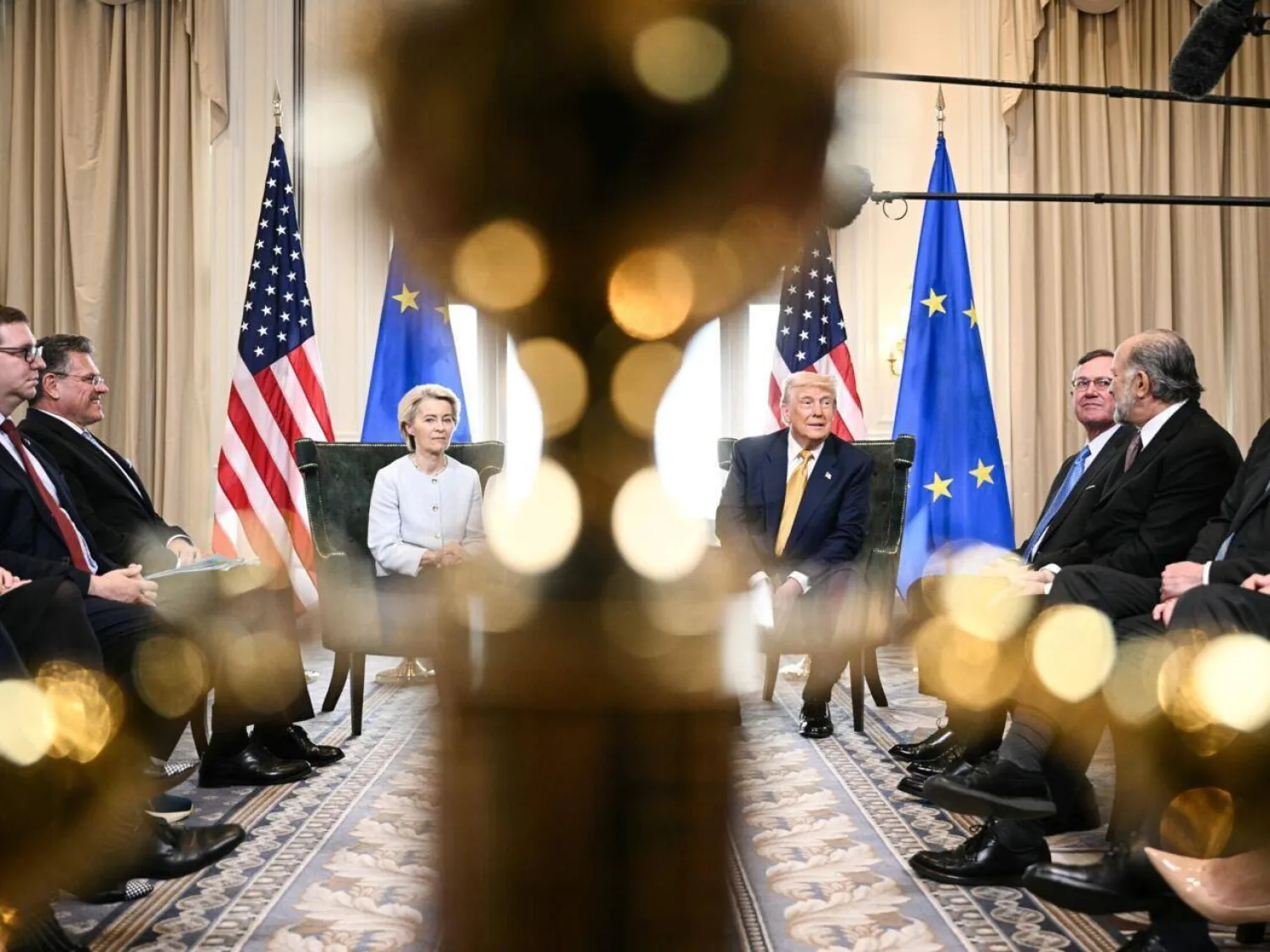

Under Trump Pressure, EU Eyes Deal to End Trade Standoff

US President Donald Trump and EU chief Ursula von der Leyen sealed the deal in Turnberry, Scotland last year. Brendan SMIALOWSKI / AFP/File
TT

Under Trump Pressure, EU Eyes Deal to End Trade Standoff

US President Donald Trump and EU chief Ursula von der Leyen sealed the deal in Turnberry, Scotland last year. Brendan SMIALOWSKI / AFP/File

The EU hopes Tuesday to strike a deal towards implementing its nearly year-old trade pact with the United States -- with an increasingly impatient Donald Trump threatening steep new tariffs unless it is done by July 4.

The 27-nation bloc struck an accord with Washington last July setting levies on most European goods at 15 percent, but to the US president's frustration a final version of the text still needs nailing down on the EU side, AFP said.

"A deal is a deal," the US mission to the EU posted on X Monday, saying the bloc "must live up" to the agreement sealed in Turnberry, Scotland, between Trump and EU chief Ursula von der Leyen.

Negotiators from the EU's parliament and capitals will meet Tuesday night in Strasbourg to push for a compromise that would allow the bloc to meet Trump's deadline and hopefully turn the page on more than a year of transatlantic trade battles.

Short of that, Trump has warned the EU should expect "much higher" tariffs -- and has already vowed to raise duties on European cars and trucks from 15 to 25 percent.

The tariff blitz unleashed by Trump before the Turnberry accord, including hefty levies on steel, aluminium and car parts, jolted the bloc into cultivating trade ties around the world.

But the EU cannot afford to neglect the 1.6-trillion-euro ($1.9-trillion) relationship with the United States, its largest trade partner.

Cyprus, which holds the rotating presidency of the EU, said its goal "remains, the swift implementation of the EU-US joint statement".

To reach a compromise with member states, parliament is under pressure to renege on several amendments it added to the text in March which the Americans consider unacceptable.

The head of parliament's trade committee, Bernd Lange, struck an optimistic note, saying the sides had "already made a lot of progress".

"I hope we can reach a compromise, including new propositions," Lange said.

But first, he needs to hammer out a common stance between the parliament's different factions, which looked set to keep haggling until the last moment.

- 'Sunrise' to 'sunset' -

The EU parliament's conditional green light came after months of delay caused by Trump's designs on Greenland and a US Supreme Court ruling striking down many of the president's levies.

The assembly's largest force, the conservative European People's Party to which von der Leyen belongs, is now pushing hard to implement an accord it says is vital to ending a period of damaging uncertainty for EU businesses.

EPP lawmaker Zeljana Zovko told AFP she was "confident that we will get it done".

The EPP has firm support from the hard-right ECR party, whose shadow rapporteur on the file, Kris Van Dijck, also said he was "cautiously optimistic".

But several political groups had yet to make their position public as of Monday night, and it remained unclear how far the majority would compromise to get a deal.

Lawmaker Kathleen Van Brempt of the Socialists and Democrats, parliament's second-biggest group, said they would "engage constructively" but fight for safeguards "to guarantee stability, predictability and protection for European businesses and workers".

One bone of contention is a suspension clause toughened by parliament that would scrap favorable tariff conditions for US exporters, should the United States later breach the terms of the deal.

Another concerns so-called "sunrise" and "sunset" clauses under which the EU side of the accord would kick in once the United States makes fully good on its pledges, and would expire unless renewed in 2028.

Green lawmaker Anna Cavazzini said "the odds are good" but warned member states would need to "budge" on parliament's main priorities.

"These past weeks have shown time and again that Trump is not to be trusted, so the EU needs stronger tools at hand," she said.



Oil Extends Climb on Prolonged Hormuz Export Uncertainty

An automated oil drilling rig operated by ExxonMobil in Midland, Texas, US, August 17, 2026. REUTERS/Sheila Dang
TT

Oil Extends Climb on Prolonged Hormuz Export Uncertainty

An automated oil drilling rig operated by ExxonMobil in Midland, Texas, US, August 17, 2026. REUTERS/Sheila Dang

Oil prices climbed for a fourth straight day on Wednesday as investors weighed conflicting messages from Tehran and Washington on whether the Strait of Hormuz is open to ships.

Brent crude futures climbed 69 cents, or 0.8%, to $91.71 by 0415 GMT, while US West Texas Intermediate crude futures were up 76 cents, or 0.9%, to $85.70 a barrel, Reuters reported.

Both contracts closed on Tuesday at their highest in more than three weeks as hopes of peace between the US and Iran faded.

US President Donald Trump said on Tuesday no talks were taking place with Iran ⁠and insisted the ⁠Strait of Hormuz was open, contradicting Iran's assertion that the critical waterway remained shut to shipping.

A temporary ceasefire agreement expired on Monday and a senior Iranian official told Reuters that his country was moving to a "fully offensive" military posture due to the diplomatic stalemate, though there were no reports of fresh strikes by either side on Tuesday.

"The shipping risks are increasing again as attacks from Iran ⁠and Houthis remain prevalent in both key chokepoints, keeping oil prices supported in the near term," said June Goh, senior oil market analyst at Sparta Commodities, referring to the Strait of Hormuz and Bab el-Mandeb strait.

Shipping through Hormuz slowed, data showed on Wednesday, as most shipowners avoided the key waterway due to a lack of clear signaling on its reopening from a blockade.

"However, Gulf producers are finding alternative export routes to bring oil out to the Gulf of Oman," said Goh. "If sustainable, this could help increase shut-in production from these two producers."

To avoid the Strait of Hormuz, Iraq's cabinet approved mechanisms for exporting Iraqi ⁠crude through specialized international ⁠and local companies and via multiple export outlets, the government said on Tuesday.

The contracts under the new mechanism will run for three months starting September 1, according to a statement issued after the cabinet meeting.

In the US, crude oil and distillate inventories fell, while gasoline stocks rose last week, market sources said, citing data from the American Petroleum Institute.

Official inventory numbers from the US Energy Information Administration are due at 10:30 a.m. ET (1430 GMT), with analysts polled by Reuters expecting crude stocks fell by about 600,000 barrels in the week ended August 14.


Iraq Approves Three-Month Mechanism to Export Crude via Local, International Firms

The Zubair Oil Field in Basra, Iraq, April 6, 2026. (Reuters)
TT

Iraq Approves Three-Month Mechanism to Export Crude via Local, International Firms

The Zubair Oil Field in Basra, Iraq, April 6, 2026. (Reuters)

Iraq's cabinet approved mechanisms for exporting Iraqi crude through specialized international and local companies and via multiple export outlets, the government said on Tuesday.

The contracts under the new mechanism will run for three months starting September 1, according to a statement issued after the cabinet meeting.

Iraq ‌is seeking ‌to diversify its oil ‌export ⁠channels and maintain flexibility ⁠in marketing its crude amid the Iran war and the closure of the Strait of Hormuz, which has disrupted regional oil flows and created uncertainty around shipping routes.

Iraq ⁠has worked to develop ‌alternative export ‌routes in addition to its traditional southern terminals, ‌including routes through Türkiye and Syria, ‌as it seeks to reduce reliance on Gulf shipping routes.

Iraq is OPEC's second-largest oil producer and relies heavily on ‌crude exports for state revenue. Most of its exports are ⁠shipped ⁠from terminals in the southern Gulf, leaving the country particularly exposed to disruptions in the Strait of Hormuz.

The government did not immediately provide details on the companies to be selected, the volumes to be exported under the mechanism, or the specific export outlets covered by the contracts.


Aramco, Maaden Sign Joint Venture Agreement on Mineral Exploration, Hard-Rock Mining in Saudi Arabia

File photo of the Saudi flag - SPA
TT

Aramco, Maaden Sign Joint Venture Agreement on Mineral Exploration, Hard-Rock Mining in Saudi Arabia

File photo of the Saudi flag - SPA

Aramco and Maaden announced the signing of a shareholders’ agreement to form a Joint Venture (JV) to unlock new opportunities in mineral exploration and hard-rock mining in the Kingdom of Saudi Arabia.

Combining the strengths of two leaders in their respective fields, the JV would focus on copper and other minerals critical to the energy transition. The JV plans were first disclosed in January 2025.

The JV is expected to be owned 51% by Maaden and 49% by Aramco, and focus on exploration across Zone-4, also known as the Transition Zone, within the Arabian Platform. It represents a major new opportunity for mineral discovery in the Kingdom.

Spanning approximately 182,000 square kilometers, nearly 10% of Saudi Arabia’s total land area, the expected exploration area stretches along a 100-kilometer-wide zone running parallel to the Arabian Shield.

Aramco Vice President of Transition Minerals Saleh M. Al Saleh said: "Over 90 years, Aramco has accumulated and analyzed the largest amount of geological and geophysical data ever acquired in a single basin for the Kingdom. This partnership intends to leverage this legacy information to find minerals in the JV area within the basin. Maaden’s expertise, our people, high-performance computing, and AI are expected to play a pivotal role in accelerating the discovery of key transition minerals at low cost."

Maaden Executive Vice President for Exploration Darryl Clark said: “Maaden has been advancing one of the world’s largest single jurisdiction exploration programs across the Arabian Shield to help unlock the Kingdom’s mineral potential. This joint venture would take that ambition into a new area. By combining Maaden’s exploration and development expertise with Aramco’s extraordinary knowledge of the Arabian Platform, we would have an opportunity to move faster, explore smarter, and create new opportunities to discover the minerals that will power the energy transition.”

Copper, which is increasingly significant for electric vehicles, power networks, energy storage, and renewable energy systems, would be a main focus of the JV. Copper is a major metal making up over 20% of the $1.2 trillion mined metals market. The copper market is currently valued at approximately $250 billion and is projected to grow to over $400 billion by 2035. The JV would also explore for other energy transition minerals including zinc, lead, and rare earth elements that are expected to be crucial to industries of the future.

Leveraging advanced computational algorithms, AI, and high-performance computing, the JV intends to target areas most likely to contain copper and valuable minerals, accelerating the path from regional screening to target definition and discovery. This is expected to support long-term sector development, reinforce the Kingdom’s role in the global minerals value chain, and help meet rising demand for transition minerals.

The effectiveness of the shareholders’ agreement and the incorporation of the JV is conditional upon the fulfillment of certain condition precedents, including, but not limited to, obtaining all the required corporate and regulatory approvals and antitrust clearance.