


How Might This World Cup Be Won on the Pitch?

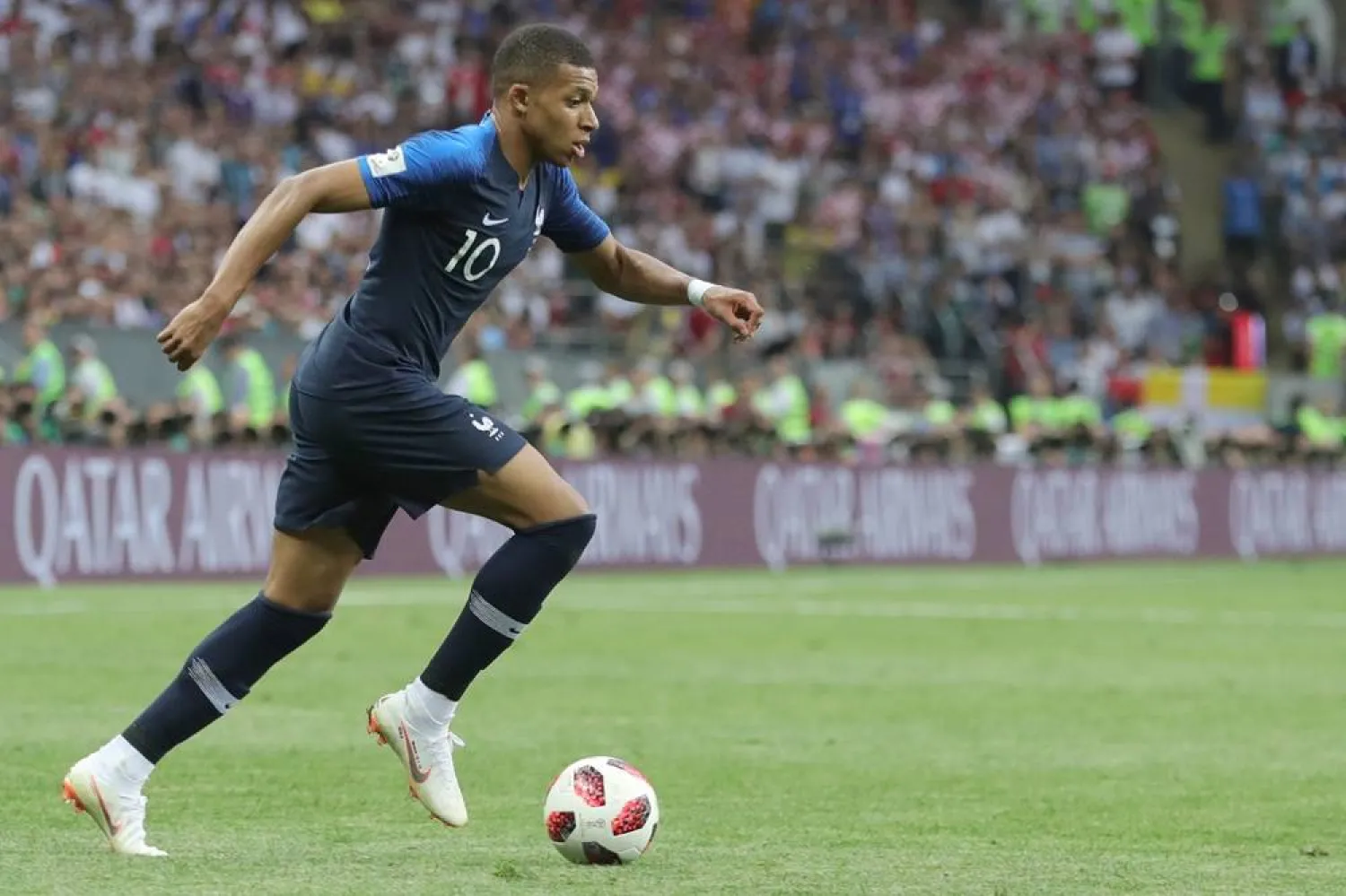
15 July 2018, Russia, Moscow: France's Kylian Mbappe in action during the FIFA World Cup 2018 final match between France and Croatia at the Luzhniki Stadium. (dpa)
TT

How Might This World Cup Be Won on the Pitch?

15 July 2018, Russia, Moscow: France's Kylian Mbappe in action during the FIFA World Cup 2018 final match between France and Croatia at the Luzhniki Stadium. (dpa)

The World Cup represents football's pinnacle, the ultimate prize every young player dreams of winning. But whether the tournament is where the very best football is played is a different question entirely.

Elite European clubs with vast revenues concentrate so much of the top talent, and the very best games are often played in the latter stages of the UEFA Champions League -- think of Paris Saint-Germain's recent 5-4 win over Bayern Munich.

It is hard for most international teams to reach the same level -- Luis Enrique himself has taken PSG to greater heights than he managed with Spain at Euro 2020 or the 2022 World Cup.

"I don't think you can compare the international game with elite club football. They each have their own character," insists Andy Roxburgh, the ex-Scotland manager, now technical director of the Asian Football Confederation having previously had the same role with UEFA.

"In international football, there's no transfer market. You select and you use what's available to you."

Therefore, he says, national team coaches usually have to be pragmatic.

"In the international scene, because there's fewer games, and they're usually high-profile games, results are magnified and exaggerated," he tells AFP from Kuala Lumpur.

- High intensity? -

"A national team manager gels the players together, adds his own philosophy, and the national culture is taken into account. But the way the players play at their club has a big, big influence."

An obvious example is the Spain team that won back-to-back Euros either side of lifting the 2010 World Cup, while leaning heavily on the all-conquering Barcelona of the era.

So how exactly might this World Cup be won?

As tactical systems at elite clubs become more advanced, the world's top national teams -- in Europe and South America, plus perhaps Morocco, Senegal and Japan -- may be best suited to borrow elements from their ways of playing.

There is the quick counter-attack, something PSG have demonstrated in devastating fashion in the Champions League and which Argentina used to score their stunning second goal in the 2022 World Cup final against France.

"The key moment in a game of football is the change from defensive phase to attacking phase, when the opposition has no time," said France coach Didier Deschamps a few months after that game.

In order to recover the ball quickly, many of the world's top teams now play with a high press.

Roxburgh, now 82, has followed international football's evolution since managing Scotland at the 1990 World Cup.

"What has changed is the speed of the game. The pressure on the ball is far more intense," he says.

"So collective play at international level today is more sophisticated than previously.

"In the past it depended a lot on individual stars -- today the stars play for the team."

- Set-pieces -

However, the energy required to deploy that high press may come up against one significant problem at this World Cup: the heat of a North American summer.

"I know we're going to have water breaks, but that might not be enough to allow teams to press and play high-intensity," adds Roxburgh.

"We'll see. Jesse Marsch, who's right into high pressing up in Canada, might be able to do that, but I'm not sure that in some parts of the US or even Mexico it will be easy to do."

There is also something more basic, but which has become a defining feature of this Premier League season: the weaponization of set-pieces and long throws.

"These things will matter... All these patterns are back and crosses are back, as well," said England's Thomas Tuchel earlier this season.

And set-pieces are one aspect of the game coaches can control, while the three-minute hydration breaks FIFA is introducing for midway through each half at the World Cup could well also prove significant for them.

"These could be a big moment for coaches from a tactical viewpoint," said former Arsenal midfielder Gilberto Silva, the 2002 World Cup winner with Brazil who is now part of FIFA's technical study group.

"Now they have two more opportunities, beyond half-time, to make changes. That is a big advantage for them."



Alcaraz Withdraws from Wimbledon with Wrist Injury

Tennis - Wimbledon - All England Lawn Tennis and Croquet Club, London, Britain - July 14, 2024 Spain's Carlos Alcaraz poses for a picture with the trophy after winning his men's singles final against Serbia's Novak Djokovic. (Reuters)
TT

Alcaraz Withdraws from Wimbledon with Wrist Injury

Tennis - Wimbledon - All England Lawn Tennis and Croquet Club, London, Britain - July 14, 2024 Spain's Carlos Alcaraz poses for a picture with the trophy after winning his men's singles final against Serbia's Novak Djokovic. (Reuters)

Carlos Alcaraz's hopes of regaining his Wimbledon title have been dashed with the two-time champion announcing Tuesday he is withdrawing as he recovers from a wrist injury.

"My recovery is going well and I'm feeling much better, but unfortunately I'm still not ready to play, I am obliged to withdraw from both Queen's and Wimbledon," said Spaniard Alcaraz, who lost to world number one Jannik Sinner in last year's final.

"These are two really special tournaments for me and I'll miss them a lot. We'll keep working to come back as soon as possible."

Alcaraz sustained the injury during the first round of the Barcelona Open and subsequently pulled out of tournaments in Madrid and Rome and then Roland Garros, where he is the reigning two-time champion.

The world number two became the youngest man to complete the career Grand Slam in January with his triumph at the Australian Open. The 23-year-old holds a 22-3 record this season and also won a title in Doha.

Wimbledon will be only the third Grand Slam that Alcaraz has missed since making his main draw debut at the 2021 Australian Open.

Alcaraz's injury has stopped him continuing his exciting rivalry with Italian Sinner, 24, who is firm favorite to triumph in Paris and London.


Guardiola Set for Emotional Man City Farewell After Era-Defining Decade

Manchester City's Spanish manager Pep Guardiola poses with the trophy on the pitch after the English FA Cup final football match between Chelsea and Manchester City at Wembley stadium in London, on May 16, 2026. (AFP)
TT

Guardiola Set for Emotional Man City Farewell After Era-Defining Decade

Manchester City's Spanish manager Pep Guardiola poses with the trophy on the pitch after the English FA Cup final football match between Chelsea and Manchester City at Wembley stadium in London, on May 16, 2026. (AFP)

Pep Guardiola is expected to take charge of Manchester City for the final time on Sunday, drawing the curtain down on a decade that has reshaped not only his club but English football itself.

When the Catalan arrived in 2016, he was already regarded as one of the game's great innovators. What followed was something even more profound: a transformational reign that turned City from wealthy contenders into the defining team of an era.

Ten years on, Guardiola leaves City having won 15 major trophies, not including the UEFA Super Cup and Club World Cup.

His trophy cabinet includes six Premier League titles -- including a record four in a row -- and the club's first Champions League crown, a haul that places him among the most successful ‌managers in English ‌football history.

This season alone, he has guided City to both the League ‌Cup ⁠and FA Cup ⁠titles, and pushed Arsenal right to the wire in the Premier League race.

His final match, expected to be Sunday's league game against Aston Villa, will close the book on a story of dominance, reinvention and influence that extended far beyond results.

And the Etihad Stadium crowd will surely soak up every second, singing their tribute song to their beloved manager: "We've got . . . Guardiola!" to the tune of The Dave Clark Five's "Glad All Over".

Guardiola's legacy at City is measured not just in silverware but in the scale of control his teams exerted. At their peak, ⁠they amassed points totals previously unimaginable, winning four straight league titles between ‌2021 and 2024 and forcing rivals into near-perfection just to keep ‌pace.

In 2023, they completed the treble, joining Manchester United's 1999 side as the only English teams to hoist the ‌league, FA Cup and Champions League trophies in the same season.

GAME CHANGER

The 55-year-old is credited with changing ‌the game by imposing a level of control and technical precision rarely seen in English football, turning City into the benchmark for how the game could be played.

His teams did not simply win; they dominated by keeping the ball, dictating tempo and suffocating opponents through positional play and relentless pressing.

Beyond the results, fans will surely miss Guardiola's entertaining, ‌restless presence. Usually dressed in his favored knit jumpers and smart trousers, he prowls the technical area, arms cutting through the air as he ⁠points, waves and barks instructions.

Frustration ⁠flashes quickly, sometimes with a sharp kick at a cooler. He has been known to cushion stray balls with a deft touch of a foot, or turn and encourage the crowd to cheer.

He frequently speaks to opposing players on the pitch after matches, to offer tactical tips or praise a performance.

City's players have praised his impact and marveled at his relentless quest for excellence.

"He changed the way I see football," City captain Bernardo Silva said after Saturday's FA Cup win.

"That winning mentality is nothing like I've ever seen," defender John Stones added.

For all the tactics, Guardiola's greatest legacy will have been cultural. He made style the norm and forced the Premier League to evolve around it.

If Sunday indeed ends his tenure, his influence will not fade.


Stuttering Sabalenka Seeks to Set Down Marker at Roland Garros

 Belarus' Aryna Sabalenka returns the ball to Romania's Sorana Cirstea during their match at the Italian Open tennis tournament in Rome, Saturday, May 9, 2026. (AP)
Belarus' Aryna Sabalenka returns the ball to Romania's Sorana Cirstea during their match at the Italian Open tennis tournament in Rome, Saturday, May 9, 2026. (AP)
TT

Stuttering Sabalenka Seeks to Set Down Marker at Roland Garros

 Belarus' Aryna Sabalenka returns the ball to Romania's Sorana Cirstea during their match at the Italian Open tennis tournament in Rome, Saturday, May 9, 2026. (AP)
Belarus' Aryna Sabalenka returns the ball to Romania's Sorana Cirstea during their match at the Italian Open tennis tournament in Rome, Saturday, May 9, 2026. (AP)

Aryna Sabalenka looked unbeatable when the clay-court season got underway last month, but now as the world number one arrives in Paris for her latest tilt at winning Roland Garros, her dominance of the women's game has started to show cracks.

The four-time Grand Slam champion still holds more than 1,000 ranking points on her closest challengers but foremost on her mind over the next fortnight will be going one better than her runner-up finish last year in the French capital, when she lost in three sets to Coco Gauff.

If her aims ahead of the tournament, which starts on Sunday, mirror that of her men's counterpart, Jannik Sinner who is also hunting a first title on the red dirt in Paris, Sabalenka's stranglehold over her competitors is suddenly a lot less dominant than the Italian's.

When Sabalenka swept to the Sunshine Double at the WTA 1000 hardcourt events in Indian Wells and Miami in March, she had then won three of the four tournaments she had played in this season -- the only blight on that record being a three-set defeat to Elena Rybakina in the Australian Open final.

And as she jetted into Madrid for the start of the European clay swing on a 15-match winning streak, it had seemed little would stand in her way to claiming a fourth career title at the Caja Magica as she began preparations for the French Open.

But a quarter-final exit at the hands of 30th seed Hailey Baptiste put paid to the Belarusian's ambitions in Spain, before she followed that up by crashing out of the Italian Open against a resurgent Sorana Cirstea in the third round, after which she said she felt like "my body was limiting me from performing on the highest level".

"I guess we never lose; we only learn, so it's OK," Sabalenka mused after exiting a 1000 tournament at the round-of-32 stage for the first time since February 2025.

With the 28-year-old top seed now looking uncertain on the clay, the draw again appears to be wide open.

- 'Big battles' -

Rybakina, who beat Sabalenka in last season's WTA Finals decider and then in Melbourne in January to claim her second major title, will be one of the main contenders despite having never progressed beyond the last eight at Roland Garros.

The Kazakh world number two is the player who has arguably enjoyed the best season on the tour this year, barring Sabalenka, and last month won indoor on the clay in Stuttgart but similarly had disappointing runs in Madrid and Rome.

Iga Swiatek, the erstwhile "queen of clay", has of late shown glimpses of the form that took her to world number one and four Roland Garros titles in the early 2020s.

Since her last triumph in Paris two years ago, the 24-year-old has struggled to find consistency but will be hoping her new collaboration with Rafael Nadal's former coach Francisco Roig can help her re-find her best tennis on the surface she had for so long dominated.

Defending champion Gauff will certainly not cede her title lightly and the world number four enters the fray on the back of a strong run in Rome, which ultimately ended in defeat at the final hurdle to the in-form Elina Svitolina.

The 31-year-old Ukrainian has won two titles already this year, including a first 1000-level crown in eight years at the Italian Open, and will certainly fancy a deep run in Paris, after reaching the final eight for the fifth time in her career last year.

"(Winning Rome) gives me a lot of confidence. Gives me a good look at Roland Garros," Svitolina said.

"But... There are really tough players. You cannot underestimate (them). You need to be ready for the first-round matches, big battles. Everybody's there to beat you."

Alongside Svitolina, Madrid Open winner Marta Kostyuk, rising starlets Mirra Andreeva, Iva Jovic and Victoria Mboko, as well as Amanda Anisimova will be dark horses for a maiden Grand Slam title.