

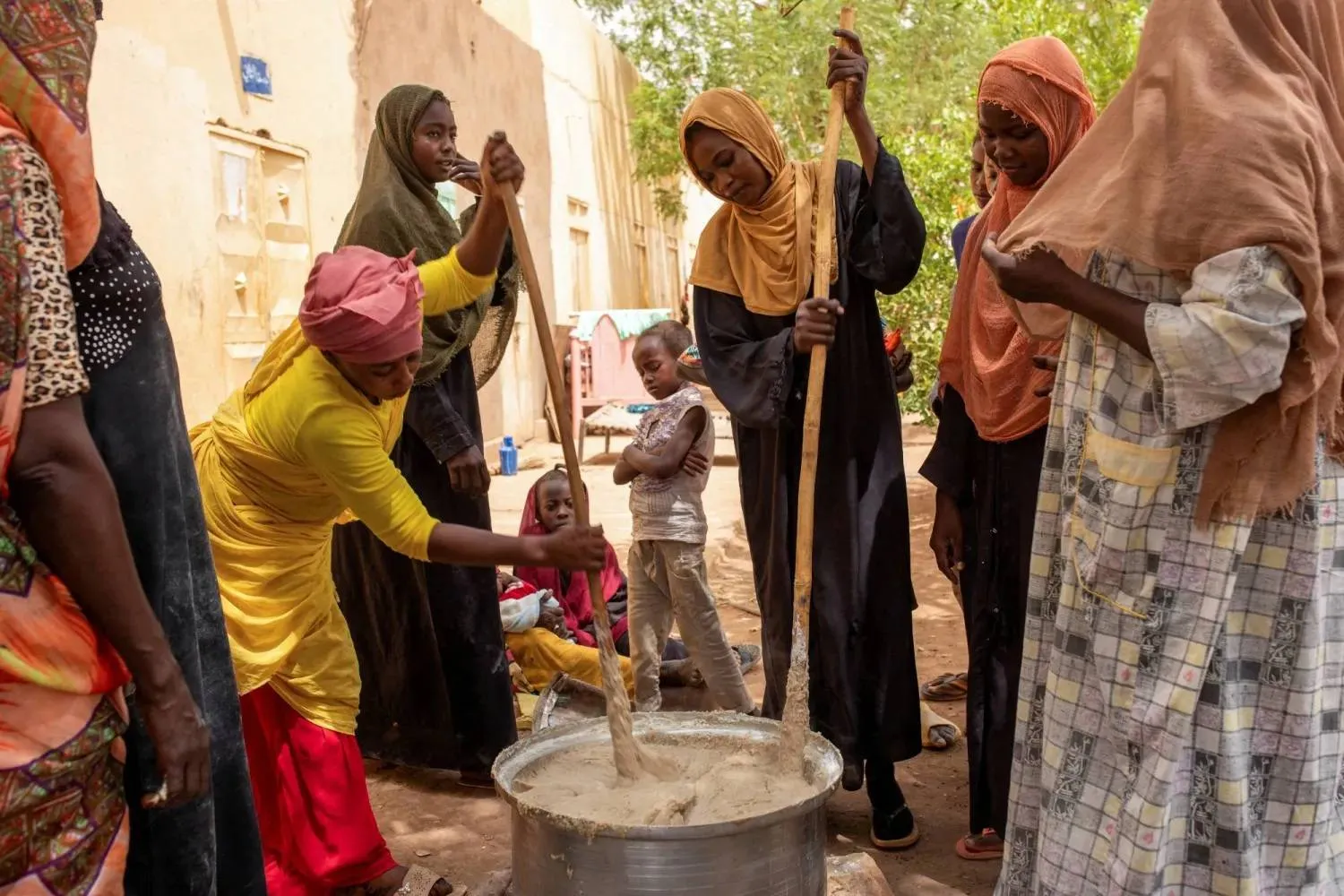

MSF Warns Aid Used for 'Military Objectives' in S.Sudan

FILE PHOTO: Sudanese women from community kitchens run by local volunteers prepare meals for people who are affected by conflict and extreme hunger and are out of reach of international aid efforts, in Omdurman, Sudan, June 22, 2024. REUTERS/Mazin Alrasheed/File Photo
TT

MSF Warns Aid Used for 'Military Objectives' in S.Sudan

FILE PHOTO: Sudanese women from community kitchens run by local volunteers prepare meals for people who are affected by conflict and extreme hunger and are out of reach of international aid efforts, in Omdurman, Sudan, June 22, 2024. REUTERS/Mazin Alrasheed/File Photo

Medical charity Doctors Without Borders warned Tuesday that aid in South Sudan was being "instrumentalized" for military and political objectives, despite the country's dire humanitarian needs.

After gaining independence in 2011, South Sudan descended into civil war and remains mired in extreme poverty, corruption and insecurity, said AFP.

Government troops under President Salva Kiir have again been clashing with militias allied to his longtime rival Riek Machar over the past 18 months, with conflict reported in 73 of 79 counties, according to the ACLED monitoring group.

Doctors Without Borders, known by its French initials MSF, warned of a "concerning trend" to block humanitarian and civilian access to contested or opposition-controlled areas and said all sides were using aid for "military and political objectives".

In a report, it said the government had prevented MSF from accessing Akobo town, a hotspot of recent fighting in Jonglei state, where the charity supported one of the few hospitals.

It condemned targeted attacks on other MSF facilities around the country between January 2025 and April 2026, saying an estimated 762,000 people had lost access to healthcare as a result.

MSF's warning comes as some global partners withdraw due to humanitarian cuts and others become increasingly outspoken about the country's dire governance.

Nick Checker, a senior US State Department official for Africa, said recently that the government had issued "insincere promises of reform" to elicit donor funds, "while simultaneously obstructing the delivery of lifesaving assistance".

The US embassy said in April the crisis was worsening despite billions of dollars in oil revenue and foreign assistance, while the United Nations says roughly two-thirds of the population faces acute hunger.



Israel Says It Recovered Remains of Soldier Killed in Lebanon in 1982

Destruction is pictured in the village of Arnoun as seen from nearby Marjeyoun in southern Lebanon on August 11, 2026. (AFP)
TT

Israel Says It Recovered Remains of Soldier Killed in Lebanon in 1982

Destruction is pictured in the village of Arnoun as seen from nearby Marjeyoun in southern Lebanon on August 11, 2026. (AFP)

The Israeli military said on Tuesday it had repatriated the remains of Sgt First Class Yehuda Katz, a soldier killed in Lebanon 44 years ago, in a joint operation with the Mossad intelligence agency.

Katz was the last Israeli soldier declared missing in the Sultan Yacoub battle against Syrian forces in eastern Lebanon in 1982.

"His return to Israel was made possible through efforts based on accurate intelligence... that lasted more than four decades," the military said in a statement.

It is not clear where his body was found.

Israeli Prime Minister Benjamin Netanyahu commended the security forces and said that "for many years, I approved numerous clandestine operations to locate the missing soldiers of Sultan Yacoub. I promised their families that we would never stop working to bring them home."

In a separate statement, President Isaac Herzog said that "the circle that remained an open and bleeding wound from the Battle of Sultan Yacoub is finally closed," and that he had kept a photograph of Yehuda Katz hanging in his office as "a daily reminder of our sacred duty to bring our sons home and leave no one behind".

Katz's remains were brought to Israel and identified at an institute for the identification of fallen soldiers under the military rabbinate, the military said.

Three Israeli soldiers had been missing for decades after the Sultan Yacoub battle. In 2019, the military announced the repatriation of the remains of Sgt First Class Zachariah Baumel, while in May 2025 it said it had recovered the body of Sgt First Class Tzvika Feldman "in the heart of Syria".


Lebanon Mulls Removing Restrictions Against 600,000 Syrians

Lebanese soldiers are seen at the Masnaa border crossing with Syria in wake of the collapse of the Syrian regime. (AP file)
TT

Lebanon Mulls Removing Restrictions Against 600,000 Syrians

Lebanese soldiers are seen at the Masnaa border crossing with Syria in wake of the collapse of the Syrian regime. (AP file)

Lebanese authorities began reviewing security restrictions against some 600,000 Syrians in the latest move that reflects Beirut’s desire to open a new chapter in relations with Damascus based on clear security and legal foundations.

The restrictions are among the thorniest issues in Lebanon and that emerged during the wave of Syrian displacement sparked by the civil war. The restrictions led to hundreds of thousands of Syrians being barred entry to Lebanon.

Addressing the issue would pave the way for Lebanese-Syrian relations that are based on security coordination and respect for the law.

Asharq Al-Awsat learned that Lebanon’s General Directorate of the General Security has kicked off the legal procedures to lift security restrictions against over 600,000 Syrians that barred their entry to Lebanon for years.

A prominent security source revealed that General Security chief Hassan Choucair has formed a committee that will study the file of Syrians who have security warrants against them that have prevented them from entering Lebanon.

The warrants are tied to residency or entry violations.

The source told Asharq Al-Awsat that authorities are now examining the file of every Syrian who has been barred entry to Lebanon over residency violations, such as entering Lebanon illegally or violating residency rules or exceeding the duration of their stay.

The source said the committee has already completed tens of thousands of files.

The General Security will issue a statement upon completion of the procedures. It will inform the Syrian authorities of its results.

The move is not limited to building trust between Beirut and Damascus, but it also aims to crack down on people smuggling across the Lebanese-Syrian border.

The latest procedures will allow Syrians to enter Lebanon with their identification papers or through travel agencies as long as they meet the necessary requirements.

Syrians wishing to work in Lebanon must obtain work and legal residency permits from the General Security.

“Lebanon welcomes anyone who wants to reside on its territory as long as they are doing so legally,” said the source.

“Syria is a sisterly country and organizing the movement of people in and out of both countries benefits them both,” he added.


More Displacement in Sudan as Battles Intensify

Sudanese army solders take part in a military parade on August 17, 2026, in the city of Gedaref in eastern Sudan during celebrations to mark the 72nd anniversary of the Sudanese Armed Forces. (AFP)
TT

More Displacement in Sudan as Battles Intensify

Sudanese army solders take part in a military parade on August 17, 2026, in the city of Gedaref in eastern Sudan during celebrations to mark the 72nd anniversary of the Sudanese Armed Forces. (AFP)

At least 12 people were killed and other wounded in Sudan’s North Kordofan as the army launched air strikes and drone attacks on the Rapid Support Forces (RSF).

The fighting sparked a wave of displacement to the city of El Obeid.

Military troops continued to mobilize on the Kordofan and Blue Nile fronts, a sign that more fighting was to come.

Witnesses said the army launched airstrikes on RSF positions in North Kordofan and the Blue Nile at a time when ground fighting had eased between the two warring parties. The two sides had been relying increasingly on drones in the war.

The army and its allied forces have been focusing on expanding their control in North Kordofan and securing the surroundings of El Obeid. The RSF is positioned in areas west and south of the city.

The latest strikes were aimed at stemming any possible renewed fighting in the area.

The United Nations Office for the Coordination of Humanitarian Affairs (OCHA) warned that ongoing violence in Sudan continues to kill civilians and force more people from their homes.

In North Kordofan State, local authorities reported that more than a dozen civilians were killed and others injured in clashes in Um Arada town, southwest of the state capital El Obeid, on Friday, OCHA said in a statement.

The International Organization for Migration (IOM) says that more than 4,200 people were displaced from the town and surrounding areas on Friday and Saturday.

Increased violence across North Kordofan is also affecting humanitarian operations, forcing humanitarian partners to suspend activities in Al Mazroub locality, which is facing a cholera outbreak.

Meanwhile, in Blue Nile State, renewed fighting was reported in Geisan and Kurmuk towns and surrounding areas last week. IOM says that about 5,400 people were displaced in recent days.

OCHA once again “called on all parties to protect civilians and civilian infrastructure, and to allow aid to reach people quickly, safely and without obstruction.”

“Despite the insecurity, the UN and its humanitarian partners continue to deliver assistance to people in need. Across the Darfur region, the World Food Program reached about 2.3 million people with food assistance last month,” said OCHA.

OCHA continues to urge donors to provide additional funding for the humanitarian response. This year's humanitarian appeal for Sudan remains about 41 percent funded, with $1.2 billion received against the $2.9 billion required, added the statement.