

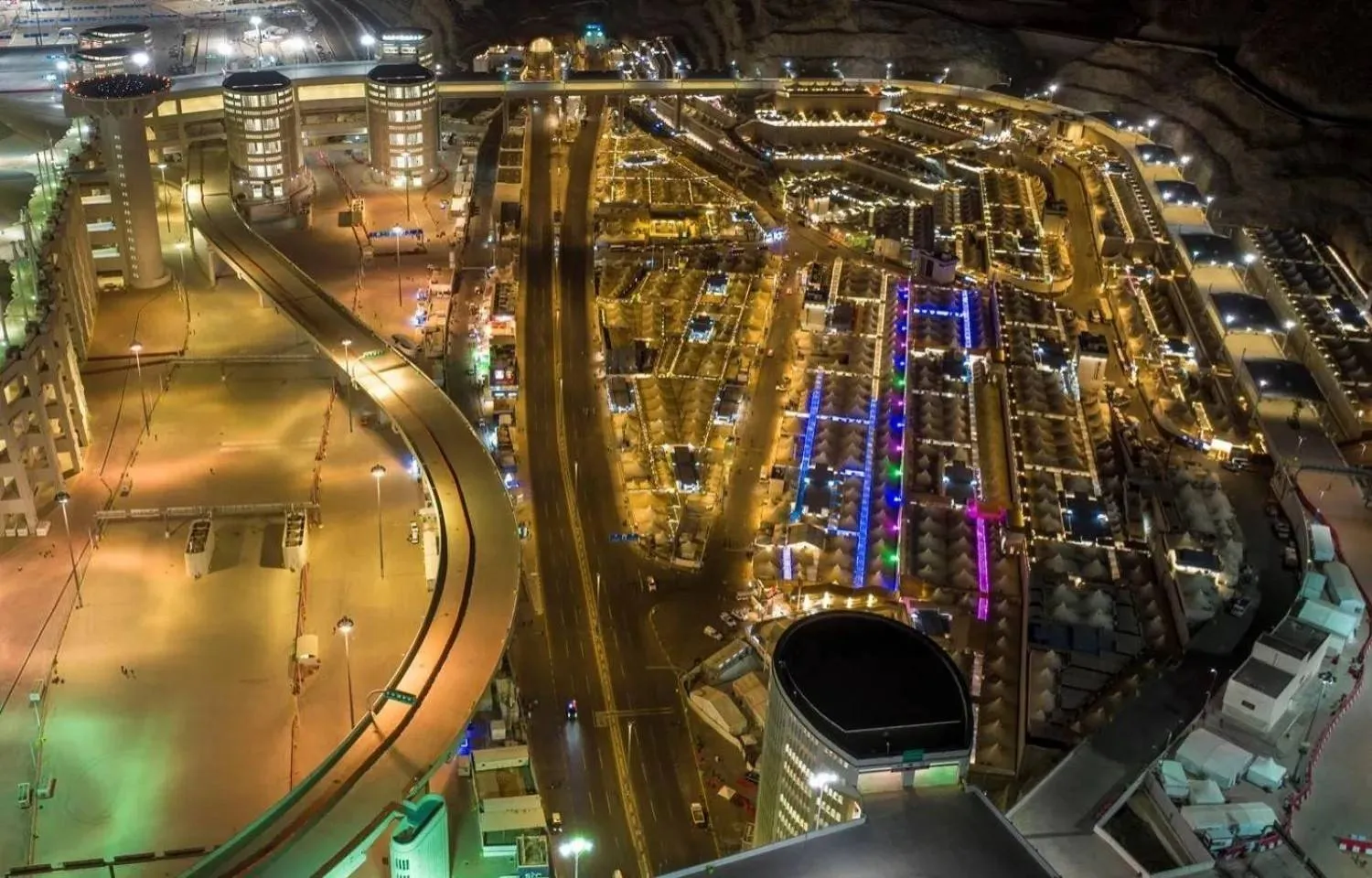

Saudi Arabia Expands Use of AI to Serve Hajj Pilgrims

The Smart Makkah Operations Center is one of the operational and technical pillars supporting SDAIA’s work during Hajj (SPA)
TT

Saudi Arabia Expands Use of AI to Serve Hajj Pilgrims

The Smart Makkah Operations Center is one of the operational and technical pillars supporting SDAIA’s work during Hajj (SPA)

The Saudi Data and Artificial Intelligence Authority, known as SDAIA, has expanded the technological transformation Saudi Arabia is driving during the Hajj season, rolling out programs designed to boost operational efficiency and strengthen coordination among government agencies in one of the world’s largest annual logistical operations.

The aim is to deliver faster and better services to pilgrims.

SDAIA’s work included operating and supporting 75 sites in the holy sites and 14 sorting sites and security control centers by providing technical systems and services. It also supported Hajj operations at air, land and sea ports across the Kingdom in cooperation with the Ministry of Interior, while running technical systems and platforms in the holy sites.

Makkah Route

Dr. Majid AlShehry, official spokesman for SDAIA, told Asharq Al-Awsat that the authority had continued to support the Ministry of Interior’s Makkah Route initiative, now in its eighth year and implemented with several government agencies.

He said SDAIA provided advanced technical services in 10 countries through 17 international ports, equipping the initiative’s halls with the latest digital solutions powered by data and artificial intelligence. The services helped pilgrims complete procedures at airports in their home countries before arriving in Saudi Arabia.

Mobile device

AlShehry said SDAIA, in partnership with the Ministry of Interior, had developed a mobile device this year supported by data and AI technologies to help authorities complete pilgrims’ procedures automatically and flexibly, particularly for the elderly and people with disabilities.

The device verifies travel documents and visas with high accuracy, ensuring a smoother and safer experience from departure. It can capture biometrics, take a facial image and read a pilgrim’s passport data in no more than 40 seconds, helping improve performance and ease the Hajj journey this year, 1447 AH.

SDAIA also supported Hajj operations at air, land and sea ports across the Kingdom in cooperation with the Ministry of Interior, while running technical systems and platforms in the holy sites and supporting sorting sites and security control centers, AlShehry said.

He said the work strengthens technical integration with relevant government agencies, speeds up procedures, supports business continuity and improves operational efficiency during the season.

SDAIA has reinforced its technical capabilities at the Kingdom’s air, land and sea ports with specialized teams working around the clock to ensure the continuity of technical services and primary and backup communication networks, maintaining uninterrupted operational readiness.

It provided technical services at several key ports, including King Abdulaziz International Airport in Jeddah, Prince Mohammad bin Abdulaziz International Airport in Madinah, Taif Airport, Jeddah Islamic Port, the Empty Quarter crossing, Al Batha, Salwa, Al Ruqi, King Fahd Causeway, Halat Ammar, Neom Port, Jadidat Arar, Al Haditha and Al Wadiah.

Operating 75 sites in the holy sites

AlShehry said SDAIA’s work extended to operating and supporting 75 sites in the holy sites and about 14 sorting sites and security control centers. This included providing technical systems and services, supervising infrastructure and communication rooms, preparing workstations and connecting them to SDAIA’s network under approved cybersecurity standards.

The work also covered preventive maintenance, receiving and immediately handling technical reports, and training participating staff to use modern systems and platforms.

AlShehry described the Smart Makkah Operations Center, SMART MOC, in Makkah as one of the main operational and technical pillars supporting SDAIA’s Hajj work this year. The center monitors the performance of systems and digital platforms supervised by the authority and tracks response indicators and business continuity around the clock.

He said specialized Saudi staff monitor data flow, detect technical challenges and address them proactively, helping maintain stable and reliable digital services in line with operational requirements and cybersecurity standards.

Surveillance cameras

SDAIA, in partnership with the Ministry of Interior, developed a smart digital system for security surveillance cameras through the Sawaher platform, AlShehry said.

The platform included infrastructure for smart surveillance cameras, security monitoring rooms and operational platforms to support field monitoring and crowd management in the holy sites and on roads leading to them during Hajj.

The system analyzes data, grouping indicators and crowd behavior using advanced algorithms to measure density and crowd numbers.

AlShehry also cited the Baseer platform, which SDAIA developed with the Ministry of Interior through advanced technical work based on AI technologies and algorithms, including computer vision and large language models.

He said Baseer monitors crowds, supports their safety and helps smooth their movement as they enter the Two Holy Mosques during the Hajj 1447 season. The platform is integrated with security and service agencies, providing field commanders with accurate, immediate analysis, supporting decision-making and improving pilgrim safety.

19 languages

AlShehry said the comprehensive national application Tawakkalna accompanied pilgrims during this year’s Hajj through an integrated package of services available in 19 languages.

Pilgrims can log in easily to view services relevant to their journey, including Hajj permits available through Tawakkalna in integration with the unified digital Hajj permit platform, Tasreeh. The application also allows users to view all types of Hajj permits issued by government agencies.

On charitable work, AlShehry said the national platform Ehsan continued to support projects serving pilgrims by offering trusted opportunities to support Hajj-related initiatives.

He said Ehsan also enabled the electronic performance of the udhiyah sacrifice ritual in line with Islamic guidelines and organized digital mechanisms that ensure efficiency and reliability, while strengthening the sustainability of charitable impact through the Ehsan Endowment Fund.

GCC and US Stress Commitment to Strategic Partnership, Regional Security

US Secretary of State Marco Rubio speaks during a meeting with Foreign Ministers of the Gulf Cooperation Council Member States at The Ritz-Carlton Bahrain, in Manama, Bahrain, June 25, 2026. REUTERS/Eric Lee/Pool
TT

GCC and US Stress Commitment to Strategic Partnership, Regional Security

US Secretary of State Marco Rubio speaks during a meeting with Foreign Ministers of the Gulf Cooperation Council Member States at The Ritz-Carlton Bahrain, in Manama, Bahrain, June 25, 2026. REUTERS/Eric Lee/Pool

Foreign Ministers of the Gulf Cooperation Council (GCC) countries, along with US Secretary of State Marco Rubio, stressed on Thursday their commitment to strengthening their strategic partnership and intensifying coordination on regional and international issues of mutual interest.

During a meeting in the Bahraini capital, Manama, the ministers discussed a number of regional and international issues, emphasizing the importance of enhancing coordination and joint consultation in a manner that supports regional security and stability and protects shared interests.

The meeting also explored opportunities to strengthen cooperation in investment, trade, energy, and advanced technologies, in addition to supporting initiatives aimed at achieving sustainable development and promoting economic prosperity.

Participants stressed the importance of collective action to confront common challenges and of adopting diplomatic solutions to resolve crises, in a way that enhances security and peace in the region and the world.

Bahrain's Foreign Minister Abdullatif Al Zayani, who chaired the gathering, said GCC countries stress the need to respect national sovereignty and protect maritime routes, including the Strait of Hormuz.

In his opening remarks, Al Zayani welcomed the efforts that led to the cessation of hostilities and the signing of a memorandum of understanding between the United States and Iran. He also welcomed the announcement by the Sultanate of Oman of a corridor for the safe passage of vessels through the strait.

As for Rubio, he said that any deal with Iran would take the interests of Gulf states into account.

"The reality of it is that no country on Earth has the right to charge for the use of international waterways. And that will never be an acceptable condition of any deal. The president's been fundamentally clear about that," said Rubio.


Rubio: Kuwait is an Indispensable Partner for Regional Security and Stability

Kuwait's Emir Sheikh Meshal al-Ahmad al-Sabah during his meeting with US Secretary of State Marco Rubio (KUNA)
TT

Rubio: Kuwait is an Indispensable Partner for Regional Security and Stability

Kuwait's Emir Sheikh Meshal al-Ahmad al-Sabah during his meeting with US Secretary of State Marco Rubio (KUNA)

US Secretary of State Marco Rubio has described Kuwait as “an indispensable partner for regional security and stability.”

Rubio held talks with Kuwait's Emir Sheikh Meshal al-Ahmad al-Sabah on efforts to bolster security and stability, Kuwait's state news agency KUNA said on Wednesday.

He also attended a flag-raising at the US Embassy, which resumed operations after Iran-linked attacks forced a suspension, the State Department said.

"The American flag: a symbol of liberty, unity and freedom now flies proudly once again over Kuwait City. Kuwait is an indispensable partner for regional security and stability," Rubio wrote on social media following the ceremony.

US Secretary of State Marco Rubio upon his arrival in Kuwait as part of his Gulf tour (US Secretary of State's account on social media)

Earlier, UAE President Sheikh Mohamed bin Zayed Al Nahyan discussed with Rubio strategic cooperation between the two countries and ways to further strengthen coordination across various fields in support of shared interests, Emirates News Agency (WAM) reported.

The meeting in Abu Dhabi also addressed regional and international issues of mutual concern, with a focus on developments in the Middle East. Sheikh Mohamed and Rubio underscored the importance of advancing the foundations of security, stability, and lasting peace across the region, WAM said.

On Monday, State Department spokesperson Tommy Pigott said Rubio will travel to the UAE, Kuwait, and Bahrain from June 23-25.

“The Secretary will discuss a range of regional priorities including the memorandum of understanding with Iran, efforts to secure full and free safe transit through the Strait of Hormuz, and the importance of peace and stability in the region. In Bahrain, the Secretary will also meet with the Gulf Cooperation Council to discuss shared priorities across the region,” Pigott said.


Faisal bin Farhan, Araghchi Discuss Latest Developments

Saudi Minister of Foreign Affairs Prince Faisal bin Farhan bin Abdullah
TT

Faisal bin Farhan, Araghchi Discuss Latest Developments

Saudi Minister of Foreign Affairs Prince Faisal bin Farhan bin Abdullah

Saudi Minister of Foreign Affairs Prince Faisal bin Farhan bin Abdullah held a phone call with his Iranian counterpart, Abbas Araghchi, the Saudi Press Agency reported on Wednesday.

During the call, the two ministers reviewed the latest developments in negotiations between Iran and the United States, as well as progress in implementing the agreed understandings, SPA said.

They also discussed regional developments and underscored the importance of continuing efforts to advance dialogue and diplomatic solutions in a manner that serves the shared interests of the countries and peoples of the region, the news agency added.
