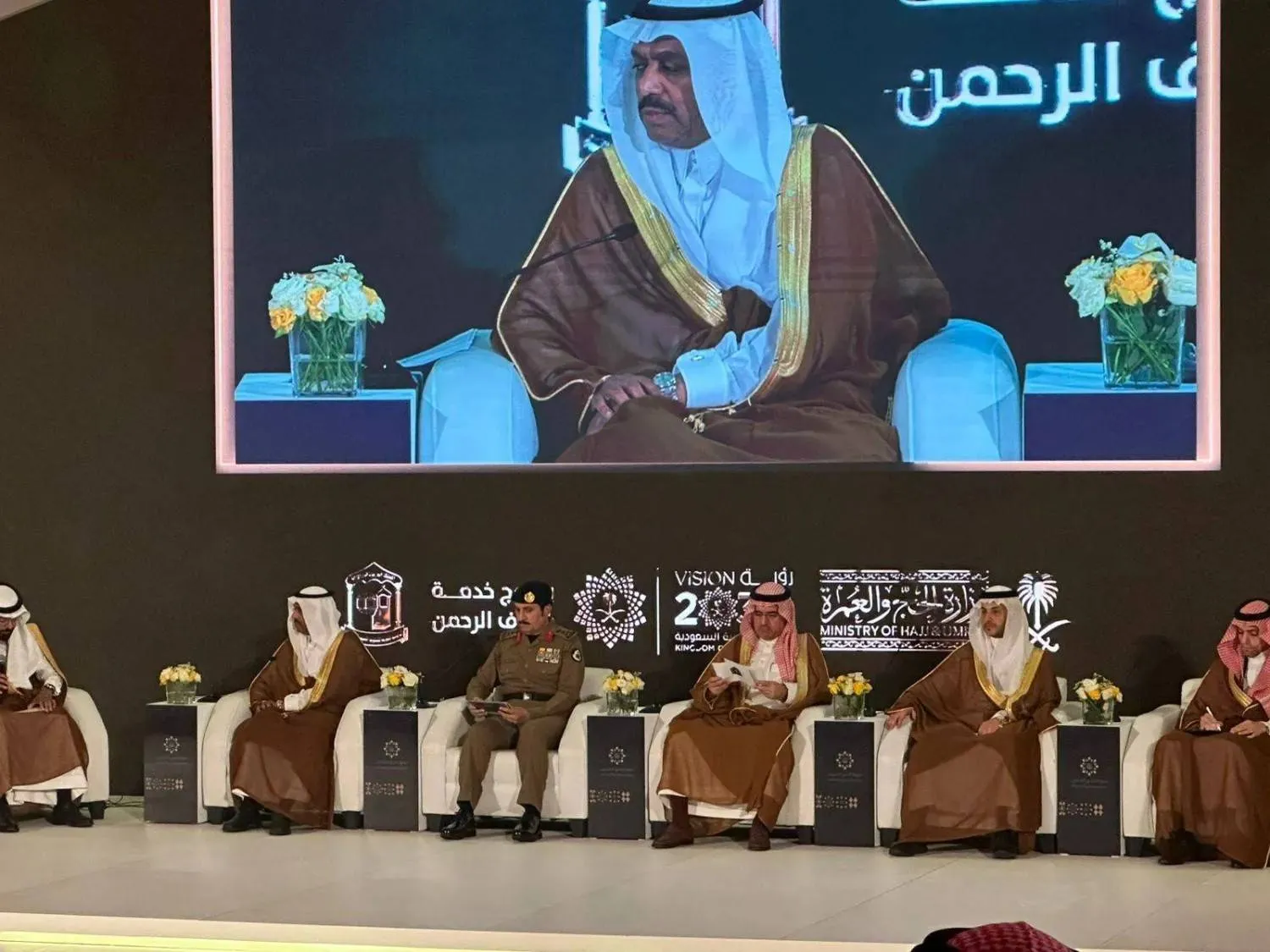

As the Grand Hajj Symposium marked 50 years since its launch, its opening session highlighted the scale of change in Saudi Arabia’s Hajj system over the past few decades.
The success of the season is no longer measured only by the safe arrival of pilgrims and their protection, but by the system’s ability to manage the entire “pilgrim journey,” from the moment travel is planned until pilgrims return home.
At a session bringing together leaders from the Hajj, security and services sectors, one phrase by Mohammed Abulkhair Ismail, chief executive of the Pilgrim Experience Program, stood out as the clearest summary of Saudi Arabia’s new operating philosophy: “The Hajj season now begins before it ends.”
The session was attended by Dr. Abdulfattah Bin Sulaiman Mashat, Saudi deputy minister of Hajj and Umrah; Lt. Gen. Mohammed bin Abdullah Al-Bassami, director of Public Security; Makkah Mayor Musaed bin Abdulaziz Al-Dawood; Saleh bin Ibrahim Al-Rasheed, chief executive of the Royal Commission for Makkah City and Holy Sites, and the chief executive of the Pilgrim Experience Program.
From serving pilgrims to managing the experience
Mashat said the question in the past was, “Who will serve the pilgrim upon arrival?” Today, he said, the question has become: “Is everything ready before the pilgrim arrives?”
He said the Hajj system no longer operates by reacting to events, but through early preparedness and coordination among different entities. The pilgrim experience, he said, now begins before arrival in the Kingdom and continues until departure.
Mashat said the Grand Hajj Symposium had evolved over half a century from a platform for intellectual discussion into a space that produces operational solutions reflected in the development of Hajj services. Work among agencies, he said, is no longer separate, but part of an integrated system moving in harmony.
600 operational roles and 60 government entities
Al-Bassami said today’s Hajj system is built on integration among more than 60 government entities, managed through a unified operations center.
He said nearly 600 operational roles are coordinated through joint plans covering security, transport, housing, catering and crowd management.
Al-Bassami said Saudi Arabia had moved from the concept of “securing the route” to “engineering human movement,” using analysis and proactive risk forecasting.
True success, he said, is not only in confronting danger, but in preventing it before the pilgrim feels it.
He said the achievements of the last Hajj season formed “a baseline to build on this year,” especially in improving the flow of movement inside Makkah and the holy sites.
4.5 million people within weeks
Al-Dawood said Makkah faces an exceptional operational challenge during Hajj, as its population rises from about 2.5 million to nearly 4.5 million within a short period.
He said the city currently has 62 tunnels inside Makkah and the holy sites, describing the number as among the highest in the world for a single city.
Al-Dawood said the Makkah municipality is working to make the city “a civilized environment that is human-friendly,” focusing on pilgrim safety, food monitoring and environmental health. Its goals, he said, include reaching “zero food poisoning cases” and keeping the season free of epidemics.
18.5 million Umrah pilgrims and 91% satisfaction
Al-Rasheed said Makkah had transformed from a city that once faced access difficulties into the largest Arab city for visitors.
He said the number of Umrah pilgrims rose from 8.5 million in 2019 to more than 18.5 million last year.
The Royal Commission, he said, had established projects and specialized centers to improve the pilgrim experience, including Kidana and the transport center. Pilgrim satisfaction, he added, had reached 91%.
Al-Rasheed also reviewed Saudi Arabia’s Project for the Utilization of Hady and Adahi, saying its operational capacity exceeds 1.2 million heads of livestock, with meat distributed to beneficiaries in more than 25 Islamic countries.
4,700 operational milestones and 150 performance indicators
Ismail said the Pilgrim Experience Program aims to unify the definition of success across different entities in line with the goals of Saudi Vision 2030.
He said the system relies on more than 40 indicators to measure readiness, more than 150 operational indicators, and about 85 indicators to measure pilgrim satisfaction.
The Hajj Project Management Office, he added, reviews more than 600 operational plans each year and measures their integration through more than 4,700 operational milestones monitored in the field.
Mashat said the next phase would mark a shift from “developing Hajj services” to “developing the pilgrim experience” itself, while Al-Bassami said Saudi Arabia was developing an advanced global model for crowd management.
Al-Dawood said raising awareness among Hajj and Umrah pilgrims would remain the most important future challenge. Officials from the Hajj system said pilgrim security and safety would remain the foundation on which all other services are built.
Artificial intelligence and awareness, the next phase
Dr. Osama Al-Zamil, adviser to the Presidency of Religious Affairs at the Grand Mosque and the Prophet’s Mosque, told Asharq Al-Awsat that the Hajj and Umrah system had expanded its use of artificial intelligence in religious and awareness services.
These include translating the Arafat sermon into more than five international languages and using robots to answer questions from worshippers inside the Grand Mosque and the Prophet’s Mosque.
Al-Zamil said these technologies help strengthen religious guidance in several languages, while also broadcasting awareness messages to pilgrims.
He said the most important advice to pilgrims is to follow the Hajj instructions and regulations, because doing so directly affects their safety and the smooth flow of the season.
At the end of the session, participants agreed that the main challenge in the coming years will be using artificial intelligence and emerging technologies to improve the pilgrim experience and crowd management.