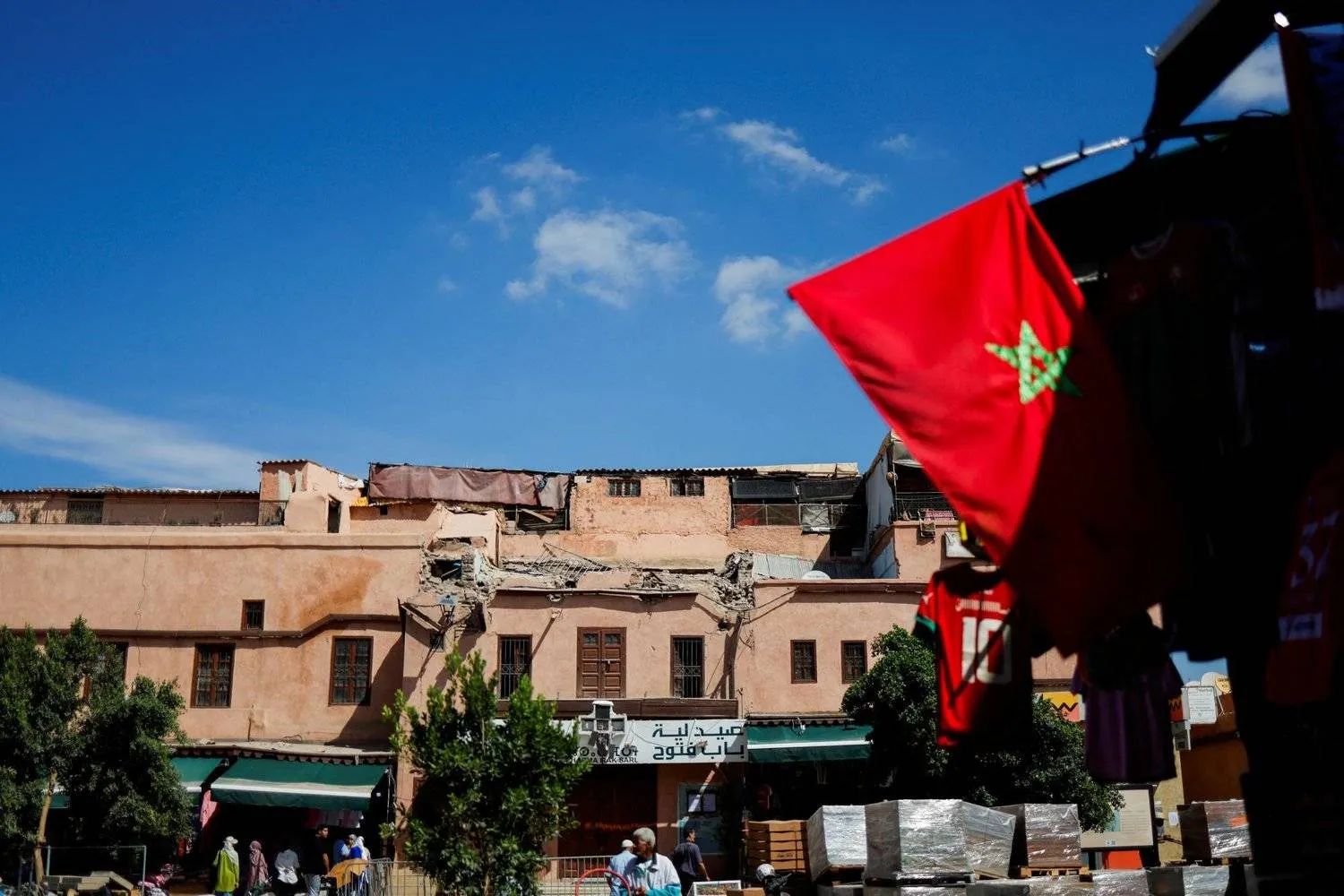
Building Collapse Kills 11 People in Morocco's Fez

The Moroccan flag is seen in front of a destroyed building following the devastating earthquake in Marrakesh last month. (Reuters)
TT

Building Collapse Kills 11 People in Morocco's Fez

The Moroccan flag is seen in front of a destroyed building following the devastating earthquake in Marrakesh last month. (Reuters)

Eleven people were killed and six others injured when a four-storey building collapsed overnight in the Moroccan city of Fez, about 200 kilometres (124 miles) east of Rabat, state-owned broadcaster 2M said on Thursday.

Authorities said a search for others who might still be buried was ongoing. Media showed footage of rescuers and residents digging through the rubble, Reuters reported.

An investigation has been launched into the incident, and residents of adjacent buildings were asked to evacuate as a precaution against potential further collapses, authorities said.

Fez, a former capital dating back to the eighth century and the country's third-most-populous city, has seen similar incidents in recent months, including one in December when two buildings collapsed, killing at least 22 people.

In 2010, the collapse of a minaret in the historic northern city of Meknes killed 41 people.

Adib Ben Ibrahim, housing secretary of state, said last year that approximately 38,800 buildings across the country had been classified as being at risk of collapse.


Berri Puts War’s End in Washington’s Hands, Links Army Deployment to Israeli Withdrawal

Parliament Speaker Nabih Berri receives a delegation from the American Task Force on Lebanon (ATFL) (Parliament Speaker’s Office)
TT

Berri Puts War’s End in Washington’s Hands, Links Army Deployment to Israeli Withdrawal

Parliament Speaker Nabih Berri receives a delegation from the American Task Force on Lebanon (ATFL) (Parliament Speaker’s Office)

Lebanese efforts are continuing on several fronts to advance negotiations and implement the “Framework Agreement,” as Parliament Speaker Nabih Berri tied the immediate deployment of the Lebanese army south of the Litani River to an end to Israel’s war, a ceasefire and an Israeli withdrawal to the international border.

Berri said only the United States and President Donald Trump could compel Israel to take those steps.

His remarks come as Israeli escalation continues in southern Lebanon, while uncertainty persists over the eighth round of Lebanese-Israeli negotiations, with no official date set.

Berri: The Army should be the sole security force

Berri made the comments during a meeting with a delegation from the American Task Force on Lebanon (ATFL), headed by Ambassador Edward Gabriel.

The talks covered political and field developments, Israel’s continued military operations and destruction of southern villages, as well as direct negotiations and the “Framework Agreement,” according to a statement from the parliament speaker’s office.

Berri said what was happening in the south was “unbearable,” citing the destruction of villages, attacks on civilians and violations of international and humanitarian laws and norms.

He said some of the destruction and attacks had surpassed “the crimes and massacres against people, buildings and heritage that have occurred and continue to occur in Gaza.”

Berri said the United States was the only country capable of ending the situation.

“The United States is the only country, and its president, Donald Trump, is the only president capable of compelling Israel to end its war, cease fire and withdraw to the international border in the south,” he said.

Berri, whom Hezbollah had previously tasked with negotiating on its behalf, linked those steps to Lebanon assuming security responsibility in the south.

“At that point, I guarantee the immediate deployment of the Lebanese army in the area south of the Litani,” he said.

He said the army should be the sole force responsible for security and the only armed force in the area.

Berri also said the area south of the Litani belonged to its residents, adding that southerners were eager to see the army protect their security and stability.

Ali al-Taher and US pressure

Gabriel described the meeting as “very good,” saying talks covered reform, Lebanon’s security situation and developments in the south, particularly the direct negotiations and the Framework Agreement.

He said the delegation saw strong interest from Berri in making progress on the “pilot zones” and a personal commitment to their success.

On the Ali al-Taher hill, Gabriel said Israel needed to make clear whether it accepted Lebanese army control of the position.

He said people in the south did not want war and wanted to return home, adding that he would convey Berri’s views to US policymakers.

Asked about US pressure on Israel, Gabriel said Trump was working very hard to push the Israelis to stop the death and destruction.

He said Trump had told the Israelis, “Enough, enough”, adding that he expected Washington to keep pressing Israel to end the war.

Eighth round: Tentative timing, low expectations

The timing of the eighth round of Lebanese-Israeli negotiations remains unclear.

Ministerial sources told Asharq Al-Awsat that a date under discussion for early September “remains tentative” and that official invitations have not yet been sent. They said invitations could be issued in the coming days.

The sources said Lebanon would attend any negotiating meeting but voiced limited optimism about the next round, given the current political and military conditions and Israel’s escalating positions.

“There are no high expectations for the outcome of the negotiations, especially before the next Israeli elections in October,” the sources said.

Still, they said Lebanon hoped the talks would produce positive results.

They said Israel’s positions were “clear and concerning to Lebanon” and that Washington needed “to exert pressure to deter Israel.”

Lebanon’s diplomatic outreach has taken on added importance in that context, including President Joseph Aoun’s visit to Rome.

Ministerial sources said the visit has two main objectives.

The first is to meet Pope Leo XIV and brief him on the latest developments surrounding the Framework Agreement, particularly the role he could play in supporting the political track.

The second is to meet with Italian President Sergio Mattarella and Prime Minister Giorgia Meloni to discuss what will follow the end of UNIFIL’s mandate if the international force cannot be extended.

The sources said the issue is linked to an earlier French-Italian initiative proposing that international forces could take on security responsibilities in the south if UNIFIL’s mandate is not renewed at the end of this year.


Ghalibaf Discusses Iranian Plan in Baghdad to ‘Hide’ Faction Weapons

This handout photograph taken and released by the Iraqi Prime Minister's Media Office on August 19, 2026 shows Iran's Parliament Speaker Mohammad Bagher Ghalibaf (L) and Iraq's Prime Minister Ali al-Zaidi during their meeting in Baghdad. (Photo by Iraq's Prime Minister Media Office / AFP)
TT

Ghalibaf Discusses Iranian Plan in Baghdad to ‘Hide’ Faction Weapons

This handout photograph taken and released by the Iraqi Prime Minister's Media Office on August 19, 2026 shows Iran's Parliament Speaker Mohammad Bagher Ghalibaf (L) and Iraq's Prime Minister Ali al-Zaidi during their meeting in Baghdad. (Photo by Iraq's Prime Minister Media Office / AFP)

Iran is pushing proposals to avert a confrontation between Iraq’s government and Tehran-aligned armed factions over their weapons, with Parliament Speaker Mohammad Bagher Ghalibaf taking the effort to Baghdad ahead of a Sept. 30 disarmament deadline.

Iraqi sources said Ghalibaf’s visit to Baghdad on Wednesday goes well beyond its stated parliamentary purpose, with talks focused on political and security issues — chiefly the fate of armed factions’ weapons as the deadline to bring all arms under state control approaches.

The sources said Ghalibaf was carrying Iranian proposals aimed at averting a direct confrontation between the Iraqi government and Tehran-aligned factions.

The ideas include “freezing” or concealing heavy weapons and possibly transferring a large portion of them temporarily to Iran until a political settlement is reached over the future of the factions’ arsenals.

The details of the proposals could not be independently verified, and neither Tehran nor the Iraqi government has announced them publicly.

An Iraqi government source, who asked not to be identified, said the government was “determined to respect its deadlines” and bring weapons under state control by the end of September, coinciding with the completion of the withdrawal of US forces from Iraq under a timetable agreed by Baghdad and Washington.

The Iraqi government has said Sept. 30 marks the end of the timeline for implementing its weapons-control plan.

The government source said the position was reaffirmed during meetings held by Prime Minister Ali al-Zaidi after his return from Washington, and at the latest meeting of the State Administration Coalition, which backed efforts to bring weapons under state control.

The coalition had previously voiced support for the plan, while the government has taken practical steps including forming a committee to oversee disengagement and integration, creating a weapons database and closing fictitious offices linked to the Popular Mobilization Forces.

Pressure builds with armed factions

Ghalibaf’s visit comes as tensions rise between the government and some armed factions, particularly Kataib Hezbollah, which has rejected handing over what it calls “resistance weapons.”

The government source said the authorities would not be drawn into “wars of words” or “ill-considered confrontations” and would press ahead with enforcing the constitution and the law.

He said the increasingly sharp tone of some faction statements, along with videos and remarks seen as inciting or threatening the prime minister, showed the pressure building around the weapons-control plan.

Statements by Kataib Hezbollah have stirred debate within political circles and among the factions themselves, particularly over the language used against al-Zaidi.

Media outlets and social media platforms have also carried statements and videos containing direct threats or warnings to the prime minister, including the phrase “don’t play with the big boys,” attributed to a local official in Babil province, according to the sources.

The government source said al-Zaidi’s refusal to respond in kind, coupled with his insistence on sticking to the timetable, had put Shiite forces within the Coordination Framework in a difficult position.

They now face, he said, regional and international support for the prime minister on one side and political pressure and corruption cases involving some figures linked to them on the other.

The source said some leaders affected by those cases had left the country, while others had disappeared from public view, prompting factions within the Coordination Framework to look for a settlement that could prevent an inter-Shiite confrontation.

“Freeze,” hide or move the weapons

A well-informed political source told Asharq Al-Awsat that one option under discussion was to extend the deadline implicitly without making a formal announcement.

Under that approach, the prime minister would be persuaded that progress had been made in bringing weapons under state control, while the continued possession of arms by two or more factions whose leaders had their own “convictions and conditions” could be handled through dialogue rather than armed confrontation.

The source said those backing the proposal feared a clash between the government and Shiite factions. But al-Zaidi, he added, remained committed to enforcing the law and was relying on judicial support for the weapons-control effort.

According to the source, the prime minister believes any retreat from the deadline or from the substance of the plan would leave him a prime minister “stripped of authority.”

He believes some faction statements have sought to reinforce that image by questioning his political legitimacy, describing him as still merely “designated” to form a government and criticizing his young age.

The government says the plan is rooted in its ministerial program, which calls for bringing weapons under state control, enforcing the rule of law, unifying security decision-making and placing military resources and capabilities within the official state system.

The political source said one version of the proposal Ghalibaf is believed to be discussing with the factions, al-Zaidi and some Coordination Framework leaders would “freeze” or “conceal” the factions’ heavy weapons.

It would also raise the possibility of moving a large portion of those weapons to Iran as a “deposit” until talks are completed.

The source said the idea was designed to offer a face-saving way out for factions that regard the weapons as “Shiite weapons” that cannot be negotiated away, while allowing them to avoid a complete break with the prime minister and the Shiite forces backing him, as well as Sunni and Kurdish forces that support bringing weapons under state control.

Why Ghalibaf matters

Ghalibaf’s visit carries added weight because of his position within Iran’s political establishment and is not confined to parliamentary ties.

He arrived in Baghdad at the head of a parliamentary delegation but has since held meetings and conducted activities with a wider political and security dimension.

The way he was received at Baghdad airport also carried political significance, according to the sources.

Adnan Fayhan, first deputy speaker of parliament and a senior figure in the Asaib Ahl al-Haq movement, received Ghalibaf instead of Parliament Speaker Haibat al-Halbousi.

In his remarks in Baghdad, Ghalibaf openly acknowledged the political and regional dimension of the visit.

He said the “resistance” in Iraq had become a fundamental element of the country’s strength and that ties between Baghdad and Tehran were moving toward consolidating a “new regional order” free from foreign interference.

Ghalibaf said the visit aimed to strengthen cooperation among countries in the region and to build new security and regional arrangements.

His remarks align with a broader Iranian view of the role armed factions play in regional security calculations.

Tehran’s recent moves suggest the factions’ weapons have become part of a wider discussion between Iran and Iraqi political forces, rather than simply an internal dispute over enforcing a government decision.

Ghalibaf’s visit was preceded by an unannounced trip to Baghdad by Esmail Qaani, commander of the Quds Force of Iran’s Revolutionary Guards, whose meetings covered the factions’ weapons and regional developments, according to Iraqi sources.


Israel Army Chief Vows in Syria to Deter Threats to Border

Eyal Zamir and Israeli troops during a visit to an Israeli-occupied security zone in southern Syria. (Israeli army)
TT

Israel Army Chief Vows in Syria to Deter Threats to Border

Eyal Zamir and Israeli troops during a visit to an Israeli-occupied security zone in southern Syria. (Israeli army)

Israel's army chief said Wednesday during a visit to an Israeli-occupied security zone in southern Syria that the military would not allow threats to "establish themselves" on the border.

"We are monitoring the changes on the Syrian front. We will not allow hostile forces to establish themselves on our borders, and we will know how to use our operational capabilities precisely where and when needed," Lieutenant General Eyal Zamir told troops.

Israeli forces have been stationed in a security zone in southern Syria since the fall of the Assad regime in December 2024, occupying what was previously a buffer zone patrolled by the United Nations that had separated Israeli and Syrian forces in the Israeli-occupied Golan since 1974.

The top general said the army cannot afford to let down its guard on any of Israel's active war fronts, including Syria.

"We are still in a multi-front war, alert and operating in all arenas -- escalation can develop in any one of them, and we must remain in constant readiness."

Zamir's visit came one day after Israel bombed the Abu al-Duhur air base in Idlib province in northwestern Syria, accusing Damascus of violating an agreement by accepting Turkish troops on it.

"Israel repeatedly warned Syria that such a deployment would pose a threat to Israel's security. Syria chose to ignore these warnings," said a statement by the Office of Prime Minister Benjamin Netanyahu, which stopped short of acknowledging Israeli responsibility.

Türkiye, which has had tense relations with Israel in recent years, rejected the allegations, while the US ambassador to Türkiye Tom Barrack condemned the strikes, saying they constituted an "unnecessary escalation."

Syria's foreign ministry condemned "in the strongest terms the Israeli airstrikes" targeting the base, calling them "an unjustified act of aggression" and urging action by the UN Security Council.

The attacks come as Syria "has exercised restraint and worked to consolidate stability and avoid escalation", it added.

Despite tensions between the neighbors, Israel and Syria's new authorities have held several rounds of direct talks and have agreed to establish an intelligence-sharing mechanism.

But last week Israeli Defense Minister Israel Katz said that his country planned to keep troops in Syria.

Israel captured most of the Golan from Syria in the 1967 Arab-Israeli War and later annexed the areas under its control, in a move not recognized by the international community except for the United States and Colombia.