Syria Signs Deal with CMA CGM to Operate Two Dry Ports, State Media Says

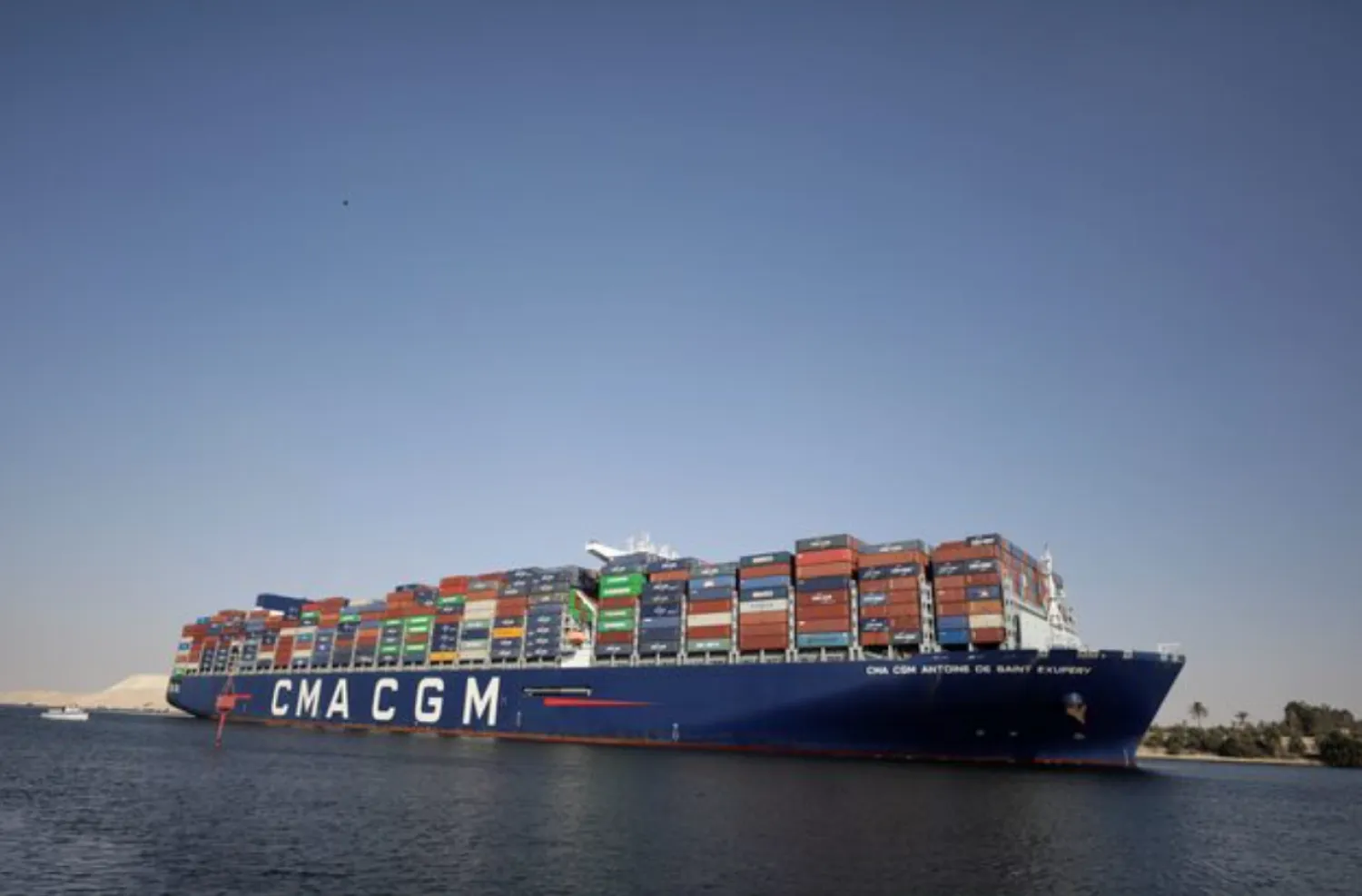
A shipping container belonging to CMA CGM passes through the Suez Canal in Ismailia, Egypt October 5, 2021. REUTERS/Mohamed Abd El Ghany
TT

Syria Signs Deal with CMA CGM to Operate Two Dry Ports, State Media Says

A shipping container belonging to CMA CGM passes through the Suez Canal in Ismailia, Egypt October 5, 2021. REUTERS/Mohamed Abd El Ghany

Syria's General Authority for Borders and Customs has signed an agreement with French shipping and logistics group CMA CGM to operate two dry ports within the free zones of Adra, in Damascus' outskirts, and Aleppo, Syrian state news agency SANA reported on Tuesday.

The deal covers the management and operation of the dry ports to support logistics and trade. It coincided with the launch of a trial freight train linking Latakia port, which is Syria’s principal maritime access point, to Adra after a 14-year halt due to the Syrian civil war.

CMA CGM was not immediately available for comment.

The agreement follows a separate deal signed in May 2025 under which CMA CGM secured a 30-year contract to modernise and operate Latakia port. Chief Executive Rodolphe Saadé, a Franco-Lebanese of Syrian origin, has family roots in the country.

On May 11, the European Union restored the full application of its 1977 cooperation agreement with Syria, ending a partial suspension imposed in 2011 over human rights violations under Bashar al-Assad.

The move follows Assad's fall in December 2024 and the lifting of most EU economic sanctions in 2025, and is intended to support Syria's economic recovery and signal renewed EU engagement with the country.


Türkiye Denies Military Presence at Abu al-Duhur Airbase Before or During Israeli Strike

A satellite image shows craters on the runways of the Abu al-Duhur airbase near Syria's Aleppo after an Israeli attack, August 19, 2026. (Pleiades Neo © Airbus DS 2026/Handout via Reuters)
TT

Türkiye Denies Military Presence at Abu al-Duhur Airbase Before or During Israeli Strike

A satellite image shows craters on the runways of the Abu al-Duhur airbase near Syria's Aleppo after an Israeli attack, August 19, 2026. (Pleiades Neo © Airbus DS 2026/Handout via Reuters)

Türkiye has reaffirmed its support for Syria’s efforts to develop its military capabilities and infrastructure and preserve its unity and sovereignty, while denying that any Turkish delegation was present at the Abu al-Duhur military airbase before or during Tuesday’s Israeli strike.

A Turkish Defense Ministry official described the attack as an attempt to destabilize Syria, undermine its security, unity and territorial integrity, and damage its infrastructure.

Speaking at the ministry’s weekly briefing Thursday, the official said any attack violating Syria’s sovereignty and territorial integrity was unacceptable, stressing that no Turkish military delegation had been at the base before or during the strike.

The official urged Israel to halt such “reckless” attacks and abide by international law, adding that Türkiye would continue to support Syria in building its military capabilities and infrastructure under the principle of “one state, one army.”

Israeli Prime Minister Benjamin Netanyahu’s office said after the strike that Israel had warned Syria against allowing a Turkish presence at Abu al-Duhur.

“Our message was very clear: Don’t do it,” it said, adding that Damascus had ignored the warning.

The Turkish presidency rejected the allegations as “baseless,” accusing Netanyahu of promoting them ahead of Israel’s October elections and calling on the international community to curb Israeli actions threatening regional peace and stability.

Syrian Foreign Minister Asaad al-Shaibani told Axios that Damascus had previously informed Israel there were no plans to establish a Turkish military base at Abu al-Duhur, which was being rehabilitated for use by the Syrian Air Force.

Al-Shaibani said Turkish military personnel had previously visited the airbase as part of broader training and military cooperation, but denied any Turkish buildup there. The facility was largely empty and work had not yet begun, he added.

There was no intention to establish a Turkish base, permanent Turkish military presence or deploy Turkish troops there, al-Shaibani underlined, saying Israel had no legitimate justification for bombing the facility.

He stressed that Syria remained open to negotiations with Israel on de-escalation, provided any agreement addressed both sides’ security concerns and respected Syrian sovereignty.

Türkiye-Israel relations have grown increasingly strained since Israel’s 2010 raid on the Mavi Marmara, part of the Gaza-bound Freedom Flotilla. US mediation later helped repair ties, culminating in a meeting between Turkish President Recep Tayyip Erdogan and Netanyahu in New York on September 19, 2023.

Relations deteriorated sharply after the Gaza war erupted on October 7, 2023. Ankara has accused Israel of committing “genocide” in Gaza and suspended trade.

The rivalry intensified in Syria after Bashar al-Assad’s fall in December 2024 and Türkiye strengthened political, economic, defense and security ties with President Ahmed al-Sharaa’s government.

Israel, concerned about Türkiye’s military presence in Syria, previously struck the Hama military airport, claiming Ankara planned Turkish air and ground bases at Palmyra, the T4 military airbase in Homs province and the Menagh military airbase in the Aleppo province.


Experts to Asharq Al-Awsat: Expanded Yemeni Army Deterrence Operations Pave Way for Wider Battle

Yemeni Defense Minister Lt. Gen. Taher al-Aqili during a meeting with military commanders in Marib. (SABA)
TT

Experts to Asharq Al-Awsat: Expanded Yemeni Army Deterrence Operations Pave Way for Wider Battle

Yemeni Defense Minister Lt. Gen. Taher al-Aqili during a meeting with military commanders in Marib. (SABA)

Military escalation in Yemen is entering a new phase after the National Defense Council ordered an expansion of air and missile deterrence operations against the Houthis, a move military experts say lays the groundwork for shifting from repelling attacks to striking their sources.

Experts told Asharq Al-Awsat that the deployment of government drones marks a significant change in the balance of power. They believe government forces may possess more advanced drones that have yet to be deployed, while cautioning that the confrontation remains tied to regional tensions and calculations in Iran and the United States.

From defense to preemptive strikes

Brig. Gen. Yasser Saleh, a Yemeni military and strategic expert, said the National Defense Council’s directive aims to neutralize Houthi missile and drone capabilities amid the group’s continued escalation on battlefronts and attacks on vital facilities and infrastructure.

Government operations initially focused on repelling attacks because forces lacked sufficient air defense systems to intercept missiles and drones, Saleh explained.

Raising the level of deterrence would mean conducting preemptive strikes against launch sites and other sources of fire, reducing the Houthis’ ability to mount further attacks, he added.

Saleh described the deployment of government drones as a major development because ground forces require close air support. Drones can conduct reconnaissance, identify targets and strike enemy movements, potentially becoming a key asset if developments lead to a decisive battle.

Government forces are currently using small loitering drones and others capable of dropping munitions, while they are believed to possess more advanced aircraft capable of carrying guided missiles, flying longer distances and striking targets deep inside Houthi-held territory, he said.

Unifying government forces would also allow simultaneous operations on multiple fronts, preventing the Houthis from choosing the time and place of battle or concentrating their forces on a single axis, Saleh went on to say.

Possible offensive

Brig. Gen. Mohammed Al-Kumaim, a Yemeni military expert, said expanded deterrence operations could pave the way for the use of strategic-range drones alongside advanced rocket launchers with ranges of 40 to 60 kilometers.

Potential targets could include command, control and communications centers, supply and reinforcement routes, and missile and drone launch sites.

Al-Kumaim described heavy fire against forward Houthi positions as “preparatory fire” that typically precedes offensive operations, particularly as the group continues to mass forces across several fronts.

He called the deployment of drones a “qualitative shift,” although those seen so far have limited range and capabilities.

Government forces are believed to possess other systems that have yet to enter combat, including the Naqam, Ayban and Shaheen, as well as specialized units trained to operate them.

Al-Kumaim said government forces are better organized than they were in 2022, with a unified operations room and stronger coordination among military fronts and formations.

Rebuilding deterrence

Political and military expert Abdul Wahab Buhaibeh said the council’s directives shift government forces from reacting to Houthi attacks toward seizing the initiative.

He expects longer-range drones to be deployed for reconnaissance, intelligence gathering, artillery and missile fire correction, as well as direct strikes.

The directives also include heightened readiness, stronger early-warning capabilities, intensified intelligence operations and tighter security and maritime measures to track weapons-smuggling routes to the Houthis, alongside preparations for possible ground operations.

Buhaibeh described the approach as a multidimensional strategy combining air and missile operations with security, intelligence and maritime efforts to rebuild deterrence after years in which the Houthis benefited from their relative superiority in missiles and drones and divisions among their opponents.

Yemen and the regional conflict

The experts agreed that Yemen’s escalation cannot be separated from the broader regional conflict.

Saleh said Tehran could push its allies to widen the confrontation if fighting with Washington resumes, while Buhaibeh warned that continued Houthi control of Hodeidah and the Red Sea coast gives Iran leverage over international shipping.

Speaking to AFP, Yemen’s information minister had warned of a Houthi plan to seize coastal areas near the Bab el-Mandeb Strait.

Three Houthi military sources and a spokesman for government forces stationed near the strait also told the agency that the group was planning to advance toward those areas.

Saleh said mounting domestic pressure on the Houthis, combined with regional tensions, could lead to a broader confrontation and potentially pave the way for what he called a “battle of liberation.”

Al-Kumaim, meanwhile, stressed the need for a decisive move before Yemen’s crisis again becomes part of potential US-Iran arrangements, saying the situation is heading toward further escalation but remains dependent on regional and international developments.


US Hits Hezbollah with Fresh Sanctions, Says Iran Controls it

FILE PHOTO: A general view of the US Department Of The Treasury on day two of a partial government shutdown in Washington, D.C., US, February 1, 2026. REUTERS/Ken Cedeno/File Photo
TT

US Hits Hezbollah with Fresh Sanctions, Says Iran Controls it

FILE PHOTO: A general view of the US Department Of The Treasury on day two of a partial government shutdown in Washington, D.C., US, February 1, 2026. REUTERS/Ken Cedeno/File Photo

The United States announced new sanctions Thursday against a Hezbollah financing network, while highlighting the Lebanese armed group's close ties to Iran's Revolutionary Guards.

Hezbollah's legal designation as a terrorist organization has been amended to note that it operates in "service to the Iranian regime under the command of Iran's Islamic Revolutionary Guard Corps," particularly the elite Quds Force, the Treasury Department said in a statement.

The new redesignation "specifies that Hezbollah is an Iranian proxy, not a stand-alone operation as implied by the previous designation," a State Department official said.

"This underscores that Hezbollah operates with little to no regard for Lebanese sovereignty, the Lebanese people, or the Lebanese state."

Hezbollah drew Lebanon into the broader Middle East war in March with rocket fire at Israel in support of its backer Iran.

Israel responded with a heavy air campaign and ground invasion that Lebanese authorities say have killed more than 4,300 people.

"This action builds on years of US designations that have repeatedly documented the operational, financial, and logistical integration between Hezbollah and the IRGC-QF," the State Department official said, calling Hezbollah "an extension" of the latter.

"It is not a Lebanese resistance movement," as Hezbollah describes itself, the official said.

The new sanctions target 10 people who are allegedly part of a network that transfers cash to Hezbollah, which has already been punished with US sanctions many times, the Treasury statement said.

The network utilizes couriers travelling on commercial airline flights “to move up to hundreds of millions of dollars between jurisdictions, providing an avenue outside the formal financial system for Hezbollah to obtain foreign currency and evade sanctions," the statement said.

US Treasury Secretary Scott Bessent said earlier on Thursday that he would hold a press conference on Monday about "the toughest sanctions in history" that Washington plans to impose on Iran.

He said that a plan to sharply increase pain from economic sanctions on Iran aims to "collapse" the country's government.

"It is going to work in Iran and we are going to collapse this regime," he told CNBC. "This is going to be the greatest coordinated economic isolation in the history of the world."