


Xi Hails ‘Unbreakable’ Pakistan Ties, Praises Role in Iran Peace Efforts

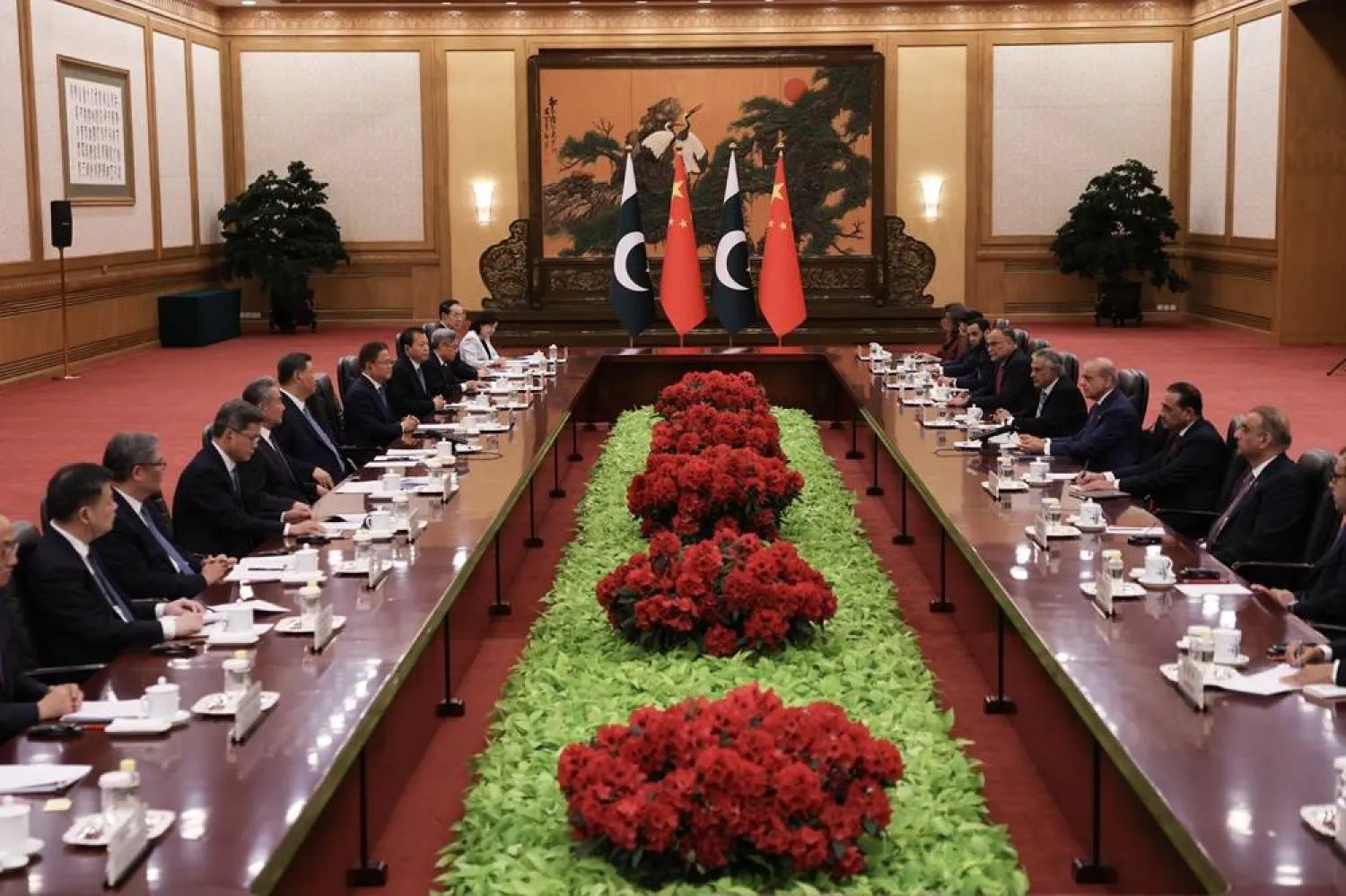
Chinese President Xi Jinping (6-L) and Pakistan's Prime Minister Shehbaz Sharif (4-R) attend a meeting at the Great Hall of the People in Beijing, China, 25 May 2026. (Pool/EPA)
TT

Xi Hails ‘Unbreakable’ Pakistan Ties, Praises Role in Iran Peace Efforts

Chinese President Xi Jinping (6-L) and Pakistan's Prime Minister Shehbaz Sharif (4-R) attend a meeting at the Great Hall of the People in Beijing, China, 25 May 2026. (Pool/EPA)

China's President Xi Jinping hailed Beijing's "unbreakable" friendship with Pakistan on Monday as he met visiting Prime Minister Shehbaz Sharif, seeking to deepen their "all-weather" partnership. 

Pakistan is among an exclusive group of countries China regards as an "all-weather strategic partner," with ties featuring close economic, trade and security cooperation. But repeated extremist attacks on Chinese nationals and projects in the South Asian country have emerged as ‌an irritant, while ‌Islamabad's warming ties with Washington have added complexity ‌to ⁠its ties with ⁠Beijing. 

Greeting Sharif at Beijing's Great Hall of the People, Xi called the Pakistani leader an "old friend" and said the two countries had "understood, trusted and supported each other" over decades, forging an "unbreakable traditional friendship." 

"No matter how the international situation changes, China always prioritises the development of China-Pakistan relations in its neighbourhood diplomacy," Xi said. 

LET'S WORK TOGETHER 

Beijing was ⁠willing to work with Islamabad to build a ‌more close-knit China-Pakistan community with a ‌shared future and achieve more in their "all-weather" cooperation, Xi added. 

Sharif, in turn, ‌called China and Pakistan two "iron brother" countries with a relationship that ‌is "next to none". 

He was accompanied at Monday's meeting by Pakistan's Army chief, Asim Munir, who was recently in Tehran for meetings with the Iranian leadership. 

Following a rickety ceasefire in the Iran conflict, achieved in April, Pakistan ‌hosted mediation talks in Islamabad between Washington and Tehran, relaying proposals and missives between the warring countries ⁠even when ⁠tensions escalated. 

Weeks into Islamabad's diplomatic efforts, Washington has reported progress in negotiations with Tehran. 

"I know that you have just returned from Iran and made positive efforts for the current peace. We still appreciate the constructive role played by Pakistan," Xi said. 

For Pakistan, engaging China in its mediation efforts is important given Beijing and Tehran's close ties. 

China and Pakistan issued a five-point initiative in March as their foreign ministers met in Beijing, calling for peace talks and restoration of normal navigation in the Strait of Hormuz, the vital waterway through which roughly a fifth of the world's oil and liquefied natural gas normally passes. 


Obama Doubts Trump-Iran Deal Will Make Improvement Over His 2015 Pact

President Obama meets with President-elect Donald Trump in the Oval Office of the White House in Washington, November 2016 (AP) 
TT

Obama Doubts Trump-Iran Deal Will Make Improvement Over His 2015 Pact

President Obama meets with President-elect Donald Trump in the Oval Office of the White House in Washington, November 2016 (AP) 

Former US President Barack Obama said it was unrealistic to expect that any deal between US President Donald Trump and Tehran would mark a “significant improvement” over his own nuclear pact 11 years ago.

In interview excerpts released Sunday on ABC News talk show “This Week,” the former President also suggested it was better to negotiate a deal that falls short of all of Washington's requirements in order to avoid an outright war.

“It is doubtful that any agreement that arises is going to be significantly different or a significant improvement from the deal that we had in the first place,” Obama said, referring to 2015's landmark pact that Trump abandoned, according to AFP.

Obama added that his own deal “had worked for a long stretch of time before... the United States pulled out of it.”

US and Israeli forces sparked the Middle East war in late February when they launched strikes against Iran. For months, Trump has bandied about a potential peace deal with the Iranian republic.

The US President has stressed the deal would forever block Iran's ability to produce a nuclear weapon and would lead to the immediate opening of the blockaded Strait of Hormuz.

According to Obama, the troubled progress of a new US-Iran deal is a reminder that Washington can not “just bully our way or bomb our way to solutions” instead of engaging in comprehensive diplomacy.

“You'd think we would have learned that lesson by now,” Obama said.

On Monday, US and Iranian officials said they had agreed on a framework to end their war, halt the US blockade of Iran and reopen the Strait of Hormuz, a preliminary pact that sent oil prices falling but leaves the fate of Iran's nuclear program to further negotiations.

“The Deal with the Islamic Republic of Iran is now complete,” Trump wrote on his Truth Social platform around ‌5:30 pm ET local time in Washington (2130 GMT) on Sunday. His post came shortly after Pakistani Prime Minister Shehbaz Sharif, whose country has served as a mediator, announced a deal had been struck early on Monday local time, according to Reuters.

The memorandum of understanding is scheduled to be officially signed on Friday in Switzerland.

Before the deal was announced, a senior Iranian official told Reuters that, ⁠under the terms of the draft, the US would agree to release $25 billion of frozen Iranian assets. The Trump administration has previously said any release of Iranian money would only take place once Iran has fulfilled certain conditions under a peace deal.

A US official, also speaking before the announcement, said the agreement would ultimately lead to the dismantling of Iran's nuclear program, with its stockpile of highly enriched uranium to be destroyed and removed. The senior Iranian official said the draft deal would allow Iran, which denies seeking a nuclear bomb, to dilute its enriched uranium inside the country.


Trump Turns 80 with Cage Fight, Iran Deal

 Mauricio Ruffy celebrates after winning his fight against Michael Chandler at UFC Freedom 250 on the South Lawn of the White House, Sunday, June 14, 2026, in Washington. (AP)
Mauricio Ruffy celebrates after winning his fight against Michael Chandler at UFC Freedom 250 on the South Lawn of the White House, Sunday, June 14, 2026, in Washington. (AP)
TT

Trump Turns 80 with Cage Fight, Iran Deal

 Mauricio Ruffy celebrates after winning his fight against Michael Chandler at UFC Freedom 250 on the South Lawn of the White House, Sunday, June 14, 2026, in Washington. (AP)
Mauricio Ruffy celebrates after winning his fight against Michael Chandler at UFC Freedom 250 on the South Lawn of the White House, Sunday, June 14, 2026, in Washington. (AP)

US President Donald Trump celebrated his 80th birthday with an extraordinary display of political machismo Sunday, staging a cage fight on the White House lawn hours after announcing a peace deal with Iran.

In unprecedented scenes, Trump walked out of the Oval Office alongside Ultimate Fighting Championship (UFC) boss Dana White and headed towards the giant arena dubbed "The Claw."

On the way, the reality TV star-turned-president mounted the historic Truman balcony and saluted while the national anthem and 12 US military jets staged a noisy flyover of the White House.

Trump then took his place on the South Lawn, beside the mesh-fenced cage called the Octagon where 14 fighters will beat each other bloody in the first professional sporting event ever held at the White House.

He was cageside as the first fighter, Brazil's Diego Lopes, won by a knockout.

The icing on the cake for the birthday festivities of the oldest US president ever to take office had come earlier as he said a peace deal with Iran was now "complete."

But there could still be rain on Trump's parade, with thunderstorms over Washington causing at least one delay to the $60 million mixed martial arts tournament.

The "UFC Freedom 250" event is linked to this year's festivities for the 250th anniversary of US independence -- but it also happens to fall not only on the US public holiday of Flag Day, but on the same day that Trump enters his ninth decade.

- 'Bit of selfishness' -

Critics have derided the cage fight, saying it is a tacky debasement of the White House by a president who has repeatedly shattered norms during his time in power.

Billionaire Trump has also faced criticism for staging the event amid a war with Iran that has sent global energy prices soaring and caused a major knock-on effect for US consumers.

But fans gathered to watch the extravaganza on a giant screen on the Ellipse outside the White House defended the event.

"I do think maybe it's like a little bit of selfishness, but he is the leader, so he has a say," Nyles Rife, a 35-year-old sports performance coach from Virginia, told AFP.

"If I was a president, if I were to have a UFC event on my birthday, and it fell on the 250th anniversary/Flag day, I'd do the same. Why not?"

Mark Toone, a 50-year-old US Marine Corps veteran, said the fight was "totally emblematic and representative of American culture."

"I think that it's unfortunate that the opposition is spreading lots of lies and untruths about this event," he said.

The billionaire president -- who has deep ties with a sport whose young male fans reflect his own political base -- has defended the UFC event as a unique spectacle.

"This is going to be an event you're really gonna like," Trump said as he hosted some of the muscle-bound fighters in the Oval Office in May.

The White House says the UFC is bearing the entire cost.

- 'Not a number I like' -

But there has also been criticism of the commercialization of the event in the home of American democracy, with sponsors having their logos emblazoned on the Octagon.

The fight is also being broadcast exclusively by Paramount, the US broadcaster run by Trump ally David Ellison.

The macho spectacle has meanwhile distracted from questions about Trump's health as he ages.

Trump loves to compare his virility to Democratic predecessor Joe Biden, who also turned 80 in office, but was forced to drop his bid for a second term after a disastrous debate with the Republican.

But from bruised hands to a vein condition in his legs and apparent sleepiness in meetings, Trump has also had a number of issues, even though his doctor says he's in excellent health.

Trump admitted that he was "not happy about that birthday that I'm having," in a video posted by one of his officials this week. "It's not a number I like, but I'm here nevertheless."

For his last birthday, Trump oversaw an unprecedented military parade in Washington, marking the 250th anniversary of the US army.


The Iranian Leaders Killed in Israeli-US War

Alireza Tangsiri is the latest top Iranian security official to be killed in the conflict. SEPAH NEWS/AFP
TT

The Iranian Leaders Killed in Israeli-US War

Alireza Tangsiri is the latest top Iranian security official to be killed in the conflict. SEPAH NEWS/AFP

Over the course of the US-Israeli war on Iran, waves of airstrikes killed an entire echelon of the Iranian republic's political and military elite, starting with supreme leader Ali Khamenei.

President Donald Trump had claimed in March that the campaign had achieved "regime change", but Iran showed resilience in rapidly replacing killed leaders and keeping up the war against the US and Israel.

With Washington and Tehran agreeing on a deal announced Monday to halt the conflict, here is a recap of some of the key figures killed in the war:

- Supreme leader Ali Khamenei -

Khamenei, Iran's number one since 1989, was killed in the first hour of the war on February 28 in a strike on a meeting of senior officials in Tehran that also left his daughter-in-law, daughter and at least one grandchild dead, according to reports.

His low-profile son Mojtaba survived -- although reportedly with injuries -- and took over as supreme leader. He has yet to make a public appearance.

Ali Khamenei has yet to be buried, with state media reporting on Saturday that his funeral will take place on July 9 in his hometown, the northeastern city of Mashhad, following three days of funeral ceremonies in Tehran and another in the holy city of Qom.

- Security chief Ali Larijani -

The killing of Larijani, who despite not being a cleric was a pillar of the system for decades, was likely the biggest loss to the Iranian republic after the death of Ali Khamenei.

Larijani was killed on March 17 in an Israeli strike, reportedly in the Tehran region and which also killed family members.

The previous week, he had defiantly walked in public in Tehran at a pro-government rally.

- Revolutionary Guards chief Mohammad Pakpour -

Pakpour, previously head of the Guards' ground forces, took over as commander-in-chief in June 2025 after his predecessor Hossein Salami was killed in Israel's 12-day war against Iran.

He was killed on the first day of the war and has been replaced by former interior and defense minister Ahmad Vahidi.

- Guards naval chief Alireza Tangsiri -

A veteran of the 1980-1988 Iran-Iraq war, Tangsiri was one of the longest-serving senior figures in the Revolutionary Guards as the head of its navy since 2018 and one of its highest-profile faces within the Iranian republic.

Israel's defense minister described him as the "man who was directly responsible for the terrorist operation of mining and blocking the Strait of Hormuz".

- Adviser Ali Shamkhani -

Shamkhani, a mainstay of the Iranian republic's armed forces since the 1980s, was killed in an airstrike on the first day of the war.

He was given a public funeral in Tehran's Tajrish Square.

He had been severely wounded, and initially reported dead, in a strike during Israel's June war against Iran but later re-emerged.

- Intelligence Minister Esmail Khatib -

A cleric, Khatib was killed by an Israeli strike in Tehran early on March 18.

As Iran's intelligence minister since 2021, he was accused by rights groups of playing a key role in the suppression of protests.

- Defense Minister Aziz Nasirzadeh -

A veteran of the Iran-Iraq war in the 1980s, Nasirzadeh had served as defense minister since 2024.

He was also killed in a strike on the first day of the war.

- Basij commander Gholamreza Soleimani -

Soleimani headed the Basij, a volunteer paramilitary group that is a branch of the Revolutionary Guards and notorious among rights groups for suppressing protests.

He was killed in an airstrike on March 17.

- Guards spokesman Ali Mohammad Naini -

Naini was killed in March in what the Guards described as a "cowardly" attack by the United States and Israel.

Just before his death was confirmed, the Fars news agency issued a statement quoting Naini as saying Iran's missile production deserved a "perfect score" and was continuing despite the war.

- Head of military office Mohammad Shirazi -

Killed on the opening day of the war, Shirazi had the crucial job of coordinating between the various branches of the Iranian security forces at the office of supreme leader.

- Armed forces chief Abdolrahim Mousavi -

Mousavi, killed on the first day of the war, had only taken up his post -- a senior position that coordinates between the Guards and the regular army -- in June 2025 following the death of his predecessor Mohammad Bagheri in the 12-day war.
