


US Strikes Iran, Drawing Retaliatory Attack on American Base

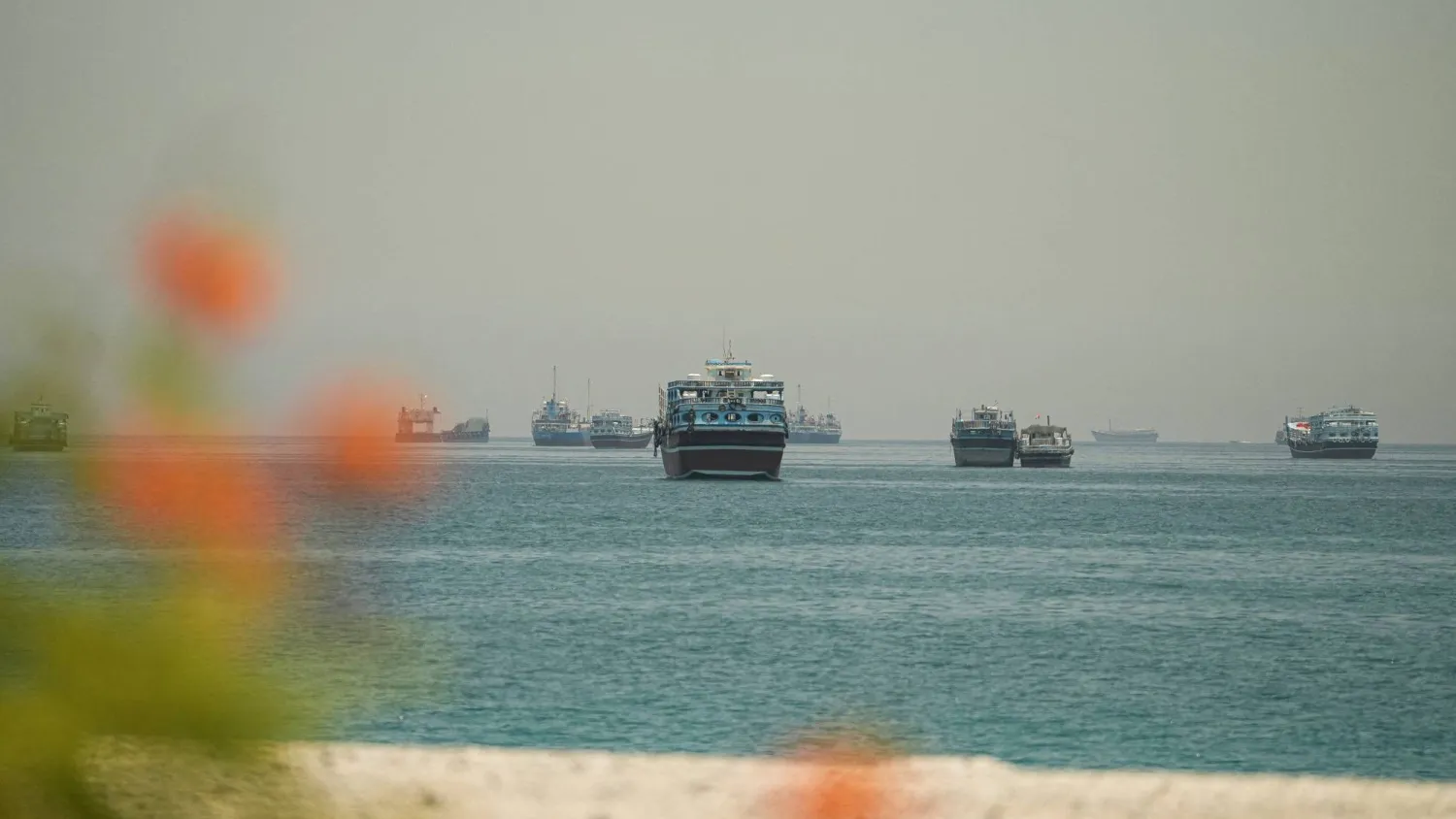
Vessels anchored at the Strait of Hormuz, as seen from Musandam, Oman, May 25, 2026. (Reuters).
TT

US Strikes Iran, Drawing Retaliatory Attack on American Base

Vessels anchored at the Strait of Hormuz, as seen from Musandam, Oman, May 25, 2026. (Reuters).

The United States struck southern Iran on Thursday, drawing retaliation from Tehran against a US military base, in the most serious clashes since an April ceasefire began.

The fighting threatened to jettison a fragile diplomatic push to forge a peace agreement and open the Strait of Hormuz, which has become a key point of contention in efforts to formally end the war.

The fresh fighting appeared to begin when Iranian forces fired at four ships attempting to cross the Strait, state broadcaster IRIB reported on Thursday.

US forces launched strikes that hit a ground control station in the southern port area of Bandar Abbas, a US official, speaking on condition of anonymity told AFP, prompting swift response by Iran.

"Following this morning's aggression by the invading US military against a location on the outskirts of Bandar Abbas Airport using aerial projectiles, the American air base that served as the source of the attack was targeted at 4:50 am (0120 GMT)," the Guards said, according to Iranian state broadcaster IRIB.

The Guards did not provide details on the location of the base, though Kuwait's military said its air defenses were responding to an "enemy" attack on Thursday.

The clashes threw into question talks aimed at formally ending the war that began on February 28 with US-Israeli strikes on Iran.

A key focus of the proposed deal has also been restoring full traffic to the Strait of Hormuz, which Tehran has effectively closed, leaving global energy markets grappling with curbed supplies of the huge amounts of oil and gas that normally pass through it.

Oil prices bounced higher on Thursday after reports of the strikes, reversing much of Wednesday's fall on the hopes of a possible imminent deal.

Fresh strikes were also reported in Lebanon, another front of the war.

Israel said it hit the southern city of Tyre, after warning it would take action against Iran-backed Hezbollah and declaring all areas south of the Zahrani River, which lies roughly 40 kilometers (25 miles) from the border, as "combat zones".

The United States Treasury also announced sanctions on Wednesday against Iran's Gulf Strait Authority, Tehran's new agency that collects fees for travelling through the Strait of Hormuz.

- Lebanon operations intensify -

Iran and the United States have traded threats for weeks while negotiating through Pakistani mediation.

Neither side appeared ready to compromise on the main sticking points: Hormuz and Iran's nuclear program.

On Wednesday, the Guards' navy said only ships "willing to abide by Iranian order" could pass through Hormuz.

US Secretary of State Marco Rubio said Tuesday that a deal remained within reach, but that the Hormuz would be reopened "one way or the other".

Iran has also insisted any peace accord must apply to Lebanon, where an April 17 ceasefire has done little to halt fighting between Israel and Hezbollah, which drew the country into the war by attacking Israel in early March in retaliation for the death of Iran's supreme leader.

Israeli Prime Minister Benjamin Netanyahu vowed Monday to "crush" Hezbollah, while army chief Lieutenant Colonel Eyal Zamir said Wednesday that Israel was "intensifying our operations" against the group.

After the warning to evacuate large areas in southern Lebanon, many residents fled to Tyre, according to AFP journalists -- the city subject to new Israeli evacuation orders and where the military said it had begun strikes against Hezbollah infrastructure on Thursday morning.

- 'Nothing is certain' -

In signs of a possible return to normality despite conflict around the region, Iranian authorities partially restored access to the global internet this week after a three-month shutdown.

"I do feel better now because I finally can use my favorite applications," said Hana, a 20-year-old student in Tehran who gave only her first name.

"At the same time, I have this concern that war might resume any minute and just cut me off again from my friends."

Amir, a 27-year-old software developer in the Iranian capital, also feared renewed fighting despite talk of a deal.

"I feel like nothing is certain yet," he said.

"The daily question is: Will there be missile strikes tonight?"


French Far-left Leader Demands 'Overhaul' of German Ties

Jean-Luc Melenchon, leader of the left-wing party La France Insoumise (LFI) and candidate for the 2027 French presidential election, delivers a speech during the Maritime Economy Conference (Les Assises de l'economie de la mer) in Montpellier, southern France, 25 November 2026. (EPA)
TT

French Far-left Leader Demands 'Overhaul' of German Ties

Jean-Luc Melenchon, leader of the left-wing party La France Insoumise (LFI) and candidate for the 2027 French presidential election, delivers a speech during the Maritime Economy Conference (Les Assises de l'economie de la mer) in Montpellier, southern France, 25 November 2026. (EPA)

French hard-left presidential candidate Jean-Luc Melenchon on Friday called for an "overhaul" of ties with Berlin, voicing stinging criticism of Germany's economic dominance in the EU and its record military spending.

The France Unbowed (LFI) party leader, who is polling in second place for April's election, told French broadcaster LCI during a Berlin visit that he sees a "need for a thorough overhaul of the French-German relationship".

"I am hostile to the liberal (economic) policy of German governments that dominates the European Union," the 75-year-old said ahead of the launch of the German edition of his latest book at Berlin's Babylon cinema.

Melenchon’s economic platform, which includes a proposal to cancel French debt held by the European Central Bank, is dramatically opposed to traditional German doctrines of tight budgets and low borrowing.

Melenchon -- currently the favorite to reach a run-off against far-right veteran Marine Le Pen -- has also railed against Chancellor Friedrich Merz's commitment to transform the German military into the "strongest conventional army in Europe".

"We have the duty to ask: to make war against whom?" he said Friday, warning that Paris could be drawn into unwanted conflict as Germany's growing military strength makes it a "target" for other countries.

Melenchon’s rivals have accused him of cozying up to President Vladimir Putin's Russia, with LFI's pledge to leave NATO a particular concern for many of France's allies amid the ongoing war in Ukraine.

The far-left party leader has been highly critical of Germany's position in the conflict, accusing Merz's government of saber-rattling.

"They need to tone it down, because all this one-upmanship leads nowhere," he said.

But Melenchon flatly denied charges he is "Germanophobic," calling himself a "sort of disciple of Karl Marx" and a lover of Beethoven.

He also expressed pride at the German translation of his latest book, published in English under the title "Now, the People! Revolution in the 21st Century".

The politician further touted his close ties with Germany's far-left Die Linke party, which finished first in Berlin's state election in September.

Melenchon met the party's national leader Ines Schwerdtner on Friday, saying the two were "united in mobilizing against an economy of rearmament and war".


Mossad and Israeli Military Chiefs at Odds Over Striking Iran

Mossad chief Roman Gofman and Israeli military Chief of Staff Eyal Zamir (Israeli military)
TT

Mossad and Israeli Military Chiefs at Odds Over Striking Iran

Mossad chief Roman Gofman and Israeli military Chief of Staff Eyal Zamir (Israeli military)

Israeli Mossad chief Roman Gofman and military Chief of Staff Eyal Zamir are at odds over whether to launch another strike against Iran. While Gofman supports a unilateral Israeli attack without US participation if no alternative remains, Zamir favors waiting for a decision from US President Donald Trump.

Israeli news website Ynet, in a report published jointly with Yedioth Ahronoth on Friday, said Gofman had adopted a more hawkish position during recent security discussions, amid concerns that Iran may be secretly continuing to develop chemical weapons.

According to senior officials familiar with his position, Gofman believes further delays in confronting the alleged Iranian chemical weapons threat could leave Israel facing an operational challenge that would be far more difficult to eliminate.

In Gofman's assessment, the mere emergence of such a threat makes it too risky to allow Iran to acquire these capabilities.

Security sources said Mossad and Israeli military intelligence, known as Aman, share the same intelligence assessments. Zamir also supports striking Iran but believes the threat is not yet imminent.

Zamir considers it preferable to await Trump's decision and act alongside the Americans, whose participation could provide a significant force multiplier and improve the chances of achieving a lasting strategic outcome.

A security source said the military's position is that Israel would attack without US involvement if an immediate existential threat emerged.

"But that is not the situation at present," the source added.

Reuters reported on November 18, citing two informed sources, that the Israeli military assesses Iran does not pose an imminent threat to Israel, meaning immediate military action is unnecessary.

Ynet explained that operational responsibility for any strike would ultimately fall to the Israeli military. The air force would carry out the main offensive operations, air defenses would respond to Iranian retaliation, and military intelligence would provide the information needed to sustain the campaign.

Disagreement Before the Elections

The differences between Gofman and Zamir date back to before Israel's elections.

According to Ynet, Trump raised military readiness for a possible strike against Iran roughly a month before the elections, prompting Israel to reach its highest level of alert.

Zamir opposed going to war before the elections, while Gofman took a different position, arguing that Israel should seize the opportunity to act jointly while the United States remained prepared to participate.

Trump ultimately abandoned plans for the attack, and the alert level was lowered.

Gofman visited Washington three weeks ago, presenting new intelligence concerning developments in Iran's alleged chemical weapons program and seeking to advance plans for a joint strike. His position was based on the assessment that the opportunity to inflict significant damage on Iranian capabilities would not remain open indefinitely.

Two sources told Reuters that Gofman had advocated joint US-Israeli strikes during meetings with American officials and had met CIA Director John Ratcliffe.

They said Gofman briefed US officials on Israeli intelligence concerning Iran, with one source indicating that the information related to Tehran's nuclear program.

Israeli media also reported that Gofman traveled to Miami to meet US envoy Steve Witkoff.

Former Israeli minister Ron Dermer, a close associate of caretaker Prime Minister Benjamin Netanyahu, was in the United States around the same time to advocate a joint attack, according to the two sources.

The sources described Gofman's and Dermer's contacts as part of Netanyahu's efforts to persuade Trump to launch another strike against Iran, saying Netanyahu believes the opportunity is narrowing.

One source said Israel fears the United States could begin withdrawing its substantial military deployment from the region before the end of the year.

Following the visit, Trump announced on November 9 that he was postponing strikes against Iran after meeting Qatar's prime minister.

A source involved in diplomatic efforts said Gulf leaders had urged Trump not to attack Tehran.

Washington has yet to make a decision.

Ynet said the window of opportunity being discussed in Israel extends until the new US Congress is sworn in, approximately six weeks away.

Unilateral or Joint Strike?

Ynet noted that Israel is capable of attacking Iran independently, as it demonstrated during Operation Rising Lion. However, the United States possesses capabilities Israel lacks, most notably B-2 bombers and bunker-busting munitions.

A joint strike would provide Israel with American political backing, while a unilateral operation would give it greater freedom to make decisions without being constrained by White House calculations or Trump's willingness to sustain the campaign.

The report cautioned that Israeli and American interests do not necessarily align.

Trump could seek to halt operations after achieving limited objectives or pursue a diplomatic agreement, while Israel might prefer to continue striking until it has inflicted more substantial damage on Iranian capabilities.

Ynet concluded that Israel does not necessarily need the United States to attack Iran, but it does need American participation to improve the chances of achieving a strategic outcome rather than merely an operational success.

The calculations also include the risk that Israel's overt and covert regional allies could face Iranian retaliation.

According to the report, Washington understands these potential consequences and has therefore not yet given the green light for a joint military operation.

Ynet emphasized that the disagreement within Israel does not concern the need to address the Iranian threat itself, but rather how and when to act.

Chemical Weapons Allegations

Israeli Defense Minister Israel Katz accused Iran on Tuesday of working to develop chemical weapons.

In a statement published by the Likud party, Katz said Israel would not allow Tehran to acquire such capabilities.

During a briefing with Israeli journalists, Katz also raised the possibility of a preemptive strike.

"If we discover that the Iranians intend to attack Israel, can't we ask the military to launch a preemptive strike and thwart the threat?" he asked.

Iranian Foreign Minister Abbas Araghchi responded Wednesday, accusing Israel of attempting to deceive the United States and draw it into another war by alleging that Iran was concealing chemical weapons in pharmaceutical factories, despite being a member of the Organization for the Prohibition of Chemical Weapons.

Avigdor Lieberman, leader of the Yisrael Beytenu party and an ally of Gadi Eisenkot, who has been tasked with forming Israel's next government, described the statements concerning Iranian chemical weapons as serious.

However, he said there was "no justification for an independent Israeli attack in the near future."

Netanyahu's political rivals have accused him of seeking to escalate the conflict to improve his political standing following an inconclusive election, allegations he has denied.


Iran Guards Say Tanker Hits Mine Near Strait of Hormuz

In this handout photo provided by the Lewis Pugh Foundation, taken from a boat accompanying endurance swimmer Lewis Pugh, smoke rises from a burning liquefied petroleum gas tanker in the Strait of Hormuz off the Musandam Peninsula, Oman, Tuesday, Nov. 17, 2026. (Lewis Pugh Foundation via AP)
TT

Iran Guards Say Tanker Hits Mine Near Strait of Hormuz

In this handout photo provided by the Lewis Pugh Foundation, taken from a boat accompanying endurance swimmer Lewis Pugh, smoke rises from a burning liquefied petroleum gas tanker in the Strait of Hormuz off the Musandam Peninsula, Oman, Tuesday, Nov. 17, 2026. (Lewis Pugh Foundation via AP)

A tanker was hit by an explosion after striking a mine ⁠while attempting to ⁠cross the Strait of Hormuz ⁠through what the Revolutionary Guards’ navy called an unauthorized route, the Guards said in ⁠a ⁠statement carried by the state broadcaster IRIB on Friday.

The Guards said on Thursday that two tankers had exploded and caught fire after hitting sea mines north of Oman's Khasab port.

One of the vessels was a supertanker carrying more than 2 million barrels of crude oil, the Guards said in a statement carried by the semi-official Tasnim ⁠news agency.

Iran has ⁠long said that vessels cannot safely transit the Strait of Hormuz without coordinating with Tehran, citing the threat of sea mines among other risks.

Maritime security agencies, however have frequently reported incidents involving ships in the region as strikes by unknown projectiles, although ⁠they tend to cover fewer incidents than the number reported by the Guards and do not always align.
