


Israel Moves to Entrench Control over the West Bank Through New Land Registry System

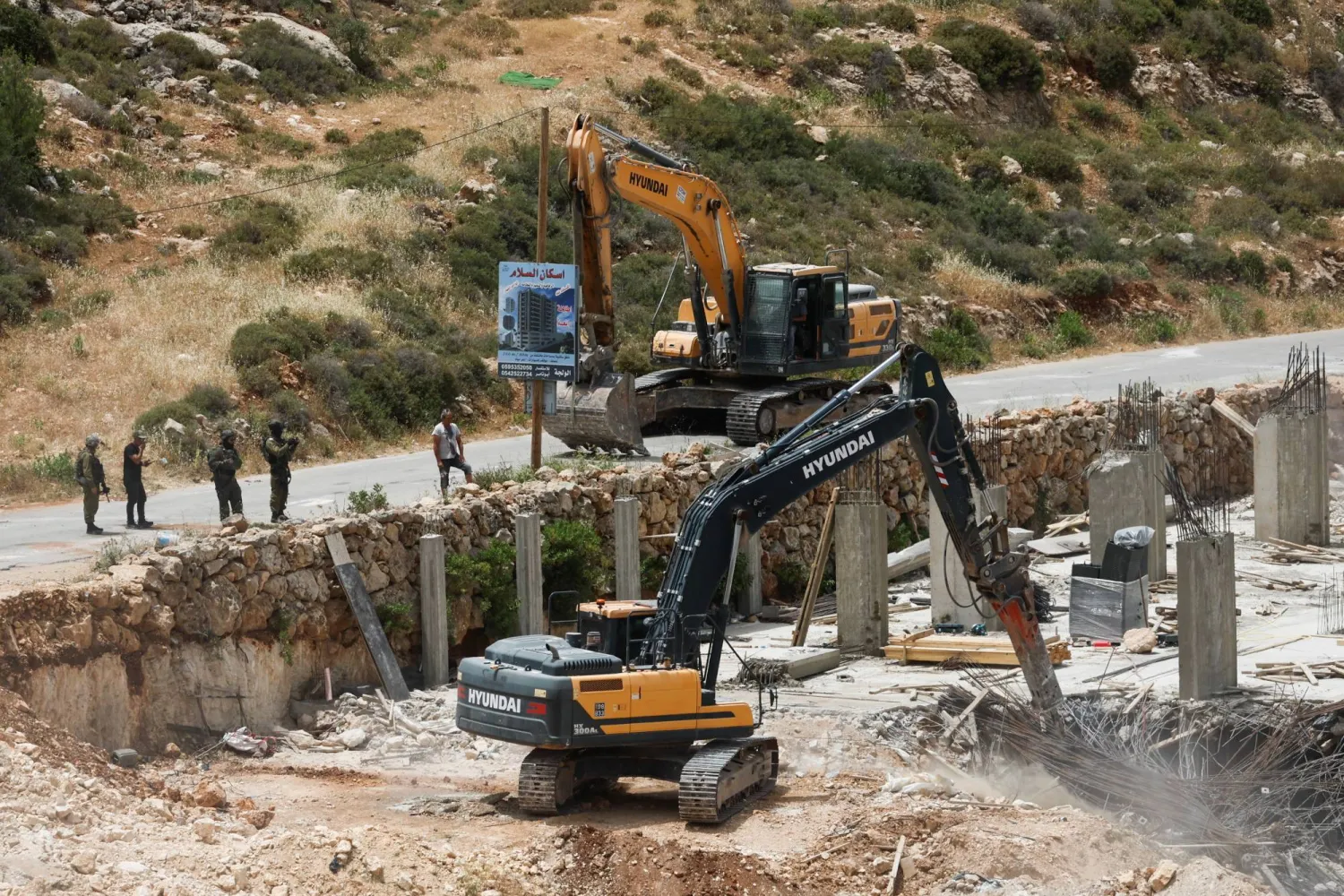
Israeli troops stand guard as heavy machinery demolishes a Palestinian building in Walaja near Bethlehem, in the Israeli-occupied West Bank, May 18, 2026. (Reuters)
TT

Israel Moves to Entrench Control over the West Bank Through New Land Registry System

Israeli troops stand guard as heavy machinery demolishes a Palestinian building in Walaja near Bethlehem, in the Israeli-occupied West Bank, May 18, 2026. (Reuters)

Israel on Wednesday launched an electronic land registration system in the occupied Palestinian territories, a move aimed at cementing Israeli control over the West Bank and advancing the territory’s de facto annexation.

Branded by Israeli authorities as a modernization of the digital property registry, the initiative was denounced by the Jerusalem Governorate as a tool to institutionalize the unlawful seizure of Palestinian land through a restructuring of land registration mechanisms in favor of settlement expansion.

The Israeli security cabinet approved the broader land settlement plan in May 2025, authorizing a comprehensive process to register land ownership across the West Bank.

Palestinian officials say the measure is designed to complete the legal and administrative integration of occupied territory into Israel by placing all land registration procedures under Israeli authority.

In February, the Israeli government formally approved reopening land registration in the West Bank.

The cabinet backed a proposal put forward by Deputy Prime Minister and Justice Minister Yariv Levin, Finance Minister Bezalel Smotrich, and Defense Minister Israel Katz. The plan includes registering vast areas of the West Bank as “state land.” Implementation was assigned to the Israeli Ministry of Justice’s Land Registration and Settlement Authority, with a dedicated state budget for the project.

Israeli officials said the initiative would improve transparency, resolve legal disputes, facilitate infrastructure development, and streamline land marketing.

Smotrich described the move as a step toward strengthening Jewish settlement throughout what Israel calls Judea and Samaria, the biblical term used by Israeli officials for the West Bank. “For the first time since the Six-Day War, we are restoring order and proper governance in land management,” he said at the time

According to the Jerusalem Governorate, authority over land registration has already been transferred to the Israeli Ministry of Justice and the Survey of Israel, with 244 million shekels ($79 million) allocated to the effort.

Palestinian officials say the process effectively paves the way for the permanent takeover and registration of nearly 58 percent of Area C — equivalent to roughly 35 percent of the West Bank excluding East Jerusalem.

The move marks a serious shift in Israeli policy toward both the Palestinian Authority and the future status of the West Bank. Until now, land records in the territory had largely remained confidential.

The new framework also expands Israeli oversight and enforcement powers, including demolition authority, into Areas A and B in matters related to water violations, environmental hazards, and archaeological sites.

Palestinians warned that opening the land registry, known as the “tabu,” will allow Israeli settlers and organizations to identify Palestinian landowners directly and pressure them into selling property, thereby facilitating land acquisition.

Particularly contentious is the extension of the policy into Area A, which under the Oslo Accords falls under full Palestinian civil and security control and was previously off-limits to Israelis.

The measure could effectively strip the Palestinian Authority of its role in regulating land ownership, property transactions, and planning in Areas A and B, while granting Israeli authorities expanded inspection and demolition powers.

A legal analysis published by Birzeit University’s Institute of Law argued that Israel is effectively “swallowing” the West Bank by redesigning the mechanisms of control in ways that amount to practical annexation.

The institute said the measures consolidate Israeli dominance, marginalize the Palestinian Authority, legitimize settlement expansion, and create irreversible facts on the ground.

Under the current plan, Israel’s military Central Command is expected to complete land settlement procedures for 15 percent of the West Bank by 2030, initially focusing on Area C.

The Palestinian presidency has instructed its ministries and agencies not to cooperate with any Israeli-imposed arrangements.

Palestinian officials insist international law prohibits an occupying power from annexing occupied territory, permanently seizing public or private property except under strict military necessity, or altering the legal status of occupied land — all of which, they say, is now taking place openly through administrative and technological means.



Sudan Court Sentences RSF Leader to Death in Absentia

Burnt shops lies down closed in downtown in Khartoum, Sudan June 25, 2026.  REUTERS/El Tayeb Siddig
Burnt shops lies down closed in downtown in Khartoum, Sudan June 25, 2026. REUTERS/El Tayeb Siddig
TT

Sudan Court Sentences RSF Leader to Death in Absentia

Burnt shops lies down closed in downtown in Khartoum, Sudan June 25, 2026.  REUTERS/El Tayeb Siddig
Burnt shops lies down closed in downtown in Khartoum, Sudan June 25, 2026. REUTERS/El Tayeb Siddig

A court in Sudan's army-controlled city of Port Sudan on Sunday sentenced paramilitary leader Mohamed Hamdan Dagalo and 15 others to death in absentia over charges of killing a regional governor and war crimes in Darfur, state media reported.

The ruling, issued by a judiciary functioning under the army, is the first against the leadership of the Rapid Support Forces (RSF) since war broke out between the group and the Sudanese army in April 2023.

The court convicted Dagalo and the other defendants of war crimes, crimes against humanity, genocide and attacks on civilians and public facilities, state news agency SUNA reported.

Those sentenced include Dagalo's brother and deputy, Abdelrahim Hamdan Dagalo, as well as several RSF officers and tribal leaders from Arab communities in West Darfur, AFP said.

The case centers on the killing of West Darfur governor Khamis Abbakar in June 2023, shortly after RSF forces seized El-Geneina, the state capital.

Abbakar was killed hours after accusing the RSF and allied militias of carrying out attacks against civilians.

UN experts determined that between 10,000 and 15,000 people, mostly from the Massalit ethnic group, were killed in El-Geneina during the violence.

The RSF has repeatedly denied allegations of genocide and other war crimes.

The court said it would refer the case to the Supreme Court for review and seek the arrest and extradition of those convicted through Interpol and other international channels.

Sudanese army leader Abdel Fattah al-Burhan and Daglo had jointly led the 2021 coup that derailed Sudan's transition to civilian rule, before falling out over plans to integrate the RSF into the regular army, a dispute that eventually led to war.

Now in its fourth year, the conflict between the army and the RSF has killed tens of thousands of people, displaced more than 11 million and triggered what the United Nations describes as the world's largest displacement and hunger crises.


New Syrian Parliament Meets for First Time in Damascus

 Members of Syria's newly formed People's Assembly attend the body's inaugural session, the first parliament session since the end of the rule of ousted Syrian President Bashar al-Assad, in Damascus, Syria, July 12, 2026. REUTERS/Khalil Ashawi
Members of Syria's newly formed People's Assembly attend the body's inaugural session, the first parliament session since the end of the rule of ousted Syrian President Bashar al-Assad, in Damascus, Syria, July 12, 2026. REUTERS/Khalil Ashawi
TT

New Syrian Parliament Meets for First Time in Damascus

 Members of Syria's newly formed People's Assembly attend the body's inaugural session, the first parliament session since the end of the rule of ousted Syrian President Bashar al-Assad, in Damascus, Syria, July 12, 2026. REUTERS/Khalil Ashawi
Members of Syria's newly formed People's Assembly attend the body's inaugural session, the first parliament session since the end of the rule of ousted Syrian President Bashar al-Assad, in Damascus, Syria, July 12, 2026. REUTERS/Khalil Ashawi

Syria's new parliament convened for the first time on Sunday, 19 months after opposition factions led by President Ahmed al-Sharaa toppled Bashar al-Assad, a milestone in the country's political transition despite the chamber's current limited powers.

Sharaa, in a speech at parliament in Damascus, told lawmakers to "make this council a model of responsibility and competence" and described it as "a platform for truth and justice".

"Syria is writing a glorious history that reflects its heroism, and we face the responsibility of building both the nation and the individual," he said.

The parliament has been seen as a test of Sharaa's pledge to build an inclusive new order in Syria, which was run as a police state by the Assad family for decades, with a legislative chamber that was seen as a rubber stamp.

Under the country's interim governing arrangements, two-thirds of the members of the 210-seat chamber were chosen last year by regional electoral colleges, while Sharaa named the remaining third on July 1.

Officials have said this system was necessary because years of war had left millions displaced and made it impossible to rely on accurate population records or voter rolls.

Critics say it gives the executive branch extensive control over the selection process.

Sharaa has said he supports holding general elections once infrastructure and documentation allow.

A temporary constitutional declaration introduced in 2025 granted parliament limited authorities, and there is no requirement for the government to win a parliamentary vote of confidence.

The Assembly can propose and approve laws. It has a 30-month term that is renewable, and it assumes legislative authority until a permanent constitution is adopted and elections are organized.


Israeli Attacks in Gaza Kill Five People, including a Girl, Say Medics

11 July 2026, Palestinian Territories, Nuseirat: A vehicle damaged in an Israeli strike is seen at the scene in the Nuseirat refugee camp in the central Gaza Strip, where a Palestinian was killed and others were wounded. (dpa)
TT

Israeli Attacks in Gaza Kill Five People, including a Girl, Say Medics

11 July 2026, Palestinian Territories, Nuseirat: A vehicle damaged in an Israeli strike is seen at the scene in the Nuseirat refugee camp in the central Gaza Strip, where a Palestinian was killed and others were wounded. (dpa)

Israeli attacks killed at least five people in the Gaza Strip on Sunday, including a 9-year-old girl, Palestinian health officials said.

Medics said Israeli gunfire directed at a tent encampment on the eastern side of the Al-Bureij refugee camp in central Gaza killed 9-year-old Tala Abu Matar. The Israeli military did not immediately comment on the girl's death.

An airstrike at a metal foundry in Gaza City's Sabra neighborhood killed four people. Witnesses said the site was hit with three Israeli missiles.

Israel's military told Reuters it had struck "terrorist" infrastructure, without giving further details.

The ceasefire agreed in October 2025 between Israel and Hamas halted major fighting in the enclave, but it has failed to stop Israeli attacks that have killed more than 1,000 Palestinians since it took effect. Four Israeli soldiers have been killed by militants in Gaza over the same period.

The latest violence comes as Hamas leaders visited Cairo for further talks over implementing the second phase of US President Donald Trump's Gaza peace plan.

The discussions include Hamas disarmament and Israeli army withdrawals, according to sources close to the talks, adding that there had not yet been a breakthrough.

Nearly all of Gaza's 2 million people, most of whom have been displaced several times, now live on a tiny strip of land along the coast, mainly in makeshift tents or damaged buildings, under Hamas control.