


Iran War Has Complicated Plans for an Int’l Force in Gaza That Has Yet to Materialize

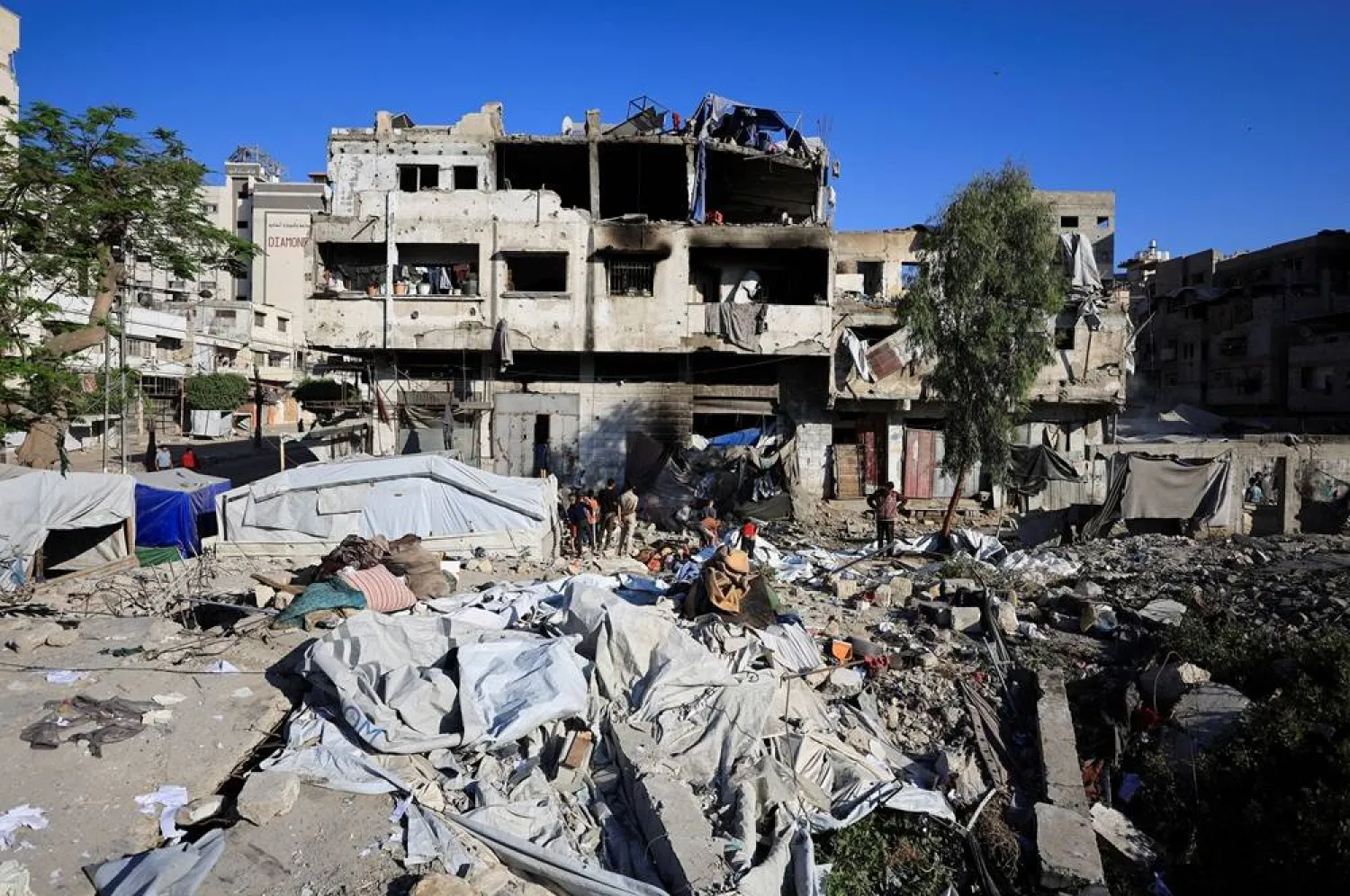
Palestinians inspect the damage at the site of an Israeli strike on Wednesday in Gaza City, May 28, 2026. (Reuters)
TT

Iran War Has Complicated Plans for an Int’l Force in Gaza That Has Yet to Materialize

Palestinians inspect the damage at the site of an Israeli strike on Wednesday in Gaza City, May 28, 2026. (Reuters)

The International Stabilization Force for Gaza was announced with great aplomb at the inaugural meeting of US President Donald Trump's Board of Peace in February. The American general tapped to lead the 20,000-strong force said it would ensure “future prosperity and enduring peace” after the devastating Israel-Hamas war.

Three months on, he still has no force to lead as none of the five countries that pledged troops have come through with any significant contributions.

Efforts to shore up the fragile ceasefire have stalled as Hamas has refused to disarm and Israel has seized more territory while continuing to strike what it says are militant targets, often killing civilians.

Indonesian commitment on indefinite hold

The biggest blow to the planned force came about a week after the US and Israel attacked Iran on Feb. 28, when Indonesia put its commitment of 8,000 troops on indefinite hold. Some 1,000 were to have been sent in April, followed by the remainder in June.

Indonesian's pledge was by far the largest of the group, which also includes Morocco, Kazakhstan, Kosovo and Albania. US Maj. Gen. Jasper Jeffers, who spoke at the Board of Peace event, was to command the force.

Indonesia suspended its plans over what Defense Minister Sjafrie Sjamsoeddin said last week seemed to be a lack of commitment from a distracted Washington, saying “we have not yet received any implementation guidelines.”

“New dynamics have emerged,” he told parliament. “Because the intensity of the conflict between US and Iranian forces remains very high, the BoP has tended to be left behind. Since the BoP has been left behind, the ISF has also been left behind.”

US attack on Iran influenced Indonesia's decision

Domestic issues may have factored into Indonesia's decision, said Muhammad Zulfikar Rakhmat, director of the Indonesia-Middle East/North Africa desk at Jakarta's Center for Economic and Law Studies.

The Iran war is extremely unpopular in Indonesia, the most populous Muslim country. The economy is suffering from soaring prices as a result of the conflict, and there is widespread skepticism of the Board of Peace.

“If you talk to the people on the street, I don’t think they believe that the Board of Peace will actually help the people of Gaza,” Rakhmat said. There are also concerns about sending troops to the Middle East when the economy is faltering, he added.

Indonesia lost four peacekeepers who were part of the United Nations mission in Lebanon during fighting between Israel and the Iran-backed Hezbollah. That has further soured public opinion on such international commitments, he said.

Board of Peace blames stalled ceasefire on Hamas

The US military’s Central Command declined to comment or make Jeffers available for an interview, referring all queries to the Board of Peace.

Board of Peace spokesman Brad Klapper also declined to comment on Indonesia's decision or the future of the stabilization force, pointing instead to May 21 remarks made at the UN by Nickolay Mladenov, a former Bulgarian defense minister who Trump appointed director of the Board of Peace.

Mladenov said the international force would not be able to begin operations until there was agreement and implementation of a second phase of the ceasefire, which would see Hamas disarm and Israel begin to withdraw. Israeli troops control some 60% of Gaza.

Mladenov has blamed the deadlock on Hamas, saying its disarmament is “non-negotiable” and is holding up progress on other fronts, including Israel's withdrawal and reconstruction.

“You cannot build a future with armed groups running the streets, hiding in tunnels and stockpiling weapons,” Mladenov said in Jerusalem this month. “You cannot deliver reconstruction with militias on every corner.”

Hamas blames delays on Israel

Hamas says Israel has repeatedly violated the ceasefire, holding up its further implementation, and has accused Mladenov of siding with Israel.

Israeli strikes have killed more than 880 Palestinians since the ceasefire, according to local health officials. Israel says it was responding to violations of the truce.

Hamas is also demanding Israel withdraw from areas seized since the start of the ceasefire, according to an Egyptian official with knowledge of the discussions, speaking on condition of anonymity to discuss closed-door talks. Egypt has long served as a mediator with Hamas.

Many of the countries that have pledged forces have refused to send troops without a deal on Hamas disarming, the official said.

Token forces committed and none yet known to be on the ground

Kazakhstan has said its support for the stabilization force would be limited to “the humanitarian component,” including sending medical units with a field hospital. Its Foreign Ministry did not respond to a request for comment.

Albania's Defense Ministry also declined to comment on its troop commitment, saying it was a “dynamic and ongoing process.”

Earlier this month, its chief of staff, Lt. Gen. Arben Kingji, told reporters that while the military had “participated in reconnaissance activities,” no troops had yet been sent. He said only a few would be dispatched as part of the stabilization force headquarters, without giving numbers, adding that further contributions would be considered.

Kosovo, which is expected to send 20 troops, said in April that it was in the “final phase of preparations.” The Defense Ministry did not reply to a request for an update.

Morocco's Foreign Ministry also did not reply. At the inaugural meeting of the Board of Peace, Foreign Minister Nasser Bourita said it would deploy “high-level military officers to the joint military command of the ISF.”

Indonesian turnaround can't be ruled out

Despite the delays from Indonesia, Rakhmat said it was too early to rule out eventual participation in the stabilization force.

President Prabowo Subianto is a former army general who has been keen to raise Indonesia’s profile on the world stage and wants to avoid jeopardizing economic ties with the US, Rakhmat said.

“Prabowo wants to strengthen ties to Washington and sign different agreements with the US, so to completely withdraw and completely cancel the plan, I don't think it's on the table,” he said.


Gaza’s Children Lose Simple Joy as Israel Warns Against Kite-Flying

Boys fly a kite against the backdrop of smoke rising from the Gath shelter, that houses displaced Palestinians, after an Israeli air strike in the west of Khan Younis, southern Gaza Strip on January 31, 2026. (AFP)
TT

Gaza’s Children Lose Simple Joy as Israel Warns Against Kite-Flying

Boys fly a kite against the backdrop of smoke rising from the Gath shelter, that houses displaced Palestinians, after an Israeli air strike in the west of Khan Younis, southern Gaza Strip on January 31, 2026. (AFP)

There are few joys left for 10-year-old Ahmed Hamdouna, whose childhood has already been scarred by years of war and displacement in Gaza.

Now, what little reprieve he found playing with scraps of plastic and sticks has also been torn away, as Israel warns it will step up military operations in the territory if kites continue to land on the Israeli side of the border.

"My father stopped me from flying my kites because of the occupation's threats," said Ahmed, who has been displaced to Deir el-Balah in the central Gaza Strip.

"I felt heartbroken after spending so much time collecting sticks and nylon, only for the occupation to prevent us from playing with them," he told AFP.

"We are just young children. They destroyed our home and our whole neighborhood -- what more do they want?"

Israel accuses Hamas of cynically using children and says the kites could pose a threat, years after a wave of incendiary kites and balloons sparked fires in Israeli farmland.

A series of kites have flown in recent days across the border into southern Israel, communities shaken by the Hamas-led attacks of October 7, 2023.

Hamas has denied responsibility. No explosives were detected, but at least one kite had a political message on it.

On Wednesday, an official of the US-led Board of Peace supervising the ceasefire plan in the territory said: "All militant activity in Gaza must stop, including the flying of kites."

"Israel, too, must comply with the ceasefire," a board official said.

Hamas spokesman Hazem Qassem said the popular committees in Gaza's displacement camps were trying to prevent children from flying kites, over fears they could be targeted by the Israeli military.

Ahmed said he was now scared of playing, but couldn't understand why the Israeli military was "afraid of kites when they are just paper and string".

"I don't want to hurt anyone. I just want to play like children everywhere else," he said.

- 'Sense of freedom' -

For Gaza's children, building kites was a simple way to find joy among the ruins of war.

"There are no toys here, no amusement parks, not even a football to play with. The kite is the only thing we can make with our own hands that makes us happy when we fly it in the sky," said 11-year-old Yamen al-Mubayyed, who has also been displaced to Deir el-Balah.

"My friends and I get together and make them using pieces of wood we collect from destroyed houses, along with paper and string. We glue them together using flour and water, then go to the sea to fly them," he told AFP.

Yamen said even the buzz of Israeli surveillance drones didn't put him off flying his kites.

"It is the only thing that makes us feel that we children are alive and gives us a sense of freedom," he said.

Israel has kept up attacks in Gaza, saying it is targeting gunmen, despite a US-backed ceasefire which came into effect in October.

Israeli army chief Lieutenant General Eyal Zamir on Tuesday vowed to push on with demilitarizing Gaza "using all necessary means".

- 'Kill the joy in their hearts' -

For parents in Gaza, the once-harmless activity now carries immense worries.

Akram Abu Shurkh, 30, said he had forbidden his children from making kites but felt he had "killed the joy in their eyes" in doing so.

"These are children who do not understand military calculations. They only see it as a game and a way to release their energy," he told AFP.

"But I see death in the touch of the string and the flying of the kite."

In southern Gaza, 34-year-old Umm Moaz Huwayla said her heart raced from worry every time her children went outside with their kites, but felt she couldn't stop them from playing.

"The occupation wants to kill the joy in their hearts," she told AFP.

"They are not asking for much, only to live their childhood, even with a piece of string and a sheet of paper."


From UNIFIL to Verification Committees... Will Int’l Force in Lebanon Have Expanded Powers?

UN peacekeepers (UNIFIL) vehicles drive in the Lebanese village of Wazzani near the border with Israel, southern Lebanon, July 6, 2023. (Reuters)
TT

From UNIFIL to Verification Committees... Will Int’l Force in Lebanon Have Expanded Powers?

UN peacekeepers (UNIFIL) vehicles drive in the Lebanese village of Wazzani near the border with Israel, southern Lebanon, July 6, 2023. (Reuters)

With UNIFIL’s departure now all but certain, the question is no longer whether the UN force will remain in southern Lebanon, but who will replace it, and with what powers.

A European-led force and verification committees are under discussion, potentially expanding the international role from monitoring UN Security Council resolution 1701 to verifying exclusive state control over weapons south of the Litani River.

European-led force

Abbas Daher, director of the Center for Media Foresight, told Asharq Al-Awsat that a decision not to renew the UN Interim Force in Lebanon’s (UNIFIL) mandate was now “virtually certain,” despite recent attempts involving Italy to revive efforts for an extension.

“However, President Joseph Aoun’s visit to Italy and the current visit by Lebanese army Commander Gen. Rodolphe Haykal to continue discussions on implementation have effectively opened debate over the force that could succeed UNIFIL, whether in the form of verification committees or a force with a predominantly European composition,” Daher said.

“Discussions are now underway, and European countries, led by Italy, France and Spain, and perhaps Germany, are considering establishing a primarily European force to continue the mission,” he added.

“Efforts are also being made to gain international support for this arrangement.”

As for the verification committees, Daher said there was a proposal for the United States to play a role, particularly in verifying that weapons were under the state’s exclusive control and monitoring implementation. Discussions with Washington remain open, he added.

Italian proposal

Separately, local media reported having reviewed a four-page Italian proposal for the post-UNIFIL phase. The plan calls for a smaller, but more effective international presence focused on supporting the Lebanese army, protecting civilians and backing the mechanism monitoring the ceasefire.

The force could play a role in the disarmament measures, conditional on political approval.

Force’s mission

The debate over the force’s composition is closely tied to questions about its jurisdiction, mission and powers.

Asked how the new force would differ from UNIFIL, Daher said: “UNIFIL’s duties were defined by an international mandate and resolution 1701.”

“Lebanon will insist on replicating the experience or substance of the resolution in defining the nature of its work. The question, however, is whether that will succeed or whether amendments will be imposed, because Washington, under Israeli pressure, wants any committee to have greater executive powers.”

Retired Brig. Gen. Fadi Daoud agreed that the most important issue in the next phase was not limited to which party would replace UNIFIL. Rather, he said, it concerned a change in the nature of the international mission itself and the potential redefinition of the relationship between the new force and the Lebanese army.

“The process of ending UNIFIL’s mission has effectively become a reality, despite Lebanese efforts to secure an extension,” Daoud told Asharq Al-Awsat.

“The central question has therefore become: Who will replace it? The alternative arrangement will be the one that receives US approval,” he added.

“We are moving from peacekeeping forces to verification committees — from a mission linked to resolution 1701 to a different mechanism suited to a post-1701 phase, at least in the form in which we have known it over the past years.”

“Lebanon has no problem with any mechanism for verifying exclusive state control over weapons south of the Litani because it is committed to this issue,” Daher said.

“But the fundamental question is whether Israel will withdraw or remain an occupying force. If verification committees carry out their work, the army reaches certain areas and confirms that they are free of weapons, will Israel uphold its end of the arrangement and withdraw?”

“There must be a clear framework for an Israeli withdrawal, just as there is a clear framework for ensuring exclusive state control over weapons in the south.”

Powers of the verification committees

From a military perspective, Daoud said the scope of the committees’ powers lay at the heart of the debate. The distinction between verifying that the army had completed its mission and helping oversee its implementation could determine whether any new arrangement was viable.

“Will the verification committees’ role be limited to confirming that the Lebanese army has completed the task required of it, or will they take part in overseeing how it is carried out? There is a very significant difference between the two,” he stressed.

“For example, if information is received about a weapons depot at a particular location and the Lebanese army raids the site, will the committee merely receive a report confirming that the mission was completed and verify its outcome? Or will it accompany the military force and monitor the search on the ground using personnel, cameras and communications equipment?” he added.

“This is not a technical detail. It could be the most dangerous issue in any new arrangement because the Lebanese army cannot easily accept a foreign party or an entity outside its military chain of command exercising such close oversight over how it performs its duties or directing it during search operations,” he continued.

“An international body can verify that a mission has been carried out and confirm its results. But moving toward direct supervision of its implementation could create serious and sensitive problems,” Daoud said.


Gaza’s Diabetes Patients Face a War Without Respite

Palestinian child Al-Baraa Abdel Aal, who has diabetes, was forced to use expired medication in Gaza (Asharq Al-Awsat)
TT

Gaza’s Diabetes Patients Face a War Without Respite

Palestinian child Al-Baraa Abdel Aal, who has diabetes, was forced to use expired medication in Gaza (Asharq Al-Awsat)

Diabetes patients in the Gaza Strip are fighting two battles without respite - the fallout from an Israeli offensive that began nearly three years ago despite a ceasefire announced almost a year ago, and a daily struggle to secure medication as Israel tightens restrictions on the entry of drugs and other medical supplies, despite appeals from UN and health organizations.

The war has forced people with chronic illnesses to use expired medication as access to safe treatment has dwindled.

Habib Abu Daqqa, 11, who was diagnosed with diabetes a year before the war, has spent more than three months at Nasser Medical Complex after falling into a coma following an injection of expired diabetes medication.

His mother, Maysaa Abu Daqqa, who also has diabetes, told Asharq Al-Awsat that her son has become severely distressed and needs regular, safe treatment before he can leave the hospital.

She resorted to the expired injection because of his condition, despite warnings from some doctors, while others had told her it could still be used. He subsequently developed diabetic ketoacidosis and was admitted to intensive care.

Before the war, she recalled, both had reliable access to medication and appropriate food and followed regular treatment and dietary plans. She attributed their deteriorating health partly to the period of famine in Gaza.

In 2024, the Palestinian Health Ministry estimated that around 350,000 people with chronic illnesses in Gaza lacked necessary healthcare, including about 71,000 diabetes patients, 225,000 people with hypertension and 45,000 with cardiovascular disease.

Al-Baraa Abdel Aal, 14, who has Type 1 diabetes, also required intensive care after medication shortages forced him to take expired drugs.

“Before the war, I had access to all kinds of medication, especially insulin,” Abdel Aal told Asharq Al-Awsat. Suitable food was also readily available.

“I spent eight days in intensive care. I saw death,” he recalled, adding that expired medication and substitutes left him severely fatigued.

Wafaa Washah, 36, a Jabalia refugee camp resident displaced to Khan Younis who has had diabetes for 13 years, explained that economic hardship and her husband’s unemployment had deprived her of suitable food and even clean drinking water.

She recounted that she nearly slipped into a coma several times after using expired medication because no alternatives were available. During the famine, shortages of food, particularly flour, left her suffering frequent dizziness and fever.

Farah Lafi, 19, noted that the crisis extends beyond insulin to glucose test strips needed for frequent blood-sugar monitoring. She estimated that expired medications retain only about 30% of their effectiveness, undermining patients’ daily activity and ability to function.

Ibrahim Dhair, a diabetes consultant at hospitals in southern Gaza, described diabetes patients as among those hardest hit by severe drug shortages. Much of the available medication is expired and can lead to complications including diabetic ketoacidosis and admission to intensive care.

Even when insulin is available, proper refrigeration poses another problem, he explained. Many residents live in tents without basic services, while extreme heat can spoil medicines that must be stored at specific temperatures.

Dhair added that doctors sometimes issue guidance on how to manage available medicines, but with stocks continuing to run out, he described the current situation as a crisis beyond the healthcare system’s capacity to handle.
