Israel Carries Out Strike on Beirut Suburbs, First Near Capital in Weekshttps://english.aawsat.com/arab-world/5278113-israel-carries-out-strike-beirut-suburbs-first-near-capital-weeks
Israel Carries Out Strike on Beirut Suburbs, First Near Capital in Weeks
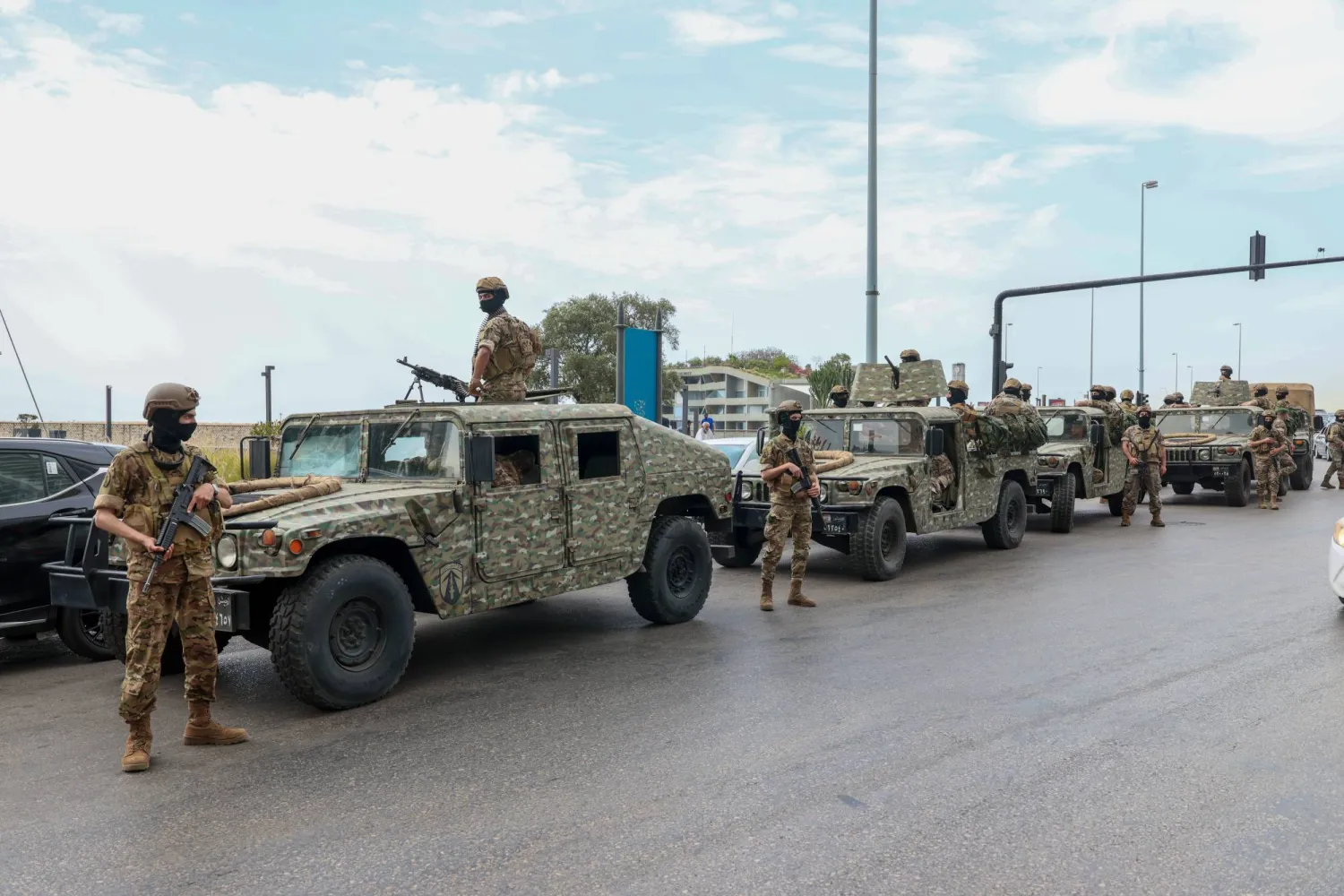
Lebanese army soldiers man a checkpoint in Beirut, Lebanon, 14 May 2026. Lebanese authorities announced that Internal Security Forces (ISF) and the Lebanese army have been mobilized as part of increased security measures to manage stability and protect displaced communities following a wave of internal displacement. EPA/WAEL HAMZEH
Israel Carries Out Strike on Beirut Suburbs, First Near Capital in Weeks
Lebanese army soldiers man a checkpoint in Beirut, Lebanon, 14 May 2026. Lebanese authorities announced that Internal Security Forces (ISF) and the Lebanese army have been mobilized as part of increased security measures to manage stability and protect displaced communities following a wave of internal displacement. EPA/WAEL HAMZEH
An Israeli strike hit a building in the southern suburbs of the Lebanese capital on Thursday, the first strike to hit near Beirut in weeks amid a ceasefire that has failed to halt fighting between Israeli troops and Hezbollah in south Lebanon.
The Israeli military said it had conducted a precise strike in Beirut but did not offer additional details. Two Israeli security sources said the target was Ali al-Husseini, whom they described as head of the missile division within the Imam Hussein Division, a militia that Israeli officials say is aligned with Hezbollah and Iran.
There was no immediate comment from Hezbollah or Iran on the attack. A Lebanese security source said it was carried out with two precision missiles targeting a building in Beirut's southern suburbs.
The strike dealt another blow to a fraying ceasefire announced by Washington on April 16 that was meant to halt the war raging between Israel and Iran-backed Hezbollah since March 2.
Exchanges of fire between the two longtime foes have continued, but have been mostly concentrated in southern Lebanon. Apart from a strike on Beirut's southern suburbs in early May that killed a Hezbollah commander, the capital and its suburbs had been spared new bombardment during the truce.
ISRAEL PUT OFF BEIRUT STRIKES DUE TO US, OFFICIALS SAY
Israeli officials say the military had held off from striking in Beirut for three weeks due to requests from the administration of US President Donald Trump. Still, Israeli surveillance drones are heard flying over Beirut on a daily basis.
The two Israeli security sources said Thursday's strike came following a “very intense dialogue” with the Trump administration in recent days. Heavy Israeli strikes hit towns and villages in southern Lebanon overnight and into Thursday, after Israel declared a new swathe of the area "a combat zone".
The Israeli military said residents should leave any towns south of the Zahrani River, which runs about 40 kilometres (25 miles) north of Israel's border with Lebanon. Together with a border zone occupied by its troops, Israel's evacuation orders over the last three months span about 2,000 sq km of Lebanon – about a fifth of the entire country.
An Israeli strike on Thursday morning killed six people including two children and their parents near the southern town of Adloun, Lebanon's health ministry said. Another strike, on the port city of Sidon, killed five people including two women. Sidon lies outside of the area designated as a combat zone by the Israeli military, and the strike was carried out without warning. Taghrida Ramadan, a woman living in Sidon, told Reuters she had been sleeping at home when she was jolted awake by the strike, which hit a building across from hers.
"We looked around and found the rubble on us - stones from the strike, because it was nearby and directly facing us," Ramadan said. While her house was damaged, her relatives were not seriously injured. Another Israeli strike later on Thursday killed two Syrian nationals, including a child, in the city of Tyre, which falls within the zone Israel said must be emptied.
Between Bringing Down Governments and Losing Control: Hezbollah Faces a New Political Equationhttps://english.aawsat.com/arab-world/5278147-between-bringing-down-governments-and-losing-control-hezbollah-faces-new
Between Bringing Down Governments and Losing Control: Hezbollah Faces a New Political Equation
The Lebanese government in session chaired by President Joseph Aoun (Lebanese Presidency)
Since becoming involved politics in 1992, Hezbollah gradually evolved from a parliamentary player with limited influence into a central force in Lebanon’s governing equation. The group first engaged in legislative work and did not directly join governments until 2005, following the assassination of former Prime Minister Rafik Hariri and the withdrawal of Syrian troops from Lebanon.
Since then, Hezbollah has sought to impose its control and influence over successive governments, obstructing some and bringing down others after introducing the concepts of the “blocking third” and consensual decision-making, while it and its ally the Amal Movement monopolized the entire Shiite ministerial share to use as leverage to topple governments or prevent them from functioning.
In this context, remarks by Hezbollah Secretary-General Sheikh Naim Qassem that “people have the right to take to the streets, bring down the government and bring down the US-Israeli project” did not come as a surprise to those who have closely followed Hezbollah’s conduct over the years in both the formation and collapse of governments. The same applies to comments by Hezbollah Political Council member and former minister Mahmoud Qamati, who said: “The president or anyone else, with a government majority, wants to target the resistance during this era. They should know that they are a passing side that comes and goes, while we are deeply rooted in this country.”
Hezbollah Secretary-General Naim Qassem
A Long Path of Pressuring Governments
Hezbollah’s first attempt to pressure the government in a bid to bring it down dates back to 2006, when it and the Amal Movement withdrew their ministers from the government of Prime Minister Fouad Siniora in protest against the vote in favor of establishing the international tribunal to prosecute Hariri’s killers.
The “Shiite duo” and the Free Patriotic Movement then organized a lengthy sit-in in downtown Beirut on the grounds that the government lacked sectarian legitimacy. Nevertheless, the cabinet continued functioning until May 2008, when Hezbollah launched a military move in Beirut and parts of Mount Lebanon in response to government decisions concerning its telecommunications network.
That escalation led Lebanese factions to convene in Qatar, resulting in what became known as the Doha Agreement, through which Hezbollah secured the “blocking third,” meaning that it and its allies obtained one-third of cabinet seats, enabling them to bring down the government.
That scenario materialized in 2011, when Hezbollah and its allies withdrew their ministers from the government of Prime Minister Saad Hariri, leading to its collapse.
Former Lebanese finance minister, current member of parliament and a high ranking member of the Shiite Muslim Amal movement Ali Hasan Khalil (L), points as he stands next to Lebanon's Prime Minister Nawaf Salam during his visit to the heavily-damaged southern village of Kfar Shouba, near the border with Israel on February 8, 2026.(Photo by Rabih DAHER / AFP)
Salam Government “Freed” From Hezbollah’s Grip
Subsequent governments were formed with Hezbollah and its allies holding the “blocking third,” allowing them to control the decisions and fate of successive cabinets. Six governments were formed from 2011 onward, culminating in the current government headed by Nawaf Salam, which is considered the first government since 2008 to break free from Hezbollah’s dominance through the “blocking third.”
As a result, Hezbollah failed to prevent the government from adopting decisions placing arms exclusively under state control, classifying its military wing as illegitimate, and passing other measures opposed and criticized by the group.
Ali al-Amin, political writer and editor-in-chief of the Janoubia website, said Hezbollah had, since the Doha Agreement, “sought to blackmail successive governments through the invention of concepts such as the ‘guaranteeing third,’ consensus, or legitimacy.”
Speaking to Asharq Al-Awsat, Amin said that “during the current phase, specifically under the present government, the equations have completely changed. The government was formed on different foundations reflecting the new political balance.”
He added that “even if Hezbollah believes bringing down the current government through street pressure is possible, it realizes that forming another government on its own terms is no longer feasible. Therefore, its current threats to topple the government amount to intimidation and rhetorical escalation, nothing more than an expression of the predicament the party is facing, reflected in Sheikh Naim Qassem’s contradictory rhetoric.”
He added that Parliament Speaker Nabih Berri is unlikely to support Hezbollah in such a move, meaning the group has virtually no chance of bringing down the government or changing the policies it is complaining about.
Abdrabbuh Mansur Hadi Dies After Leading Yemen Through Its Most Difficult Periodhttps://english.aawsat.com/arab-world/5278102-abdrabbuh-mansur-hadi-dies-after-leading-yemen-through-its-most-difficult-period
Abdrabbuh Mansur Hadi Dies After Leading Yemen Through Its Most Difficult Period
President Hadi during a previous reception hosted by King Salman bin Abdulaziz (Saba)
Former Yemeni President Abdrabbuh Mansur Hadi passed away Thursday morning after a political and military career spanning eight decades, during which he witnessed Yemen’s major political transformations and became closely associated with pivotal periods marked by conflict, upheaval and instability.
Hadi was regarded as one of the most prominent figures linked to the most complex political and military transitions in Yemen’s modern history, particularly during the post-Arab Spring period, the rise of the Houthis, and the outbreak of the war that reshaped the Yemeni landscape in all its dimensions.
Abdrabbuh Mansur was born in 1945 in the village of Dhiqin in Al-Wadea district of Abyan governorate. He joined the military at an early age and rose through the ranks of South Yemen’s armed forces before unification, later becoming one of the leading military figures to serve within the institutions of the unified Yemeni state after 1990.
During the 1994 summer war between the two partners in unification, Hadi sided with the late President Ali Abdullah Saleh, a move that later strengthened his position within Yemen’s ruling establishment.
In 1994, he was appointed vice president and remained in the post for nearly 18 years, one of the longest vice-presidential tenures in the Arab world. Throughout that period, he remained relatively distant from the political and media spotlight compared with Saleh and the network of power centers surrounding him.
Death of Abdrabbuh Mansur Hadi, the Man Who Led Yemen Through Its Most Difficult Period (Saba)
Among Yemenis, Abdrabbuh Mansur Hadi became associated with the image of a quiet and enigmatic figure who rarely engaged in public confrontations or made statements that provoked the country’s various political and tribal factions.
The defining moment of his political career came during the 2011 protests against Saleh’s rule, when Yemen entered a severe political crisis that ended with the signing of the Gulf Initiative, which transferred power peacefully to Hadi as consensus president for the transitional phase.
In February 2012, he was elected president in a consensus election in which he ran unopposed, with broad regional and international backing, to lead a transitional period aimed at restructuring the Yemeni state and drafting a new constitution.
From his first days in office, Hadi faced enormous challenges, including military divisions, the growing influence of the Houthis and Al Qaeda, economic collapse, and the complex tribal and political balances inherited from the Saleh era.
He sought to restructure the military and curb the influence of traditional power centers, while backing the National Dialogue Conference that brought together Yemen’s various political forces and was viewed at the time as a historic attempt to chart a new future for the state.
However, the transitional phase quickly entered a dangerous turn as the Houthis expanded from their stronghold in Saada toward the capital Sanaa, benefiting from an undeclared alliance with former President Ali Abdullah Saleh and networks loyal to him. On Sept. 21, 2014, the Houthis seized control of Sanaa, placing Hadi under house arrest before he later managed to flee to the city of Aden in early 2015.
From Aden, Hadi attempted to rebuild the internationally recognized government and administer the country from there, but the Houthis continued advancing southward, prompting him to leave Yemen through Oman and head to Riyadh in March 2015, coinciding with the launch of Operation Decisive Storm led by Saudi Arabia in support of Yemen’s internationally recognized government.
After relocating to Riyadh, Hadi became the political figurehead point for Yemen’s internationally recognized government and retained the backing of the United Nations, Gulf states and the international community, despite criticism directed at his government’s performance, divisions within the anti-Houthi camp, and the dysfunction of state institutions in liberated areas.
Throughout the war years, Hadi remained a central figure in the Yemeni scene, with numerous sovereign decisions and military and political appointments linked to his name. He also led multiple negotiations and settlements under UN and regional sponsorship amid an extremely complex political and military environment.
In April 2022, Hadi announced the transfer of his presidential powers to the Presidential Leadership Council headed by Rashad al-Alimi and composed of seven deputies, in a move widely viewed as a major shift in Yemen’s power structure and an attempt to unify anti-Houthi forces under a collective leadership framework.
Since then, Hadi had largely withdrawn from political and media life and settled in Riyadh, amid reports that he was suffering from health problems. During his presidency, he underwent several routine medical examinations in the United States, though the nature and details of his condition were never officially disclosed.
Despite his subsequent absence from the official scene, Abdrabbuh Mansur Hadi remains one of the Yemeni presidents most closely associated with the turbulent transformations the country has witnessed, from the political transition after 2011 to the collapse of the state and the complex war that continues to cast its shadow over Yemen to this day.
How Israel Has Emptied Southern Lebanon Far Beyond the Front Lineshttps://english.aawsat.com/arab-world/5278041-how-israel-has-emptied-southern-lebanon-far-beyond-front-lines
An Israeli military artillery unit drives into Lebanon after crossing the Israeli‑Lebanese border, as seen from northern Israel, May 27, 2026. (Reuters)
TT
TT
How Israel Has Emptied Southern Lebanon Far Beyond the Front Lines
An Israeli military artillery unit drives into Lebanon after crossing the Israeli‑Lebanese border, as seen from northern Israel, May 27, 2026. (Reuters)
The ceasefire agreed in Lebanon last month has brought little respite for civilians, who are being driven from a steadily expanding swathe of the country by a relentless Israeli campaign of evacuations and air strikes.
The US-brokered truce announced on April 16, after about six weeks of fighting, has failed to halt the violence between Israel and Hezbollah. Both are carrying out near-daily attacks while accusing the other of violating the pact.
That's left hundreds of thousands of civilians in southern Lebanon displaced from their homes. Shortly after the ceasefire declaration, Israel published a map marking out a buffer zone covering nearly 600 square km (230 sq miles) that it had occupied with ground forces, and listing 57 towns and villages where it had warned residents to evacuate.
Since then, though, the Israel military has carried out hundreds of air strikes on a far wider area outside that occupied zone and issued evacuation orders covering more than 100 additional Lebanese towns and villages, according to a Reuters review of Israeli statements.
Together with the occupied zone, these orders span about 2,000 sq km of Lebanon – about a fifth of the entire country – much of which has been rendered effectively off-limits to residents, according to the review and interviews with local officials, aid workers and displaced people. The reporting provides one of the most detailed pictures yet of the growing displacement crisis engulfing this small country on the eastern Mediterranean.
The fighting is part of a wider conflagration across the Middle East sparked by the Hamas-led attacks on Israel of October 7, 2023. Israel aims to drive back its sworn enemies – Iran and its proxy forces, including Hezbollah and Hamas – with a stated strategy to create "buffer zones" along its borders with Gaza, Syria and now Lebanon to safeguard its citizens.
People look at the damages at the site of an Israeli strike in Tyre, southern Lebanon, on May 28, 2026. (AFP)
The growing evacuation area, along with confusion about ongoing attacks and the eventual extent of the Israeli buffer zone, has made many residents fear they may never return to their homes.
"There is no way we are coming back now," said Iyad Watfi, a mukhtar – elected official – in Bazouriye, who said the town once home to 13,000 people had been hit by multiple air strikes and evacuation orders since the truce. "Last week, we had 20 buildings destroyed in the town in one night."
Only a tiny portion of the population remained, with most others sheltering in tents to the north, he said, adding that few felt safe to return in the foreseeable future.
The latest Lebanese conflict erupted on March 2 when Hezbollah fired rockets at northern Israel in solidarity with Iran, which was under Israeli and US attack. Israel responded with a ground invasion of Lebanon, leading to fighting that has so far killed more than 3,000 people and displaced hundreds of thousands, according to the Lebanese government.
The Israeli army told Reuters its air campaign in Lebanon since the ceasefire was not aimed at displacing civilians but rather designed to eliminate threats from Hezbollah, which it accused of embedding forces and weaponry in civilian areas. It characterized the evacuation notices as "recommendations" issued before air strikes, allowing citizens to leave if they choose.
Southern Lebanon "remains an active combat zone where Israeli troops continue to engage with terrorist elements on a daily basis," it added.
Hezbollah's media office didn't respond to a request for comment. The group has itself carried out regular attacks, including kamikaze drone strikes, since the ceasefire. It has said that, despite the truce, it has the right to resist continued Israeli aggression and denies placing military assets in civilian areas.
Smoke billows from southern Lebanon following Israeli strikes, as seen from Nabatieh, Lebanon May 28, 2026. (Reuters)
Reuters reached mukhtars from 20 of the towns and villages subject to Israeli evacuation orders since the ceasefire, communities with pre-conflict populations ranging from hundreds to thousands of people. Most estimated the percentage of residents remaining in single digits, saying most had fled northwards or to the coastal cities of Tyre and Sidon.
"People's nerves are shattered. They can't take it anymore, so they left," said Ali Nazzal, a mukhtar in Srifa who said the village was virtually deserted. "The ceasefire is a lie."
The situation looks increasingly bleak for civilians in Lebanon. Israeli Prime Minister Benjamin Netanyahu pledged on Monday that Israel would escalate its strikes, prompting residents to flee southern suburbs of Beirut, further to the north.
Israel has since issued a new slew of evacuation orders, encompassing more than a dozen new towns and villages and declaring a large section of the south a "combat zone".
The ongoing conflict could have implications for the broader US-Israeli war on Iran, with Tehran demanding a halt to Israeli attacks in Lebanon as a condition in peace talks.
ISRAEL STRIKES OVER 1,000 TARGETS SINCE TRUCE
On March 31, Netanyahu said his country's area of occupation in Lebanon would stretch to the Litani River, about 30 km north of the border with Israel. He described it as "a vast buffer zone" to thwart anti-tank fire and the threat of invasion.
By the April 16 ceasefire, Israeli forces had only occupied about half of that area. However, the subsequent barrage of air strikes and evacuation orders has driven people from areas even well beyond the river.
Only about half the towns and villages subject to evacuation orders since the ceasefire are south of the Litani, with the rest to the north of the river, some more than 20 km from the waterway, the review of Israeli statements found.
On May 12, the Israeli military said it had struck more than 1,100 targets since the ceasefire, including weapons warehouses, launchers and sites where Hezbollah was operating. Reuters identified the location of more than 300 of those strikes during the first month of the ceasefire by reviewing reports published by Lebanon's state news agency.
An analysis of nighttime lights data captured by the satellite-based VIIRS sensor, which was carried out for Reuters by Professor Hadi Jaafar at the American University of Beirut, showed a significant reduction in light emissions across south Lebanon since the conflict began. The light levels have remained depressed in some areas during the ceasefire, strongly suggesting that many displaced residents have not returned, Jaafar said.
A man checks the site of destroyed buildings that were hit in Israeli airstrikes in the southern port city of Tyre, Lebanon, Thursday, May 28, 2026. (AP)
'WE WANT TO RETURN, EVEN TO SLEEP ON GROUND'
Israeli forces have used explosives and bulldozers in demolitions that effectively erase many villages in the 600 sq km zone its ground forces occupied before the ceasefire after the defense minister vowed on March 31 to destroy "all homes" near the border.
In areas outside Israeli occupation, many residents tried to return during the ceasefire but were driven out again, often within days, by renewed evacuation orders and air strikes, according to local officials, displaced people and aid workers.
Hawraa Yousef Ghadbouni, 39, said she fled from the southern town of Qlaileh to the coastal city of Sidon after the latest conflict began on March 2, sleeping in a car with her husband and three children.
After the ceasefire, they returned and found their home partially standing, with two rooms still intact, amid ruined houses and shops. Within a day, shelling and air strikes forced them to flee again, this time to the coastal city of Tyre, about 10 km to the north. When Tyre, too, was bombed, they returned to Sidon, taking refuge in a school turned shelter.
"We want to return, even if we have to sleep on the ground," Ghadbouni said. "What matters is going back. Life here is not sustainable."
In the town of Bedias, about a half-hour drive north of Qlaileh, Wael al-Amin, a 48-year-old medic, was sitting outside his brother's home on May 10, drinking coffee and watching his children play despite the steady buzz of a drone overhead.
"I thought, 'Let them play'," he said from a hospital in Tyre. "These are children. Who would target them?"
Moments later, a blast tore through his brother's house, sending a cloud of debris into the air. Amin stumbled through the smoke until he found his eight-year-old son, wounded amid the rubble.
"He told me, 'I'm here'," he said.
Amin pulled the boy to safety before discovering that his brother had been killed in the strike.
لم تشترك بعد
انشئ حساباً خاصاً بك لتحصل على أخبار مخصصة لك ولتتمتع بخاصية حفظ المقالات وتتلقى نشراتنا البريدية المتنوعة