


Lebanon Decries Israeli Attacks Damaging Heritage Sites

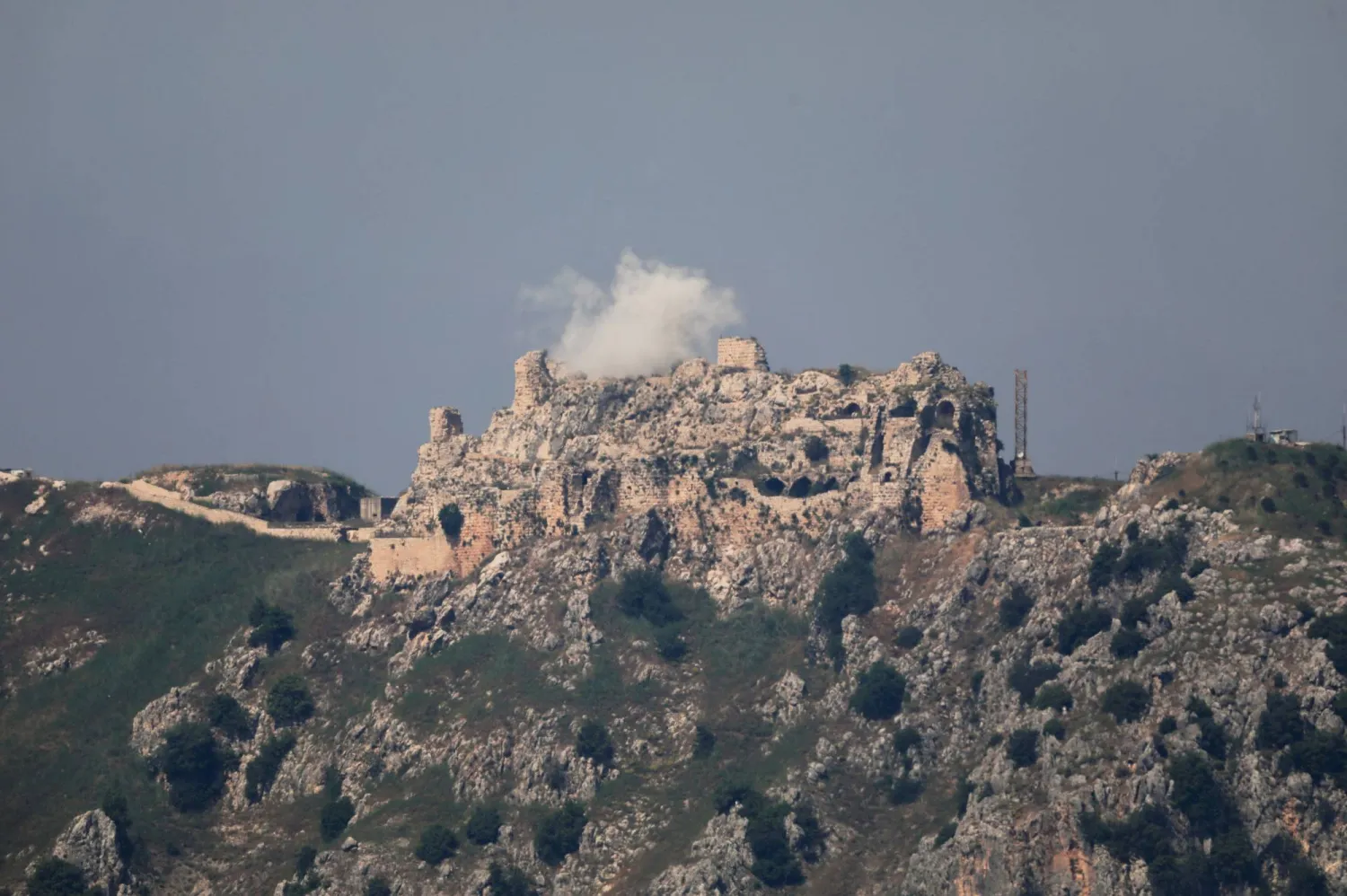
Smoke rises from Beaufort Castle following strikes, as seen from Marjayoun, southern Lebanon, May 27, 2026. REUTERS/Stringer
TT

Lebanon Decries Israeli Attacks Damaging Heritage Sites

Smoke rises from Beaufort Castle following strikes, as seen from Marjayoun, southern Lebanon, May 27, 2026. REUTERS/Stringer

Lebanese authorities on Thursday decried Israeli attacks near UNESCO-protected historic sites and landmarks in the country's south.

Culture Minister Ghassan Salame "made numerous contacts with his counterparts worldwide and relevant international organizations to draw their attention to the huge damage to archaeological sites and heritage districts" in south Lebanon, the state-run National News Agency said.

He highlighted the ancient city of Tyre and Beaufort castle in the Nabatieh district, emphasizing that "a large number of these sites enjoy enhanced protection from UNESCO, making it necessary to protect them from any Israeli air or artillery attack".

Prime Minister Nawaf Salam said on X that "nothing can justify the ongoing attacks on the Tyre and Nabatieh regions and the destruction of their historical landmarks".

Israel has issued repeated evacuation warnings to swathes of the southern coastal city of Tyre in recent days and carried out heavy strikes.

Early Thursday, Israel's military warned it would target a building in Tyre which it showed on an accompanying map as located very close to the city's archaeological area.

Around two hours after the warning, AFP footage showed a fireball followed by smoke as a strike hit the district.

The south Lebanon municipality of Arnoun, where the historic Beaufort castle is located, said in a statement on Facebook that it "condemns in the strongest terms the attack that targeted" the site, blaming Israeli bombardment and urging authorities to protect it "from further damage".

On Wednesday, an AFP correspondent saw smoke rising near Beaufort castle after what appeared to be artillery fire.

Israeli forces used the castle, also known as Qalaat al-Chakif, as a base during their previous two-decade occupation of southern Lebanon which ended in 2000.

In November 2024, during a previous war between Israel and Hezbollah, UNESCO granted 34 heritage sites in Lebanon including Tyre and Beaufort Castle "provisional enhanced protection".

"Non-compliance with these clauses would constitute 'serious violations' of the 1954 Hague Convention and... potential grounds for prosecution," it said at the time.

This April, UNESCO added another 39 Lebanese sites to the list.


Hamas Calls Netanyahu’s Plan to Expand Control in Gaza a Dangerous Escalation

 29 May 2026, Palestinian Territories, Dair al-Balah: Palestinians inspect the rubble of a building destroyed in an Israeli airstrike in Deir al-Balah, central Gaza Strip. (dpa)
29 May 2026, Palestinian Territories, Dair al-Balah: Palestinians inspect the rubble of a building destroyed in an Israeli airstrike in Deir al-Balah, central Gaza Strip. (dpa)
TT

Hamas Calls Netanyahu’s Plan to Expand Control in Gaza a Dangerous Escalation

 29 May 2026, Palestinian Territories, Dair al-Balah: Palestinians inspect the rubble of a building destroyed in an Israeli airstrike in Deir al-Balah, central Gaza Strip. (dpa)
29 May 2026, Palestinian Territories, Dair al-Balah: Palestinians inspect the rubble of a building destroyed in an Israeli airstrike in Deir al-Balah, central Gaza Strip. (dpa)

Hamas said on Friday that Israeli Prime Minister Benjamin Netanyahu's declaration that his country would expand its area of control in Gaza was a dangerous escalation, as residents of the Palestinian territory also voiced alarm at the plan.

Under a ceasefire deal in October Israel's military was to remain in control of 53% of Gaza, but Netanyahu said on Friday that it would expand that area to an initial 70%, without laying out details or a timeline.

The Palestinian group, which triggered two years of devastating warfare in Gaza with its October 7, 2023, attack on Israel, described his comments as a plan for ethnic cleansing and forced displacement of Palestinians.

MAJOR DISPUTES POSTPONED

"Any attempt to impose a new reality of occupation in Gaza is null and illegitimate," said Ismail al-Thawabta, head of the Hamas-run Gaza government media office, adding that Netanyahu's statement "represents a dangerous escalation".

More than eight months into the ceasefire, and with global attention fixed on the war in Iran, Gaza's underlying conflict remains stubbornly ‌unresolved with continued ‌Israeli attacks, little aid reaching civilians and the risk of major new violence.

Israel has already expanded its ‌area ⁠of control in ⁠Gaza from the 53% lying behind a "yellow line" mapped into the ceasefire deal up to around 64%, with an area it has designated as restricted in maps shared with aid groups.

Any further reduction in space available to the more than 2 million Gaza residents who are mostly crammed into tents in the tiny Palestinian territory risks worsening already dire conditions there.

"Where do we go? To the sea? There is no space," said Mohammed al-Shagra, 72, in Khan Younis.

Last year's deal brokered by US President Donald Trump established a Board of Peace to oversee a phased ceasefire, and was ratified by the United Nations Security Council.

However, many of the toughest areas of dispute including the disarmament of Hamas, a full Israeli ⁠withdrawal and the make-up of a Gaza government were postponed to later in the process. ‌

The Board of Peace negotiators have been talking to both sides on the disarmament issue.

Israel ‌and Hamas have repeatedly accused each other of violating the truce. Israeli strikes in Gaza have killed more than 900 Palestinians since the start of ‌the truce while Palestinian attacks have killed four Israeli soldiers.

Israel's military and the prime minister's office did not immediately respond ‌to a Reuters request for additional information and comment on Netanyahu's statement.

A spokesperson for the Board of Peace said it would not have a comment on Netanyahu's statement.

The foreign ministries of permanent UN Security Council members Britain and France did not immediately respond to requests for comment.

A German foreign ministry spokesperson said Germany was concerned about Israeli plans to take more of Gaza and opposed a permanent division of the Palestinian territory.

RISK OF FURTHER VIOLENCE

Facing ‌elections this year and under pressure for Israel's failure to secure its strategic goals in wars in Iran and Lebanon, Netanyahu may be seeking to bolster his standing with voters.

"He's determined ⁠to look tough in front of ⁠the electorate and he's blamed by his opponents for having fought this seven-front war, but having won none of the wars," said Max Rodenbeck, Israel-Palestine Project Director at International Crisis Group.

"Unless there's some sort of pushback from the Trump administration it really does risk a return to something very bloody," he added, pointing to other ways in which Israel has been ramping up pressure on Hamas including continued aid restrictions on Gaza and strikes targeting Hamas figures.

For people inside Gaza, where nearly all the population had to flee their homes during the war and with most still living in temporary tents or shelters, the prospect of increased Israeli military pressure is alarming.

"We see no ceasefire or anything and they keep advancing beyond the yellow line. For how long will the world stay silent?" said Mohammed al-Jundi, a displaced man in Gaza City.

In Israel, a return to tougher military pressure is seen by security hawks as the only way to force Hamas to disarm and achieve a longer-term agreement.

"It looks as if we are taking a step towards another collision. But I believe this time it will be much shorter and maybe would open the path towards a new future," said Kobi Michael, a researcher at Israel's Institute for National Security Studies and a former official in the country's strategic affairs ministry.


Germany Says Israeli Plans to Take More of Gaza are Cause for Concern

Palestinians inspect the damage at the site of an Israeli strike on Wednesday in Gaza City, May 28, 2026. REUTERS/Dawoud Abu Alkas
TT

Germany Says Israeli Plans to Take More of Gaza are Cause for Concern

Palestinians inspect the damage at the site of an Israeli strike on Wednesday in Gaza City, May 28, 2026. REUTERS/Dawoud Abu Alkas

The German government is concerned about ‌Israeli ‌plans to ‌take ⁠more of Gaza, ⁠a foreign ministry spokesperson ⁠said ‌on ‌Friday, adding ‌that ‌Germany opposes a permanent ‌division of the ⁠Palestinian territory.

The Israeli military said Wednesday evening it had launched strikes in the northern Gaza Strip targeting two Hamas militants. 10 people were killed, including five children and an elderly person, as well as a Hamas militant.

The strikes came as Israeli Prime Minister Benjamin Netanyahu said Israel was expanding its control in Gaza.

“Right now we are tightening the grip on Hamas," Netanyahu said Thursday at the Jordan Valley Conference in the occupied West Bank. “We are now in 60% of the territory of the Gaza Strip. You know that? We were at 50%, we moved to 60%."

He said the next step was to move to 70% control, with Israel “tightening the grip" on Hamas "from every direction.”


Sudanese Medical Group Accuses Paramilitary Force of Killing 27 in Attack Targeting Civilians

Ibrahim Ali, 26, a Sudanese refugee who fled Al-Fashir amid ongoing conflict in Sudan between the paramilitary Rapid Support Forces (RSF) and the Sudanese army, walks along a road towards his family's tents at the Tulum refugee camp, in Wadi Fira province, eastern Chad, November 29, 2025. (Reuters/Amr Abdallah Dalsh)
TT

Sudanese Medical Group Accuses Paramilitary Force of Killing 27 in Attack Targeting Civilians

Ibrahim Ali, 26, a Sudanese refugee who fled Al-Fashir amid ongoing conflict in Sudan between the paramilitary Rapid Support Forces (RSF) and the Sudanese army, walks along a road towards his family's tents at the Tulum refugee camp, in Wadi Fira province, eastern Chad, November 29, 2025. (Reuters/Amr Abdallah Dalsh)

A humanitarian organization on Friday accused forces affiliated with a Sudanese paramilitary group of targeting civilians in an area of Sudan free of any military presence during Eid al-Adha, killing 27 people, among them elderly people.

Sudan Doctors Network, a group that tracks violence across the country, blamed forces affiliated with the paramilitary Rapid Support Forces for carrying out the attacks on Thursday on villages in al-Murrah area located west of Barah town in North Kordofan.

It said the attacks worsened already “catastrophic humanitarian conditions that citizens are enduring due to the ongoing war."

A full-scale war erupted in April 2023 after long-simmering tensions between the army and the RSF escalated. The Kordofan region has become one of the conflict’s main epicenters, with fighting intensifying on several fronts, including through drone warfare.

The RSF and its allies control the western Darfur region and areas in the Kordofan region along the border with South Sudan — both regions rich in oil fields and gold mines. The RSF also repeatedly clashed with the army over Barah.

Thursday's attacks were carried out during the second day of Eid al-Adha.

The doctors' network said in its statement that “targeting villages and civilian areas and liquidating citizens in this horrific manner constitutes a flagrant violation of international humanitarian law.”

Earlier this month, intense clashes in southern Sudan in South Kordofan between forces linked to the rebel group Sudan People’s Liberation Movement-North and the Otoro tribe killed over 61 people, including nine children. Last week, a drone strike on a bustling market in central Sudan killed 28 people and wounded dozens more.

The war in Sudan broke out in April 2023 after long-simmering tensions between the army and RSF erupted into a full-out war. The conflict has killed at least 59,000 people, displaced some 13 million, and pushed many parts of the country into famine. More than 30 million people are in need of humanitarian assistance.

Both of Sudan’s warring sides have been accused by the United Nations and rights groups of committing atrocities, including ethnic cleansing, extrajudicial killings and sexual violence against civilians. Aid groups say the true toll could be much higher as access to areas of fighting across the vast country remains limited.
